
Keep Exercising at Home During Spain's Heat Wave
Staying active in a Spanish apartment without AC during a July heat wave requires earlier or later workout times, reduced intensity, and smart cooling. This article explains how to structure a safe, effective bodyweight routine.
- Equipment tier required
- none
- Duration
- 30 min
- Difficulty
- beginner
- Target area
- full body
- Space footprint needed
- mat-sized
- Noise level
- low
If you are exercising at home during a heat wave in Spain, the workout has to change before you even unroll the mat. Spain’s third heat wave of 2026 began on July 21, with temperatures reaching 45°C in parts of the country, so this is not just an uncomfortable living-room session with the balcony door open [1]. Spain’s MoMo mortality monitoring estimated 27,564 heat-attributable deaths between 2015 and 2025, and mortality risk rises 9.1–10.7% per degree above the health threshold [2].
The practical question is smaller and more urgent: what do you do tonight, in a rented apartment without reliable cooling, when the floor still feels warm and your usual routine starts with jump squats? You do not need to prove anything to the heat. You need a session that keeps the habit alive without turning your body into the cooling system for the room.
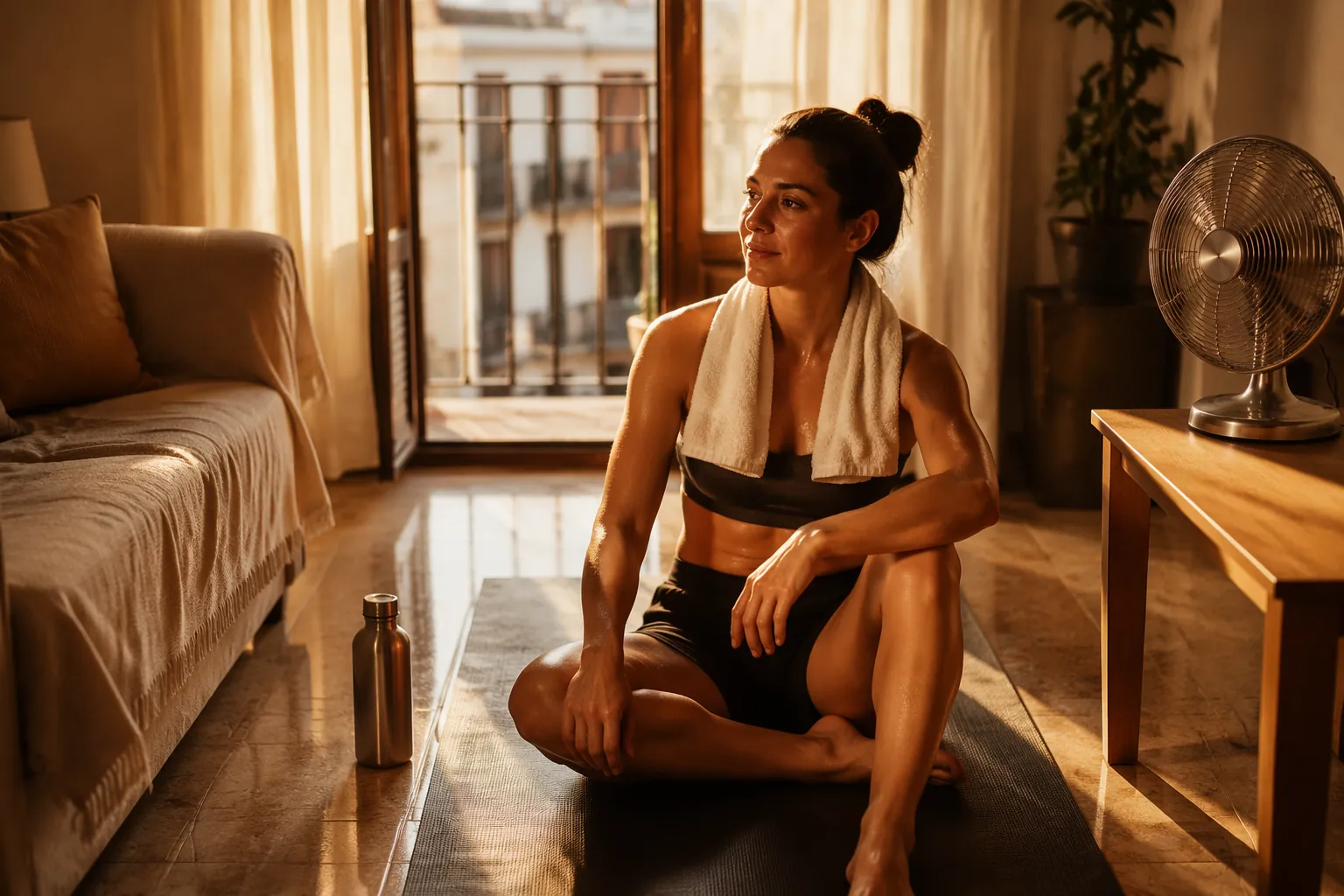
What changes in today’s home workout
Keep the workout, but change the conditions around it. The best version is shorter, quieter, less explosive, and deliberately cooled. If your normal home session is a 30-minute bodyweight circuit with hard intervals, today’s version should feel like controlled maintenance.
| Normal home workout habit | Heat-wave adjustment |
|---|---|
| Training whenever work ends | Train before 10 AM or after 8 PM when the apartment and exterior surfaces are less heat-loaded |
| Working at the usual effort level | Reduce intensity by one zone: hard becomes moderate, moderate becomes easy |
| Starting as soon as you change clothes | Pre-cool first with 10 minutes of forearm immersion in cold water |
| Using 1:1 intervals, such as 40 seconds work and 40 seconds rest | Use a 1:2 work-to-rest ratio, such as 30 seconds work and 60 seconds rest |
| Choosing burpees, sprint intervals, mountain climbers, and jump squats | Choose walking lunges, glute bridges, step-backs, wall sits, dead bugs, and controlled squats |
| Resting by standing still and sweating | Cool between sets with a cold wet towel rotated over the neck, armpits, and groin |
The timing change matters more than it sounds. In hot weather, shaded and direct-sun surfaces can differ by 12–15°C, which helps explain why a room beside a sun-hit balcony may still feel hostile long after sunset [3]. Before 10 AM is usually the cleaner option. After 8 PM can work, but in a small apartment that has absorbed heat all day, it may still need a gentler plan.
Set up the room before you set up the circuit
A small apartment gives you very little margin. The sofa is close, the balcony glass holds heat, the mat traps sweat, and a fan can make the room feel active without actually making your body safer. Start by making the workout area less punishing.
- Close curtains or blinds on sun-hit windows before the room heats up, not just when you start exercising.
- Move the mat away from balcony glass, exterior walls, and direct afternoon sun.
- Put a bowl or basin of cold water near the mat for pre-cooling, plus one or two towels you can wet and rotate.
- Keep movements low-impact enough that you are not adding unnecessary heat, noise, and breathlessness.
- Use the fan cautiously. If the indoor temperature is above 40°C, do not rely on a fan as your main cooling strategy.
That fan point deserves care. Time reported WHO Europe guidance warning against relying on electric fans above 40°C because they may circulate hot air and increase heat stress [5]. Humidity level and fan type matter, so treat the 40°C threshold as a conservative rule unless you have checked the original WHO guidance for your exact conditions. A fan can help move air across a wet towel or through a cooler room; it cannot make a dangerously hot room safe by itself.
Pre-cool for 10 minutes, then start below your usual effort
Before the warm-up, put your forearms in cold water for 10 minutes. The point is not comfort theater. Forearm immersion before exercise can provide a greater heat buffer before core temperature becomes dangerous, according to BBC Future’s reporting on guidance from the University of Sydney’s Heat and Health Research Centre [3].
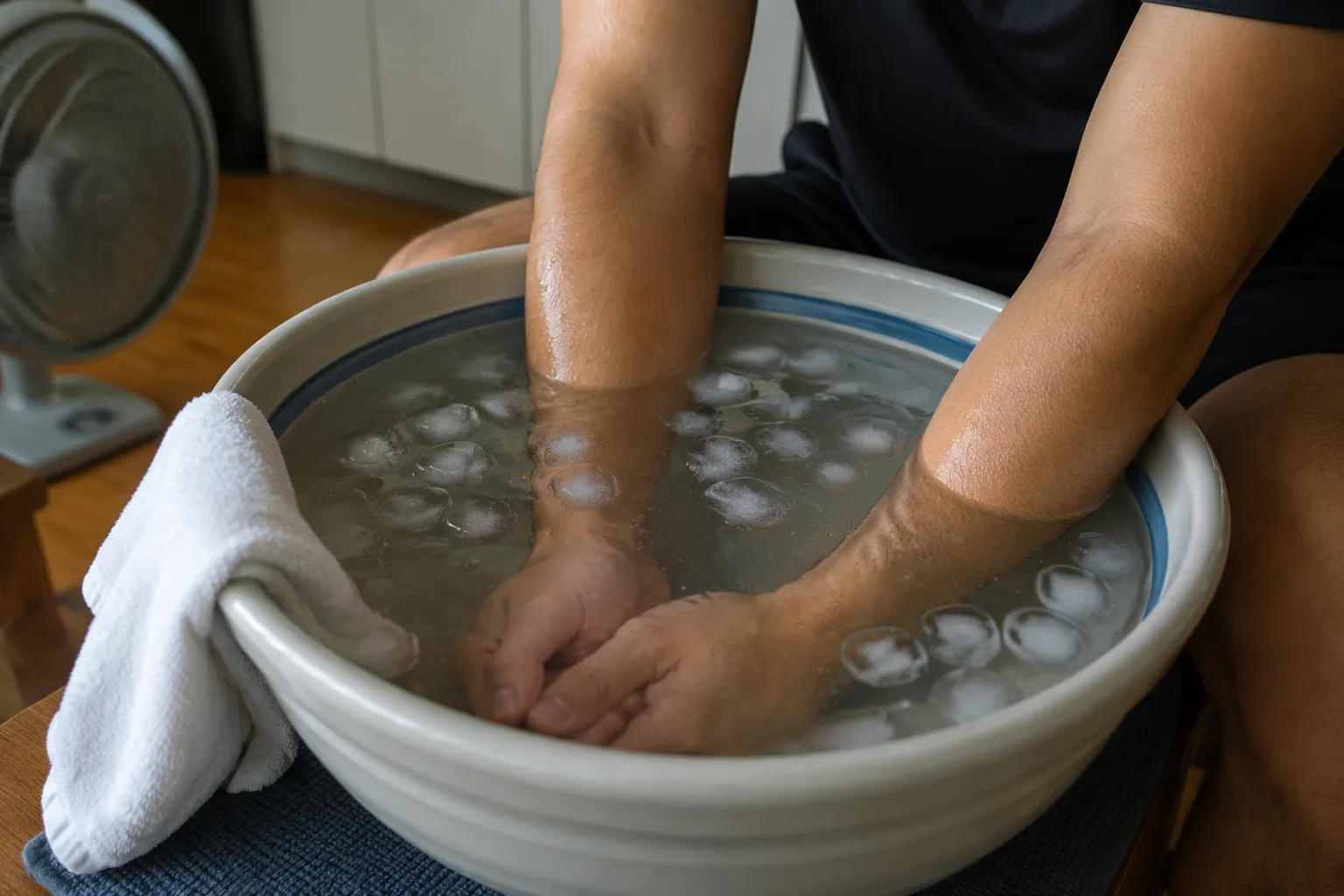
Use the full 10 minutes. This is a good time to decide what kind of session you are actually allowed to do today. If you planned a hard circuit, make it moderate. If you planned moderate strength work, make it easy strength practice. If the apartment is already oppressive before you begin, make the workout mobility, breathing-paced strength, or skip it.
The reason is physiological, not motivational. During exercise in the heat, blood is diverted toward the skin for cooling, which reduces oxygen delivery to working muscles and brings on fatigue earlier than the same workout would in cooler conditions [4]. So the fix is not to keep the same HIIT session and call it indoor training. The fix is to reduce the heat your muscles and cardiovascular system must handle.
The small-apartment heat-wave circuit
This routine needs only a mat-sized space. It avoids jumping, fast transitions, and exercises that drive your heart rate up before your muscles have done much useful work. Use 30 seconds of work followed by 60 seconds of rest. That 1:2 ratio is the main governor on the session.
| Block | Exercise | How to do it in heat |
|---|---|---|
| Warm-up | Slow marching, shoulder circles, hip hinges | 4–5 minutes only. You are preparing joints, not chasing sweat. |
| Circuit 1 | Sit-to-stand or slow bodyweight squat | 30 seconds work, 60 seconds rest. Keep the tempo smooth and stop short of breathlessness. |
| Circuit 1 | Incline push-up on a counter or wall | Use a higher surface than usual if needed. Heat is not the day to prove floor push-up volume. |
| Circuit 1 | Glute bridge | Replace sprint intervals or jump work with this. It trains the posterior chain without spiking heat load. |
| Circuit 1 | Dead bug | Move slowly. Exhale as the arm and leg extend. Keep the low back controlled. |
| Circuit 2 | Reverse lunge or supported step-back | Use a chair or wall for balance. Choose walking lunges only if you have enough space and feel steady. |
| Circuit 2 | Wall sit | Hold at a manageable depth. Stand up before your breathing becomes strained. |
| Circuit 2 | Bird dog | Use this as active strength work, not filler. Slow repetitions are enough. |
| Circuit 2 | Side plank from knees | Short holds are fine. Switch sides after the rest period, not in a rush. |
Do one round of Circuit 1 if the room feels heavy. Do two rounds if you are still steady and your breathing settles during the 60-second rests. Add Circuit 2 only if the first block felt controlled. A full session will take roughly 20–35 minutes depending on how many rounds you complete, but the clock is less important than how quickly you recover between efforts.
Exercise swaps that actually lower the heat load
Some substitutions look easier on paper because they are easier on the body’s cooling system. That is the point. Burpees, mountain climbers, high knees, squat jumps, and sprint intervals all combine speed, impact, and rapid breathing. In a hot room, they compete with your body’s attempt to shed heat.
| Skip during the heat wave | Use instead | Why it fits a hot apartment |
|---|---|---|
| Burpees | Slow squat to calf raise or sit-to-stand | Keeps leg work without repeated floor-to-standing transitions |
| Mountain climbers | Dead bug or bird dog | Trains trunk control without driving breathing rate as high |
| Sprint intervals | Glute bridges | Builds hips and posterior chain while lying down and staying controlled |
| Jump squats | Slow squats or wall sit | Removes impact and reduces sudden heart-rate spikes |
| Fast lunge jumps | Reverse lunges or supported step-backs | Keeps single-leg strength while lowering instability and heat strain |
If you usually train by feel, use breath as the limiter. You should be able to bring your breathing down during the 60-second rest. If every rest period starts with you bent over, hands on knees, waiting for your pulse to stop hammering, the next round should be easier or gone.
Use the cold wet towel between sets
Between rounds, rotate a cold wet towel over the neck, armpits, and groin. Time’s heat wave safety coverage describes this approach as more effective than ice packs because the towel covers more skin area [5]. In a small apartment, that matters: you need repeatable cooling, not a dramatic ice-pack moment that helps one spot while the rest of you keeps overheating.
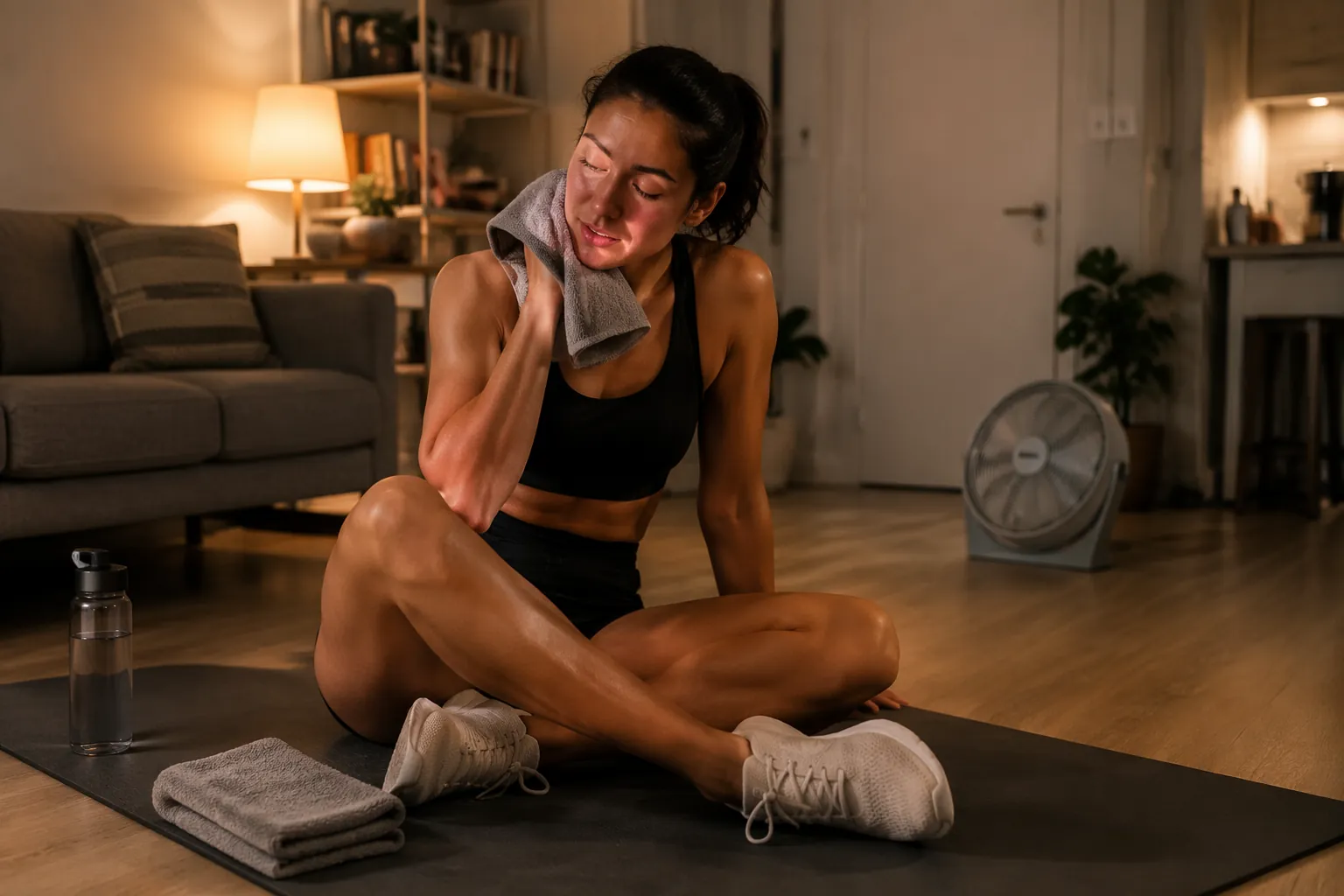
A simple pattern works well: towel on the neck during the first half of the rest, then under one arm or across the upper chest, then switch sides during the next rest. If you have a second towel, keep it in cold water while the first is in use. Do not wait until you feel overheated; make cooling part of the interval structure from the first set.
A 7-day pattern for the rest of the heat wave
A streak survives better when not every day asks for the same thing. During extreme heat, alternate strength, mobility, and recovery so the body gets repeated exposure without repeated strain. Keep the same timing rules: before 10 AM if possible, after 8 PM only if the apartment has actually cooled enough.
| Day | Session | Heat adjustment |
|---|---|---|
| Day 1 | Heat-wave circuit: Circuit 1 only | Use 30 seconds work, 60 seconds rest. Stop after one round if recovery is slow. |
| Day 2 | Mobility and easy core | 15–25 minutes. Dead bugs, bird dogs, hip mobility, gentle stretching. |
| Day 3 | Heat-wave circuit: Circuit 1 plus optional Circuit 2 | Add the second block only if breathing settles during rests. |
| Day 4 | Recovery walk indoors, gentle mobility, or full rest | If the apartment is still hot at night, choose rest without treating it as failure. |
| Day 5 | Strength focus | Slow squats, incline push-ups, glute bridges, wall sit. Fewer exercises, cleaner reps. |
| Day 6 | Mobility plus light balance work | Keep it easy. Use supported step-backs, calf raises, shoulder mobility. |
| Day 7 | Repeat the best-controlled session of the week | Do not chase the hardest day. Repeat the day where you recovered best. |
This is not a deload week in the usual gym sense; it is a heat-managed week. The win is finishing sessions with enough reserve that you can sleep, work, and train again without feeling as if the apartment extracted a tax from you.
When to cut the session short
Some evenings are not training evenings. If the room is above 40°C, if the fan is only pushing hot air around, or if your breathing does not settle during doubled rest periods, scale the workout down to mobility or stop. The decision is easier if you make it before pride gets involved.
Also stop if coordination drops, chills appear despite the heat, dizziness builds, or you feel confused rather than merely tired. A home workout is supposed to be contained. Once the room and your body both feel unmanageable, the session has stopped being contained.
Acclimatization helps, but it is not armor
After 7–14 days of consistent exercise in heat, the body can adapt: resting core temperature may lower, sweat rate can increase, and blood plasma volume can expand [6]. That helps explain why someone who has lived through many Spanish summers may tolerate a warm room differently from a newly arrived northern European remote worker who assumes summer discomfort is basically the same everywhere.
The adaptation is temporary. Without continued heat exposure, it can be lost within 2–4 weeks [6]. So treat acclimatization as a useful shift, not permission to return to hard indoor intervals while the apartment is still radiating heat at night. Keep moving, but let the heat set the terms.
References
- Spain hits 42C: nine regions on alert for extreme heat — Euronews / Reuters, July 2026.
- Spain records highest number of May heat-related deaths — Reuters, June 2026.
- How to exercise safely in hot weather — BBC Future, June 2026.
- Exercising in Hot and Cold Environments — American College of Sports Medicine.
- Heat wave safety coverage citing WHO Europe fan guidance — Time.
- ACSM consensus statement on heat acclimatization — Korey Stringer Institute.
What a small equipment investment adds
We don't have a build tagged to this exact tier yet. Browse all builds.
How often should you repeat this?
See our recovery and rest reference for citation-anchored rest-interval guidance.
Spot something off?
Tell us if a movement, tier assumption, or duration didn't match your experience.