
Can FightCamp Deliver a Good Workout Despite the Controversy?
FightCamp offers legitimately challenging home boxing workouts, but its F BBB rating, $1,467 year-one cost, and apartment space demands mean it makes sense only if you can commit to 3+ sessions per week and have a 6x6 foot area for a sand-filled bag.
- Equipment tier required
- $300-800
- Duration
- 30 min
- Difficulty
- intermediate
- Target area
- full body
- Space footprint needed
- 6x6 ft
- Noise level
- ✓
FightCamp sits in an awkward place for anyone trying to build a home boxing routine in an apartment. The workouts get real praise from independent testers. The business side has enough smoke to make a cautious buyer slow down: the company’s Better Business Bureau profile shows an F rating and more than 15 complaints involving cancellation difficulty or continued billing after cancellation.[1] Reddit has its own customer-service stories, including a thread from a user describing “Zero Customer Support” while trying to get a refund.[2]
That matters because FightCamp is not a casual purchase. The Core package at $999 plus a $39 monthly membership comes to about $1,467 in the first year, or roughly $122 per month. The higher package at $1,299 plus the same membership reaches about $1,767 in year one. At that point, the question is no longer whether boxing at home sounds fun. It is whether this particular system earns gym-membership money after you account for space, noise, setup, subscription risk, and how often you will actually put on the gloves.
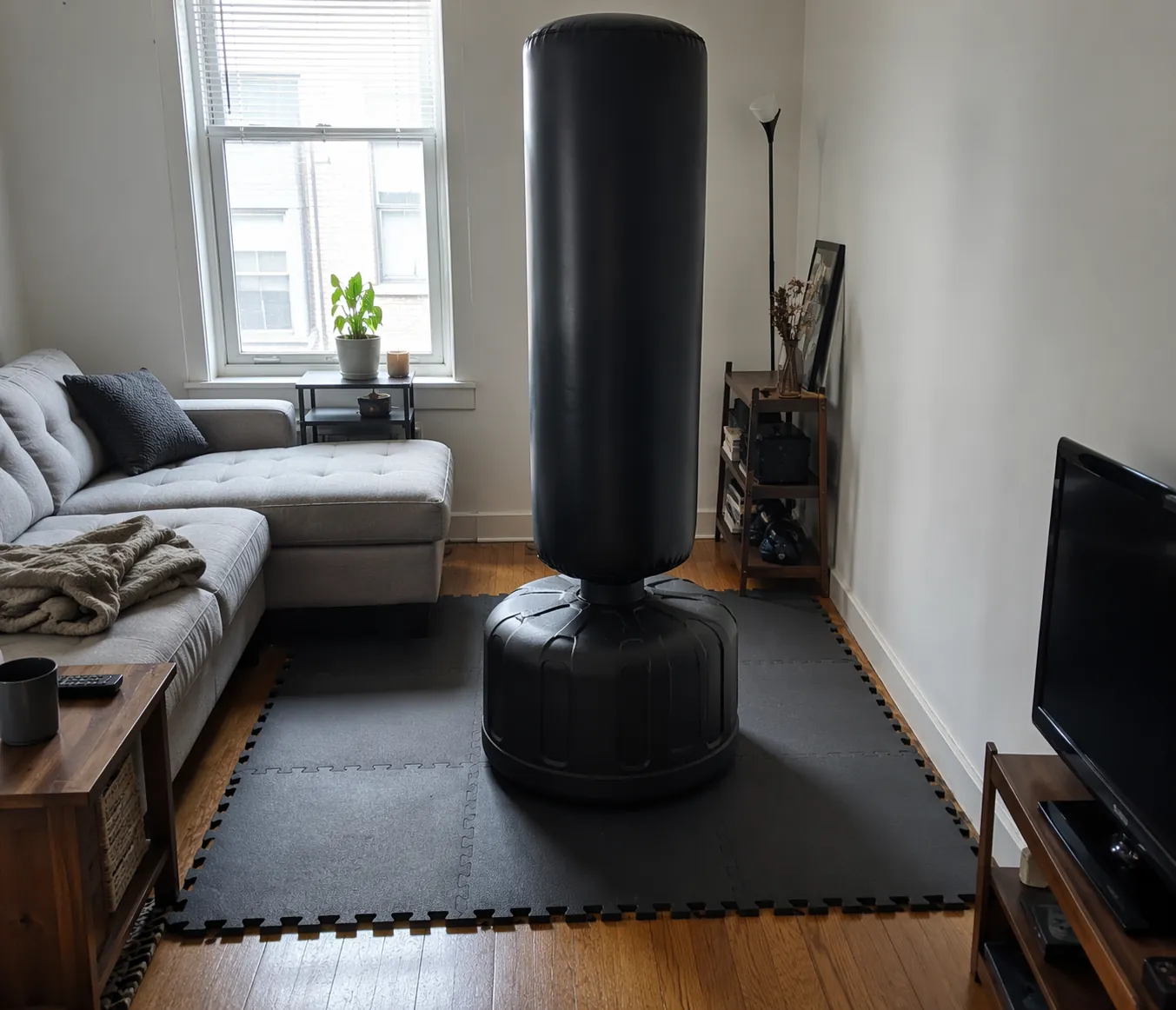
The apartment test comes before the workout review
FightCamp can be a good workout and still be a poor apartment purchase. A freestanding bag changes a room even when nobody is using it. It needs a landing zone, a storage plan, and a neighbor-management plan. The app can be polished, the punches can be tracked, and the coach can be excellent; none of that helps if the bag blocks the path to the sofa or thumps through the floor every time a combination lands.
FightCamp’s own small-space setup guidance points to a 6-by-6-foot to 8-by-8-foot workout area, recommends puzzle mats, and tells users to fill the bag base with sand.[3] A separate hands-on review by Graham Mann says the base takes 350 pounds of dry sand and warns that water filling can make the bag slide or tip during harder workouts.[4] Those details are not minor. They are the difference between a clean product photo and an object you have to live around.
| Apartment condition | What it means in practice |
|---|---|
| Clear 6x6 ft minimum | Enough room to punch, pivot, step back, and move around the base without hitting furniture. |
| Better 8x8 ft zone | More realistic if you want lateral movement instead of standing in one narrow lane. |
| 350 lb dry-sand base | More stable than water for hard workouts, but difficult to move once filled. |
| Puzzle mats under the setup | Helps protect floors and reduce impact noise, though it cannot make punching silent. |
| Permanent or semi-permanent placement | The bag is not something most renters will casually move in and out of a closet. |
The sand requirement deserves more attention than it usually gets. A 350-pound base is good for stability, but it also means the bag becomes a fixture. If you fill it properly, you probably are not sliding it across hardwood every morning. If you do not fill it properly, you may get the exact problem the system is supposed to avoid: a bag that shifts, tips, or forces you to hold back.
Puzzle mats are the other unglamorous part of the setup. FightCamp’s own guidance recommends them for small spaces.[3] In an apartment, they do three jobs: they mark the workout area, protect the floor, and take some edge off the repeated impact of footwork and bag movement. They do not erase sound. A jab-cross-hook sequence against a freestanding bag is still a physical event in a building full of other people.
The subscription complaints are not just reputation noise
The BBB record should not be treated as a court ruling. BBB complaints are submitted by consumers, and the public profile does not independently prove every allegation or show the full denominator of satisfied customers. Some complaints may have been resolved after filing. Still, an F rating paired with more than 15 cancellation-related complaints is relevant for a connected fitness product that depends on a recurring membership.[1]
The Reddit example has the same limitation and the same practical value. One thread does not establish how often refund problems happen, but it shows the kind of failure that matters to a buyer: not a bad class, not a weak coach, but a customer trying to unwind a purchase and feeling stuck with support.[2] For apartment fitness gear, exit friction counts. If a bike becomes a coat rack, you can sell it. If a subscription becomes a billing chore, the problem follows you into next month.
That does not make FightCamp a scam. It makes the purchase less forgiving. A renter who is already uncertain about space, noise, or long-term use should not treat the monthly fee as a harmless add-on. It is part of the product.
The workout quality is the reason this is still a real decision
If the training were mediocre, the verdict would be easy. It is not. PopSugar’s reviewer described FightCamp as offering legitimately challenging workouts with good instruction, while also noting the cost barrier and the reality that similar cardio can come from shadow boxing.[5] Healthline’s review, written by a kickboxing instructor, praised the workout experience but flagged the subscription commitment.[6] Garage Gym Reviews found strong build quality and a good app experience, while questioning whether the price makes sense compared with a simpler bag setup.[7]
Graham Mann’s review also supports the same middle-ground reading: the workouts and tracking can be good enough to make the system motivating, but the hardware setup has to be done correctly, especially the sand-filled base.[4] That is the pattern across the better hands-on coverage. Reviewers are not saying the product is empty hype. They are saying the experience is strong, then arriving at a harder question: strong compared with what, and at what total cost?
There is a broader reason boxing-style fitness works. Harvard Health has described fitness boxing as a way to improve balance, upper-body strength, endurance, and aerobic capacity without the head-trauma risk of sparring or competitive boxing.[8] The article is from 2015, so it is not evidence about FightCamp specifically, but the basic appeal still applies: punching combinations, footwork, and intervals can create serious conditioning without needing a traditional gym floor.
The math improves only if you train often
The cleanest way to judge FightCamp is to stop thinking about the first week. Most expensive fitness gear feels exciting in week one. The better test is whether you will still train three or more times per week after the novelty is gone.
| Actual use | First-year cost per workout with the Core package |
|---|---|
| 1 session per week | About $28 per workout |
| 2 sessions per week | About $14 per workout |
| 3 sessions per week | About $9 per workout |
| 4 sessions per week | About $7 per workout |
Those figures use the roughly $1,467 first-year Core cost and simple weekly training assumptions. They do not include extra mats, replacement wraps, gloves beyond the package, or any future price changes. They also do not measure motivation, which is where connected equipment can be genuinely useful. If seeing punch counts, output, streaks, and coached classes gets you to train when a free video would not, that has value.
But the frequency line is still unforgiving. At one session per week, FightCamp behaves like a premium boutique class you have to store in your living room. At three sessions per week, the economics start to look more defensible, especially for someone replacing a gym membership, boxing studio, or paid app stack. Below that, the system needs a very generous definition of “worth it.”
Tracker accuracy matters less than follow-through
Mixed comments about tracker accuracy are worth noticing, but they should not dominate the decision. For most home users, the useful question is not whether every punch is captured with laboratory precision. It is whether the tracking is consistent enough to make classes more engaging and give you a reason to push harder. Independent reviewers generally found the system accurate enough for that purpose, even when they did not treat it as a perfect measurement tool.[4][7]
That distinction helps keep the controversy in proportion. A slightly imperfect punch count is annoying. A billing dispute is worse. A bag that cannot fit safely in your room is worse still. The tracker is part of the workout experience, but it is not the main risk in the purchase.
A cheaper boxing routine sets the baseline
Before spending more than $1,000, it is worth testing the behavior without the platform. A basic shadow-boxing setup can be built around wraps, gloves, a jump rope, mats, and an interval timer. Current low-cost pricing can put that kind of setup around $75, with a simple interval timer around $15, though those prices can shift.
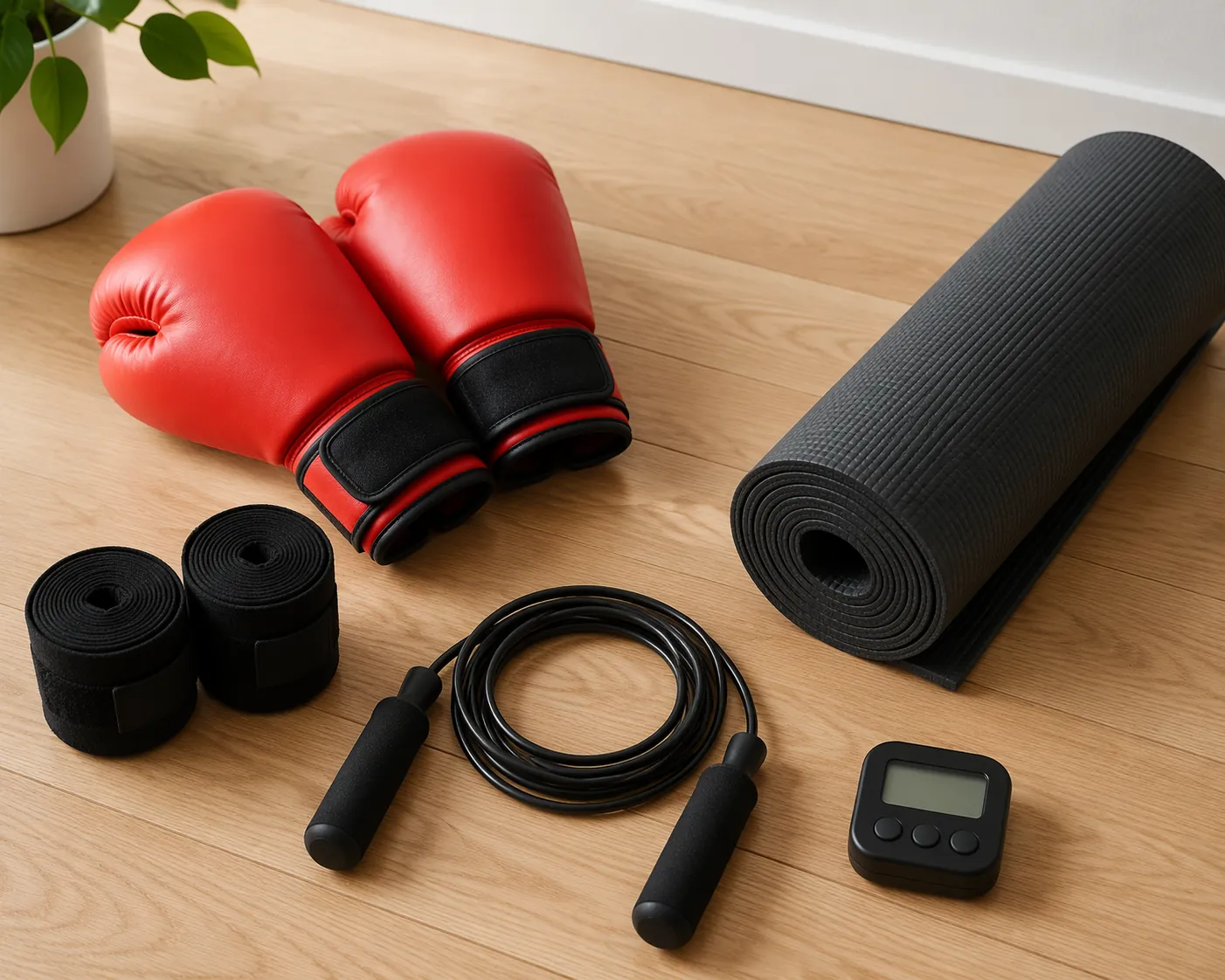
This cheaper version will not recreate FightCamp. It will not give the same app polish, punch tracking, class library, or sense of progression. It also avoids the largest apartment problems: no 350-pound base, no heavy bag impact, no recurring membership, and no cancellation exposure. For conditioning, it can still be demanding. Rounds of jump rope, shadow boxing, squats, pushups, and core work can raise the heart rate quickly when the intervals are structured well.
There is no head-to-head study in the available material proving that FightCamp produces better fitness outcomes than a disciplined YouTube or timer-based shadow-boxing routine. The stronger claim is narrower: FightCamp packages boxing conditioning in a way that testers found engaging, challenging, and well-instructed. That packaging may be exactly what some people need. It is also what makes the purchase expensive.
Who should actually buy FightCamp?
FightCamp makes the most sense for a renter who can answer yes to all of these conditions:
- You have at least a clear 6-by-6-foot area, and preferably closer to 8-by-8 feet, where the bag can live without daily rearranging.
- You are willing to fill the base with dry sand, not water, and accept that the filled bag will be difficult to move.
- You can put puzzle mats under the setup and train at times when impact noise is least likely to create problems.
- You will use the system at least three times per week for a year, not just when the launch excitement is fresh.
- You are comfortable with the subscription and cancellation risk suggested by BBB complaints and customer reports.
If those conditions are true, FightCamp can be a strong home boxing system. The classes have credible support from testers, the app experience appears to be a real advantage, and the tracking can add enough feedback to keep training from feeling anonymous. For someone replacing paid classes and training several times per week, the price is high but not irrational.
If one of those conditions fails, start smaller. Use wraps, gloves, a jump rope, mats, and an interval timer for a month. If you cannot keep that habit without a connected bag, FightCamp may not fix the problem. If you can keep it, you may discover that you wanted boxing conditioning more than you wanted a subscription boxing machine.
References
- FightCamp Fitness Center Business Profile, Better Business Bureau, https://www.bbb.org/us/ca/newport-beach/profile/fitness-center/fightcamp-1126-1000066690
- Reddit r/Fightcamp refund and support thread, Reddit, https://www.reddit.com/r/Fightcamp/comments/l477wr/
- How to Set Up Your FightCamp Gym in a Small Space, FightCamp, https://blog.joinfightcamp.com/for-members/how-to-set-up-your-fightcamp-gym-in-a-small-space/
- FightCamp Review, Graham Mann, https://grahammann.net/blog/fightcamp-review
- FightCamp Boxing Review, POPSUGAR, https://www.popsugar.com/fitness/fight-camp-boxing-review-49423483
- FightCamp Review, Healthline, https://www.healthline.com/health/fitness/fight-camp
- FightCamp Review, Garage Gym Reviews, https://www.garagegymreviews.com/fightcamp-review
- Punch up your exercise routine with fitness boxing, Harvard Health Publishing, https://www.health.harvard.edu/exercise-and-fitness/punch-up-your-exercise-routine-with-fitness-boxing
What a small equipment investment adds
We don't have a build tagged to this exact tier yet. Browse all builds.
How often should you repeat this?
See our recovery and rest reference for citation-anchored rest-interval guidance.
Spot something off?
Tell us if a movement, tier assumption, or duration didn't match your experience.