
Foam Balls or Quiet Paddles for Quiet Home Pickleball?
Wondering whether foam pickleballs or a USAP Quiet Approved paddle will make your apartment practice neighbor-friendly? This comparison shows that swapping the ball gives you roughly 10x more noise reduction per dollar, while quiet paddles only matter once you graduate to plastic-ball wall drills.
- Equipment tier required
- $0-100
- Duration
- 10 min
- Difficulty
- beginner
- Target area
- upper body
- Space footprint needed
- small
- Noise level
- quiet
If you are starting pickleball at home in an apartment, duplex, townhouse, or any room where the floor seems to report directly to someone else’s ceiling, buy foam balls first. A quiet paddle can help later, but it is the expensive second move, not the first one.
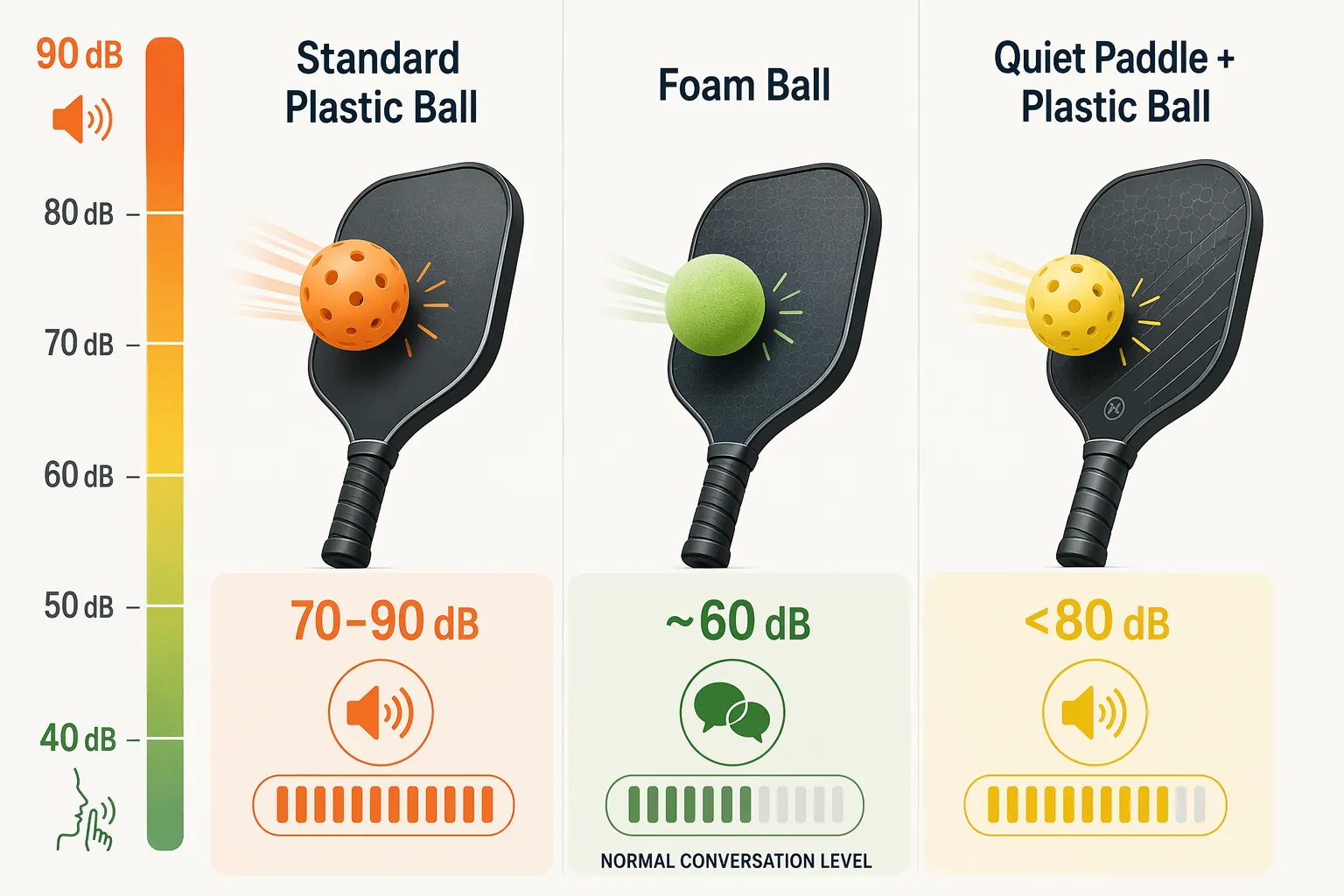
The short version is simple: foam pickleballs usually cost under $20 for a multipack and can bring beginner contact drills down around the 60 dB range, roughly normal conversation level. Standard pickleball contact is commonly discussed in the 70–90 dB range, while quiet paddles mostly reduce the sharper paddle “pop” rather than making a hard plastic ball harmless against a wall or floor.[1] Quiet paddles in current buyer lists sit much higher, roughly $149–$280.[2]
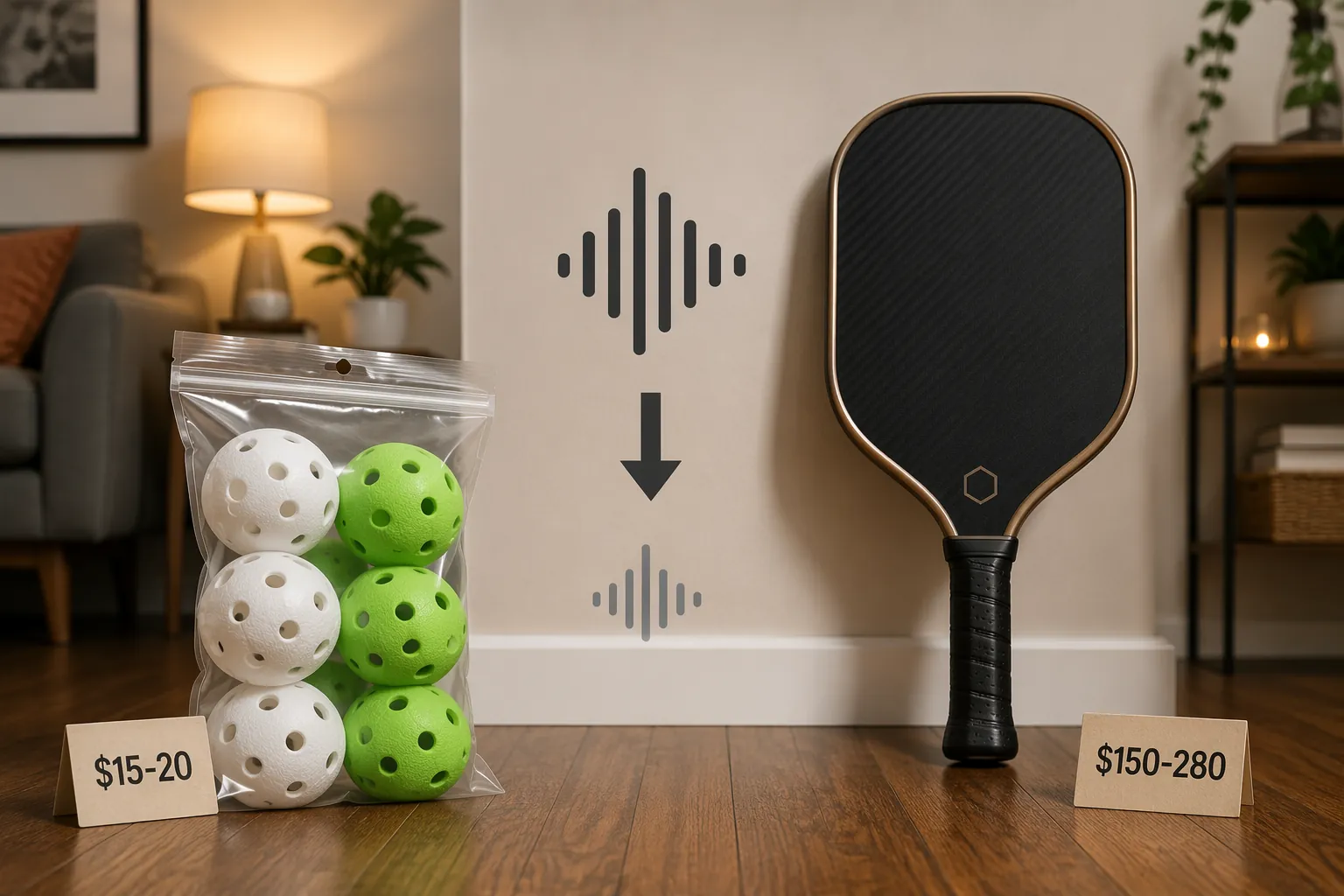
That cost gap matters because the first problem in beginner home practice is usually not tournament-like sound quality. It is repetition. A new player misses the sweet spot, taps too hard, chases rebounds, and repeats the same small sound until the room starts to feel louder than it measures. Reducing the ball’s impact solves more of that immediate problem than buying a premium paddle before the practice itself has earned one.
The Noise Problem Is Mostly Contact, Not Branding
Pickleball noise is not just one sound. There is the paddle face striking the ball. There is the ball striking a wall, garage door, cabinet, floor, or baseboard. There is also the tone of the hit: the hard, bright pop that carries through shared walls more annoyingly than a softer thud at the same general loudness.
That is why foam balls change the room so quickly. They soften both sides of the contact. A foam ball hitting a paddle is quieter than a plastic ball hitting a paddle, and a foam ball that gets away from you is less likely to punish the wall, door, or floor. For early dink motions, grip changes, hand-eye timing, and controlled volleys into open space, that is a more useful fix than shaving the paddle pop while leaving the ball hard.
Paddles Point’s acoustic meter testing is especially useful here because it gives the category a practical ceiling instead of just calling it “quiet.” Its Gamma Librarian test reported a 60 dB ceiling, which lines up with the idea of conversation-level practice rather than court-like impact.[1] That does not prove every foam ball performs the same way in every apartment, but it is enough to explain why the first purchase should be the ball.
Why the Foam Ball Wins the First $20
A beginner does not need a perfect simulation of outdoor pickleball on day one. They need reps they will actually do. If the sound makes you flinch after the third tap, you will either quit early or practice timidly. Foam balls make it easier to repeat the boring, valuable beginner work: find the middle of the paddle, keep the wrist quiet, control the height, and stop swatting at every ball like it owes you rent.
The money math is lopsided. If a foam multipack under $20 brings home-practice sound from the broad 70–90 dB pickleball-hit range down around 60 dB, the player gets a large practical reduction for a small spend.[1] A quiet paddle at $149–$280 may reduce the paddle’s contribution, but it does not make a hard plastic ball soft when it hits the wall, floor, or furniture.[2]
| Beginner purchase | Typical cost in the brief | What it mainly quiets | Best use at home |
|---|---|---|---|
| Foam balls | Under $20 to about $30 for a multipack | Ball-to-paddle and ball-to-room impact | Beginner reps, soft volleys, dinks, hand-eye drills |
| Quiet paddle | $149–$280 | Sharper paddle pop, especially with plastic balls | Plastic-ball wall drills after basic control improves |
This is also where product claims need a little patience. The Ninja Ball is marketed around extreme quietness, including a “0 dB” style claim in the foam-ball category.[3] That should not be read as a literal lab measurement of a struck ball; it is better treated as marketing language for a very soft-surface practice ball. Boomer, DrillPickle, Tourna, Gamma Librarian, and Ninja-style foam balls all point in the same useful direction, but the available evidence is a mix of product pages, user reports, and limited third-party testing rather than a broad independent lab comparison across every model.[1][3][4]
The Part a Quiet Paddle Actually Solves
Quiet paddles are not fake solutions. They are just solving a narrower problem. USA Pickleball’s Quiet Category work around the OWL paddle reported measurements under 80 dB and under 600 Hz, compared with standard paddles described at 85+ dB and around 1,100–1,200 Hz; the release also described roughly a 50% perceived noise reduction.[5] The frequency detail matters because the irritating pickleball pop is partly about pitch, not only volume.
Still, that OWL information comes through USA Pickleball’s own institutional press release, not a large independent test set repeated across many apartments and wall types.[5] “Quiet Approved” is meaningful as a category signal. It is not a magic apartment permission slip.
The current quiet-paddle market also asks for real money. Pickleheads’ 2026 quiet paddle roundup lists models such as the Whisper Silencer at $200, OWL PXE at $169, Stafford OverSpin at $149, Diadem Hush at $250+, Gearbox at $275, and Selkirk LUXX at $280, with trade-offs around power, control, spin, and feel.[2] That is a normal gear decision for someone who knows how they like to play. It is a strange first bill for someone still learning to tap the ball cleanly in a hallway.
Foam Balls Feel Different, and That Is the Real Trade-Off
The honest complaint about foam balls is not that they are useless. It is that they feel deader. They do not pop off the paddle like a plastic pickleball. They can make timing easier, rebounds softer, and mistakes less punishing. For a brand-new player, that is usually a feature. For someone trying to copy match-speed drives against a wall, it becomes a limitation.
So the right question is not “Which quiet product is best?” It is “What kind of practice am I doing tonight?” If tonight is ten minutes of paddle control in a living room, foam balls are the sane answer. If tonight is plastic-ball wall work because you are training the bounce, rebound, and contact feel you expect on court, then the paddle starts to matter.
- Use foam balls for first-contact drills, dink motion, soft volley control, grip comfort, and small-space coordination.
- Use a quiet paddle when you are intentionally keeping the plastic ball in the routine and need to reduce the sharper pop.
- Do not judge foam balls by whether they perfectly reproduce outdoor play; judge them by whether they let you practice without creating a repetitive household problem.
- Do not judge quiet paddles by whether they make pickleball silent; judge them by whether they reduce the paddle tone enough for the specific room and drill.
A Buying Sequence That Matches Home Practice
Start with a foam-ball multipack. Gamma Librarian has the clearest third-party meter support in the provided materials, while Ninja Ball, Boomer, DrillPickle, and Tourna show that the category has more than one option.[1][3][4] If your first goal is quiet beginner training, the exact foam brand matters less than avoiding the hard plastic-ball problem too early.
Then pair the balls with a small-space routine rather than free-hitting until something rattles. A structured sequence like pickleball drills for home practice in small spaces gives the quiet gear a job: short controlled reps, not random impacts. That is how a beginner gets better without turning every missed touch into a neighbor’s problem.
Add a quiet paddle only when the plastic ball becomes necessary. That point usually arrives when you want more realistic rebound, paddle feedback, spin response, or wall-drill timing. At that stage, Pickleheads’ list is useful because it shows the quiet-paddle category as a set of trade-offs rather than one universally correct upgrade.[2]
If your home practice is also meant to keep you moving, use the quiet setup for skill work and add conditioning separately with a 20-minute pickleball home workout for small spaces. Footwork and fitness can be trained without making the ball louder.
For quiet beginner pickleball training at home, the first purchase is foam balls. They are cheap, forgiving, and quiet where a beginner most needs quiet: the repeated contact between ball, paddle, room, and confidence. A quiet paddle is the later upgrade for plastic-ball wall work, not the price of admission.
References
- Best Silent Pickleballs, Paddles Point.
- Best Quiet Pickleball Paddles, Pickleheads.
- Ninja Ball, Enhance Pickleball.
- DrillPickle Quiet Pickleballs, DrillPickle.
- USA Pickleball Announces OWL as First Quiet Category-Certified Paddle, USA Pickleball.
What a small equipment investment adds
Cable Machine Alternatives That Save Space and Money
Compare the best cable machine alternatives for home gyms – from resistance bands and pulley systems to suspension trainers and compact digital units – and find the right option for your space and budget.
Small Treadmill Buying Guide: 7 Critical Specs to Check Before You Buy
A cross-category spec primer for apartment and small-space dwellers comparing walking pads, ultra-compact folding treadmills, and full-size folding treadmills. Learn the concrete thresholds for motor HP, deck length, noise, warranty, and subscription lock-in so you can compare apples to apples.
How to Practice Basketball at Home Without Noise Complaints
Learn how to run a full basketball workout in a small apartment without noise complaints. This guide covers no-dribble handling drills, wall form shooting, and silent ball options that let you train without disturbing neighbors.
How often should you repeat this?
See our recovery and rest reference for citation-anchored rest-interval guidance.
Spot something off?
Tell us if a movement, tier assumption, or duration didn't match your experience.