
Gabby Thomas' Running Drills You Can Do at Home
Learn the specific running drills Olympic sprinter Gabby Thomas uses in her warm-ups, adapted for a small apartment with no equipment. Perform A-skips, high knees, and wall drives in a 6x6-foot area to improve speed mechanics in just 15 minutes.
- Equipment tier required
- none
- Duration
- 15 min
- Difficulty
- beginner
- Target area
- legs
- Space footprint needed
- 6x6 feet
- Noise level
- low
The small-space test is simple: clear roughly a 6x6-foot patch of floor, stand far enough from the coffee table to swing your arms, and ask whether the drill still teaches sprint mechanics when you cannot actually sprint. For the Gabby Thomas home running drills people usually want, the answer is mostly yes. A-skips, B-skips, high knees, butt kicks, and wall drives are not track-only magic tricks. They are compact ways to rehearse posture, knee drive, ankle position, and leg cycling before faster running.
That does not make this a copy of Thomas's professional training. Her real work includes coached track sessions, lifting, recovery, and a much larger weekly training load than a renter can or should imitate in a living room; Women's Health has described her routine as including more than 20 hours of training per week in the off-season and running sessions that can last more than 3 hours [1]. The useful home version is narrower: a 15-minute technique block, 2 to 3 times per week, built from the same drill vocabulary she has repeatedly shown in public training content and adapted with sprint-coaching guidance for confined spaces.
| Drill | Home Version | Main Point | Time |
|---|---|---|---|
| A-skip | In place or 2 to 3 steps forward and back | Knee drive, dorsiflexed foot, tall posture | 2 minutes |
| High knees | March-to-run rhythm in place | Fast contacts without collapsing posture | 2 minutes |
| Wall drives | Hands on wall, alternating knee drives | Sprint angle, hip projection, force direction | 3 minutes |
| B-skip | Small-range skip with controlled lower-leg extension | Front-side mechanics without reaching | 2 minutes |
| Butt kicks | Quiet hamstring-cycle version, not heel-slamming cardio | Backside recovery and rhythm | 2 minutes |
| Reset and repeat | Repeat the sharpest drills, not the loudest ones | Quality under light fatigue | 4 minutes |
What This Borrows From Gabby Thomas, and What It Does Not
The drills here are Thomas-inspired because they come from the basic sprint-mechanics family she has made visible in public warm-up and training clips: A-skips, B-skips, high knees, butt kicks, and wall drives. The apartment setup is the adaptation. Small-space sprint-training guides from SimpliFaster, Haylie McCleney's Speed School, and Next Level Athletics all support the idea that athletes can practice speed mechanics indoors with short drill blocks, wall sprints, and confined-space movement patterns rather than needing a full track for every technical session [2][3][4].
The distinction matters. A wall drive in your hallway is not Thomas's acceleration session. A quiet A-skip beside your couch is not a substitute for flying 200s or coached block starts. It is a way to rehearse positions: tall torso, active arms, knee up, toe up, foot striking under the body instead of reaching out in front. TrainingPeaks describes running drills as tools for reinforcing proper mechanics, not as stand-alone proof that a runner has become faster [5].
That is enough to be useful. Speed qualities can fade when they are not practiced; SimpliFaster notes that speed skills can begin to deteriorate after roughly 5 days without high-intensity practice, which is one reason short maintenance sessions at home have value when track access is irregular [2]. The goal is not to leave the room exhausted. It is to leave with cleaner positions than when you started.
Set Up the 6x6-Foot Sprint Corner
You need less room than most workouts pretend you need, but the floor still has to cooperate. Clear a square about the size of a small rug. Move anything with sharp corners. If you are on hardwood, tile, or thin apartment flooring, use athletic shoes with clean soles or a firm exercise mat that does not slide. A thick, squishy mat can make the ankle wobble during skips; a firm surface with a little sound dampening is better.
- Best surface: firm floor, low-pile rug, or a non-slip mat that stays flat.
- Best time: daylight or early evening if you have downstairs neighbors, not late-night high-knee intervals.
- Best footwear: running shoes or trainers that let you land quietly without sliding.
- Best intensity: crisp and technical, not so fast that every landing thumps.
If the drill gets loud, assume form is leaking before you assume you need more toughness. Heavy footfalls usually mean you are bouncing vertically, reaching forward, or letting the ankle go floppy. In an apartment, quiet is not just politeness; it is feedback.
The 15-Minute Session
Thomas's full warm-up has been reported as lasting 45 to 60 minutes, which makes sense for an Olympic sprinter preparing for high-speed work [1]. At home, cut the ambition down without cutting out the point. A focused 15-minute block is long enough to practice the positions and short enough that the last few minutes do not turn into sloppy conditioning.
| Minute | Action | How Hard |
|---|---|---|
| 0:00-2:00 | Easy march, ankle bounces, arm swings | Warm, quiet, relaxed |
| 2:00-4:00 | A-skips | Precise, not fast |
| 4:00-6:00 | High knees | Quick contacts, controlled height |
| 6:00-9:00 | Wall drives | Strong positions, short sets |
| 9:00-11:00 | B-skips | Small range, clean timing |
| 11:00-13:00 | Butt kicks | Light rhythm, no heel-slamming |
| 13:00-15:00 | Repeat A-skips or wall drives | Choose the drill that stayed cleanest |
Work in short bites: 10 to 20 seconds on, then enough rest to reset your posture. If you are breathing hard enough that your shoulders climb and your feet slap, rest longer. This is a mechanics session wearing the costume of a workout.
A-Skips: The Drill That Looks Easy Until You Do It Quietly
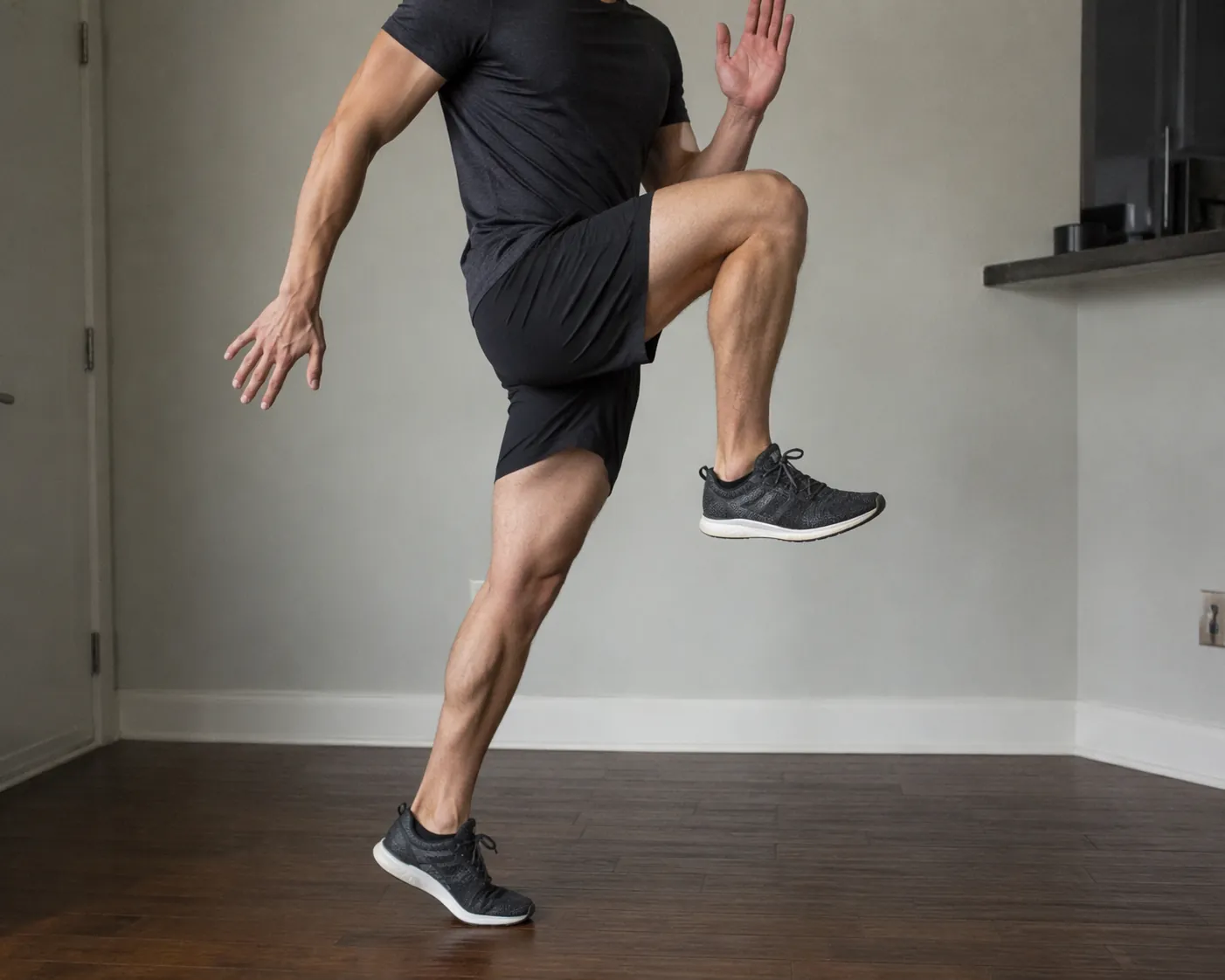
A-skips are the cleanest entry point because they slow sprinting down without removing the important shapes. You drive one knee up, keep the foot pulled toward the shin, strike down under your hips, and switch sides with a light skip. Coaching sources commonly use A-skips to teach front-side mechanics, posture, and rhythm [3][5].
In a room, do them almost in place. Take one or two tiny steps forward, then back up and repeat, or stay on a single floorboard and alternate sides. The knee does not need to rise as high as a highlight clip. Aim for a thigh angle that you can control while keeping the ribs down, hips tall, and foot flexed. Your arms should move as if you are running: cheek-to-pocket path, elbows bent, shoulders loose.
- Feel: the lifted-side glute and hip flexor working, the standing foot landing under you, and the ankle staying stiff enough to rebound.
- Avoid: bouncing straight up and down, kicking the foot forward, or landing with a flat, sleepy slap.
- Apartment cue: make the landing sound like a quick tap, not a stomp.
The common home mistake is turning A-skips into cardio skips. The drill gets bigger, the arms get theatrical, and the foot starts landing ahead of the body. Shrink it. If you cannot keep the toe up and land underneath yourself, reduce the knee height before you add speed.
High Knees: Sprint Rhythm Without the Runway
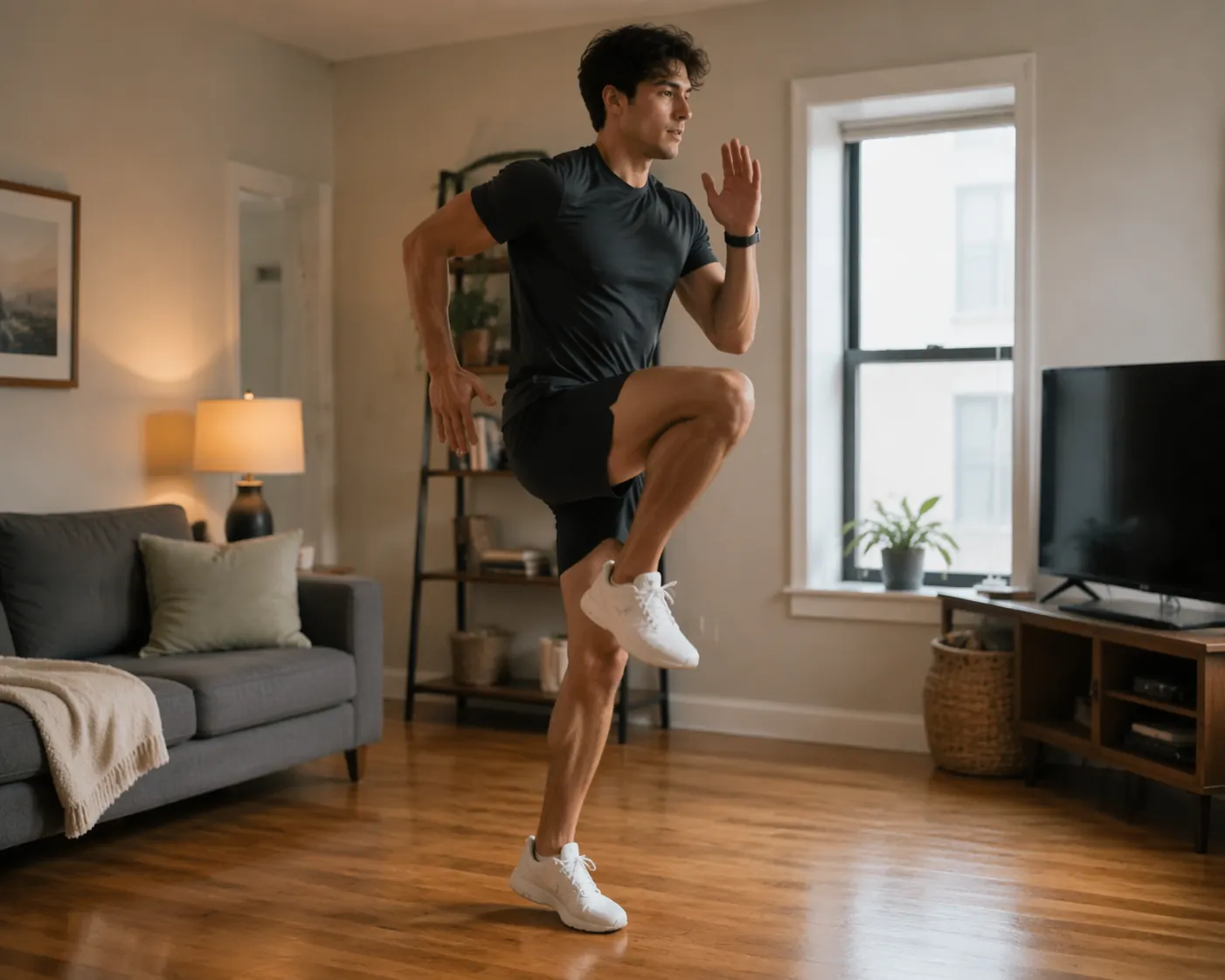
High knees are familiar enough to be dangerous. Most people have done them in a boot-camp class, usually as a way to get tired quickly. For sprint mechanics, the point is different: quick ground contact, upright posture, active arms, and knees that rise because the hips are doing their job, not because you are leaning back and yanking your thighs up.
Start with a high-knee march for 20 seconds. Freeze each rep for a split second: knee up, toe up, opposite arm forward, torso tall. Then turn the march into a faster rhythm for 10 to 15 seconds. Stay in place or move no more than a step forward and back. If your heels drift behind you and your knees barely lift, slow down. If your feet crash into the floor, lower the knee height and make the contacts quicker.
- Good rep: knee lifts in front of the hip, foot stays dorsiflexed, landing happens under the center of mass.
- Noisy rep: the body bounces upward, the foot reaches forward, and the landing shakes the floor.
- Useful regression: march-high knees, where every rep pauses long enough to check posture.
If you live above someone, high knees are the drill to police most carefully. Do not chase maximum speed. Chase identical contacts. Ten quiet seconds with clean positions beat 40 seconds of ceiling-rattling knees-to-nowhere.
Wall Drives: The Most Apartment-Friendly Sprint Drill
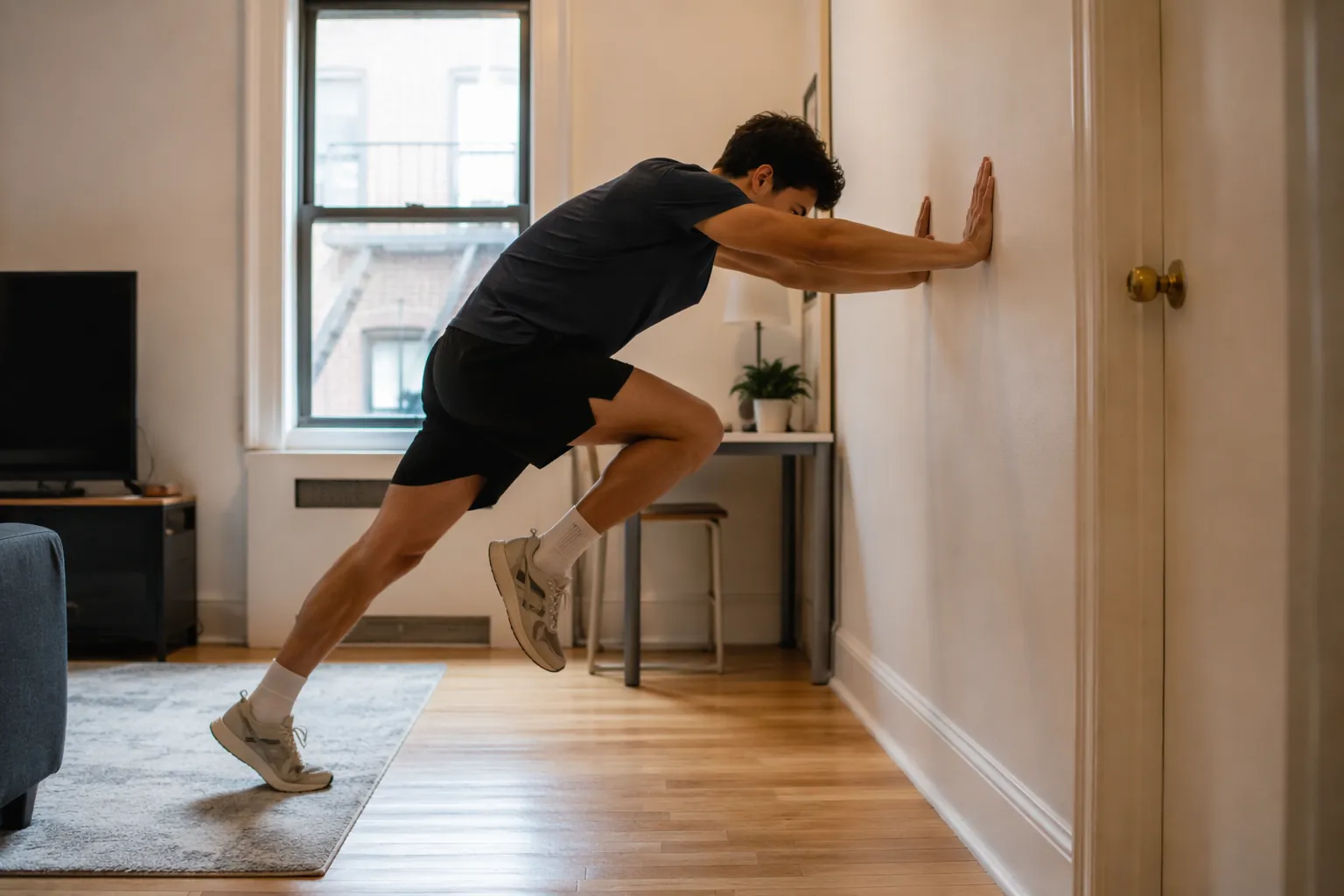
Wall drives solve the space problem better than almost anything else in this routine. You get to feel a sprint-like forward lean without needing a hallway, driveway, or track. Small-space sprint guides often use wall sprints, wall drives, or wall holds because they let athletes practice acceleration angles in a confined area [2][4].
Place both hands on a sturdy wall at about shoulder height. Walk your feet back until your body forms a straight diagonal line from head to heel. The angle should feel athletic, not like a collapsing plank. Brace lightly through the trunk, push the floor away through the standing leg, and drive one knee forward and up. Hold for one second. Switch legs without letting your hips sink.
The wall is not there for leaning lazily. It gives you a direction to push against. In acceleration, the body has to project forward while the leg drives down and back. A wall drive lets you rehearse that relationship slowly enough to notice whether the knee is coming through cleanly or the foot is just pawing at the floor.
| Version | How to Do It | Use It For |
|---|---|---|
| Wall drive hold | Drive one knee up and hold for 1 to 2 seconds | Learning the angle and knee position |
| Alternating wall drive | Switch knees every rep with control | Practicing rhythm without impact |
| Fast wall sprint | Run the legs quickly for 5 to 8 seconds | Adding speed after the holds stay clean |
Start with holds before fast switches. If your lower back arches, move your feet closer to the wall. If your shoulders shrug, lower your hands slightly and soften the elbows. If the standing heel keeps dropping heavily, reset the whole line and think about pushing through the ball of the foot.
B-Skips and Butt Kicks: Keep Them Small Enough to Matter
B-skips add a lower-leg extension to the A-skip pattern. In track space, that extension can travel. In an apartment, it should be modest. Drive the knee up first, then let the lower leg open slightly before the foot comes down underneath you. The mistake is reaching out in front like you are trying to scrape gum off your shoe. That creates braking, noise, and a drill that teaches the opposite of what you want.
Use B-skips as a coordination drill, not a power drill. Ten clean reps per side are plenty. If the timing feels awkward, go back to A-skips and add only a tiny lower-leg flick. There is no prize for making the fanciest drill in the sequence look busy.
Butt kicks also need a rewrite for home use. The usual group-fitness version encourages people to kick their heels high and fast, often with the knees pointing down and the body leaning forward. For sprint mechanics, keep the thigh relatively underneath you and think of the heel cycling up as part of the leg recovery, not as a donkey kick. Stay light, keep the arms running, and stop before the contacts get loud.
How Often to Do the Drills
For most home exercisers, 2 to 3 sessions per week is the useful range. That gives enough repetition to keep the patterns familiar without pretending that a living-room drill block replaces sprint practice. SimpliFaster's home-training guidance supports short, focused technical work for sprinters when normal training conditions are limited [2].
Place the session before an easy run, before a lower-body strength workout, or on a separate day when you want speed practice without much fatigue. Avoid doing it after a hard leg day if your calves and hip flexors are already cranky; sloppy mechanics repeated tired are still sloppy mechanics.
| Goal | Weekly Use | Best Placement |
|---|---|---|
| Maintain running mechanics | 2 times per week | Before easy runs or short home workouts |
| Improve coordination | 3 times per week | On nonconsecutive days |
| Warm up for faster running | Before track, treadmill, or outdoor speed work | After general warm-up, before hard reps |
| Apartment-friendly conditioning | Use cautiously | Keep impact low and stop before form breaks |
Optional Add-Ons: Pilates and Low-Volume Plyometrics
Thomas's broader training is not just drills. Women's Health has reported that Pilates is part of her routine, and Thomas described it as “humbling” because it activates small stabilizing muscles [1]. That does not mean every runner needs to bolt a full Pilates class onto a 15-minute drill session. It does mean there is a sensible add-on if you want more trunk and hip control: 5 to 10 minutes of dead bugs, side planks, glute bridges, or slow single-leg balance work after the drills.
Plyometrics are trickier in an apartment. Thomas's elite training context includes explosive work, but repeated jumping is where the renter problem becomes real. If you add plyos, keep them low-volume and quiet: ankle pops on a mat, tiny line hops, or snap-downs performed during reasonable hours. If you cannot land softly, the drill is not ready for your floor.
A Few Form Checks Before You Call It Done
- Posture: ribs stacked over hips, not leaning back to fake knee height.
- Foot position: toes pulled up on the lifted leg, not hanging loose.
- Ground contact: quick and under the body, not forward and braking.
- Arms: running rhythm, not limp hands or exaggerated punching.
- Noise: light enough that a neighbor would not know which drill you are doing.
A phone video from the side helps, especially for A-skips and wall drives. You are looking for whether the foot lands underneath you, whether the knee actually drives forward, and whether the torso stays organized. Do not grade the clip like a professional sprint coach. Just catch the obvious leaks before they become the habit you are practicing.
You cannot recreate Gabby Thomas's professional training in an upstairs apartment, and that is not a failure of imagination. Her full program belongs on a track, with a coach, a training group, and recovery resources. What you can do is practice the foundational speed mechanics that show up in her warm-up vocabulary: knee drive, dorsiflexion, posture, rhythm, and force direction. Fifteen careful minutes in a 6x6-foot space is enough room for that.
References
- All About Track & Field Olympian Gabby Thomas' Diet, Workouts, Women's Health
- Home training guide for sprinters (programming, frequency, small-space adaptation), SimpliFaster
- 10 at-home speed drills with form instruction, Haylie McCleney's Speed School
- Small-space speed/agility training framework, Next Level Athletics
- Running form drills for proper mechanics, TrainingPeaks
What a small equipment investment adds
We don't have a build tagged to this exact tier yet. Browse all builds.
How often should you repeat this?
See our recovery and rest reference for citation-anchored rest-interval guidance.
Spot something off?
Tell us if a movement, tier assumption, or duration didn't match your experience.