
Geno Smith's Training Camp Routine for Home Workouts
This article adapts Geno Smith's training camp preparation—focused on conditioning, core strength, and quarterback-specific movement—into a three-day-per-week home workout you can do in a small apartment with minimal equipment.
- Equipment tier required
- $0-100
- Duration
- 30 min
- Difficulty
- beginner
- Target area
- full body
- Space footprint needed
- small room
- Noise level
- low
Geno Smith’s training camp routine is not available as a complete home workout, and pretending otherwise would be the wrong place to start. The useful part is narrower and better: during his Seahawks period, SI.com reported that Smith’s offseason work leaned hard into conditioning, core strength, leg drive, and quarterback movement, including treadmill work, sprints, gassers, core/cardio emphasis, and weight-room habits coaches described as “second to none.” He also stayed in Seattle for two extra weeks after the season to keep training with assistant strength coach Danny van Dijk, and offensive coordinator Shane Waldron said he arrived at the offseason program in “midseason form.” [1]
That reporting is from June 2023, not a live window into his 2026 Jets preparation. So this is not “Geno Smith’s exact apartment workout.” It is a home version built from the parts that travel: cardiovascular base, trunk control, leg strength, rotational power, single-arm upper-body work, and the willingness to train when the calendar is quiet and nobody is checking attendance.
The Three-Day Home Version
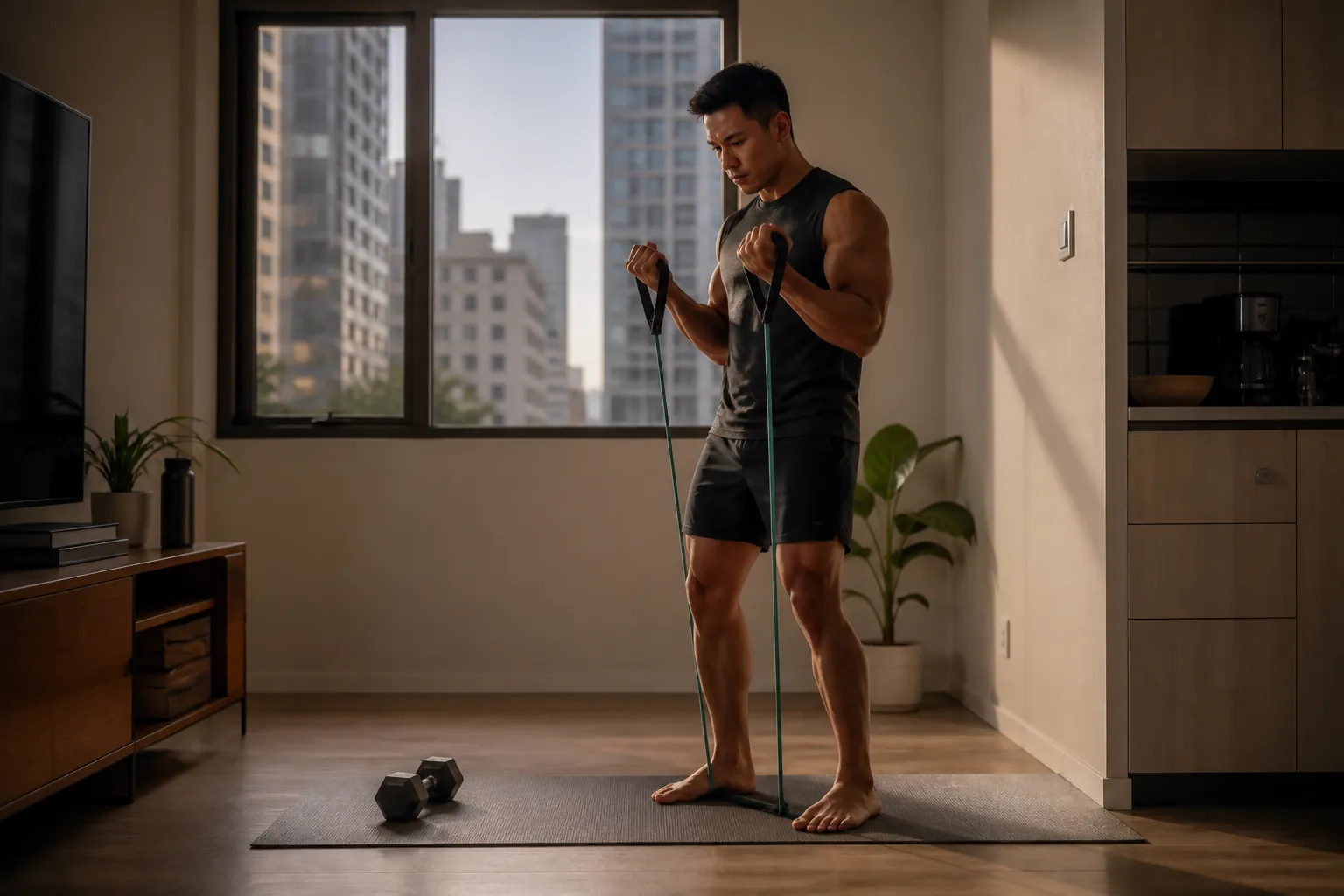
Use this as a three-day-per-week routine with at least one day between sessions when possible. You need a small open floor space, a mat or towel, a resistance band, and one or two light-to-moderate dumbbells. If you have downstairs neighbors, choose the quiet conditioning options instead of jumping or sprint-style work.
| Day | Training Bias | Main Work | Small-Space Goal |
|---|---|---|---|
| Day 1 | Conditioning and core | Low-impact intervals, plank variations, dead bugs, mountain climber options | Build the cardio and trunk-control base without needing a treadmill or field |
| Day 2 | Leg drive and rotation | Split squats, reverse lunges, glute bridges, lunge rotational twists | Train lower-body force and torso control for throwing and moving |
| Day 3 | QB-specific full body | Single-arm presses, single-arm rows, bear crawls or walkouts, conditioning finisher | Connect unilateral strength, posture, and football-style conditioning |
The weekly rhythm matters more than the exact weekday labels. Smith’s reported offseason detail that matters most for a home athlete is not the treadmill itself or the facility around him. It is that January did not become dead space. For someone training in an apartment, the equivalent is keeping the routine alive when the room is boring, the gear is basic, and there is no coach watching.
Day 1: Conditioning and Core Without a Field
Smith’s reported January work included treadmill running, sprints, gassers, and a core/cardio focus before the heavier offseason ramp-up.[1] In an apartment, the job is to preserve the intent, not the scenery. You are trying to raise breathing demand, recover under control, and keep your trunk stable while fatigue builds.
Start with six to eight minutes of warm-up: marching in place, hip circles, arm swings, bodyweight good mornings, and easy lateral steps. Keep it quiet enough that you could do it early in the morning without apologizing to the floor.
- Conditioning block: 8 to 12 rounds of 30 seconds hard, 30 seconds easy. Choose fast marching, shadow drops, step-back skaters without a hop, low-impact mountain climbers, or band-resisted marches.
- Core block: 3 rounds of dead bugs, forearm plank, side plank, and slow mountain climbers. Use 30 to 40 seconds per movement instead of chasing sloppy reps.
- Finish: 3 minutes continuous easy movement, then 2 minutes of nasal breathing or relaxed walking around the room.
The mistake is turning “conditioning” into random punishment. A quarterback does not need apartment chaos; he needs repeatable intensity. On the hard intervals, your breathing should climb. On the easy intervals, you should regain control without fully stopping. If impact is not an issue, high knees or short shuttle steps can raise the demand. If impact is an issue, band marches and fast step-backs do the job quietly.
For the core work, think less about abs and more about leakage. Can your ribs stay down during dead bugs? Can your hips stay level in a side plank? Can you move your legs without your lower back taking over? That is the home-training translation of a core that helps transfer force instead of just surviving a burn.
Day 2: Leg Drive and Rotational Strength
The lower body is where a home routine can either become useful or turn into a collection of light accessories. You probably do not have a squat rack in the living room. That is fine. Single-leg patterns make lighter loads meaningful, and they match the uneven, staggered positions that show up in quarterback movement.
- Reverse lunge: 3 sets of 8 to 10 reps per side, slow on the way down.
- Split squat: 3 sets of 8 reps per side, holding one dumbbell at the chest or two at your sides.
- Glute bridge: 3 sets of 12 to 15 reps, pausing briefly at the top.
- Lunge rotational twist: 3 sets of 6 to 8 controlled reps per side with a light dumbbell or band.
- Wall sit or squat hold: 2 rounds of 30 to 60 seconds.
USA Football includes the lunge rotational twist among exercises used to build quarterback arm strength, along with single-arm dumbbell pressing and single-arm dumbbell rowing.[2] The name can be misleading if you only think about the arm. The point is that throwing strength is not isolated to the shoulder. The legs set the base, the trunk rotates and resists rotation, and the upper body finishes the pattern.
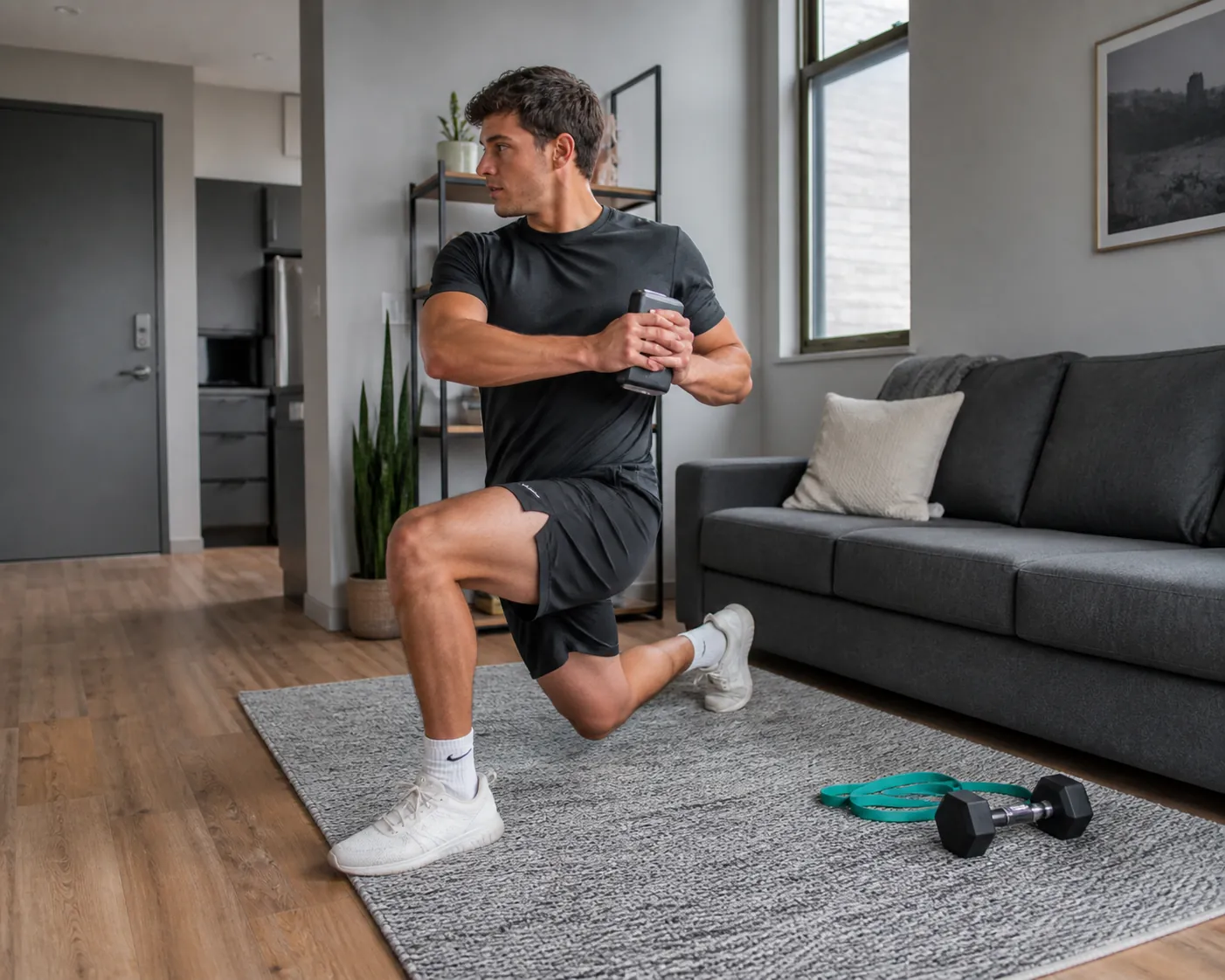
For the lunge rotational twist, keep the load modest. Step into a lunge, hold the dumbbell at chest height, rotate toward the front-leg side, return to center, and come back up. The rep should look controlled enough that you could pause at any point. If your knee caves in or your lower back does the twisting, the weight is too heavy or the range is too large.
This day should feel like strength work, not cardio wearing a leg costume. Rest between sets. Make each rep quiet, stable, and repeatable. In a small room, control is part of the load.
Day 3: Quarterback-Specific Full-Body Work
The third day connects the pieces: one side working at a time, the trunk resisting unwanted movement, the legs staying active, and conditioning layered on without turning the workout into noise. This is where the routine feels most like a quarterback adaptation instead of a general fitness circuit.
- Single-arm dumbbell press or band press: 3 sets of 8 to 10 reps per side.
- Single-arm dumbbell row or band row: 3 sets of 10 to 12 reps per side.
- Bear crawl hold, bear crawl steps, or inchworm walkout: 3 rounds of 20 to 40 seconds.
- Lateral shuffle steps in place or shadow pocket movement: 6 rounds of 20 seconds on, 40 seconds off.
- Optional finisher: 5 minutes alternating low-impact mountain climbers and fast marches.
The single-arm press and single-arm row deserve the most attention here. USA Football lists both as quarterback arm-strength exercises.[2] At home, their value is not just that one arm moves a dumbbell. It is that the rest of the body has to keep you from twisting, leaning, or dumping the work into your lower back.
For the press, stand tall or use a half-kneeling position if your ceiling or balance limits you. Press one dumbbell overhead or press a band forward from chest height. Keep your ribs from flaring. For the row, hinge with one hand supported on a chair or use a band anchored safely under your foot. Pull the elbow back without rotating the whole torso open.
NFL.com’s home football exercise guidance supports the broader idea that useful football conditioning can be built with bodyweight movements when a gym is not available.[3] Bear crawls, push-up variations, squats, lunges, and mountain climber-style work all fit the apartment version as long as they are selected for control and space, not just sweat.
How to Keep the Intensity Without Annoying the Building
Sprints and gassers are simple when you have turf. In a second-floor apartment, they become a negotiation with gravity, flooring, and whoever lives below you. The goal is not to imitate the footstrike. The goal is to imitate the energy system: short bouts of high effort, partial recovery, and enough repeatability that you can do it again next week.
| Field or Facility Version | Apartment-Friendly Substitute | What to Preserve |
|---|---|---|
| Sprints | Fast marches, band-resisted marches, low-impact high knees | Rapid turnover and breathing demand |
| Gassers | Timed intervals of step-backs, lateral steps, or shadow pocket movement | Repeat hard efforts with incomplete recovery |
| Treadmill work | Brisk indoor walk intervals, stair walking if available, low-impact circuits | Sustained cardio base |
| Weight-room lower-body work | Split squats, reverse lunges, bridges, squat holds | Leg drive and positional strength |
| Rotational medicine-ball work | Band rotations or lunge rotational twists with a light dumbbell | Hip-to-trunk force transfer |
A small-space workout also needs a ceiling on ambition. If a move makes you land hard, scrape furniture, or rush through bad positions, replace it. A quieter substitute done three times a week is more valuable than a dramatic exercise you abandon after one irritated neighbor or one tweaked knee.
The Part That Looks Like Nothing
The SI.com detail that keeps sticking is not glamorous: Smith stayed after the season and kept working with van Dijk when he could have stepped away.[1] For a professional quarterback, that still happens inside a world of staff, facilities, and career pressure. A renter with a band and a mat does not have the same support system, so the comparison has to stay honest. But the habit itself transfers cleanly.
On the Finding Mastery podcast, Smith discussed mental training ideas including visualization and habit stacking, along with the attitude that “no matter what I’ve accomplished,” there is still work ahead.[4] For this routine, that does not need to become a self-help project. Use it in the plainest way possible: attach the workout to something that already happens, and rehearse the first five minutes before you have to decide whether you feel motivated.
- After coffee: put the band and dumbbell on the mat before opening your laptop.
- After work: change clothes first, then decide how hard the session will be.
- Before training: picture the first round only, not the whole workout.
- After training: write down the day, the main exercises, and whether the intensity was low, medium, or high.
That last note matters because home workouts disappear easily. There is no check-in desk, no parking receipt, no teammate waiting. A short log gives the routine a little weight in the real world.
A Small Recovery Note, Not a Diet Plan
Bleacher Report reported in 2023 that Smith had changed his diet to become pescatarian, cutting out dairy and sweets, and that he planned to run more.[5] That is useful as a consistency clue, not as a prescription. The home version does not require copying his food rules.
What does transfer is the recovery logic: eat in a way that lets you train again, keep energy steady enough for conditioning, and avoid turning every workout into a recovery debt. If a routine depends on heroic willpower and leaves you flat for two days, it is not a routine yet.
Progression for Four Weeks
Do not make the first week a tryout. Make it a baseline. The routine should feel challenging, but you should finish knowing you could repeat it.
| Week | Conditioning Change | Strength Change | Quality Check |
|---|---|---|---|
| Week 1 | Use the lower end of the interval range | Choose loads that let every rep stay clean | No joint pain, no rushed form |
| Week 2 | Add 1 to 2 rounds to Day 1 or Day 3 | Add reps before adding weight | Breathing recovers during easy intervals |
| Week 3 | Make hard intervals slightly harder, not longer | Add a set to one main lift pattern | Trunk stays stable during single-arm work |
| Week 4 | Hold volume steady and improve control | Use slower lowering on lunges and presses | Movements look repeatable, not desperate |
If you only have twenty minutes, keep the warm-up, one conditioning block, and one strength pairing. For example: fast marches and dead bugs on Day 1, split squats and lunge rotational twists on Day 2, single-arm presses and rows on Day 3. Cutting the workout down is better than turning missed sessions into a pattern.
What “Training Like Geno Smith” Can Honestly Mean at Home
A home routine cannot recreate an NFL quarterback’s facility access, coaching, recovery support, or competitive demands. The most realistic version of a Geno Smith training camp routine for home workouts is a disciplined adaptation of the priorities that travel well: cardio base, core and leg strength, rotational control, unilateral pressing and rowing, football-style conditioning, and enough consistency to keep training through the quiet parts of the calendar.
References
- Inside Geno Smith's Intense Training Regimen For His First Offseason as Seahawks Starter, SI.com, June 5, 2023
- 4 exercises to build quarterback arm strength, USA Football
- No Gym? No Problem: 5 home exercises for football players, NFL.com
- Geno Smith, Finding Mastery, Episode 401
- Seahawks QB Geno Smith Changed Diet to Become a Pescatarian, Bleacher Report
What a small equipment investment adds
Cable Machine Alternatives That Save Space and Money
Compare the best cable machine alternatives for home gyms – from resistance bands and pulley systems to suspension trainers and compact digital units – and find the right option for your space and budget.
Small Treadmill Buying Guide: 7 Critical Specs to Check Before You Buy
A cross-category spec primer for apartment and small-space dwellers comparing walking pads, ultra-compact folding treadmills, and full-size folding treadmills. Learn the concrete thresholds for motor HP, deck length, noise, warranty, and subscription lock-in so you can compare apples to apples.
How to Practice Basketball at Home Without Noise Complaints
Learn how to run a full basketball workout in a small apartment without noise complaints. This guide covers no-dribble handling drills, wall form shooting, and silent ball options that let you train without disturbing neighbors.
How often should you repeat this?
See our recovery and rest reference for citation-anchored rest-interval guidance.
Spot something off?
Tell us if a movement, tier assumption, or duration didn't match your experience.