
Practice Golf Swing Tempo at Home Using a Free Metronome App
Improve your golf swing tempo from a small apartment using only a free smartphone metronome app. This article explains how to train the 3:1 backswing-to-downswing ratio used by tour pros, with drills that require no club, no net, and no noise complaints.
- Equipment tier required
- none
- Duration
- 10 min
- Difficulty
- beginner
- Target area
- full body
- Space footprint needed
- minimal
- Noise level
- quiet
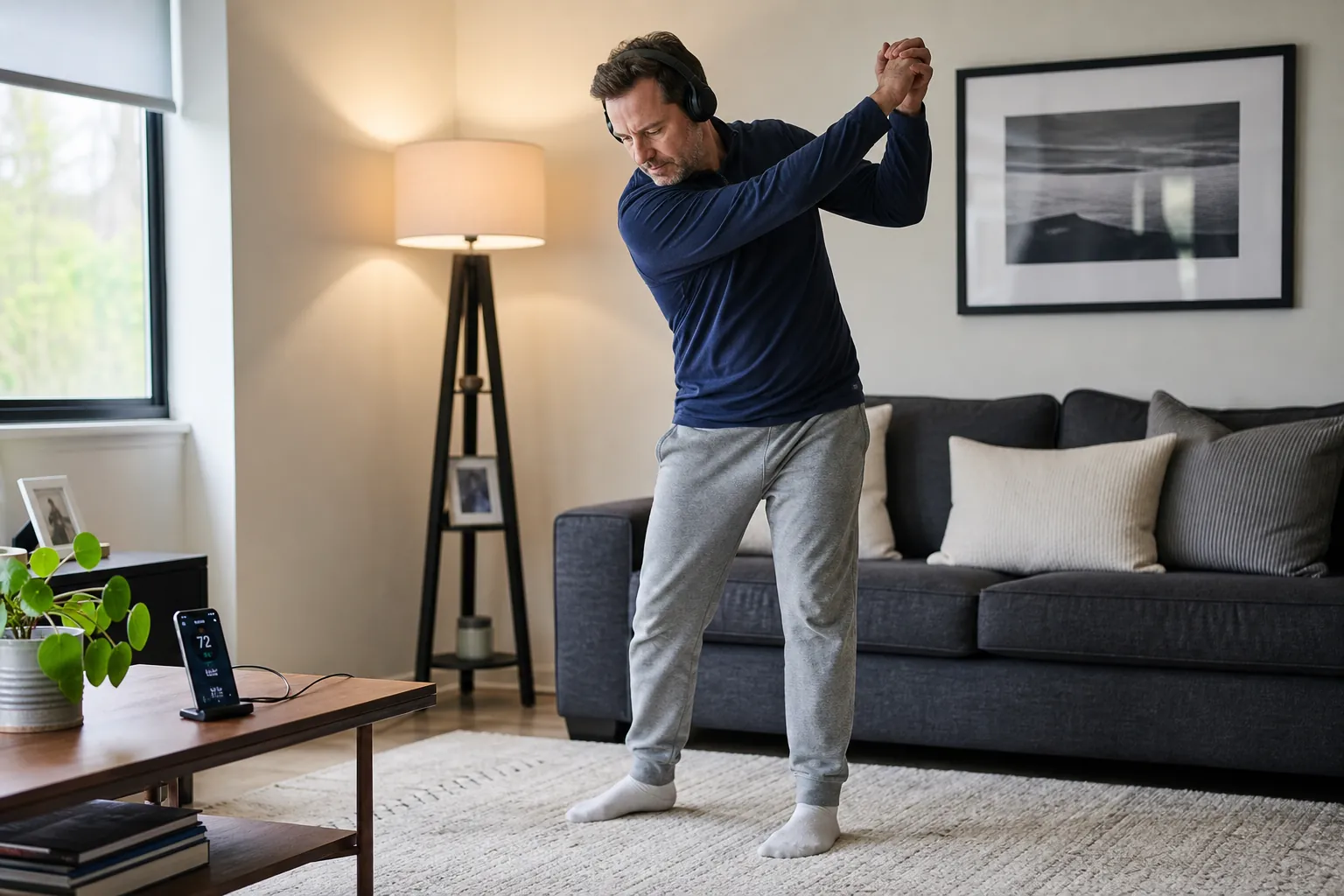
Most golf swing tempo drills for home practice fall apart before the first rep because they assume too much: a garage, a net, a mat, foam balls, ceiling clearance, or neighbors who do not mind hearing thumps through the floor. A free metronome app avoids nearly all of that. Put in earbuds, stand where you have enough room to turn your shoulders, and let the phone give you the one thing home practice usually lacks: an outside standard you cannot quietly negotiate with.
The point is not to pretend that tapping along in an apartment replaces hitting balls. It does not tell you whether the face is square, whether contact improved, or whether your driver suddenly belongs on a launch monitor. It does something narrower and useful: it trains you to start the club, complete the backswing, and arrive at impact on a repeatable rhythm. For a high-handicap golfer who tends to get slow going back and then panic on the way down, that is not a small thing.
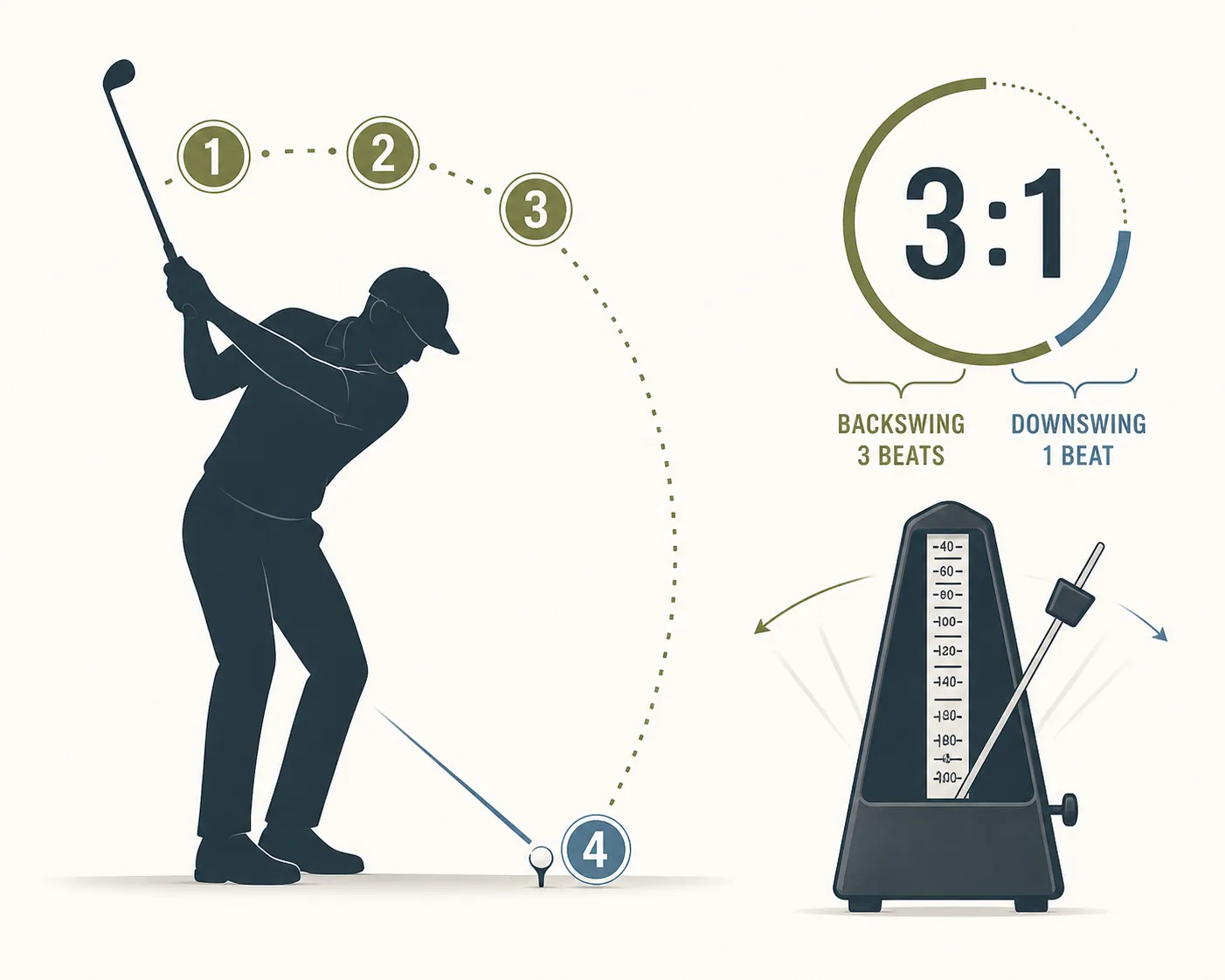
The Tempo Target: Three Beats Back, One Beat Down
Golf tempo gets muddy when it is described as “smooth” or “unhurried.” Those words may be true for a good swing, but they are not much help in a living room. The useful version is countable: the backswing takes three parts, and the downswing takes one part. Tour Tempo describes this 3:1 backswing-to-downswing relationship as common among tour professionals, with its well-known examples expressed as timing patterns such as 27/9, 24/8, and 21/7 frames — different speeds, same ratio [1].
That distinction matters. Two golfers can both have a 3:1 ratio while one swings faster overall. The ratio describes the shape of the timing: three units to the top, one unit to impact. The overall tempo describes how quickly the whole start-to-impact motion happens. Apartment practice works best when you keep both ideas separate instead of mashing them into one vague command to “swing smoother.”
| Timing idea | What it measures | How it sounds in practice |
|---|---|---|
| 3:1 ratio | Backswing time compared with downswing time | One-two-three back, four down |
| BPM or total tempo | How fast the full start-to-impact motion happens | The beats are closer together or farther apart |
| Home practice goal | Repeat the same rhythm without needing a ball | Turn, turn, turn, return |
Adam Young has written from coaching observation that many professionals fall in roughly a 60–75 BPM tempo range from the start of takeaway to impact, while many amateurs he sees are below 40 BPM [2]. That is not a peer-reviewed population study, so it should not be treated like a law of physics. It is still a useful warning sign. A lot of struggling golfers do not merely swing “too fast.” They often move slowly, stall, then throw speed in late because the downswing feels urgent.
Set Up the Free Metronome Drill
You do not need a golf-specific app to start. Any free metronome app that lets you set beats per minute will work. Stonekick’s golf metronome guidance specifically notes the practical value of using a metronome app with headphones, which is exactly the apartment-friendly version of this drill: the sound goes to you, not through the building [3].
- Open a free metronome app on your phone.
- Use earbuds or headphones so the beat is audible to you and invisible to everyone else.
- Start around 65–70 BPM if you want a simple entry point from the instruction sources, then adjust slower if you cannot stay balanced.
- Count three beats for the backswing motion and one beat for the downswing motion.
- Stop the set when the count starts chasing your body instead of guiding it.
The most basic pattern is simple enough to feel almost too plain: beat one starts the takeaway, beat two keeps the turn moving, beat three reaches the top or end of your rehearsal, and beat four is impact or the return point. If you are not holding a club, beat four is where your hands, chest, or imagined clubhead returns to the ball position.
Do not make the first session a test of athletic pride. The room is already giving you constraints. The job is to match the sound cleanly, not to prove you can make a full-speed driver motion between a couch and a lamp.
Use the Version Your Room Actually Allows
The fastest way to ruin home golf practice is to use a drill that belongs in a hitting bay. Tempo work does not require that. The same beat can govern a tiny body-turn rehearsal, a half motion with a short club, or a full swing if the space is genuinely safe. The drill changes size; the timing target does not.
No Club: Body-Turn Rehearsal
This is the best apartment version and the one most golfers should start with. Stand in golf posture with your arms crossed over your chest or your hands lightly together in front of you. On beats one, two, and three, turn your chest as if you are making a backswing. On beat four, unwind to the impact position. No ball. No club. No floor strike. No reason for anyone downstairs to know you play golf.
The value here is not that your torso alone recreates a golf swing. It clearly does not. The value is that you remove the risky parts — the clubhead, ceiling, ball, and furniture — while keeping the timing problem alive. You are teaching your body that the backswing has enough time to complete, and the downswing does not need a last-second grab.
Limited Space: Hands-Only or Short-Club Motion
If you have a little more room, rehearse with your hands together as though you are holding a grip. Keep the motion waist-high to shoulder-high rather than forcing a full arc. The count stays the same: one-two-three to the end of the backswing rehearsal, four back to the ball position.
A short training club can work if you already own one, but it is not required. A regular wedge might be safe for some people and a terrible idea for others. Before you swing anything indoors, check the ceiling, light fixtures, TV, walls, pets, and the space behind you. Also check your own honesty. If you are shortening the swing because the room demands it, good. If you are making a full swing because you are bored, put the club down.
Full Clearance: Slow Full-Swing Rehearsal
Only use a full club swing indoors when you have safe clearance in every direction. Even then, this remains a tempo drill, not a speed session. Start without a ball. Let the beat decide when the club starts, when it reaches the top, and when it returns to the impact zone. MyGolfSpy’s tempo drill coverage also centers the idea of integrating rhythm into actual swing movement rather than treating tempo as a separate thought pasted on at the end [4].
There is no bonus point for brushing the carpet, clipping a towel, or making the motion louder. Quiet is part of the drill. A tempo pattern you can repeat for ten calm reps is more useful at home than three heroic swipes that make you glance at the ceiling and hope nothing moved.
A Practical 10-Minute Home Session
A good home session should finish before your attention turns into tinkering. Ten minutes is enough to create pressure without turning the living room into a fake driving range.
| Time | Drill | What to watch |
|---|---|---|
| 2 minutes | No-club body turns at an easy BPM | Can you arrive at beat four without lunging? |
| 3 minutes | Hands-together rehearsal using the same count | Do your hands and chest stay in the same rhythm? |
| 3 minutes | Partial-motion swing rehearsal if space allows | Does the backswing finish on beat three? |
| 2 minutes | Record five reps on phone video | Does the motion match the beat or drift? |
The video check is worth doing because tempo can lie to you. A swing can feel patient while the hands snatch the start, or feel quick while the ratio is actually cleaner than usual. Put the phone somewhere safe, keep the metronome audible enough for the recording to catch, and film a few reps from face-on or down-the-line. You are not looking for perfect mechanics. You are checking whether the movement respects the count.
If you miss the beat, do not add more instructions. First make the motion smaller. Then slow the metronome. Then remove the club. Most bad apartment practice goes the other direction: the golfer keeps the full motion, adds swing thoughts, and rehearses the same timing mess with more concentration.
How to Progress Without Guessing
Improvement at home should mean something you can observe. At first, that may be as basic as matching four clean beats for five reps in a row. Later, it may mean holding the same 3:1 rhythm while making the rehearsal larger, changing clubs, or moving from no-club turns to a safe partial swing.
- Begin with the smallest motion that lets you match the beat without rushing.
- Add size before adding speed.
- Add a club only after the no-club pattern is boringly repeatable.
- Change BPM in small steps instead of jumping from slow rehearsal to full playing speed.
- Use short phone videos to compare whether beat three and beat four happen where you think they happen.
The 60–75 BPM professional range and the below-40 BPM amateur pattern from Adam Young are best used as a coaching reference, not as a diagnostic label [2]. If your current rhythm sits well below that range, the takeaway is not “copy a tour player tomorrow.” The takeaway is that there may be a measurable gap between your perceived rhythm and a more efficient start-to-impact pace.
Tour Tempo makes a stronger commercial claim: golfers with a total swing time longer than 1.5 seconds from takeaway to impact can gain 5–10 mph of clubhead speed and more than 20 yards of carry by tightening toward a 3:1 ratio at 1.2 seconds or less [1]. That is Tour Tempo’s stated product-page claim, not independent proof that an apartment drill will give every golfer twenty yards. Treat it as a reason to take timing seriously, not as a promise you can cash without ball-flight feedback.
Keep the Same Rhythm as the Motion Changes
One useful refinement is to keep the overall tempo relationship stable while the backswing length changes. Adam Young and Tour Tempo both discuss the idea that tempo can remain consistent across clubs even though the length of motion changes [1][2]. In practical home terms, that means your wedge rehearsal should not become a totally different personality from your driver rehearsal. The motion gets bigger or smaller; the count still gives it shape.
This is also where a feet-together drill can help if you have enough floor space. HackMotion includes feet-together work among its tempo drill references, and the reason is easy to understand: narrowing the stance punishes violent transitions [5]. In an apartment, keep it modest. Feet together, no ball, no full-speed lunge. If balance breaks, the tempo is not ready.
Short-game and putting tempo can use different feels. The research materials note variations such as a 2:1 ratio around 45 BPM for full-swing feel work and 65–75 BPM for putting tempo references [1][3]. That is worth experimenting with later, especially if your putting stroke gets jabby. It should not distract from the main apartment win: learning to hear and repeat the full-swing rhythm before you ever hit a ball.
What This Drill Can and Cannot Fix
A metronome can expose drifting rhythm, rushed transitions, and the habit of starting down before the backswing has actually finished. It can give a high-handicap golfer a clean assignment for days when the range is unavailable. It can make five minutes of home practice less vague.
It cannot confirm center contact. It cannot measure launch, spin, path, face angle, or carry distance. It cannot tell you whether your “impact” position in the living room matches what happens with a ball in front of you. Those checks still belong at the range, on the course, or with a coach.
That limitation is exactly why the drill is useful when kept in its lane. The free metronome app is not magic and not a substitute for hitting balls. For quiet home tempo practice, though, it is unusually strong: measurable, repeatable, safe in tiny spaces, and cheap enough that the usual equipment excuses do not apply.
References
- What The Numbers Mean, Tour Tempo, https://www.tourtempo.com/blogs/tips/what-the-numbers-mean
- Find Your Golf Swing Tempo, Adam Young Golf, 2015, https://www.adamyounggolf.com/find-your-golf-swing-tempo/
- Using a Metronome to Improve Your Golf, Stonekick, https://www.stonekick.com/blog/using-a-metronome-to-improve-your-golf
- Golf Tempo Drills, MyGolfSpy, https://mygolfspy.com/news-opinion/golf-tempo-drills/
- Best Golf Swing Tempo Drills, HackMotion, https://hackmotion.com/best-golf-swing-tempo-drills/
What a small equipment investment adds
We don't have a build tagged to this exact tier yet. Browse all builds.
How often should you repeat this?
See our recovery and rest reference for citation-anchored rest-interval guidance.
Spot something off?
Tell us if a movement, tier assumption, or duration didn't match your experience.