
An 8-Week Home Treadmill Plan for Grete's Great Gallop 10K
An 8-week home treadmill training plan for NYRR's Grete's Great Gallop 10K that maps the Ted Corbitt Loop's hills — Harlem Hill, Cat Hill, the Three Sisters — into incline work, so members can build 10K race fitness indoors. It also covers the members-only entry, the 9+1 credit, and race-day logistics.
- Equipment tier required
- $300-800
- Duration
- 30-60 min
- Difficulty
- beginner
- Target area
- legs
- Space footprint needed
- small
- Noise level
- moderate
Yes, you can use a home treadmill for a Grete's Great Gallop 10K home training plan without getting exposed by Central Park on race day. The condition is that the plan has to respect the race: this is not a flat 10K with a logo on it. NYRR describes the event as a members-only 10K on the full counter-clockwise Ted Corbitt Loop, including Harlem Hill, Cat Hill, and the Three Sisters, with the finish via the 72nd Street Transverse; the 2026 edition had 8,517 finishers and counted toward the 9+1 program for guaranteed entry to the TCS New York City Marathon [1].
That first fact matters as much as the workouts. Training can be handled before work in a small apartment. NYRR membership, registration timing, 9+1 credit, race-day pickup details, and sellout risk cannot. Keep those in a separate lane from fitness, because no incline ladder fixes a missed entry window.

The NYRR facts to solve before the workouts
Grete's Great Gallop is not a race to treat casually at the administrative level. For the 2026 event, NYRR listed it as members-only, 9+1 eligible, and held on August 22 with a 7:30 a.m. start; the official page also showed the race as completed, and the next edition's date was not announced there as of Aug. 26, 2026 [1].
| Item | What it means for a home-trained runner |
|---|---|
| NYRR members-only entry | Fitness does not get you into the race. Confirm membership and registration separately from training. |
| 9+1 credit | If you are using the race toward marathon-entry eligibility, verify that your registration and finish will count under NYRR's current rules. |
| Full counter-clockwise Ted Corbitt Loop | The course demands hill-specific preparation, not only enough total weekly mileage. |
| Harlem Hill, Cat Hill, Three Sisters | These are pacing problems as much as strength problems. The treadmill plan should teach restraint on climbs. |
| Finish via 72nd Street Transverse | You need enough late-race control to run hard after the park has already taken something out of your legs. |
| Sellout risk | Do not wait until Week 6 to decide whether you are racing. Monitor NYRR early. |
If you already have entry, the rest of this plan is about getting fit for the actual loop. If you do not, treat this as a target-race build while you watch NYRR's next listing. The workouts still make sense for a hilly Central Park 10K, but the race-credit piece lives outside the treadmill.
Why the treadmill is a good tool for this course
A treadmill is not a perfect Central Park simulator. It will not teach you how the road camber feels, how crowded the first mile is, or how a humid August morning sits on your shoulders. But for this race, the machine has one useful advantage: you can make the hills unavoidable. You can set the incline, keep it there, and learn to run by effort instead of bargaining with the terrain.
MOTTIV's treadmill guidance frames indoor training as legitimate rather than a last resort, noting that high-level athletes have used substantial treadmill work in serious training blocks [2]. That is enough to dismiss the lazy snobbery. It is not enough to say any treadmill 10K plan will do.
The common 1% incline convention has a place because it can make treadmill running behave a little more like outdoor running, but Grete's Great Gallop needs more than a token 1% setting. Runner's World also advises effort-based pacing for treadmill work because displayed treadmill pace can be unreliable, and it cites a 2022 Sports Medicine Open study when reporting that ground-force absorption was roughly 53% lower at a 5% incline than on level running [3]. Treat that last figure as a useful secondhand note about load, not as a promise that hill running is automatically safer or easier.
The practical takeaway is simple: use 1% as a default for flat portions, then deliberately build 3% to 8% work into the week. When the belt speed feels suspiciously flattering or punishing, trust breathing, posture, and repeatability over the number on the screen.
If your home setup is the limiting factor, solve that honestly. A compact running treadmill and a walking pad are not interchangeable for this plan; the incline, belt length, stability, and sustained running speed matter. The site's home treadmill buyer's guide and foldable treadmill versus walking pad comparison are the better place to sort out equipment trade-offs before you ask a small machine to handle repeated 6% climbs.
Turn the Ted Corbitt Loop into treadmill demands
The official course description gives the big pieces: one full counter-clockwise Ted Corbitt Loop with Harlem Hill, Cat Hill, the Three Sisters, and a finish via the 72nd Street Transverse [1]. A race recap from My First 5K and More gives useful runner-level texture on where the loop starts to bite mile by mile, which is what makes the treadmill translation more than a hill workout pasted into a 10K plan [4].
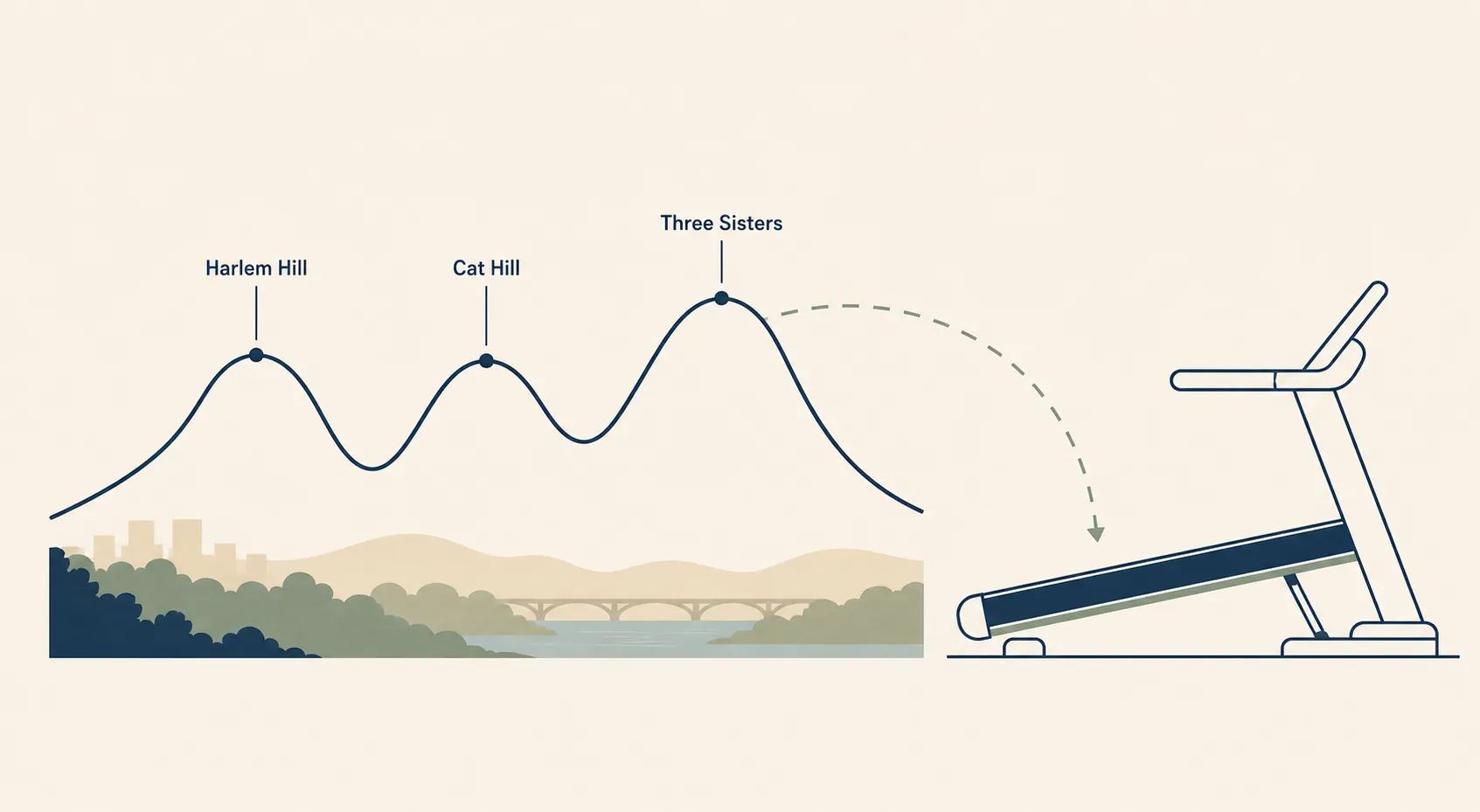
| Course demand | How to train it on the treadmill | Race-day lesson |
|---|---|---|
| Early settling miles | Run easy to steady at 1% with short 2% to 3% rollers. | Do not spend your best legs before the loop starts asking questions. |
| Harlem Hill | Use longer controlled climbs: 3 to 5 minutes at 4% to 6%, or shorter repeats at 6% to 8% when the plan calls for hill strength. | Keep cadence quick and effort contained. This is not where you prove fitness by chasing flat pace. |
| Downhill and recovery after a climb | Return to 0% to 1% and keep running smoothly instead of turning the recovery into a full stop. | The race rewards runners who recover while moving. |
| Cat Hill | Practice mid-run climbing after you are already warm: 2 to 4 minutes at 4% to 5% inside an otherwise steady run. | Expect the hill to interrupt rhythm. Shorten the stride before breathing gets ragged. |
| The Three Sisters | Use rolling incline ladders: 2%, 3%, 4%, 5%, back down, then repeat while holding effort steady. | The repeated bumps matter because they arrive when your patience is thinner. |
| 72nd Street Transverse finish | Finish some long runs with 5 to 10 minutes at steady 10K effort on 1% after hill work. | Arrive with enough control to change gears late. |
Harlem Hill is the one to respect most in training because it can tempt a runner into emotional pacing. On a treadmill, the right simulation is not a dramatic sprint at maximum incline. It is a climb you can hold without grabbing the rails, without folding at the waist, and without needing three minutes of walking afterward. If the effort spikes, reduce belt speed before reducing incline; the course will not flatten just because your watch wants a prettier split.
Cat Hill asks for a different skill. It is not only steepness; it is placement. You meet it after the race has already begun to sort people by patience. The treadmill version belongs inside the run, not as the first fresh interval of the day.
The Three Sisters are a rhythm problem. If you train only one clean climb, you may feel fine on the first bump and annoyed by the next two. Rolling incline ladders teach the legs to reset quickly instead of treating every crest as permission to quit working.
The 8-week Grete's Great Gallop 10K home treadmill plan
This plan uses Hal Higdon's novice 10K structure as the conservative frame: 8 weeks, 3 running days, 2 cross-training days, 2 rest days, mostly conversational running, and a longest run of about 5.5 miles [5]. The harder treadmill sessions borrow cautiously from Runner's World's effort-based treadmill work, including short 5K-effort repeats, 10K-effort intervals, incline ladders from 0% to 8%, and 6% to 8% hill repeats [3].
Use the days as written if your race is on a Saturday. If your schedule is different, preserve the order: quality run, easy run, long or hilly run, with rest or cross-training between them. Do not stack the hill workout and long run on back-to-back days just because the treadmill is available.
| Effort label | How it should feel | Treadmill adjustment |
|---|---|---|
| Easy | Conversational. You could speak in full sentences. | Usually 1%; use 0% briefly if fatigue or heat in the room pushes effort too high. |
| Steady | Controlled but purposeful. You are working, not racing. | 1% to 3%, depending on the workout. |
| 10K effort | The effort you could imagine holding for the race with focus. | Ignore exact displayed pace if breathing and form say the belt is lying. |
| 5K effort | Hard, short, repeatable. You should not be sprinting. | Keep recoveries honest so the final rep looks like the first. |
| Hill strength | Strong legs, controlled breathing, no rail-grabbing. | Raise incline before chasing speed. Lower speed first if form breaks. |
Week-by-week schedule
| Week | Tuesday: quality treadmill run | Thursday: easy treadmill run | Saturday: long or course-specific run | Other days |
|---|---|---|---|---|
| 1 | 30 min total: 10 min easy, then 6 x 1 min at 5K effort with 2 min easy, cool down. Keep incline at 1%. | 2 miles easy at 1%, then 4 x 20 sec relaxed strides at 0% to 1%. | 3 miles easy with 4 short rollers: 90 sec each at 3%, returning to 1%. | Mon/Fri rest. Wed/Sun 25 to 35 min cross-training, brisk walking, cycling, elliptical, or mobility. |
| 2 | Incline ladder: 10 min easy, then 1 min each at 2%, 3%, 4%, 5%, 4%, 3%, 2%, with easy running between if needed; cool down. | 2.5 miles easy, last 5 min steady at 1%. | 3.5 miles easy with 2 x 3 min at 4% to simulate controlled climbing. | Mon/Fri rest. Wed/Sun 30 to 40 min cross-training. |
| 3 | 10K-effort intervals: 10 min easy, 5 x 2 min at 10K effort with 2 min easy, cool down. Use 1% to 2%. | 2.5 to 3 miles easy at 1%. | 4 miles rolling: alternate 5 min at 1% with 2 min at 3% to 4%. | Mon/Fri rest. Wed/Sun cross-train or walk 30 to 40 min. |
| 4 | Harlem Hill intro: 10 min easy, then 5 x 90 sec at 6% with 2 to 3 min easy at 1%, cool down. | 3 miles easy. Keep it genuinely relaxed. | 4 miles with the final 8 min steady at 1% after several 2% to 3% rollers. | Mon/Fri rest. Wed/Sun 30 to 45 min cross-training. |
| 5 | Cat Hill placement workout: 12 min easy, 2 x 4 min at 4% to 5% with 4 min easy between, then 4 x 1 min at 10K effort on 1%, cool down. | 3 miles easy with 5 x 20 sec strides if legs feel good. | 4.5 miles rolling, including 3 x 3 min at 4% spread through the middle of the run. | Mon/Fri rest. Wed/Sun cross-train 35 to 45 min. |
| 6 | Three Sisters ladder: 10 min easy, then 2 rounds of 2 min at 2%, 2 min at 3%, 2 min at 4%, 2 min at 5%, with 3 min easy between rounds; cool down. | 3 miles easy at 1%, no heroics. | 5 miles easy-to-steady. Include 10 min steady near the end at 1% after rolling inclines. | Mon/Fri rest. Wed/Sun 35 to 45 min cross-training or easy walking. |
| 7 | Peak hill session: 12 min easy, then 6 x 2 min at 6% to 8% with 3 min easy at 1%, cool down. Reduce speed before form breaks. | 3 miles easy, flat-to-gentle incline only. | 5.5 miles course simulation: first half controlled at 1% to 3%, middle includes 3 x 3 min at 4% to 5%, final 10 min steady at 1%. | Mon/Fri rest. Wed light cross-training only. Sun easy walk or mobility. |
| 8 | Tune-up: 25 to 30 min total with 4 x 1 min at 10K effort, full easy recoveries, all at 1%. | 20 to 25 min easy. Add 3 short strides only if you feel fresh. | Race day or 10K time trial. Warm up easily, respect the early hills, and run the second half by effort. | Mon rest. Wed light cross-training or mobility. Fri rest. If not racing Saturday, shift the final run to your target day. |
How to run the key sessions without fooling yourself
For the 5K-effort repeats, keep the first rep almost too controlled. These are leg-turnover reminders, not apartment sprints. If the treadmill takes time to reach speed, start the interval when the belt settles rather than counting the acceleration as part of the work.
For 10K-effort intervals, use effort first and pace second. A treadmill in a warm room can make a reasonable pace feel harder than it does outdoors. Another treadmill can display a pace that flatters you. The test is whether you can finish the final repetition with the same posture, breathing control, and cadence as the first.
For hill repeats, do not hold the front rail. If you need the rail to survive 8%, the workout has become a hiking impersonation rather than run training. Lower the speed, keep the incline, and run tall. Harlem Hill does not care what your flat 10K pace is; it cares whether you can climb without spiking effort.
For the long runs, the goal is durability. The Saturday run is where the Ted Corbitt Loop starts to appear in the body: a few rollers early, a more serious climb in the middle, and a controlled finish when you would rather step off the belt. That last part is the point.
If you have followed the site's race-specific treadmill plans before, this should feel like a sibling to the Falmouth treadmill home-training guide and the 8-week Falmouth Road Race home plan, but it is not the same job. Falmouth has its own shape. Grete's Great Gallop has Central Park's counter-clockwise loop, NYRR membership, 9+1 credit, and those named hills waiting in order.
Cross-training, rest, and small-apartment reality
The two cross-training days are not filler. Use them to add aerobic time without turning every day into belt noise. Brisk walking, cycling, elliptical work, low-impact cardio, mobility, or light strength all fit. Keep the effort easy enough that Tuesday and Saturday still have quality.
Rest days are also part of the plan. In an apartment, it is tempting to compress training into whatever hour the neighbors are out or the room is cool. Do that occasionally if life requires it, but do not turn the plan into four hard days because you missed Wednesday. Skip or shorten the cross-training first; protect the three runs and the two rest days.
For runners still building the home setup, the equipment does not need to be luxurious. It does need to be stable enough for running, able to handle repeated incline changes, and tolerable in your actual space. If budget and footprint are the blockers, start with the small-space home gym under $500 guide or the broader home cardio machine guide. A beautiful plan is not useful if your machine shakes at 5% or cannot support the running you are asking from it.
Race-week execution
Race week is not the time to discover whether you can beat Harlem Hill. The hard proof should already be in Week 7. Week 8 is for keeping rhythm, checking logistics, and arriving with legs that want to run.
- Confirm your NYRR account, membership status, registration, bib pickup or race-morning instructions, and 9+1 expectations on the official race page or your NYRR dashboard.
- Keep the Tuesday tune-up short. The goal is to remind the legs of 10K effort, not to test fitness.
- Use Thursday as a calming run. If you are tired, cut it down instead of forcing the full time.
- On race morning, start the loop by effort. Let other runners win the first downhill surge if they need to.
- On Harlem Hill, shorten stride and keep breathing under control. If you trained the hill repeats correctly, this should feel familiar rather than shocking.
- Through Cat Hill and the Three Sisters, avoid treating each crest as the end of the race. Reset quickly and keep moving.
- Save the real push for the final stretch toward and through the 72nd Street Transverse, when patience finally becomes speed.
The readiness test is practical: you have secured or are actively monitoring NYRR entry separately, you completed the hill-specific treadmill progression, you practiced effort-based pacing instead of worshiping treadmill pace, and you know where the course asks for restraint. If those boxes are covered, home treadmill training is a legitimate preparation path for Grete's Great Gallop 10K.
References
- NYRR Grete's Great Gallop 10K, NYRR
- Can You Train for a 10K on a Treadmill, MOTTIV
- 10K Treadmill Training Plan, Runner's World
- Grete's Great Gallop 10K Race Recap, My First 5K and More, October 8, 2019
- Novice 10K Training Program, Hal Higdon
What a small equipment investment adds
We don't have a build tagged to this exact tier yet. Browse all builds.
How often should you repeat this?
See our recovery and rest reference for citation-anchored rest-interval guidance.
Spot something off?
Tell us if a movement, tier assumption, or duration didn't match your experience.