
Can You Work Out at Home Without AC in a Heat Advisory?
Training in a no-AC apartment during a heat advisory is a daily call between a full workout, an easy tier, and a rest day. Use measurable indoor-temperature thresholds to make that call, with the hydration, fan, and stop-symptom rules that keep it safe.
- Equipment tier required
- none
- Duration
- 25 min
- Difficulty
- beginner
- Target area
- full body
- Noise level
- low
A heat advisory does not automatically cancel a home workout without AC. It does cancel the idea that today’s workout can be chosen by habit alone. Before you start, check the room temperature where you will actually train, then choose one of three calls: train with heat rules, train easy, or make the session deliberate recovery.
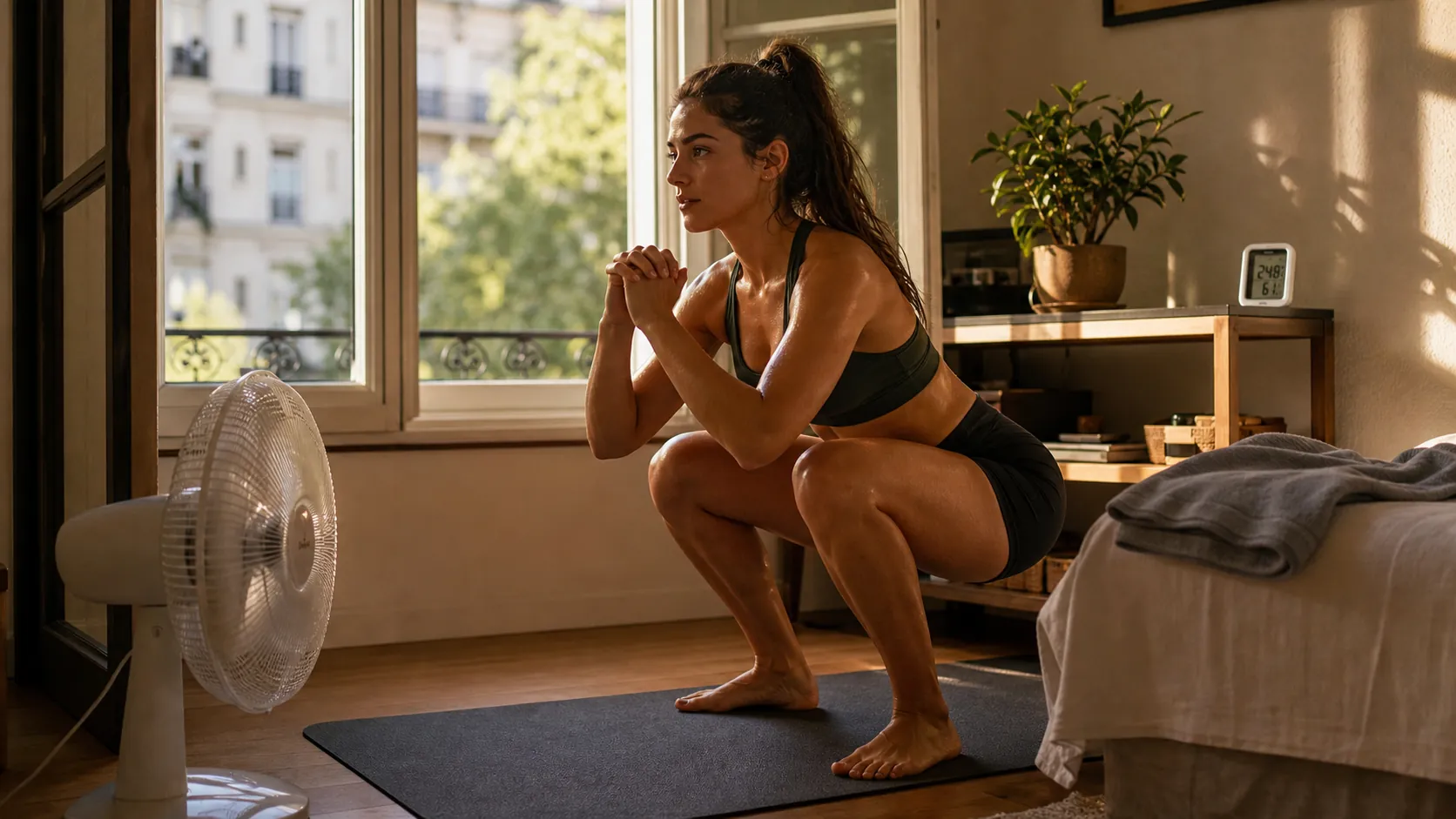
The daily decision: measure the room, then choose the tier
The National Weather Service describes a Heat Advisory as dangerous heat below warning criteria, with advice to reschedule outdoor activity and stay in a cool place when possible.[1] That matters even if your workout is indoors. A no-AC apartment can stay hot long after the outdoor temperature starts to fall, and the number that matters at 6:30 p.m. is the number on the indoor thermometer near your mat, bike, weights, or doorway pull-up bar.
Use this order before every heat-advisory workout: check your local HeatRisk or heat index, measure the indoor temperature in the training spot, then choose the tier. The outdoor alert tells you the day deserves caution; the indoor number decides what kind of session is allowed.
| Indoor temperature where you train | Today’s call | What changes |
|---|---|---|
| Below 90°F | Train, but with heat rules active | Shorter session, fan only if it is helping, planned water, lower heat-load moves, stop at symptoms. |
| About 90–95°F | Train easy only | Low intensity, short duration, more cooling breaks, no intervals, no max sets, no ego workout. |
| Hotter than about 95°F | Don’t train; do recovery | Mobility, gentle range of motion, cooling, hydration, and waiting for a safer window. |
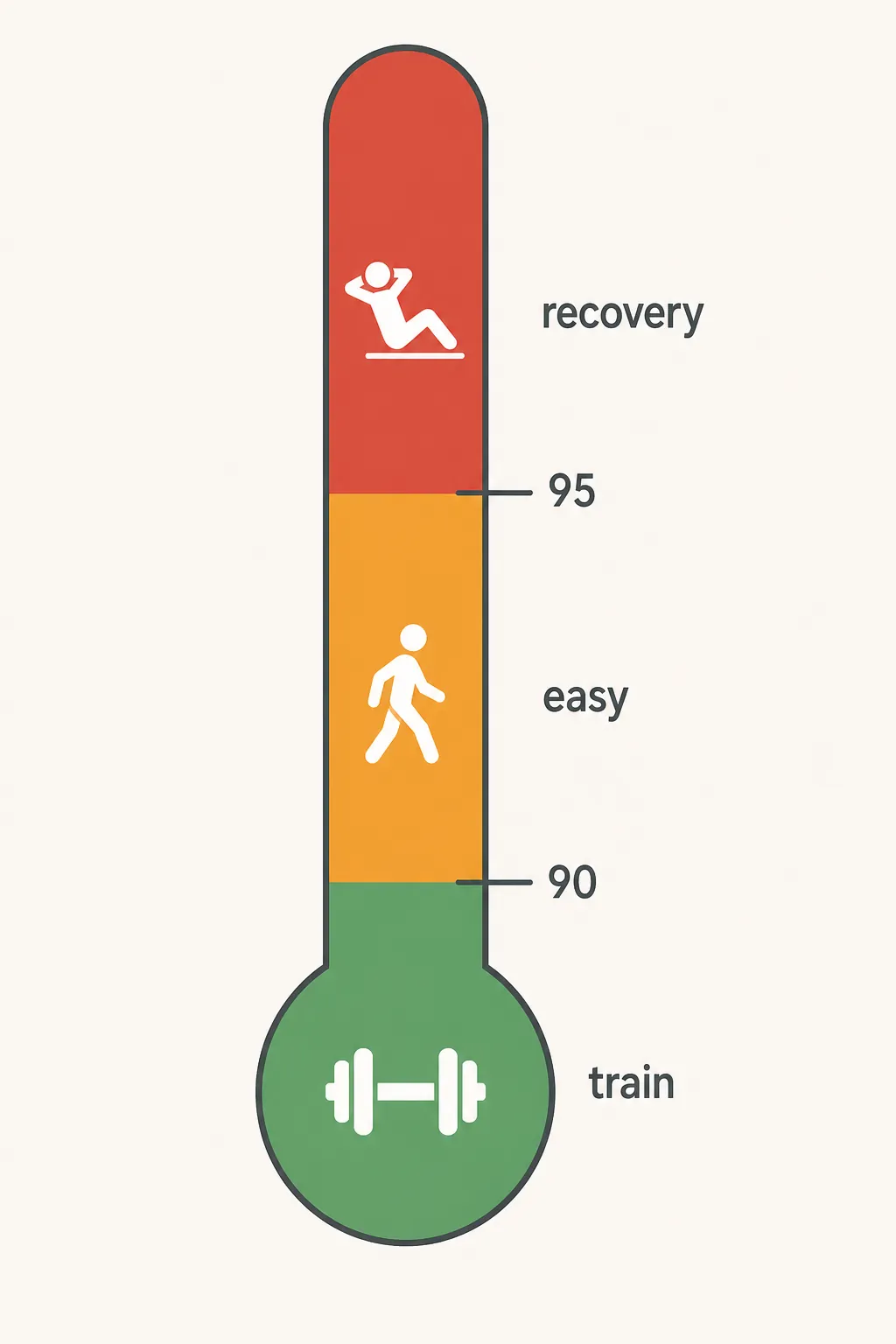
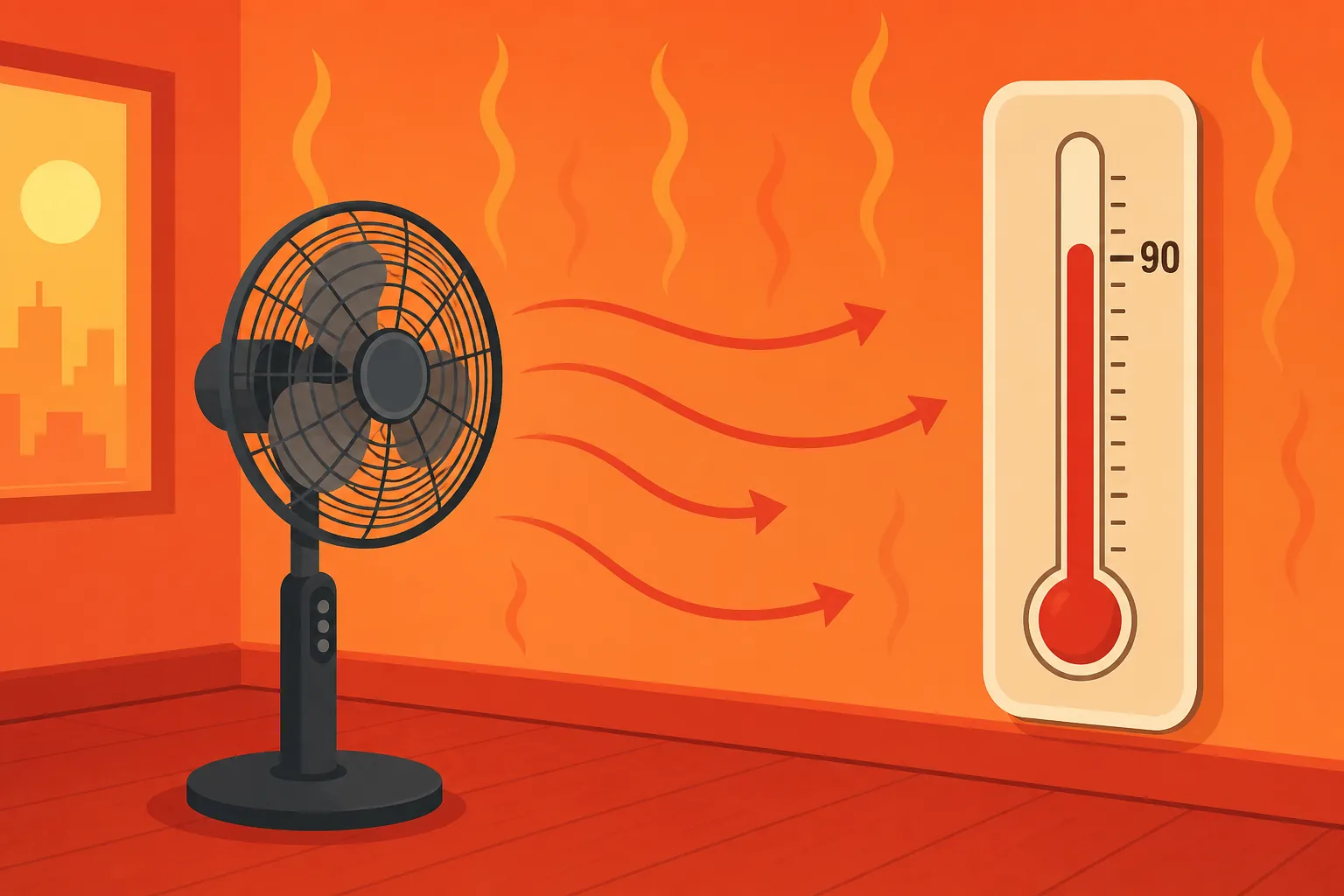
The 90°F line is not there for drama. The CDC says electric fans should be used indoors only when the indoor temperature is below 90°F; above that, a fan can increase body temperature.[2] That is a useful operating rule because “turn on the fan” is the instinct many of us reach for first in a hot apartment.
The upper edge of the easy-only band is intentionally conservative. Public-facing guidance does not agree perfectly on fan cutoffs: one Los Angeles Times article, citing WHO guidance through UCLA’s David Eisenman, discusses a cutoff around 95°F, while TODAY.com reports WHO guidance around 104°F.[3][4] For a home workout, using the CDC’s 90°F line as the point where the fan stops being assumed helpful is the cleaner rule. It gives you a number you can act on before you are already overheated.
Why indoor heat needs its own rule
Outdoor exercise advice is often built around sun, shade, wind, pavement, and the heat index. BBC Future notes that heat-index readings assume shade and no breeze, and that exercise in heat creates a competition inside the body: blood is needed both at the skin for cooling and at working muscles for movement.[5] In a small apartment, the problem is different. There may be no sun on your face, but there may also be no meaningful airflow, no cool room to retreat to, and no quick way to dump heat once the room has stored it all afternoon.
That is why the decision should be made indoors, not from the weather app alone. A heat advisory tells you the day is risky. Your thermometer tells you whether your planned workout still fits the room.
If the room is below 90°F: train, but make it a heat-managed workout
Below 90°F does not mean “normal.” It means the room has not crossed the fan cutoff used in the CDC rule, so a modified workout can stay on the table. The main changes are boring on purpose: start hydrated, reduce total heat load, use the fan intelligently, and stop earlier than you would on a mild day.
For hydration, Mass General Brigham gives a concrete pre-workout schedule: 17–20 ounces of water several hours before exercise, 8 ounces about 20–30 minutes before, and 4–8 ounces every 15–20 minutes during exercise.[6] If the session goes over an hour, CNN’s heat-exercise guidance notes that electrolytes matter, not just plain water.[7]
In practice, that usually means setting the bottle out before you start, not remembering it after the first sweaty set. If you are training after work, also account for the water you did not drink all afternoon. The best time to fix that was earlier; the second-best time is before the warmup, not halfway through burpees.
Shorten the session before you shorten the warmup. A 25-minute controlled workout is safer than a 40-minute workout that starts too hard because you were trying to “get it over with.” Keep the warmup easy, then choose movements that do not trap you in continuous high-output work: strength circuits with longer rests, low-impact intervals, controlled tempo work, mobility-strength combinations, or technique practice. If you keep a separate menu of low-heat-load routines, this is when it earns its place.
The fan belongs in this tier, but it is not magic. Aim it so it moves air across your skin, keep the room as shaded as you can, and avoid placing the fan where it only pushes warm air from a hot window or kitchen corner onto you. If your setup depends on a floor fan, resistance bands, a doorway bar, or compact equipment, a small-space testing setup is worth treating as part of safety, not apartment aesthetics.
If the room is around 90–95°F: easy means easy
This is the tier where people get into trouble by negotiating with themselves. Around 90–95°F indoors, the workout should not be a normal workout with extra water nearby. It should be deliberately easier from the first minute.
- Cut the planned duration before you start.
- Drop intensity enough that you can breathe comfortably and stop without feeling like you “failed” the session.
- Avoid max-effort intervals, AMRAP sets, heavy grinders, long jump-rope blocks, hot yoga-style flows, or anything that keeps you working continuously with little cooling time.
- Build in cooling breaks as part of the workout, not as a sign that the workout is going badly.
- Keep the stop-symptom list visible or already decided before you begin.
Good easy-tier choices are the ones that keep the habit alive without demanding much heat production: gentle mobility, easy band work, light technique practice, slow core work, balance work, or a walk inside a cooler building if that option exists. If you are already annoyed that the room is still hot, that is not a reason to “make the short one count.” It is a reason to keep the short one short.
This is also the tier where early-season heat deserves extra respect. BBC Future cites Rebecca Stearns of the Korey Stringer Institute saying acclimatization takes roughly 7–14 days; the American Heart Association describes a similar adjustment window of about 4–14 days.[5][8] The first ugly heat stretch of the season is not the time to test whether last month’s pace, reps, or density still applies.
If the room is hotter than about 95°F: recovery is the session
Above the easy band, the workout should become recovery on purpose. That is not the same as doing nothing by accident and feeling behind tomorrow. It means you choose the work that helps you return when the apartment is safer: light mobility, gentle stretching, breathing drills, an easy walk somewhere cooler if available, or simply resting and cooling down.
The recovery plan can be short and structured: drink, cool the room as much as the building allows, take a lukewarm or cool shower if that helps, prep tomorrow’s clothes or mat, and check whether an earlier morning or later evening window is likely to be safer. For more detailed hydration and return-to-training decisions, keep that material with your recovery and rest resources rather than trying to solve it mid-sweat.
If skipping the workout makes you worry about losing rhythm, keep the ritual and remove the heat load. Roll out the mat, do five minutes of easy mobility, log “heat recovery,” and stop. The point is to preserve the training habit without pretending the room is a safe training environment.
Symptoms override every tier
The table helps you start the right session. Symptoms decide whether you continue. BBC Future lists dizziness, nausea, fatigue, and palpitations as signals to stop and cool immediately.[5] Do not bargain with those signs because the session was short, because the thermometer was under 90°F, or because you already skipped yesterday.
- Stop exercising.
- Move to the coolest available place: shade, an air-conditioned lobby, a cooler hallway, a neighbor’s place, a public cooling site, or any safer room you can access.
- Remove extra clothing or gear.
- Sip water if you are alert and able to drink.
- Use wet cloths or cooling on the neck, groin, and armpits.
- Call 911 if heatstroke signs appear, symptoms are severe, or the person is confused, loses consciousness, or cannot cool down.
Those cooling steps come from the American Heart Association’s warm-weather activity guidance, which also describes heat illness as a continuum that can move from cramps to heat exhaustion to heatstroke.[8] The practical point is simple: once symptoms show up, the training decision has already changed. Cooling is now the work.
Public sources also vary on the body-temperature number attached to heatstroke. The American Heart Association lists a body temperature of 103°F or higher among heatstroke signs; Mass General Brigham describes heatstroke as a core body temperature above 104°F; CNN cites internal temperature reaching as high as 106°F within 10–15 minutes in a heatstroke discussion.[8][6][7] You do not need to settle that conflict while overheated. If serious symptoms appear, stop, cool, and seek help.
A few edge cases that change the call
If the room is below 90°F but feels worse than the number, do not force the full tier. Thermometers are helpful, but they do not capture everything about your apartment: radiant heat from walls, poor airflow, direct sun through glass, cooking heat, humidity, sleep loss, medication effects, illness, alcohol, or how dehydrated you already are. The table gives you a ceiling, not a command.
If your only available training time is the hottest part of the day, move the workout down one tier. A below-90°F room can still call for easy work if the room is climbing, the fan is weak, or the session would end with the apartment hotter than when you began.
If you are tempted to borrow work:rest ratios from outdoor heat charts, label them correctly. The National Weather Service WBGT guidance gives outdoor direct-sun work/rest and hydration recommendations, which can inspire caution, but it is not an indoor apartment workout rule.[9] A shaded living room with no AC is not the same exposure as outdoor labor in direct sun, and it is also not automatically safe just because it is indoors.
The daily call is enough: check the outdoor heat risk so you know the day is serious, measure the indoor training spot, choose the tier, and let symptoms override the plan. Below 90°F, train with heat rules. Around 90–95°F, keep it easy. Hotter than that, recovery is the correct session.
References
- Understanding Heat Alerts — National Weather Service
- About Heat and Your Health — Centers for Disease Control and Prevention
- How to stay cool without AC — Los Angeles Times — July 31, 2026
- Extreme heat wave: Using fans indoors? Expert warning — TODAY.com
- How to keep exercising when it’s really hot — BBC Future — June 18, 2026
- Prevent Overheating During Workouts — Mass General Brigham
- Heat wave exercise tips — CNN — June 13, 2026
- How to Stay Active in Warm Weather — American Heart Association
- Wet Bulb Globe Temperature — National Weather Service
What a small equipment investment adds
We don't have a build tagged to this exact tier yet. Browse all builds.
How often should you repeat this?
See our recovery and rest reference for citation-anchored rest-interval guidance.
Spot something off?
Tell us if a movement, tier assumption, or duration didn't match your experience.