
What an Extreme Heat Watch vs Warning Means for Your Workout
Not sure what to do when a heat alert pops up? Learn how each NWS alert level affects your outdoor exercise plans and when to shift your workout indoors.
- Equipment tier required
- none
- Duration
- 60 min
- Difficulty
- beginner
- Target area
- full body
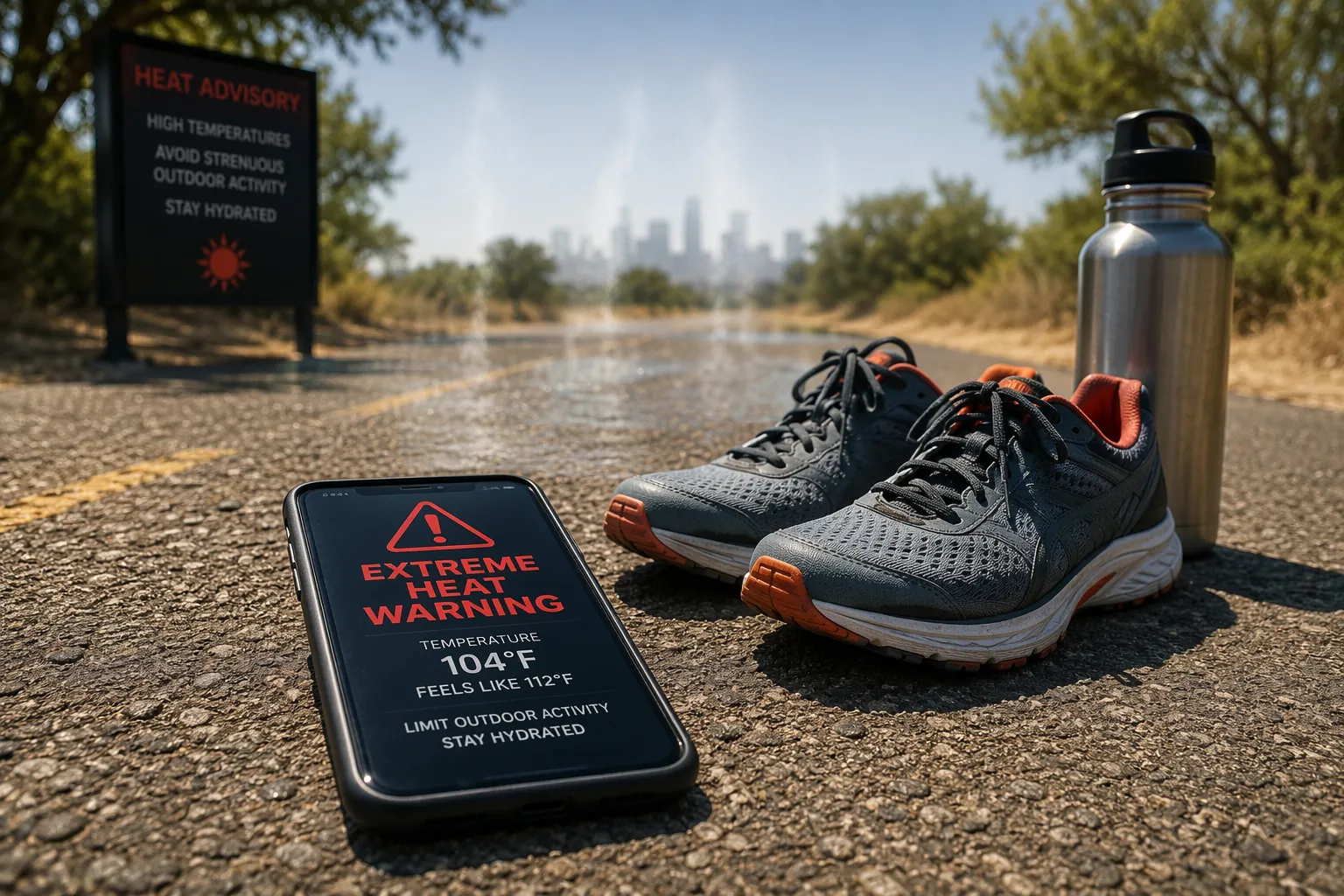
When a heat alert pops up and your shoes are already by the door, the useful question is not whether it is “hot.” It is what the alert says, when it applies, and what the heat index will be during the hour you planned to be outside.
For outdoor exercise, the quick translation is simple: an Extreme Heat Watch means plan ahead and be ready to cancel or move the session; a Heat Advisory means dangerous heat is expected soon, so postpone, shorten, or reschedule away from peak heat; an Extreme Heat Warning means dangerous heat is happening or imminent, so do not do the workout outdoors. The National Weather Service describes a Watch as conditions possible within the next few days, an Advisory as less severe than a Warning but still dangerous, and a Warning as the highest-urgency heat alert for conditions that are occurring or imminent.[1]
You may still see “Excessive Heat Watch” or “Excessive Heat Warning” in older articles, local broadcasts, or app wording. In March 2025, the NWS changed that terminology to “Extreme Heat Watch” and “Extreme Heat Warning” to make the hazard sound as serious as it is.[2] For your workout decision, treat the old “Excessive” wording and the newer “Extreme” wording as pointing to the same kind of heat danger.
The workout decision by alert level
| Alert on your phone | What it means | Workout decision |
|---|---|---|
| Extreme Heat Watch | Dangerous heat is possible in the next few days. | Keep the plan flexible. Move long runs, rides, bootcamps, and hard sessions to cooler hours or indoors if the forecast holds. |
| Heat Advisory | Dangerous heat is expected soon; Weather.com describes advisories as often issued when heat is expected within 12 hours. | Reschedule, shorten, lower intensity, or move indoors, especially for midday sessions. |
| Extreme Heat Warning | Dangerous heat is occurring or imminent. | Cancel outdoor exercise. Choose an air-conditioned indoor workout instead. |
A Watch is the one people are most tempted to shrug off because the weather may still look fine right now. That is exactly why it is useful. It is the alert that lets you move a Saturday long run to early morning, swap a track workout for an indoor strength session, or warn the group chat before everyone has built their day around a bad idea. Local NWS offices can set heat-alert criteria differently by region, so the exact threshold behind the alert is not universal.[1] The action is still the same: do not wait until the alert upgrades before making a backup plan.
A Heat Advisory is not a yellow light for “try it and see.” It means the heat is already expected to be dangerous, even if it is not at Warning level. Weather.com’s side-by-side heat-alert explainer describes a Heat Advisory as less severe than an Extreme Heat Warning but still a dangerous-heat alert, often tied to conditions expected within 12 hours.[3] For exercise, that should change the workout before you start: earlier hour, shorter route, lower pace, more shade, or an indoor option.
An Extreme Heat Warning ends the outdoor-workout debate. This is not the day for speed work, a long run, a hot yoga-in-the-park class, or a “just keep it easy” bike ride at lunch. If the official alert says the most urgent heat conditions are happening or about to happen, the safer choice is an air-conditioned treadmill, bike trainer, gym session, mobility work, or a rest day. For a broader severe-weather decision framework, the same logic applies in how to exercise safely during severe weather: the forecast does not care how consistent your training log has been.
Then check the heat index for your planned hour
The alert tells you the public-risk level. The heat index tells you what the workout hour may feel like to your body, because humidity makes it harder for sweat to cool you. That matters more than the air temperature alone when you are producing heat on purpose by running, cycling, lifting, or walking fast.
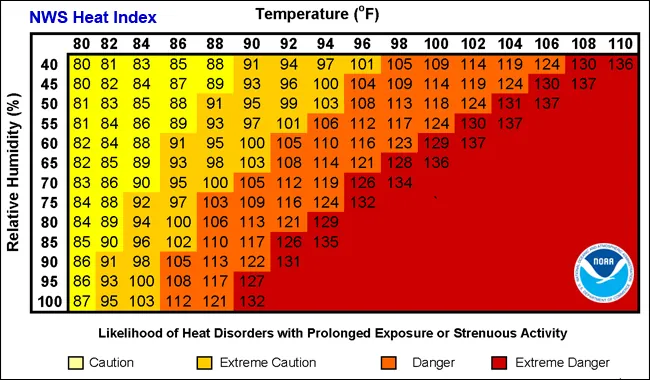
The NWS heat index chart groups risk into four zones: Caution at 80–90°F, Extreme Caution at 90–103°F, Danger at 103–124°F, and Extreme Danger at 125°F or higher.[1] Mass General Brigham’s exercise-in-heat guidance puts a practical athlete marker on that chart: once the heat index reaches 90°F or higher, athletes are at risk for heat-related illness.[4]
| Heat index | Exercise reading | Reasonable adjustment |
|---|---|---|
| 80–90°F | Caution | Keep it easy, avoid unnecessary intensity, and watch the hourly trend. |
| 90–103°F | Extreme Caution | Treat outdoor exercise as a modified session: shorter, earlier, slower, shaded, or indoors if intensity is high. |
| 103–124°F | Danger | Do not do hard outdoor efforts. Move long runs, speed work, bootcamps, and strenuous rides indoors. |
| 125°F+ | Extreme Danger | Skip outdoor exercise entirely. |
That 90°F heat-index line is where I stop treating the plan as normal. It does not automatically mean every person must stay inside for every gentle walk, but it does mean the workout has to earn its place outdoors. A recovery jog in shade at sunrise is a different load than hill repeats on pavement after work. A group bootcamp with timed intervals is different from an easy stroll with places to stop.
At a heat index of 103°F or higher, the chart is no longer giving you a mild caution. It is in the NWS Danger zone.[1] That is the point where hard efforts stop making sense outside, especially anything that raises core temperature quickly: intervals, tempo runs, long runs, heavy carries, outdoor HIIT, long climbs, and fast rides with poor airflow during stops.
Intensity changes the answer
A heat alert does not land on every workout the same way. The harder the session, the less room you have for heat. A lunch-break walk, an easy spin, a marathon long run, and a no-rest bootcamp may all be “outdoor exercise,” but they do not create the same heat load or leave the same margin for mistakes.
- Low-intensity walking: shift to shade, shorten the route, avoid peak heat, and choose indoor walking if the heat index is near or above the Danger zone.
- Easy running or cycling: move to early morning, lower pace expectations, shorten the session, and keep a clean exit route.
- Long endurance sessions: reschedule or move indoors when an Advisory overlaps the planned window; do not try to “bank” mileage under a Warning.
- Intervals, hills, tempo work, bootcamps, and outdoor strength circuits: take them indoors when the heat index reaches Extreme Caution unless conditions are clearly trending cooler and the session can be substantially reduced.
- Youth sports, group workouts, and coached sessions: decide early, because other people will follow the plan you leave standing.
The Road Runners Club of America gives runners an even more conservative line for a specific combination: it advises against running when the temperature is above 98.6°F and humidity is above 70–80%.[5] That is not the only possible cutoff for every sport or every climate, but it is a useful reminder that humidity can turn a familiar temperature into a much more punishing session.
For marginal days, the hourly forecast matters more than the daily high. If the Advisory begins at noon and the heat index is still lower at 6 a.m., an easy early session may be a different decision than the same workout at 2 p.m. For a more detailed outside-versus-treadmill call, use the hourly approach in Run Outside or Treadmill? Let the Hourly Forecast Decide.
Why fit people still get caught
Fitness helps with many things. It does not make heat alerts optional. Heat illness can move along a continuum from cramps and heat exhaustion toward exertional heat stroke, where the stakes change fast. The Korey Stringer Institute defines exertional heat stroke as a core body temperature above 104°F with central nervous system dysfunction, and reports 100% survival when cold-water immersion is initiated within 10 minutes of collapse.[6]
That is the part people tend to underestimate from the front porch. The bad decision does not always feel bad at the start. It may feel like a normal hot-weather grind until judgment, coordination, or pacing goes sideways. By then, the person who has to solve the problem may be your training partner, your spouse, a coach, a bystander, or emergency responders.
Acclimatization is another reason sudden heat waves are tricky. Susan Yeargin, writing in The Conversation and republished by PBS NewsHour, describes the American College of Sports Medicine consensus that heat acclimatization generally takes 10–14 days of 60–90 minutes of daily heat exposure.[7] If the first serious heat of the season arrives this week, your body may not be ready for the same route, pace, or class format that felt fine later last summer.
Personal risk can move the line earlier
The alert and heat index are the starting point, not a personalized medical screen. Age, pregnancy, recent illness, poor sleep, alcohol use, dehydration, low heat acclimatization, and some medical conditions or medications can reduce heat tolerance. CDC guidance for athletes emphasizes planning around heat, taking breaks, staying hydrated, and recognizing heat-related symptoms.[8]
If you have a heart condition, kidney disease, a history of heat illness, or take medications that may affect sweating, fluid balance, blood pressure, or thermoregulation, treat this as a reason to be more conservative and ask a healthcare professional for individual guidance. A public alert is built for population risk; your risk may be higher than the average person the alert is trying to reach.
What to do instead of forcing the outdoor plan
On Watch days, the best move is scheduling. Pick the cooler hour now, tell the group the backup plan, and decide what forecast change would send you indoors. On Advisory days, reduce the outdoor load before you begin: shorter duration, lower intensity, shaded route, earlier start, longer breaks, and no pressure to hit normal splits. On Warning days, move the workout inside.
Indoor does not have to mean heroic. A treadmill walk, easy bike, short strength circuit, mobility session, or full rest day is a better training decision than turning a heat warning into a medical problem. If your indoor space is also hot, treat that seriously too; ventilation, cooling, and hydration matter in a garage or spare-room setup. The practical details are covered in how to exercise safely in a hot home gym.
This is the same kind of pivot you would make for another unsafe outdoor condition. If smoke is the issue instead of heat, exercising in smoky air calls for the same basic humility: the workout adapts to the environment, not the other way around.
Heat waves can also follow you after the workout through worse sleep and slower recovery. If that is the pattern this week, hot weather sleep quality and fitness gains is worth checking before you stack another hard day on top of poor recovery.
A simple rule for the phone-alert moment
Name the alert first. A Watch means prepare to change the plan. An Advisory means reschedule, shorten, or lower the outdoor session. A Warning means take exercise indoors. Then check the heat index for the actual hour you meant to train, not just the daily high.
If the heat index is at or above 90°F, treat outdoor exercise as a modified session. If it is in the 103°F Danger zone, do not do hard outdoor exercise. If an Extreme Heat Warning is active, do not try to out-fitness the weather; choose an air-conditioned option and let the training plan survive the day.
References
- Understanding Heat Alerts, National Weather Service.
- What are Heat Watches and Heat Warnings?, Fox Weather.
- Know The Difference: Heat Advisory Vs. Extreme Heat Warning, Weather.com, July 24, 2025.
- Stay Safe Exercising in the Heat, Mass General Brigham.
- Hot Weather Running Tips, Road Runners Club of America.
- Heat Stroke, Korey Stringer Institute, University of Connecticut.
- 6 tips for staying safe while exercising in extreme heat, PBS NewsHour.
- Heat and Athletes, Centers for Disease Control and Prevention.
What a small equipment investment adds
We don't have a build tagged to this exact tier yet. Browse all builds.
How often should you repeat this?
See our recovery and rest reference for citation-anchored rest-interval guidance.
Spot something off?
Tell us if a movement, tier assumption, or duration didn't match your experience.