
How to Practice Heel Hooks at Home Without a Partner
Learn a structured three-phase method to safely practice heel hook technique at home without a partner. Using mobility prep, solo leg-entanglement drills, and a grappling dummy, you can build repeatable reps that transfer directly to live rolling.
- Equipment tier required
- $100-300
- Duration
- 20 min
- Difficulty
- intermediate
- Target area
- legs
- Space footprint needed
- 6×6 ft
- Noise level
- quiet
The hard part of practicing heel hooks at home for BJJ is not motivation. It is volume under the right constraints. A normal hobbyist class week might give you only 15–30 live reps of one technique, while reliable muscle memory usually needs 100 or more clean repetitions; the 100–300 weekly rep target is best treated as a coaching heuristic, not a lab-proven threshold.[1] That gap explains why the move can feel sharp during drilling and then disappear the second someone hides a knee line, turns their hip, or refuses to let their foot sit where the instructional promised it would.
Heel hooks make that gap awkward because they are not like shrimping down the mat or shooting a double into the air. The finish depends on leg position, hip connection, knee-line control, rotational direction, and a partner’s defensive reactions. At the same time, they are one of the submissions where bad practice can do damage before either person gets a useful pain warning. BJJ Rehab describes heel hook injuries as capable of affecting multiple knee ligaments, including the ACL, MCL, LCL, and PCL, and Digitsu similarly emphasizes that damage can occur before pain is felt.[2][3]
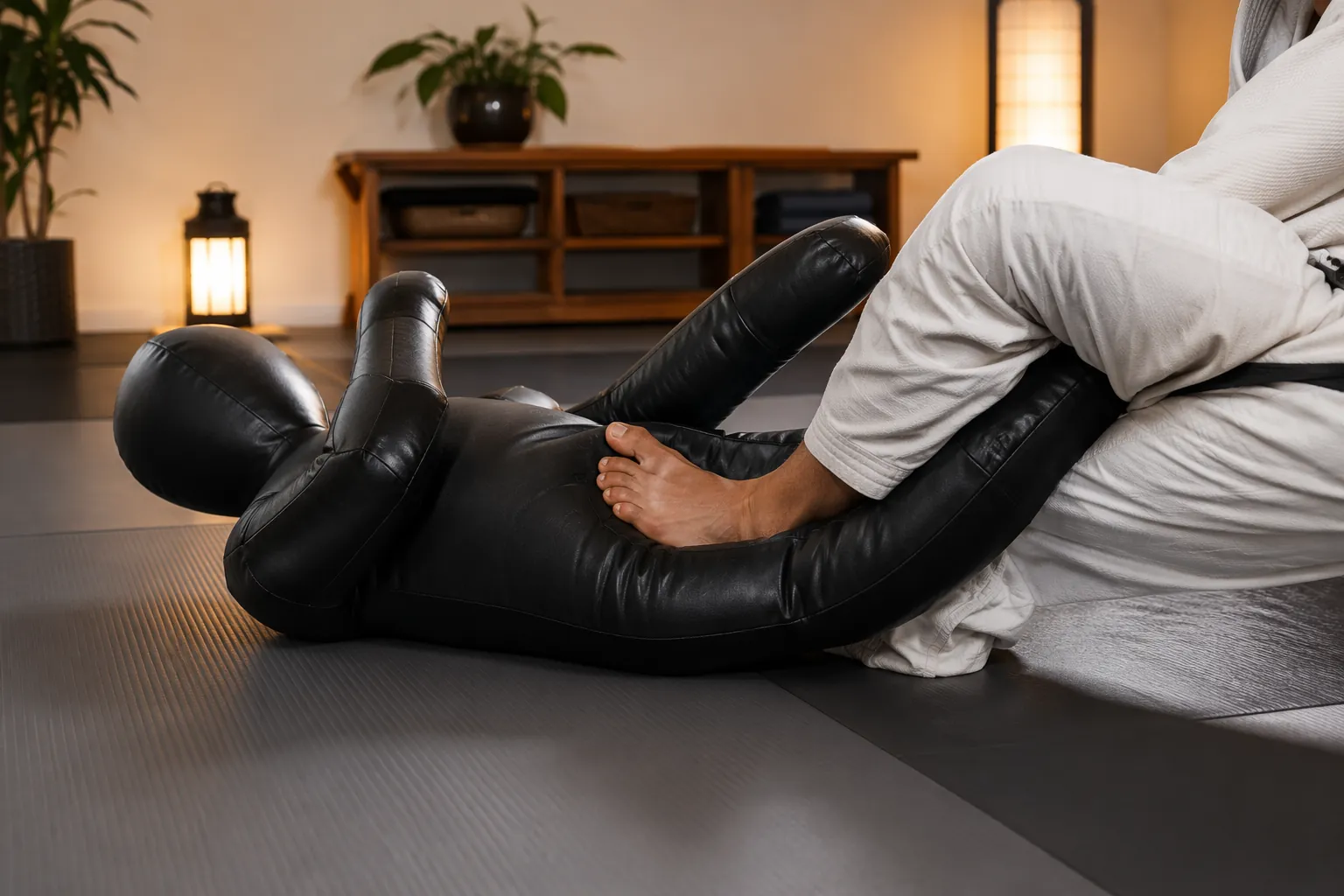
So the useful promise is narrower than “master heel hooks at home.” Home training can make your entries cleaner, your legs more organized, your hips less clumsy, and your finishing mechanics slower and safer. It can also keep class time from being wasted on basic body positioning. It cannot replace a coach watching your knee-line control, a partner giving real defensive reactions, or a room culture where people tap early and release immediately.
What You Can Safely Train Alone
A good home progression separates the parts of the heel hook that can be repeated alone from the parts that still need supervision. Alone, you can train hip mobility, adductor readiness, leg pummeling, ashi garami transitions, saddle orientation, escape movement patterns, bridge mechanics, and slow finishing alignment on a dummy built for the job. You should not train speed finishes, surprise cranks, or the habit of rotating through resistance just because nothing complains when the “partner” is vinyl and stuffing.
| Phase | Main job | What it should produce |
|---|---|---|
| Mobility prep | Prepare hips, adductors, and rotational positions | Less stiffness when entering and switching leg entanglements |
| Solo mechanics | Pattern leg positioning, hip elevation, inversion, and escape shapes | Cleaner body organization before a partner adds resistance |
| Dummy work | Add a realistic limb target for entries, control, and slow finishing mechanics | More useful reps that resemble the geometry of live heel hook positions |
That order matters. If your hips cannot rotate cleanly, your ashi entries get sloppy. If your leg positioning is sloppy, a dummy will let you repeat bad mechanics faster. If your dummy has no meaningful knee or heel shape, finishing reps become mostly pantomime.
Start With Mobility That Matches the Position
Mobility prep does not need to become a separate hobby. For heel hook training, the useful work is specific: hip rotation, adductor tolerance, and the ability to fold, flare, and turn your legs without compensating through your lower back. The Jiu Jitsu Therapist’s resistance-band leg warmup uses banded hip rotation and adductor-focused movements as solo preparation for BJJ leg positions.[4]
A short prep block can be enough before the main drilling. Use a light resistance band, move slowly, and treat the first few minutes as joint positioning rather than conditioning. If you are already breathing hard before you start drilling entries, you have probably turned the warmup into the workout.
- Banded hip external rotation: sit or lie down, anchor the band lightly, and rotate through a range you can control without yanking.
- Banded hip internal rotation: keep the motion small and clean; this is preparation for leg-lock positions, not a test of how far your knee can twist.
- Adductor rock-backs: shift weight slowly until the inside line of the thigh opens, then return without bouncing.
- Glute bridges: finish with hip extension, not lower-back arching, because that same bridge later shows up in entries and finishing mechanics.
The point is not to become bendier for its own sake. It is to remove the stiffness that makes you reach for the heel before your knees, hips, and chest are in the right relationship.
Solo Leg-Entanglement Mechanics Before Finishes
This is where home work starts to pay off, as long as you do not pretend it is live leg locking. Solo drills teach your body where to go. They do not teach you when an opponent will backstep, hide the heel, clear the knee line, or kick through your control.
Ashi garami transitions against a wall are the cleanest place to start. The wall gives you a fixed surface to manage distance and hip angle without needing another person to stand in base. Solo-drill resources from Kingz and BJJ Fanatics include wall-based ashi garami and leg-lock movement patterns that can be trained without a partner.[5][6]
Set up with your hips close enough to the wall that your feet can post without reaching. Move from one ashi configuration to another while tracking three things: your knees stay active, your hips do not fall dead to the mat, and your imaginary opponent’s knee line would remain trapped. If the transition only works when you throw your legs wildly, slow it down until the path is repeatable.
- Ashi switch against the wall: move from outside ashi to cross ashi and back, keeping your knees pinched and your hips close.
- Wall pummel: alternate inside and outside leg position without letting your feet slap or your hips drift away.
- Hip elevation reset: bridge, angle off, and return to position so your entries include hip movement instead of only leg movement.
Granby roll entries are useful next, especially if your leg-lock game comes from open guard rather than top entries. They teach inversion, hip rotation, and the ability to bring your legs back into meaningful position after rolling. Chewjitsu’s solo BJJ material includes Granby-style solo movement and hip mechanics, while BJJ Fanatics leg-lock drilling material includes solo leg-lock movement patterns.[6][7]
Do not rush the roll just because there is no partner. Start from a seated or supine position, roll over one shoulder, and finish with your hips angled as if you were entering a leg entanglement. The useful rep ends when your legs recover to a position that could control a limb. If you finish flat, twisted, or staring at the ceiling with no connection, count it as movement practice, not a heel-hook rep.
Running-man saddle escapes belong in the same block, even though they are defensive. A lot of safer finishing practice comes from understanding the escape route: turn the knee, hide the heel, clear the line, and move the hips. BJJ Fanatics identifies saddle escape and running-man style leg-lock drills among solo-compatible leg-lock movements.[7] Training that shape at home makes you less likely to panic-roll in the wrong direction during class.
Butterfly hook lifts, hip bumps, and glute bridges round out the solo block. They are not flashy, but they show up constantly: lifting a leg into your entry path, shifting hips under a trapped limb, and applying controlled hip extension. Chewjitsu’s solo drill guidance includes glute bridge and hip bump mechanics as foundational BJJ movements.[6]
Inside and Outside Heel Hooks Are Not the Same Rep
Before adding finishing mechanics, split the two main directions. Inside heel hooks and outside heel hooks are not interchangeable grips with the same danger. Evolve MMA distinguishes inside heel hooks as attacking internal knee rotation and commonly stressing structures such as the ACL, MCL, and meniscus, while outside heel hooks attack external rotation and are associated with stress to the LCL and posterolateral corner.[8] Digitsu also treats inside and outside heel hooks as mechanically distinct submissions.[3]
For home drilling, that means each finish gets its own slow path. Do not grab a heel shape and rotate the same way every time. Label the position first: what entanglement are you in, where is the knee line, which way is the knee being rotated, and where would your partner need to tap? If you cannot answer that slowly, you should not be adding speed.
Why the Dummy Matters More for Heel Hooks Than for Many Other Drills
A flat-lay dummy can be fine for sprawls, pressure movement, top transitions, and general grappling conditioning. For heel hooks, the missing details are the whole problem. If there is no meaningful heel, ankle, knee bend, or leg structure, you cannot feel whether your bite is shallow, whether the knee line is free, or whether your hip position actually matches the finish.
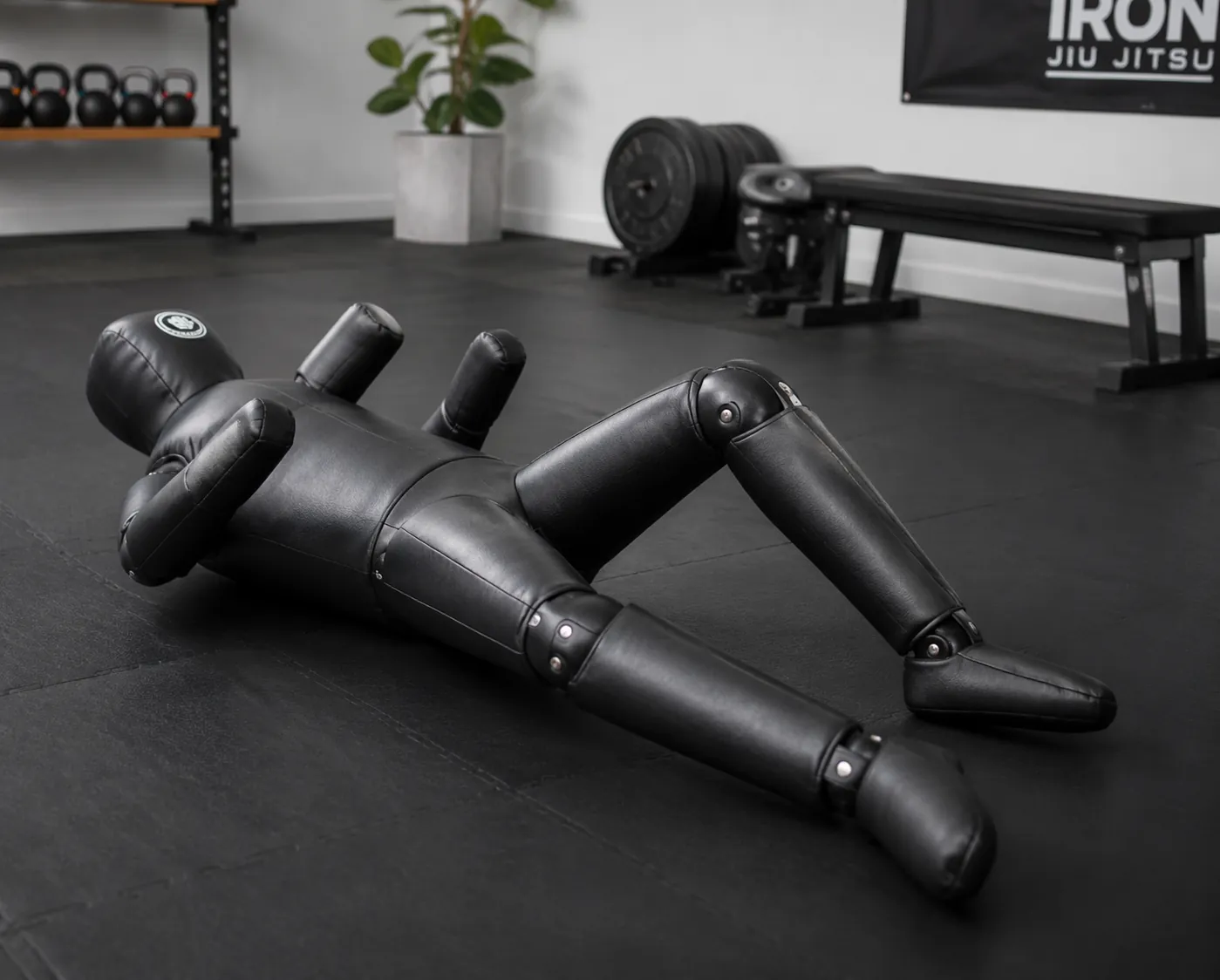
This is where the SMARTY dummies are worth discussing carefully, with the caveat that the strongest available review material comes from BJJ Equipment, an affiliate site. That matters. Affiliate reviews can still be useful, but they should not be read like independent lab testing. In this case, the review is more credible than a generic product roundup because it reports four years of durability use and side-by-side dummy testing, and it specifically identifies the Grappling SMARTY 2.0 and SMARTY XL as dummies with actual heels designed for heel hook finishing.[9]
The same source lists the SMARTY 2.0 at 5'7" and about 50 lb, and the SMARTY XL at 6'2" and about 63 lb.[9] It also reports 85%+ technique compatibility across a white-to-brown belt curriculum.[9] That compatibility figure should not be stretched into “85% of heel hook performance transfers to rolling.” It means the dummy’s body design accommodated a broad curriculum during testing. For home heel hook work, the more important point is narrower: articulated knees and a heel structure make the finishing position less imaginary.
On a useful dummy rep, you can enter, expose the heel, settle your elbow and wrist position, connect your knees, align your hips, and stop before torque becomes the point. The dummy should help you check shape. It should not teach you to rip through resistance.
A 15–20 Minute Home Session That Does Not Get Reckless
The session works best when it is short enough to repeat and structured enough that you do not drift into random leg-lock shadowboxing. Fifteen to twenty minutes is enough to collect meaningful reps if the reps are counted honestly. A sloppy inversion, a loose knee line, or a finish where you cannot name the rotation does not go in the total.
| Time | Work | Rep target |
|---|---|---|
| 3–4 minutes | Banded hip rotation, adductor prep, glute bridges | Move continuously, no forced range |
| 5–6 minutes | Wall ashi switches, Granby entries, running-man saddle escapes | 30–60 clean movement reps |
| 7–9 minutes | Dummy entries, heel exposure, inside/outside finishing alignment | 40–80 controlled technical reps |
| 1 minute | Notes | Record what failed: entry, knee line, heel exposure, or finish alignment |
Three sessions like that can put you near 100–300 weekly reps, depending on how you count and how clean the work stays. Again, that range is a coaching target from grappling-dummy training guidance, not peer-reviewed evidence.[1] Its value is practical: it gives the under-repped hobbyist a way to stop relying on the few live attempts that appear during class.
For dummy work, use a repeatable sequence instead of chasing submissions. Start from a position you actually reach in class: seated guard entry, butterfly elevation, outside ashi from a leg pummel, or saddle after a roll-through. Enter the leg entanglement, freeze long enough to check the knee line, expose the heel slowly, connect your grip, align the hip, then release. The release is part of the rep.
- Entry: get to the leg without diving past your own base or losing hip connection.
- Knee line: confirm the dummy’s knee would be trapped above your control, not already slipping free.
- Heel exposure: bring the heel to your grip; do not pretend a hidden heel is available.
- Finishing alignment: distinguish inside from outside rotation before adding hip pressure.
- Release: let go deliberately so the nervous system practices control, not only capture.
The note at the end is not busywork. If every failed rep says “finish was bad,” the note is too vague. Write down the first thing that broke. Maybe your butterfly hook lift was weak, so you entered late. Maybe your wall ashi switches looked good, but the dummy exposed that your knees open during the transition. Maybe your outside heel hook grip felt available only because the dummy could not pummel its foot back inside.
Small-space adjustments
Some solo leg-entanglement drills need roughly a 6×6 ft clear mat space, and more room is better for rolling entries. If your home mat is smaller, keep the session honest by choosing compact work: band prep, wall ashi switches, seated pummeling, bridge mechanics, and dummy finishing alignment. Save bigger Granby entries or rolling saddle transitions for the gym or a larger home mat area.
The rule is simple: if the drill makes you dodge furniture, it is the wrong drill for that room.
How to Bring the Reps Back to Class
The first test of home training is not whether you finish more heel hooks in rolling. It is whether your coach has to spend less time fixing your body organization. If your entries arrive with better hip angle, your knees stay tighter during ashi transitions, and you can explain whether you are attacking inside or outside rotation, the home reps are doing their job.
When you reintroduce resistance, keep the intensity lower than your confidence. Start with positional rounds where the goal is entry and control, not finishing. Tell your partner what you are working. Agree that taps are early and releases are immediate. Ask your coach to watch the knee-line battle, because that is where a lot of clean-looking home reps either survive or fall apart.
The realistic outcome is not a shortcut around mat time. It is a way to make scarce mat time count. Mobility prep makes the positions available, solo mechanics make the pathways less clumsy, and dummy work gives the heel and knee enough structure that your reps are not pure imagination. Live application still belongs under qualified coaching, with partners who understand leg-lock safety and tapping protocols.
References
- How to Practice BJJ at Home Without a Partner. grapplingdummy.com. 2026.
- Heel Hook Injury — BJJ Knee Ligament Damage Guide. BJJ Rehab.
- Heel Hook: BJJ Submission Breakdown & Stats. Digitsu.
- 7 BJJ Solo Drills To Warm Up the Legs Using a Resistance Band. The Jiu Jitsu Therapist.
- Solo drills guide. Kingz.
- Solo BJJ article. Chewjitsu.
- Leg lock drills. BJJ Fanatics.
- Inside vs Outside Heel Hook: Differences, Effectiveness, And When To Use Each. Evolve MMA.
- Best Grappling Dummy for BJJ: Grappling Smarty 2.0 Review. BJJ Equipment.
What a small equipment investment adds
We don't have a build tagged to this exact tier yet. Browse all builds.
How often should you repeat this?
See our recovery and rest reference for citation-anchored rest-interval guidance.
Spot something off?
Tell us if a movement, tier assumption, or duration didn't match your experience.