
Best Home Boxing Fitness Setup for Renters Under $300
This article compares freestanding, doorway, and wall-mounted punching bags for renters constrained by deposit risk, noise concerns, and a $300 budget. It finds that a doorway bag offers the best balance of quiet operation and no-installation convenience, with clear trade-offs in training feel.
- Equipment tier required
- $100-300
- Duration
- 30 min
- Difficulty
- beginner
- Target area
- full body
- Space footprint needed
- minimal
- Noise level
- low
For home boxing fitness in a rental, the best setup under $300 is usually a doorway-mounted bag, not the heaviest bag you can afford. The reason is boring and important: a renter has to care first about what the bag touches. A bag that never meets the floor, does not require drilling, and comes down before a landlord inspection is already solving the problem most generic punching-bag advice skips.
The practical winner here is Quiet Punch, provided your doorframe fits and you accept the training compromise. Its product page says it fits 28–36 inch doorframes, installs in 60 seconds, and requires no tools; the price is commonly treated as roughly $199 USD, but the product page lists pricing in JPY, so the exact USD price should be checked at publication or purchase time.[1] That makes it the lowest-risk choice for a renter trying to stay under $300 without turning a lease into a construction project.
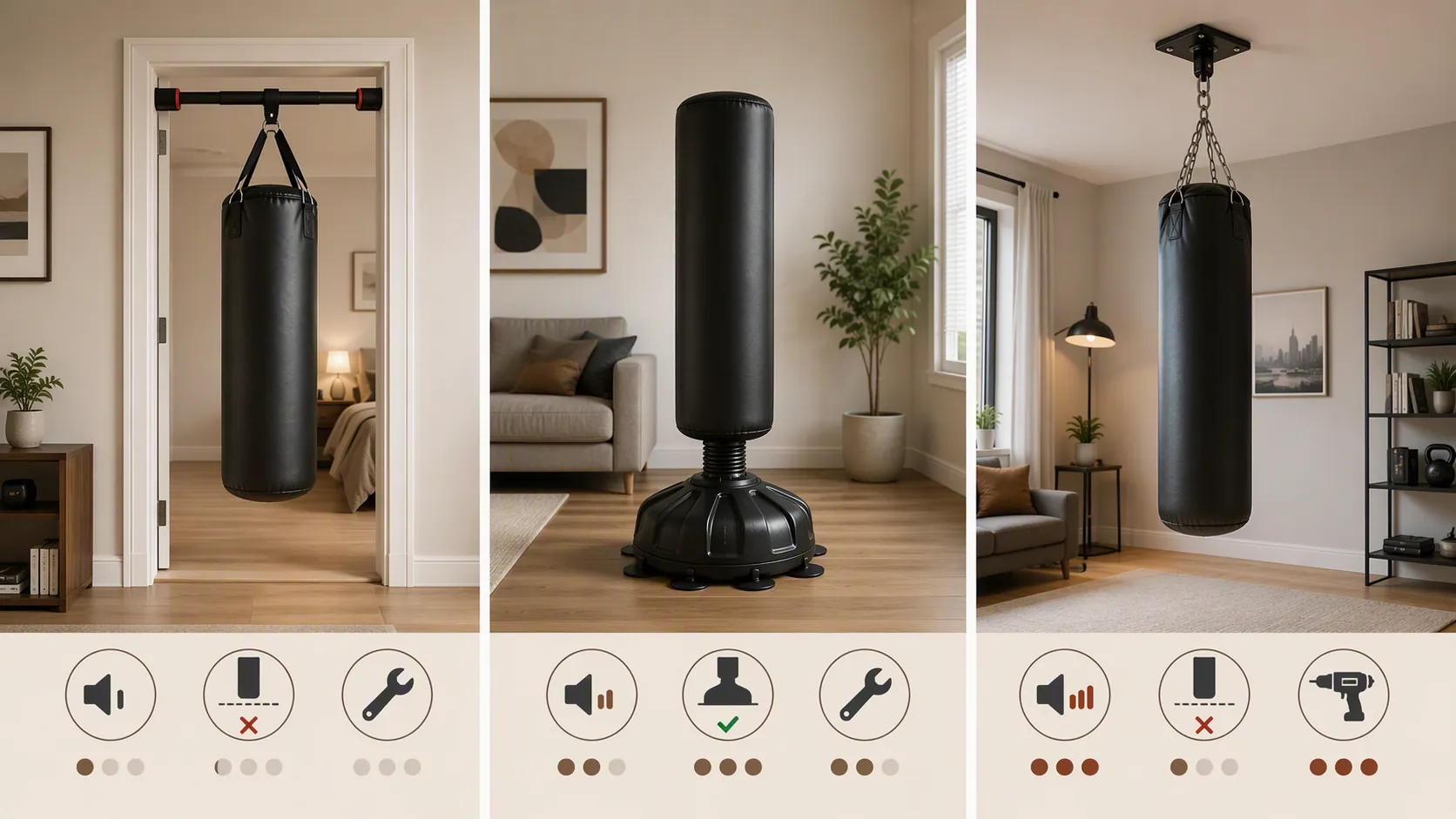
The renter-first comparison
| Bag type | Installation | What it touches | Noise and vibration risk | Deposit risk | Training feel | Under $300 fit |
|---|---|---|---|---|---|---|
| Doorway bag | No tools; fits a compatible doorframe | Doorframe only; no floor contact | Lower than freestanding or hanging bags, but not silent | Lowest, though scuffs are still possible | Good for rhythm and quick combinations; limited realism | Yes; Quiet Punch is around $199 USD but price should be verified |
| Freestanding bag | No drilling; fill or weight the base | Floor, base, and surrounding space | Can transmit vibration through floors | Medium; no holes, but floor vibration and shifting matter | More realistic than a doorway bag | Yes; FITVEN was listed around $170–180 in VeryWellFit testing |
| Wall- or ceiling-mounted bag | Requires mounting into structure | Wall, ceiling, hardware, and surrounding surfaces | Highest risk for impact transfer | High for most renters | Most traditional bag feel | Sometimes, but the housing risk is the problem |
| Double-end bag | Usually needs ceiling and floor anchors | Ceiling and floor mounting points | Depends on mounting and tension; still not installation-free | High for the core renter use case | Fast and skill-focused, but difficult for many beginners | Yes on price; BoxerPoint was noted around $40 |
That table is the decision. The rest is just checking whether your apartment is forgiving enough to move away from the safest option.
Why the usual “best punching bag” answer fails renters
A traditional heavy bag is a satisfying answer only if you control the building around it. Renters often do not. They may not own the joists, may not be allowed to drill, may have a downstairs neighbor, and may be expected to leave painted drywall and trim looking exactly as it did on move-in day.
That rules out a lot of impressive-looking gear before boxing performance even enters the conversation. A ceiling bag can feel better when struck, but it asks the apartment to absorb repeated impact. A wall mount can look compact in a product photo, then become a lease conversation. Even “minor” mounting is not minor when the person paying for patching and repainting is you.
For a renter, the order of judgment should be simple: no drilling first, then floor contact, then noise transfer, then removability, then training realism. If a product fails badly on the first two, it needs to be unusually compelling to stay in the running.
Freestanding bags are tempting because they feel more like boxing
A freestanding bag looks like the sensible compromise at first. No ceiling mount. No wall bracket. No drilling. You can put it in a corner, drag it out for a workout, and get a taller striking surface than a doorway target gives you.
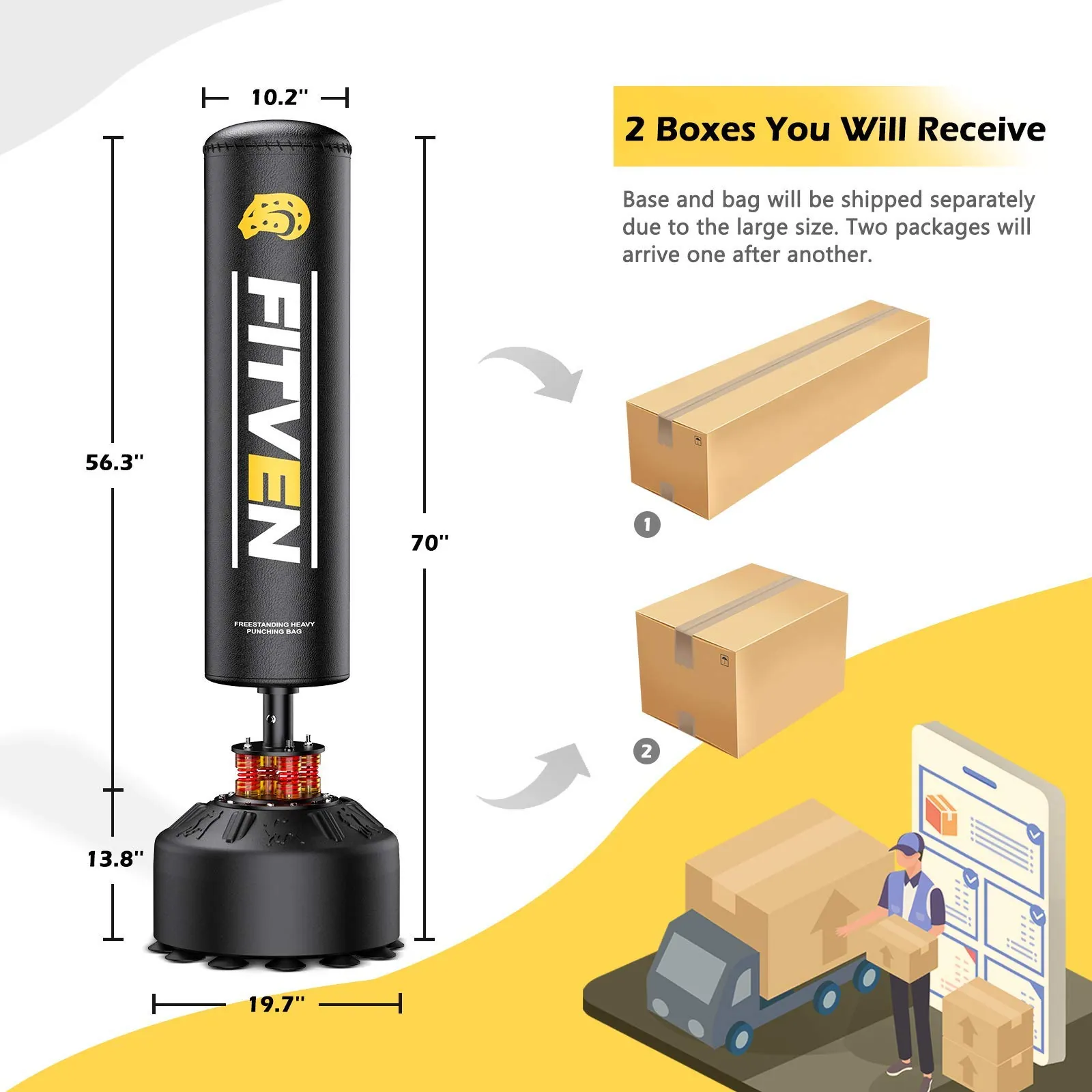
FITVEN is the freestanding option worth taking seriously under this budget. In VeryWellFit’s 2026 test of 19 punching bags, FITVEN’s freestanding bag was rated best for beginners, with pricing noted around $170–180 and a 360-degree design that is more apartment-friendly than a fixed wall setup.[2] That matters because it is not just a catalog claim; it was actually part of a comparative test.
The problem is what happens when the workout stops being polite. VeryWellFit also found that FITVEN’s suction cups loosened on hard uppercuts during lab testing.[2] That is exactly the kind of flaw that matters in an apartment: a bag that shifts, hops, or loosens does not merely interrupt a combination. It can create extra thuds, scrape the floor, or make the user pull punches because they are watching the base instead of the target.
Other boxing sources point to the same trade-off from different angles. Hayabusa recommends freestanding bags for renters concerned about noise, while still noting that they transmit vibration through floors.[3] BoxingInsider is blunter, warning that freestanding bags “tip, bounce, and don’t feel like a real bag,” while still acknowledging that they can be better than nothing for renters.[4]
That leaves FITVEN in a fair but narrower place. It is the better choice if you have a ground-floor unit, forgiving neighbors, enough room around the base, and a landlord who is unlikely to object to a heavy movable object on the floor. It is also the better choice if you care more about kicks, stronger punches, and a full-height target than about minimizing every trace of the setup.
For an upstairs apartment with hard floors, thin construction, or a neighbor below who already hears your footsteps, a freestanding base is not as harmless as “no drilling” makes it sound.
The doorway bag wins by disturbing fewer surfaces
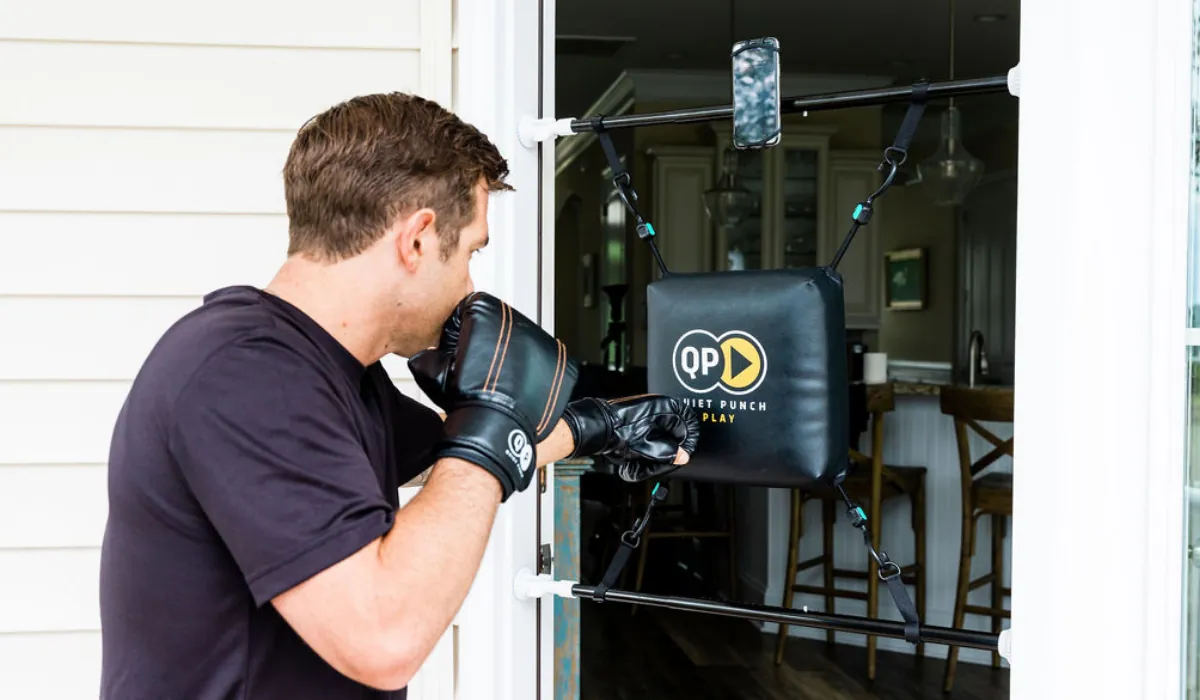
Quiet Punch’s advantage is not that it turns a doorway into a boxing gym. It does not. Its advantage is that it keeps the workout small, removable, and off the floor. The listed 28–36 inch doorframe fit range, no-tool installation, and 60-second setup are renter-relevant features, not minor conveniences.[1]
That changes the kind of risk you are taking. With a freestanding bag, impact energy has to go somewhere: into the bag, into the base, into the floor, and sometimes into the apartment below. With a doorway bag, the target is smaller and less realistic, but the setup removes the heavy base and avoids floor contact altogether. For many renters, that is the right compromise.
The quiet claim still needs restraint. Quiet Punch markets the bag as quiet enough for late-night sessions, but “quiet enough” is not silent.[1] Gloves still hit a target. The frame still carries some movement. A person still shifts weight and breathes hard in a small room. If your building has paper-thin walls, the better promise is lower-risk noise, not no noise.
The other small risk is wear around the frame. A no-tools setup avoids holes, but it does not guarantee the trim will look untouched forever. Sweaty gloves, repeated setup, and hurried removal can leave scuffs. If the doorframe has fresh paint, soft trim, or a finish that marks easily, add a visual inspection before and after early sessions. That is not glamorous advice, but it is cheaper than explaining marks during move-out.
What you give up with Quiet Punch
A doorway bag is not the best training tool for every boxer. It gives you a compact target for rhythm, hand speed, straight punches, short combinations, and conditioning intervals. It does not give the same body feel as a heavier bag. It has limited rebound compared with a fuller striking surface, and it does not invite much footwork, angle work, or head movement.
A serious boxer may outgrow it. That does not make it the wrong recommendation here. The under-$300 renter problem is not “what feels most like a boxing gym?” It is “what can I hit repeatedly in a place I do not own?” On that question, Quiet Punch gives up realism to protect the apartment.
Hanging bags are the wrong default for this renter
A hanging heavy bag belongs at the end of this article, not the center of it. It can be excellent equipment in the right space. A rented apartment is usually not that space.
The problem is not only price. Some hanging bags can fit under a $300 equipment budget, especially if the bag itself is basic. The problem is the mounting. Ceiling hardware, structural anchoring, drywall damage, impact transfer, and neighbor noise all work against the renter. If a setup requires you to ask whether your lease, ceiling, and deposit can survive it, it should not be the default recommendation.
The $40 double-end bag is cheap, not renter-simple
The BoxerPoint double-end bag deserves a quick mention because the price is hard to ignore. VeryWellFit noted it around $40, making it the cheapest space-efficient option in this comparison.[2] If budget were the only constraint, it would be attractive.
Budget is not the only constraint. A double-end bag typically needs both ceiling and floor mounting points, which puts it back into lease-risk territory. It is also a more reactive, timing-sensitive tool than many beginners expect. For a renter looking for a first home boxing fitness setup, cheap hardware that requires anchors in two directions is not actually the easy answer.
Which setup should you choose?
Choose a doorway bag if deposit safety, quiet operation, and fast removal matter most. Quiet Punch is the clearest fit for that use case because it requires no tools, sets up quickly, fits common 28–36 inch doorframes, and avoids floor contact.[1] It is the best default for renters under $300 who want boxing-style conditioning without negotiating with a ceiling joist, a base full of weight, or a downstairs neighbor.
Choose FITVEN or another freestanding bag if you can tolerate more floor vibration and want a more realistic target. The VeryWellFit test gives FITVEN credibility for beginners, and the price range keeps it inside the budget.[2] Just do not ignore the suction-cup issue on hard uppercuts or the broader freestanding-bag problem of shifting, bouncing, and transmitting vibration.[2][3][4]
Skip wall- and ceiling-mounted bags unless your landlord has clearly approved the installation and you understand the noise path through the building. For most renters, that is too many conditions for a first setup.
So the practical verdict is plain: under $300, the doorway bag wins because it preserves the apartment first and the workout second. The cost is a less realistic boxing feel. That trade-off is not a flaw to hide; it is the reason the setup works for renters at all.
References
- Quiet Punch Doorway Punching Bag — Quiet Punch
- The Best Punching Bags, Tested and Reviewed — VeryWellFit — 2026
- Punching Bag Buying Guide — Hayabusa
- How to Build a Boxing Home Gym — BoxingInsider
What a small equipment investment adds
We don't have a build tagged to this exact tier yet. Browse all builds.
How often should you repeat this?
See our recovery and rest reference for citation-anchored rest-interval guidance.
Spot something off?
Tell us if a movement, tier assumption, or duration didn't match your experience.