
A Boxing Training Plan for Home That Works on Any Budget
This tiered home boxing plan gives you a complete weekly schedule built on 3-minute rounds, whether you have no equipment, a bag and gloves, or a full setup. Each tier follows the same proven framework so you can start at your level and scale up as you add gear.
- Equipment tier required
- none
- Duration
- 30 min
- Difficulty
- beginner
- Target area
- full body
- Noise level
- low
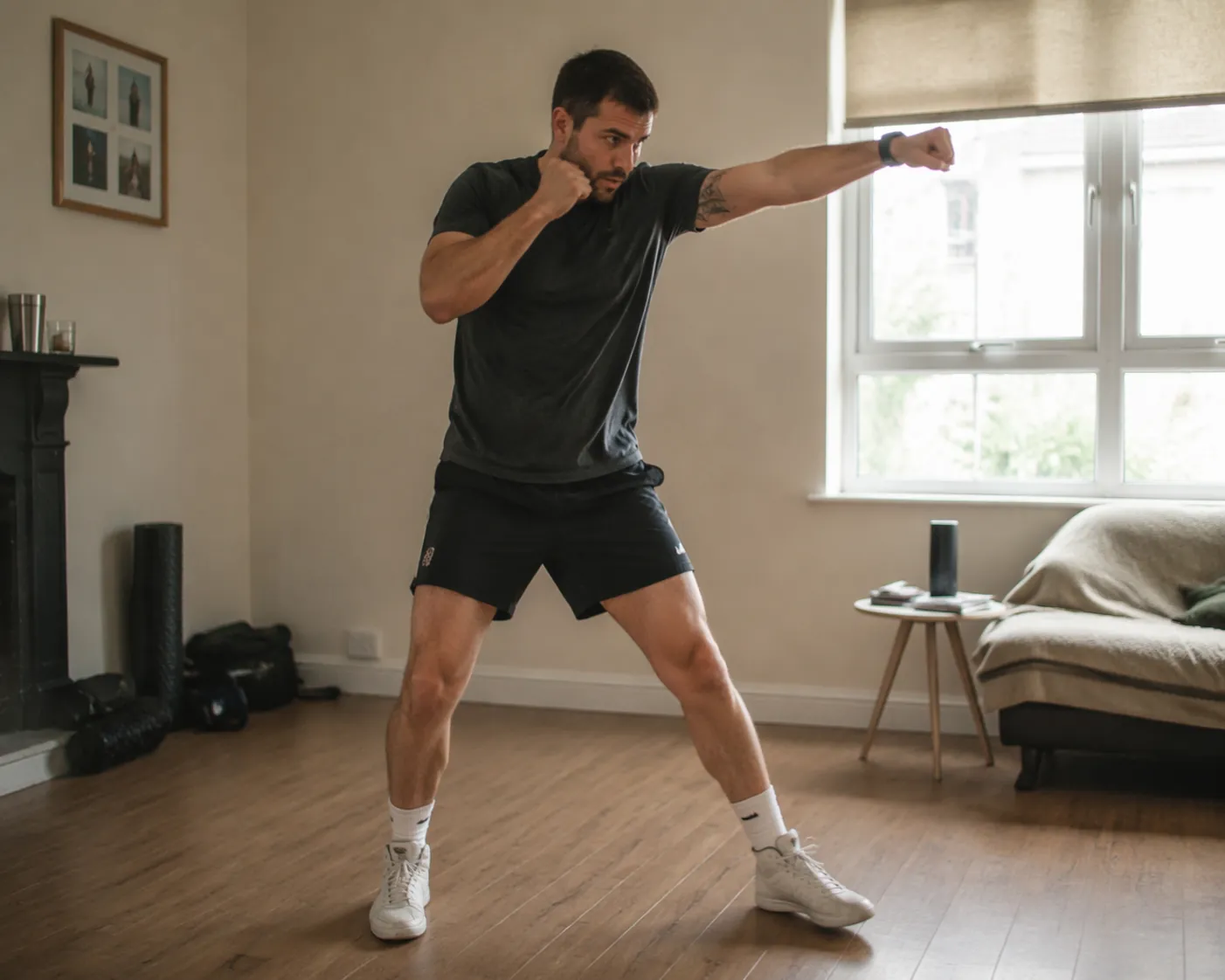
You do not need to buy a heavy bag before you start a boxing training plan for home. You need a repeatable week, a round timer, and enough space to stand in stance, step forward, step back, and rotate without clipping a lamp. The bag can come later.
The useful starting rule is simple: train in 3-minute rounds with 1-minute rest. Boxing Insider uses that format for no-equipment shadow boxing, and FightCamp uses the same basic round-and-rest structure for at-home boxing schedules built around bag work.[1][2] That matters because it means your workout format does not depend on your budget. A $0 session and a bag session can both feel like boxing practice instead of a pile of random cardio moves.
The Weekly Plan That Works at Every Budget
Here is the whole week before equipment gets involved. Keep this shape stable for at least four weeks. Change the content inside the rounds as your setup improves.
| Day | Training focus | Session format | What it should feel like |
|---|---|---|---|
| Monday | Boxing skill | 6-8 x 3-minute rounds, 1-minute rest | Clean stance, guard, footwork, straight punches, basic combinations |
| Tuesday | Strength | 30-45 minutes | Controlled reps, no rushing, enough effort to build capacity without wrecking boxing practice |
| Wednesday | Conditioning | 5-8 x 3-minute rounds, 1-minute rest | Higher breathing rate, simple movement, no technical chaos |
| Thursday | Rest or mobility | 20-30 minutes optional | Hips, calves, shoulders, thoracic rotation, easy walking |
| Friday | Boxing skill | 6-10 x 3-minute rounds, 1-minute rest | More combinations, defense, rhythm changes, sharper round discipline |
| Saturday | Strength plus optional conditioning | 30-45 minutes strength; conditioning only if separated | If both happen the same day, keep at least 6 hours between them |
| Sunday | Rest | No formal training | Recover enough to start Monday without negotiating with yourself |
This cadence lines up with Boxing Science’s weekly architecture: 2-3 boxing skill sessions, 2-3 HIIT or conditioning sessions, and 2 strength sessions per week. Boxing Science also advises leaving at least 6 hours between strength and conditioning if they land on the same day.[3] For a home plan, that 6-hour rule is more useful than most motivational advice. It stops Saturday from becoming a punishment pile of lifting, jumping, and sloppy punches.
If you only have four training days, keep Monday, Tuesday, Friday, and Saturday. If you have five, add Wednesday conditioning. If you have six, use Thursday for mobility instead of turning it into another hard workout. The plan works because the week repeats; it does not need to be dramatic.
Same Week, Three Equipment Tiers
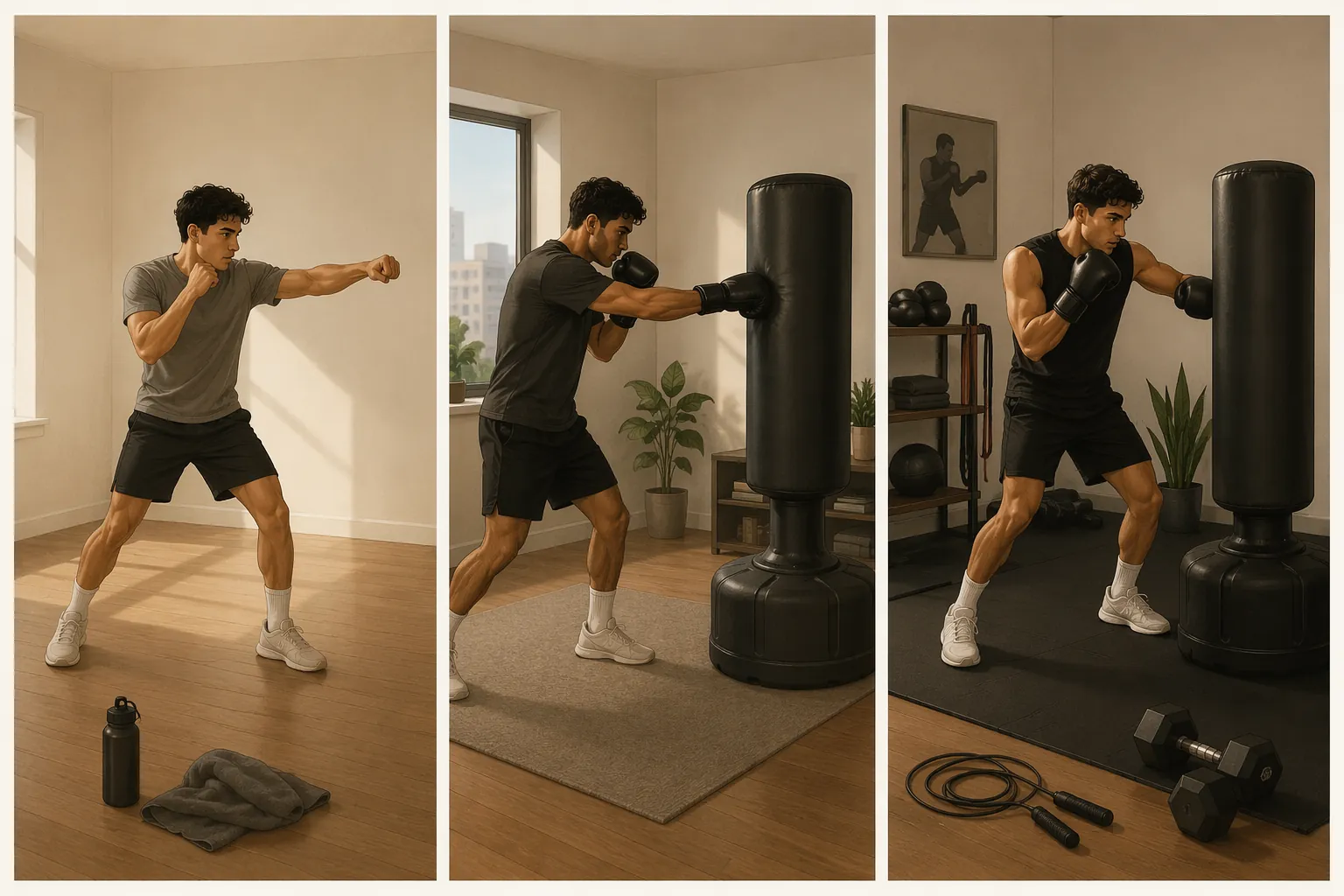
Equipment changes what you can practice, not the basic schedule. A bag makes training feel real very quickly, but it is not a substitute for stance, breathing, guard, round structure, or the decision to show up again on Friday.
| Tier | Setup | What changes | Best use |
|---|---|---|---|
| Tier 1 | $0-50 no-equipment setup | Shadow boxing, footwork, bodyweight conditioning, timer-led rounds | Starting immediately, learning rhythm, building consistency in a small space |
| Tier 2 | $100-300 bag-and-gloves setup | Bag rounds, impact feedback, more realistic combinations, power practice | When you want punches to meet resistance and technique mistakes to become harder to ignore |
| Tier 3 | $300-800 boxing-plus-strength setup | Bag work plus dumbbells, jump rope, pull or push strength options, more complete weekly training | When the weekly habit is already alive and strength tools raise the ceiling |
Those tier ranges are practical planning brackets for this article, not tested product recommendations. For broader market context, BoxingInsider’s January 2026 home boxing gym guide describes a Stage 1 setup with bag, gloves, jump rope, and timer at $300-900, and a Stage 2 setup with added strength equipment at $1,200-2,500.[4] The point is not that you must spend that much. The point is that the price can rise quickly if you treat shopping as the plan.
Tier 1: No Equipment, Still Real Rounds
No-equipment boxing is not waving your arms in the air for half an hour. It is stance, guard, rotation, breathing, foot placement, and restraint. Shape’s beginner no-equipment boxing workout emphasizes proper form and hip rotation, with the shoulders, core, and legs all involved even without a bag.[5] That is enough to make shadow boxing useful, but only if you treat the round as practice rather than pantomime.
| Tier 1 day | What to do |
|---|---|
| Monday skill | Rounds 1-2: stance, guard, step forward/back. Rounds 3-4: jab and cross only. Rounds 5-6: jab-cross, reset, breathe. Optional rounds 7-8: add slip or pivot after the combination. |
| Tuesday strength | Squats, reverse lunges, push-ups or incline push-ups, plank variations, slow mountain climbers. Keep reps clean. |
| Wednesday conditioning | Alternate shadow boxing rounds with bodyweight rounds: squats, lunges, plank shoulder taps, push-ups, or low-impact fast feet. |
| Friday skill | Repeat Monday, then add one new layer: jab to body level, cross to head level, or jab-cross-lead hook without rushing. |
| Saturday strength | Repeat Tuesday with one added set or slightly harder variation. Optional easy rope simulation or footwork rounds later in the day. |
PureGym’s at-home boxing routines show the same useful pairing: boxing rounds can sit beside bodyweight movements such as push-ups, squats, lunges, and planks.[6] Use those movements to fill conditioning days, not to interrupt every skill round. If every combination is followed by burpees, the punches usually get worse before the conditioning gets better.
Tier 2: Bag and Gloves
A bag changes the session because punches now meet resistance. BoxingInsider’s home gym guide frames the heavy bag as the piece that turns cardio into more direct skill development: punch technique, combinations, and power can be practiced solo.[4] That is the real upgrade. The bag gives feedback. It also exposes bad balance, lazy wrist position, and combinations that only worked when the air politely got out of the way.
| Tier 2 day | What to do |
|---|---|
| Monday skill | Rounds 1-2: shadow boxing warm-up. Rounds 3-6: bag rounds with jab, cross, jab-cross, and jab-cross-reset. Rounds 7-8: light defense after each combination. |
| Tuesday strength | Bodyweight strength stays. Add loaded work only if you already own safe equipment and can keep form controlled. |
| Wednesday conditioning | Bag intervals: 30 seconds steady punching, 30 seconds footwork or guard reset, repeated inside each 3-minute round. |
| Friday skill | Bag combinations with specific rules: one round only straight punches, one round adding lead hook, one round ending every combination with a step out. |
| Saturday strength | Lower-body, push, pull if available, and core. Optional light bag rounds later only if separated from strength by at least 6 hours. |
Apartment note: a bag is not just a budget decision. It is a noise, vibration, ceiling, doorframe, and neighbor decision. A freestanding bag can be more renter-friendly than drilling hardware, but it still moves, thuds, and eats floor space. If you cannot train with it consistently, it is not an upgrade yet.
Tier 3: Boxing Plus Strength Tools
The full setup is not where the plan becomes serious. It is where the plan gets more room. Dumbbells, a jump rope, a pull-up option, bands, or a bench can make the two strength days more productive and give conditioning more variety. They should not crowd out the two boxing skill days.
| Tier 3 day | What to do |
|---|---|
| Monday skill | Shadow warm-up, technical bag rounds, combination rounds, controlled power rounds. Keep at least half the session technical. |
| Tuesday strength | Squat or lunge pattern, hip hinge, push, pull, carry or core. Use loads you can control without turning Wednesday into recovery debt. |
| Wednesday conditioning | Jump rope, bag intervals, or mixed conditioning rounds. Keep the timer structure: 3 minutes on, 1 minute off. |
| Friday skill | More specific bag work: range changes, exits, punch selection, and moderate power. Do not make every round a max-effort round. |
| Saturday strength | Second strength day. If adding conditioning, separate it from strength by at least 6 hours. |
Competitive boxing strength-and-conditioning plans can run much higher in volume, but that is a different audience. A general home fitness plan should scale down from competitive demands rather than borrow them whole. More work is only useful when it improves the next session instead of stealing from it.
The 4-Week Progression
Do not change everything every week. The progression below keeps the same days and the same 3-minute round format while changing one main variable at a time: round count, combination complexity, density, then control under fatigue.
| Week | Main goal | Skill days | Conditioning day | Strength days |
|---|---|---|---|---|
| Week 1 | Learn the format | 6 rounds. Stance, guard, jab, cross, reset after every combination. | 5 rounds. Easy-to-moderate pace. Bodyweight or bag intervals stay simple. | 2 sessions. Choose movements you can repeat without soreness taking over the week. |
| Week 2 | Add volume carefully | 7-8 rounds. Add lead hook or basic defense only after straight punches stay organized. | 6 rounds. Slightly shorter pauses inside each round, but keep the 1-minute rest. | 2 sessions. Add one set to major movements or slightly harder variations. |
| Week 3 | Add complexity | 8-9 rounds. Add exits, pivots, level changes, or bag-specific combination rules. | 6-7 rounds. Use planned intervals instead of random all-out punching. | 2 sessions. Keep loads or variations steady if boxing volume increased. |
| Week 4 | Consolidate and test control | 6-8 rounds. Fewer total rounds if needed, but cleaner execution under fatigue. | 5-6 rounds. Finish with enough left to judge technique honestly. | 2 sessions. Do not chase maxes; leave the week repeatable. |
Week 1 is allowed to feel almost too simple. That is where you learn whether you can keep your hands up, breathe through your nose between exchanges, and stop drifting out of stance. Beginners often want more combinations before they have a reliable reset. The reset is part of the combination.
Week 2 adds either rounds or small difficulty, not both everywhere. A no-equipment trainee might go from 6 to 8 shadow boxing rounds on Monday. A bag trainee might keep 6 rounds but make two of them bag rounds with a jab-cross-lead hook. A full-setup trainee might add one strength set while keeping boxing volume steady.
Week 3 is where the timer starts protecting you from yourself. Instead of turning conditioning into three minutes of frantic punching, set a rule for the round. For example: 20 seconds of straight punches, 10 seconds of guard and footwork, repeated until the bell. Or one combination, one defensive move, one step out. The exact pattern can change; the rule is that the round has a job.
Week 4 is not a victory lap. It is a check on whether the plan is sustainable. If the final week only works by skipping strength, ignoring rest, or throwing ugly punches because the bag is fun, the next block should not be harder. Repeat the block with cleaner rounds before adding more.
What Each Session Is Actually For
A home boxing week falls apart when every day tries to become the hardest day. Skill, conditioning, and strength overlap, but they are not the same job.
- Skill days: practice stance, guard, footwork, punch path, rotation, combinations, defense, and reset. Sweat is allowed, but it is not the score.
- Conditioning days: raise the heart rate with boxing patterns, bodyweight movements, bag intervals, jump rope, or simple footwork. Technique should remain recognizable.
- Strength days: build the legs, trunk, shoulders, back, and pushing capacity that let boxing rounds hold together.
- Rest and mobility days: keep the week repeatable. Hips, calves, shoulders, and upper back usually need more attention than another random finisher.
For boxing skill days, the most useful home rule is to limit the menu. A beginner does not need ten combinations. Start with jab, cross, jab-cross, jab-cross-lead hook, and a simple exit. If you own a bag, hit it lightly enough that the bag does not become a metronome for bad balance. If you have no bag, use a mirror or phone video carefully; the goal is not posing, it is checking whether the rear heel, hip, shoulder, and hand are working together.
For conditioning days, pick movements that do not destroy the boxing. Push-ups, squats, lunges, planks, mountain climbers, jump rope, fast feet, and light bag intervals all fit. The mistake is packing so much fatigue into the middle of the session that every punch after round three becomes a shoulder shrug with gloves.
For strength days, keep the categories boring: squat or lunge, hinge, push, pull, brace, carry if possible. Bodyweight is enough at Tier 1. Dumbbells or bands help at Tier 3. The strength work supports the boxing week; it does not need to imitate a fight scene.
When Equipment Is Worth Upgrading
Upgrade when the missing equipment limits skill or power development, not when motivation gets bored. Motivation is too expensive to keep feeding with gear.
| Upgrade | Worth it when | Probably wait if |
|---|---|---|
| Round timer or timer app | Immediately. It gives the plan its shape. | You already have a reliable interval timer. |
| Hand wraps and gloves | You are hitting any bag or pad with regularity. | You are still only shadow boxing. |
| Heavy bag or freestanding bag | You can already complete skill rounds and need impact feedback, power practice, and combination realism. | You do not have noise tolerance, floor space, or a place to train consistently. |
| Jump rope | You have suitable flooring, ceiling height, and downstairs-neighbor tolerance. | Low-impact footwork rounds are a better fit for your space. |
| Dumbbells or bands | Bodyweight strength has stopped progressing or you need clearer pulling and loading options. | You are still missing the two weekly strength sessions. |
The heavy bag is the most tempting jump because it changes the feeling of the workout immediately. That does not make it the first required purchase. If your Monday and Friday skill sessions are still inconsistent, a bag mostly gives you a louder way to be inconsistent.
A better upgrade path is: timer first, then gloves and wraps when impact enters the plan, then bag if your space can handle it, then strength tools once the weekly rhythm is stable. Future FitAtHome build guides can split those setups cleanly into a no-gear bodyweight build, a bag-and-gloves apartment build, and a fuller boxing-plus-strength build.
A Few Claims to Ignore
Be careful with calorie promises. Big boxing calorie numbers often come from gym marketing rather than independent measurement, and they rarely tell you the trainee’s size, pace, skill level, or how much of the hour was actual work. Calorie burn is not useless, but it is a poor way to build a boxing plan.
Be just as careful with power claims. Punching harder is a real training goal, and equipment can help because impact reveals timing and balance. But for home fitness, the useful question is not a force number. It is whether your feet, hips, trunk, shoulder, and fist arrive together without pain or collapse.
Start with the tier you can follow this week, keep the weekly structure stable, and upgrade only when the equipment you do not own is clearly limiting skill or power development.
References
- The No-Equipment Boxing Workout You Can Do Anywhere, Boxing Insider
- How To Create A Workout Schedule | At-Home Boxing Training, FightCamp
- Planning Your Training Week, Boxing Science
- How to Build a Home Gym That's Actually Worth Training In, BoxingInsider, January 2026
- No-Equipment Boxing Workout at Home for Beginners, Shape
- 5 Of The Best Boxing Workout Routines For At Home And The Gym, PureGym
What a small equipment investment adds
We don't have a build tagged to this exact tier yet. Browse all builds.
How often should you repeat this?
See our recovery and rest reference for citation-anchored rest-interval guidance.
Spot something off?
Tell us if a movement, tier assumption, or duration didn't match your experience.