
How to Follow WHO Exercise Guidelines for Dementia at Home
The WHO says up to 45% of dementia risk is attributable to modifiable factors, with physical activity among the strongest levers — and its weekly exercise targets don't require a gym. Here's what the WHO guidelines actually recommend, translated into a small-space home workout week built from brisk walking, bodyweight moves, and resistance bands.
- Equipment tier required
- $0-100
- Duration
- 25 min
- Difficulty
- beginner
- Target area
- full body
- Space footprint needed
- small-space friendly
- Noise level
- low
“WHO exercise guidelines for dementia” sounds as if there should be a dementia-specific workout prescription: this many squats, this many steps, this exact brain-protective circuit. That is not quite what the World Health Organization gives. The useful answer comes from putting two WHO lanes together.
First, WHO’s dementia risk-reduction guidance supports increasing physical activity as one intervention to reduce future dementia risk, and its 2026 update says up to 45% of dementia risk is attributable to modifiable factors.[1] Second, the weekly exercise dose—150 to 300 minutes of moderate aerobic activity, muscle-strengthening on at least 2 days, and balance-focused multicomponent activity for older adults—comes from WHO’s 2020 physical activity guidelines, not from a special dementia workout chart.[2]
That distinction matters. It keeps the plan realistic, and it keeps the claim honest: this is a risk-reduction routine for adults with normal cognition who want to act on modifiable risk. It is not a treatment plan for established dementia, and it is not a promise that exercise prevents dementia in any one person.
What WHO actually says about exercise and dementia risk
The 2026 WHO dementia-risk update is clear on the direction of effort: physical activity is one of the recommended risk-reduction interventions, while B vitamins, vitamin E, omega-3, and multivitamin complex supplements are not recommended for reducing dementia risk unless there is a deficiency or another clinical reason to use them.[1] That is a useful practical contrast. If a generally healthy adult is deciding where to put limited time and attention, the guideline-supported bet is movement, not a supplement shelf.
The earlier WHO dementia guidance made an evidence-bound distinction that still belongs in the conversation: physical activity was strongly recommended for reducing cognitive-decline risk in adults with normal cognition, while the recommendation was conditional for adults with mild cognitive impairment.[3] That is not hair-splitting. A person trying to lower future risk is in a different situation from a person already living with cognitive symptoms.
The 45% number also needs clean handling. WHO’s 2026 communication says up to 45% of dementia risk is attributable to modifiable factors.[1] The 2024 Lancet Commission separately estimated that about 45% of dementia cases may be potentially preventable or delayed through 14 modifiable risk factors.[4] Those statements point in the same practical direction—risk is not wholly fixed—but they are not the same calculation and should not be blended into one slogan.
A plain health note before the workout details: if you have chest pain, unexplained shortness of breath, falls, dizziness, a recent major medical event, mild cognitive impairment, diagnosed dementia, or are unsure what is safe for you, bring the exercise plan to a clinician. Home workouts can be a serious prevention habit without pretending to replace medical care.
The WHO dose, translated into a home target
For most readers, the most useful target is not a branded “brain workout.” It is a weekly floor you can repeat in a living room, hallway, kitchen, or small apartment.
| WHO physical activity target | What it can look like at home |
|---|---|
| 150–300 minutes of moderate aerobic activity per week, or 75–150 minutes vigorous activity | Brisk indoor walking, marching in place, low-impact step-ups, or walk-march intervals done in blocks you can actually schedule |
| Muscle-strengthening activities on 2 or more days per week | Chair squats, wall or counter push-ups, band rows, band presses, calf raises, hip hinges, or carries with household objects |
| For adults 65+, varied multicomponent activity with balance and strength emphasis on 3 or more days per week | Chair-supported single-leg balance, heel-to-toe walking, slow step-ups, tai chi-style weight shifts, or short balance add-ons after walks |
| Some physical activity is better than none | A 10-minute start is still worth doing, and missed days do not ruin the week |
WHO’s 2020 guidelines also removed the old requirement that aerobic activity had to happen in bouts of at least 10 minutes to “count,” and they include the good-practice message that doing some activity is better than doing none.[2] That matters at home. A reader who can do 12 minutes before breakfast and 13 minutes before dinner has not failed the guideline just because life did not provide a perfect 30-minute slot.
What “moderate” can mean in a living room
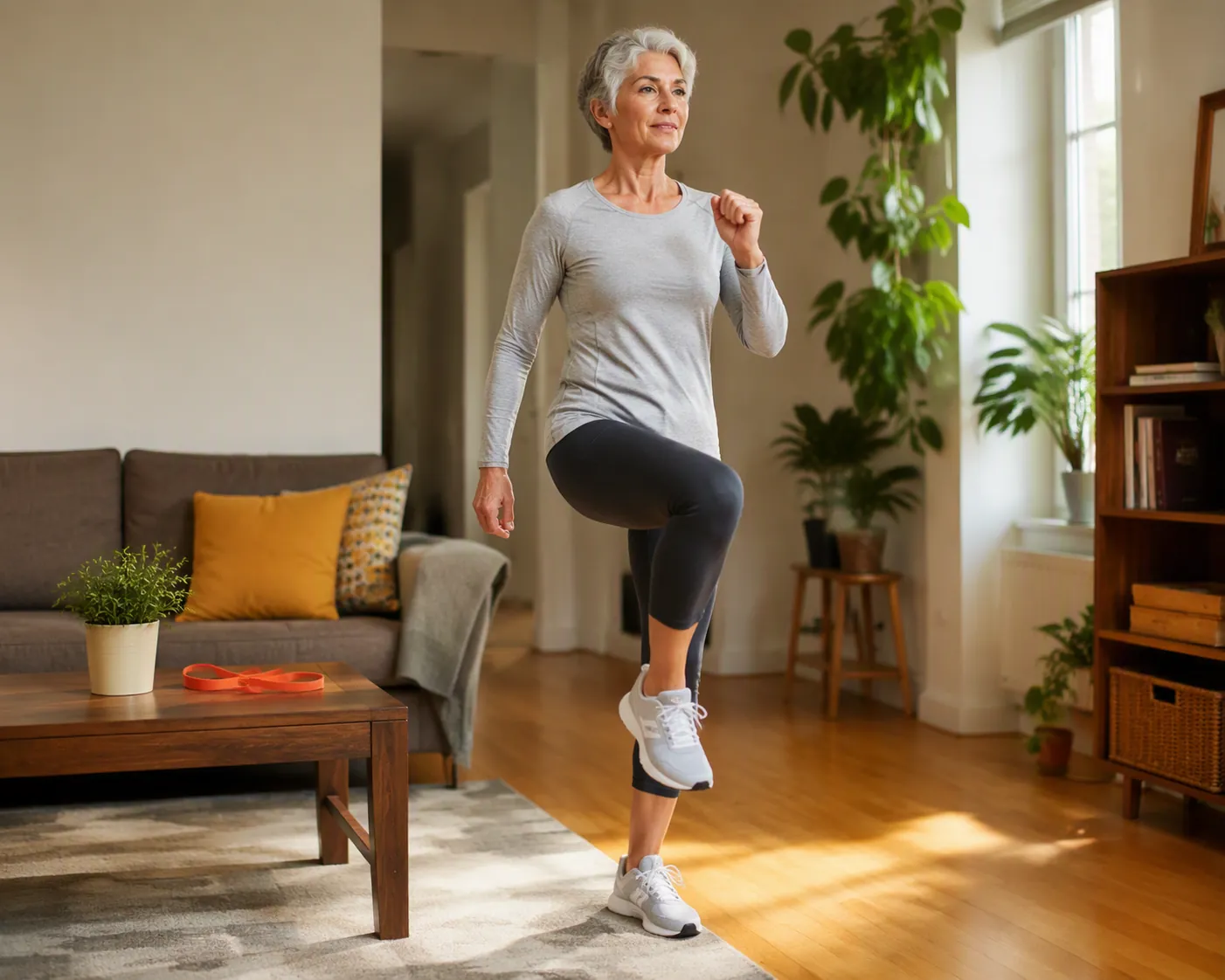
Moderate aerobic activity does not have to mean running, jumping, or owning a treadmill. At home, the most repeatable version is usually brisk walking in place or around a short loop, with the arms moving enough that the session feels purposeful rather than like waiting for the kettle.
A simple 25-minute indoor aerobic session can be built like this: 3 easy minutes to warm up, 18 to 20 minutes of brisk marching or indoor walking, then 2 to 4 easier minutes to come down. If the room is tiny, turn it into intervals: march in place, walk to the doorway and back, do low step-ups on a stable bottom stair if you have one, then return to marching. The point is not choreography. The point is accumulating enough moderate work across the week.
The Alzheimer’s Society summarizes a combined analysis of 58 studies in which regular exercisers were up to about 20% less likely to develop dementia than non-exercisers.[5] That kind of evidence should not be inflated into a guarantee for an individual household. It does support the ordinary, unglamorous choice to make regular movement part of a prevention plan.
The two strength days should be boring in the best way
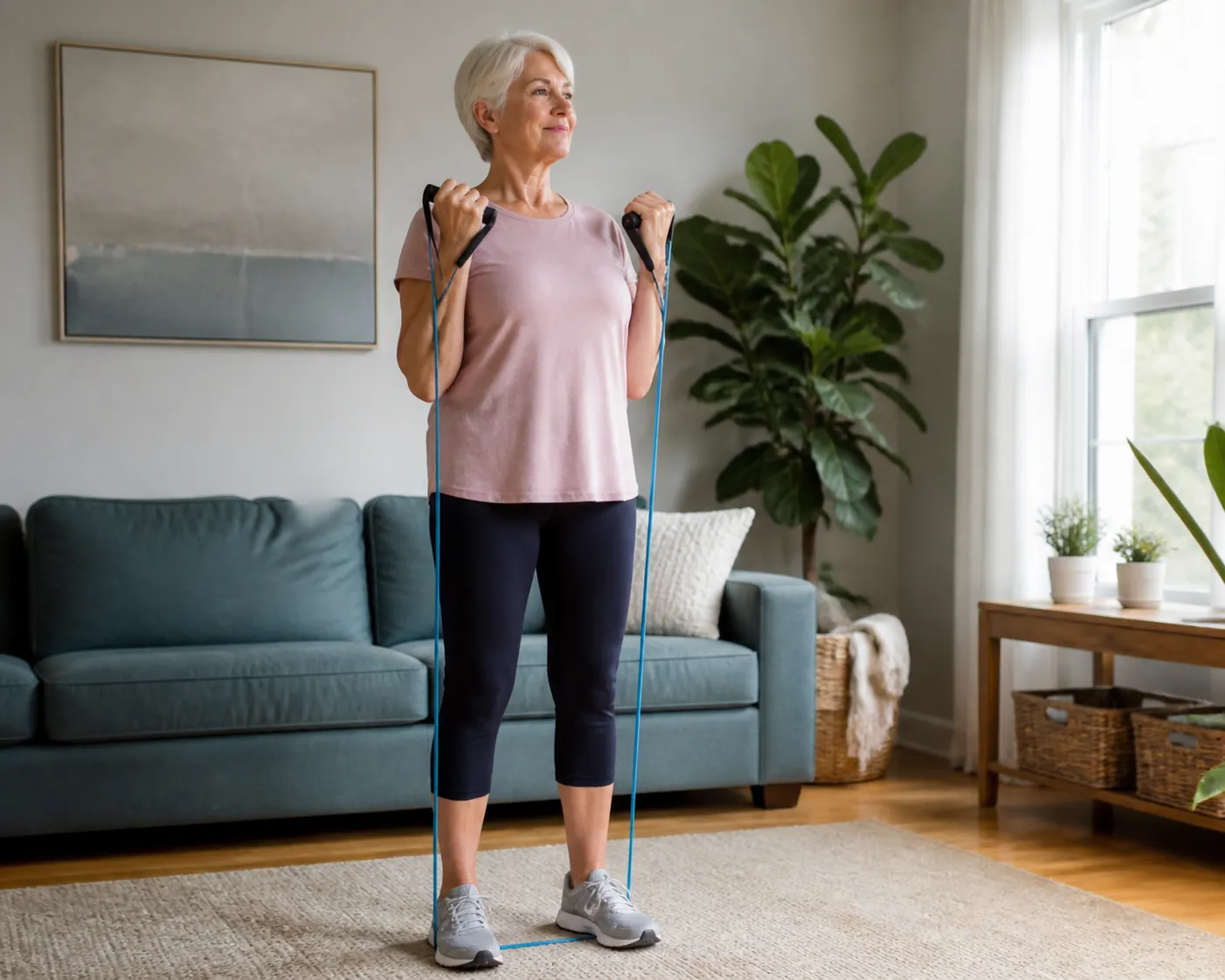
Strength training is the part people often overcomplicate. The WHO target is not “buy a machine.” It is muscle-strengthening activity on at least 2 days per week.[2] The Alzheimer’s Society lists free or low-cost home options such as resistance bands, heavy books or cans, bodyweight moves, yoga, tai chi, and Pilates.[5]
For a 20- to 30-minute home strength session, pick one lower-body move, one upper-body push, one upper-body pull, one hip or back-of-leg move, and one trunk or carry variation. That can be chair squats, wall push-ups, a resistance-band row, a slow hip hinge, and a suitcase carry with a loaded tote bag. If noise is the apartment problem, a quiet strength plan is more relevant than a harder workout. If the bigger question is where to start in midlife, a 2-day per week perimenopause strength routine gives a useful beginner pattern without turning strength work into a second job.
A 2021 review in the International Journal of Environmental Research and Public Health found that the combination of aerobic and resistance exercise appeared to have the best preventive effect in the evidence it reviewed, which fits the practical shape of the WHO-aligned week: walking alone is useful, but it should not crowd out the 2 strength days.[6]
Balance work is not only for people who feel unsteady
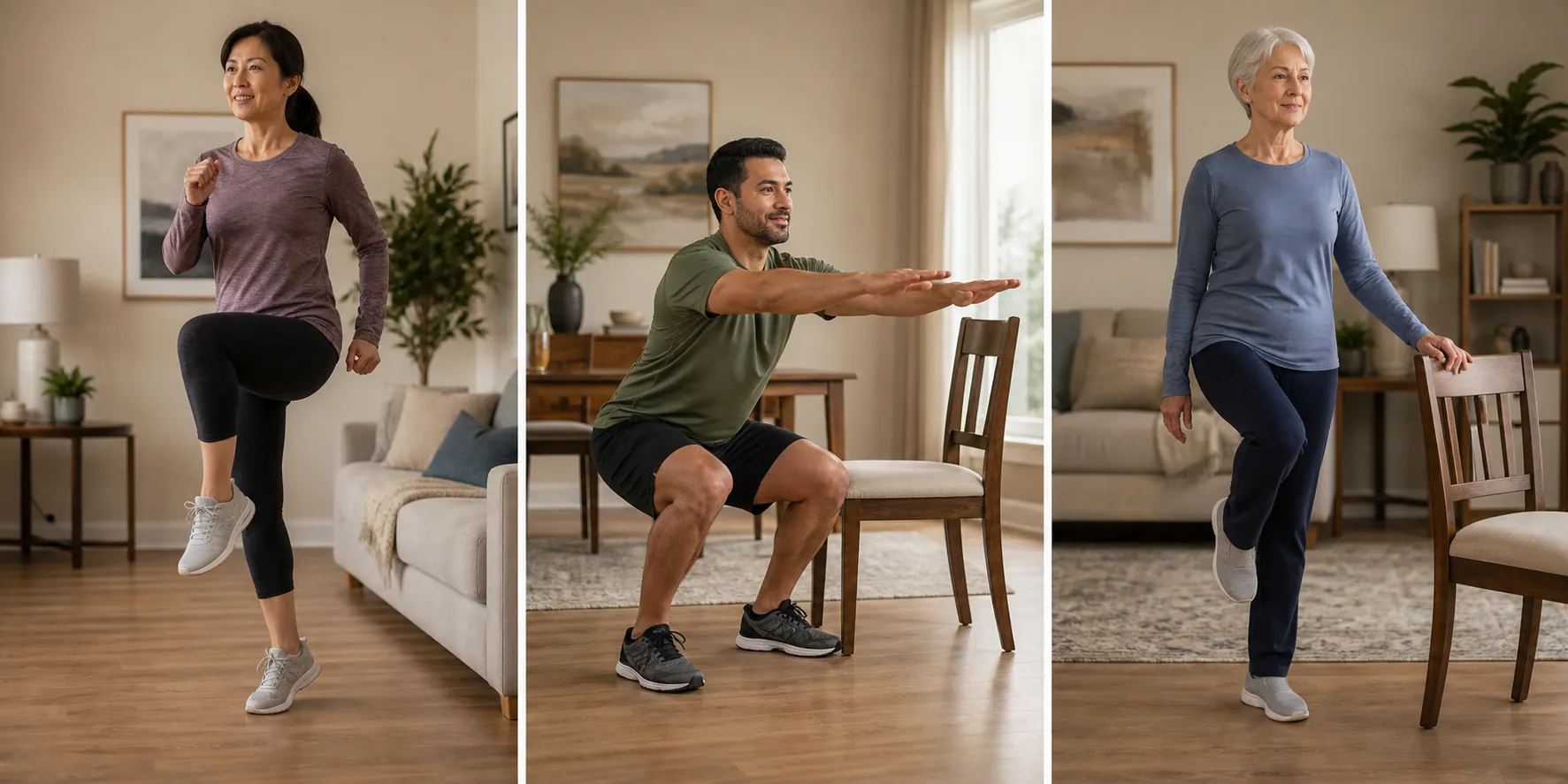
For adults 65 and older, WHO adds a specific target: varied multicomponent physical activity that emphasizes functional balance and strength on at least 3 days per week.[2] At home, that does not require a balance board. It can be 5 minutes after a walk: stand near a chair, shift weight from foot to foot, practice a controlled heel-to-toe walk along a counter, or hold a chair-supported single-leg balance.
The safety rule is simple: balance training should challenge control, not gamble with a fall. Use a chair back, counter, wall, or closed doorframe. If a move makes you grab suddenly or twist awkwardly, make it easier.
A WHO-aligned home week
The lowest complete aerobic version is 150 moderate minutes. Six 25-minute sessions gets there without asking for a heroic Sunday. Strength goes on 2 days. Balance appears 3 times, especially for adults 65 and older. The week below is a template, not a medical prescription.
| Day | Home session | What it accomplishes |
|---|---|---|
| Monday | 25 minutes brisk indoor walking or marching; 20 minutes strength: chair squats, wall push-ups, band rows, calf raises | Moderate aerobic work + strength day 1 |
| Tuesday | 25 minutes walk-march intervals; 5 minutes chair-supported balance | Moderate aerobic work + balance |
| Wednesday | 25 minutes brisk walking around the room, hallway, or yard; easy mobility if wanted | Moderate aerobic work |
| Thursday | 25 minutes marching or low step-ups; 20 minutes strength: hip hinges, counter push-ups, band pulls, loaded carry | Moderate aerobic work + strength day 2 |
| Friday | 25 minutes indoor walk; 5 minutes heel-to-toe walking near a counter | Moderate aerobic work + balance |
| Saturday | 25 minutes brisk walk-march session; 5 to 10 minutes tai chi-style weight shifts or yoga-style balance | Moderate aerobic work + balance |
| Sunday | Optional easy walk, stretching, or rest | Recovery or extra minutes toward the 300-minute upper range |
This version reaches 150 minutes of moderate aerobic activity before counting any optional Sunday movement. If 25 minutes feels too long at first, split it. A morning 10 minutes, an afternoon 5 minutes, and an evening 10 minutes still build the day. If 150 minutes is already routine, extend two or three walks or use Sunday to move gradually toward the 300-minute upper end of the moderate range.[2]
The schedule is also small-space friendly. A resistance band fits in a drawer, a sturdy chair covers squats and balance support, and household objects can load carries or simple lifts. If you eventually want a more permanent setup, use gear to make the routine easier to repeat, not to make it more complicated; a phased small apartment home gym or a small-space gym under $500 only makes sense after the basic week is working.
How to make the week survivable
Start with the aerobic minutes you can repeat, then add strength. Many people do this backward: they design the perfect routine, miss Wednesday, and decide the week is ruined. The WHO good-practice message is friendlier and more useful than that: some physical activity is better than none.[2]
- If you are inactive now, begin with 10 to 15 minutes of indoor walking on most days and add minutes before adding intensity.
- If walking in place feels dull, alternate 2 minutes marching, 1 minute hallway walking, and 1 minute low step-ups.
- If strength training is new, do one set of each move for 2 weeks, then add a second set.
- If balance work makes you nervous, keep one hand on a chair and make the movement slower rather than more dramatic.
- If the week collapses, restart with the next 10-minute walk. Do not wait for Monday.
Health-outcome articles can easily overpromise what home exercise does. The same caution applies here as it does in evidence-based discussions of whether home workouts can lower LDL cholesterol: the routine can be worth doing even when the outcome is probabilistic, influenced by other risks, and not visible week to week.
Where this plan stops
For adults with normal cognition, physical activity belongs in a serious dementia-risk reduction plan. For adults with mild cognitive impairment, the WHO recommendation has been more conditional.[3] For people with established dementia, the claim becomes narrower still: exercise may be used for general health, function, mood, mobility, or supervised care goals, but this home plan should not be presented as a cognitive treatment.
The 2021 review that supports combined aerobic and resistance work also notes the cautionary DAPA trial finding of no cognitive benefit from an exercise program in established dementia.[6] That does not make exercise useless. It keeps the prevention claim in the right lane.
If you are an adult with normal cognition trying to reduce future dementia risk, the WHO-aligned exercise target is not exotic and it is not gym-dependent. It is 150 to 300 minutes of moderate aerobic movement, 2 strength days, and—especially after 65—regular balance work. Done at home, that can look like brisk marching before dinner, chair squats twice a week, band rows beside the sofa, and a few careful balance minutes with a hand near a chair.
References
- New WHO guidelines: up to 45% of dementia risk could be prevented or delayed, World Health Organization, 15 July 2026
- WHO Guidelines on Physical Activity and Sedentary Behaviour, NCBI Bookshelf
- Reducing the Risk of Cognitive Decline and Dementia: WHO Recommendations, Frontiers in Neurology, 2022
- Dementia prevention, intervention, and care: 2024 report of the Lancet standing Commission, The Lancet, 2024
- Physical activity and exercise, Alzheimer’s Society
- Exercise as a Preventive Strategy against Dementia: A Review, International Journal of Environmental Research and Public Health, 2021
What a small equipment investment adds
Cable Machine Alternatives That Save Space and Money
Compare the best cable machine alternatives for home gyms – from resistance bands and pulley systems to suspension trainers and compact digital units – and find the right option for your space and budget.
Small Treadmill Buying Guide: 7 Critical Specs to Check Before You Buy
A cross-category spec primer for apartment and small-space dwellers comparing walking pads, ultra-compact folding treadmills, and full-size folding treadmills. Learn the concrete thresholds for motor HP, deck length, noise, warranty, and subscription lock-in so you can compare apples to apples.
How to Practice Basketball at Home Without Noise Complaints
Learn how to run a full basketball workout in a small apartment without noise complaints. This guide covers no-dribble handling drills, wall form shooting, and silent ball options that let you train without disturbing neighbors.
How often should you repeat this?
See our recovery and rest reference for citation-anchored rest-interval guidance.
Spot something off?
Tell us if a movement, tier assumption, or duration didn't match your experience.