
How to Start Home Rehab Exercises After a Fall
Older adults returning to movement after a fall need a staged plan, not a generic list of balance exercises. This guide maps the home rehab progression — medical clearance, seated mobility, leg strength, balance holds, and functional walking — with rep progressions, weekly dose anchors, and red-flag stop rules drawn from evidence-backed fall-prevention programs.
- Equipment tier required
- none
- Duration
- 15 min
- Difficulty
- beginner
- Target area
- Legs
- Space footprint needed
- Small (chair and counter)
- Noise level
- Low
The first question after a fall is not which balance drill to do. It is whether home rehab exercises are appropriate yet. For adults 65 and older, falls are common enough that families can start treating them like “one of those things,” but the numbers argue against brushing them off: about 1 in 4 older adults falls each year, fewer than half tell their doctor, and falling once doubles the chance of falling again. Among older adults who fall, 37% are injured, and the CDC specifically says to see a doctor right away after a head impact, especially if the person takes blood thinners. [1]
That does not mean every fall turns an independent adult into a patient. It means the fall changes the rules for a while. A chair that felt ordinary yesterday may feel too low today. A rug edge suddenly matters. A hallway that used to be crossed without thought may become a negotiation. Good home rehab respects that moment instead of pretending the answer is simply “do 10 balance exercises.”
Start with the clearance gate
If any of the following are present, do not start a home exercise session. Call a doctor, urgent care, or emergency services as appropriate:
- The person hit their head, especially if they take blood thinners. [1]
- There was loss of consciousness, confusion, or a new severe headache after the fall. [2]
- A limb looks deformed, the person cannot bear weight, or pain is sharp, worsening, or clearly different from ordinary soreness. [2]
- Dizziness, chest symptoms, breathing trouble, or faintness is present before or during movement. [3][4]
- Pain lingers beyond about 3 days after the fall or is not improving. [2]
This is the part families often get wrong in both directions. One person wants to rush to the doctor for every bruise; another wants to “walk it off” because no bone is obviously broken. The safer middle ground is simple: red flags make this a medical question first. Once a clinician has cleared the person for gentle home movement, the work can become exercise again.
What the home progression is based on — and what it is not
The staged plan below borrows from fall-prevention and older-adult exercise evidence. It is not proof that one universal “post-fall home rehab protocol” has been tested for every older adult after every kind of fall. That distinction matters. A recently fallen person may have pain, bruising, fear, medication changes, or a medical cause for the fall that a general fitness article cannot clear.
The closest home-based analogue is the Otago Exercise Program, which combines 17 strength and balance exercises with walking, is done at home 3 times per week, and is associated with a 35–40% fall reduction in the NCOA program summary. [5] Broader older-adult guidance points in the same direction: ACSM summarizes evidence that physical activity reduces fall-related injury risk by 32–40%, with the strongest evidence for multicomponent programs that combine balance, strength, and aerobic work. [6] A 2023 systematic review of 29 randomized controlled trials with 4,330 participants also found that balance, strength, and multicomponent programs improved mobility, balance, and leg strength and reduced injurious falls, though program length and dosage varied widely. [7]
So the plan should not be balance-only. It should move from safer positions toward ordinary daily function: seated mobility, leg strength, balance holds, then walking.
| Phase | Main purpose | Move forward when |
|---|---|---|
| Clearance | Rule out injuries or symptoms that need medical care first | No red flags are present and the person has been cleared for gentle movement |
| Seated mobility | Restart motion without making standing balance the starting line | Movement feels controlled and symptoms stay quiet |
| Leg strength | Rebuild the sit-to-stand, calf, knee, and hip strength needed for rooms, chairs, and steps | 10–15-rep sets are comfortable and form stays steady |
| Balance holds | Practice steady standing near support before adding harder foot positions | 10-second holds are steady before building toward 30 seconds |
| Functional walking | Return the work to hallways, kitchens, sidewalks, and weekly activity habits | Short indoor walks feel safe and do not provoke symptoms |
Set up the room before setting the reps
A safe home setup is not a shopping list. Use a sturdy chair that does not slide, a kitchen counter or heavy table, a clear patch of floor, and shoes or bare feet depending on what gives the person better traction at home. Skip rolling desk chairs, low sofas, soft beds, loose rugs, and “just hold the wall” improvising when a counter is available.
For early balance work, someone should be nearby if possible. Johns Hopkins specifically advises talking to a doctor or physical therapist first, having someone with you, and doing balance progressions in a corner or near a counter. [3] That nearby person is not there to hover or grab. They are there so the older adult can practice without feeling abandoned in the one moment when fear can take over.
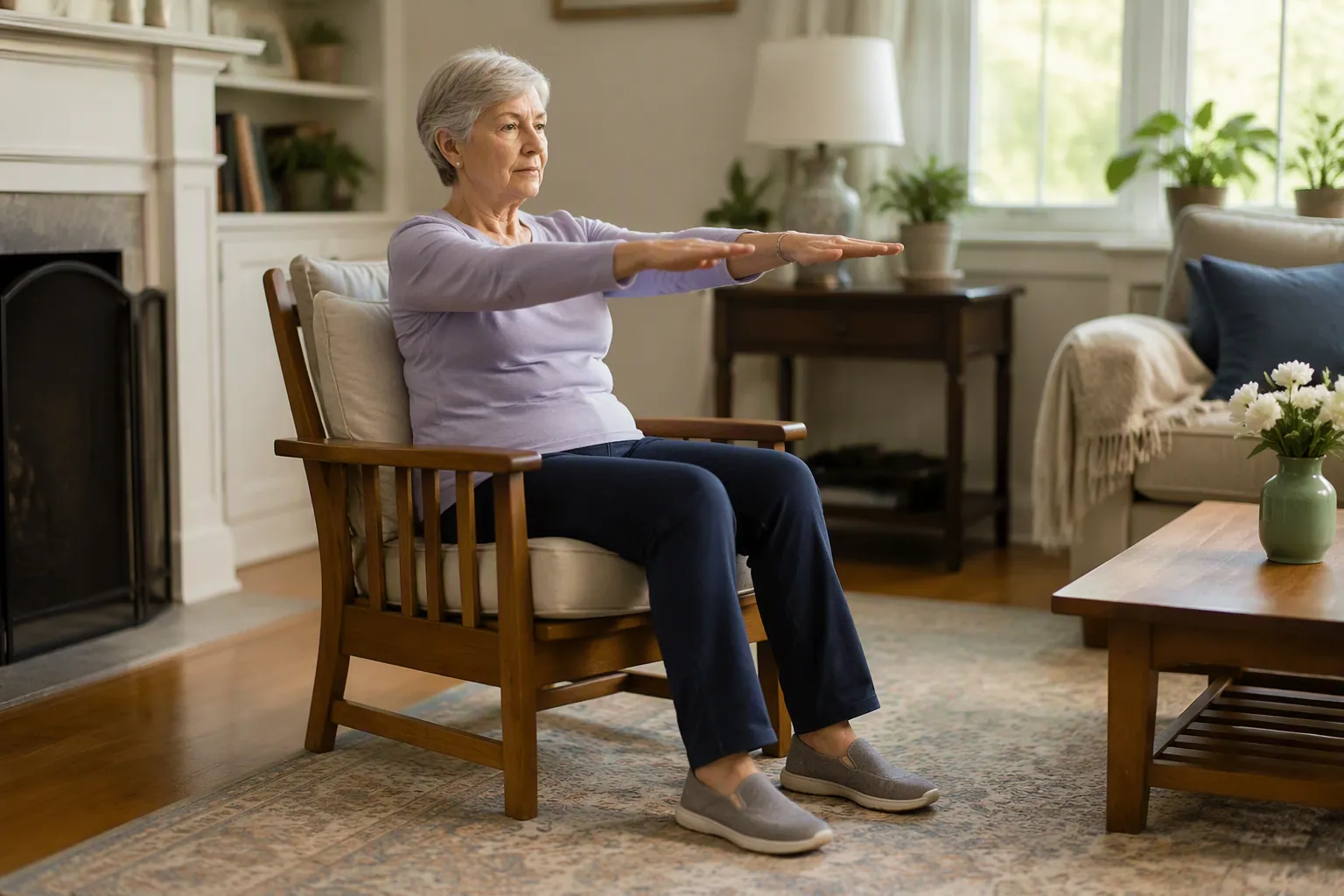
Phase 1: Seated mobility before standing balance
Seated work is not a consolation prize. After a fall, it lets the person test range of motion, breathing, pain response, and confidence without requiring them to manage standing balance at the same time. Start in a firm chair with both feet flat, hips toward the front half of the seat, and the counter or a helper close enough for the next transition.
A simple first session can include gentle shoulder reaches, ankle pumps, slow seated marching, and knee extensions. MedlinePlus includes leg extensions and hamstring stretching among home exercises to help prevent falls, with many of its strengthening moves performed for 10–15 repetitions. [4] Keep the first day easier than the person thinks they can handle. The goal is to see how the body responds later that day and the next morning.
- Stop if pain increases rather than warms up.
- Stop if dizziness, unusual breathlessness, or a “not right” feeling appears. MedlinePlus says pain, dizziness, or breathing problems are reasons to stop and talk to a provider. [4]
- Do not use seated exercises to talk yourself out of a medical evaluation when red flags are present.
Phase 2: Rebuild the legs around the chair
The chair is where fall recovery becomes practical. Getting out of a chair, lowering onto a toilet, standing at the sink, and stepping over a threshold all ask for leg strength before they ask for impressive balance. Start with the chair, not the floor.
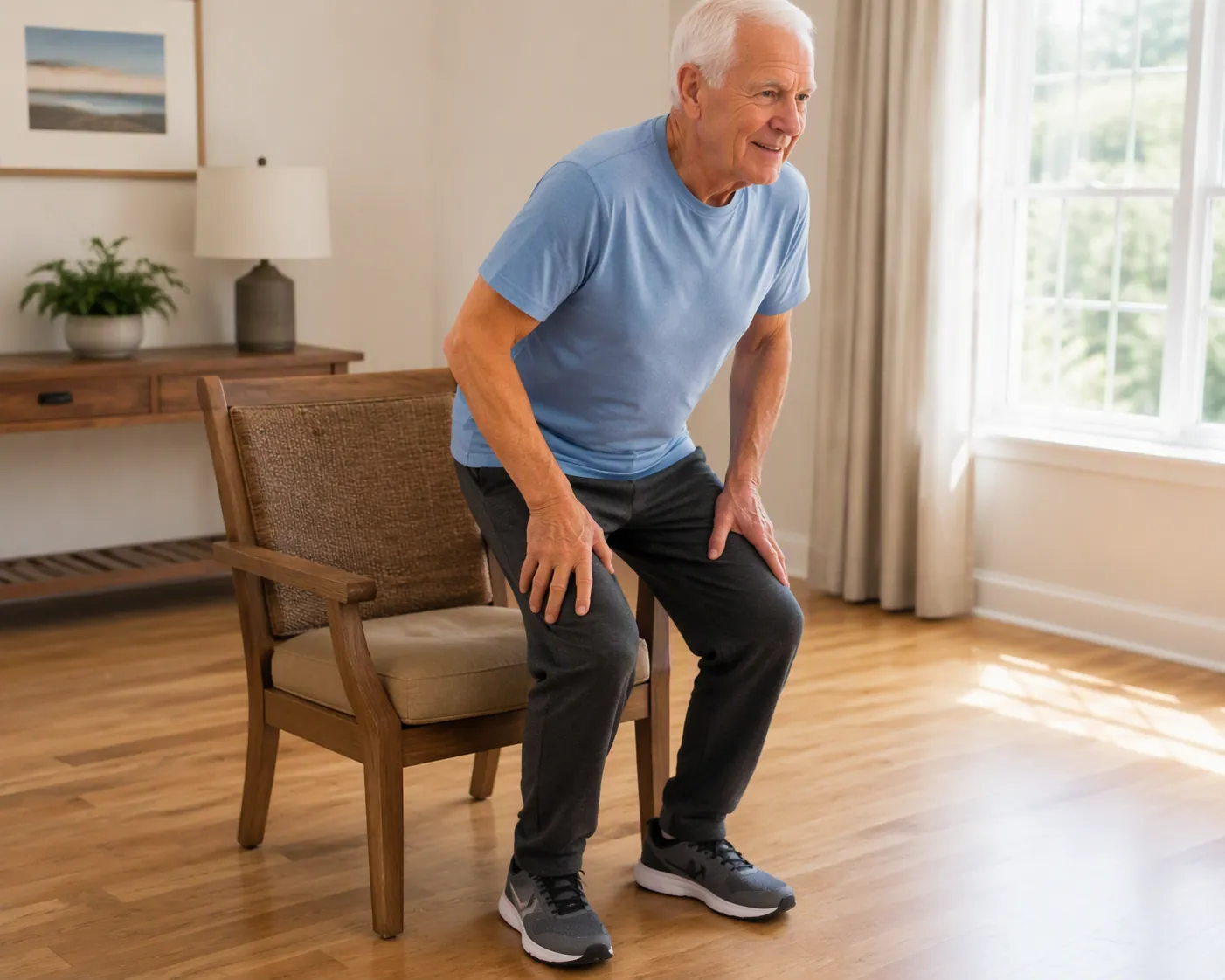
Sit-to-stand
Johns Hopkins gives a clear sit-to-stand starting point: 10 repetitions twice a day, progressing from using the hands to less hand support, then eventually toward no hands as appropriate. [3] At home, that means choosing a solid chair, placing the feet under the knees, leaning slightly forward, standing up, pausing, and sitting down with control instead of dropping into the seat.
Do not rush the no-hands version. If the person has to rock hard, twist, hold their breath, or collapse on the way down, the progression is too fast. Hands on the chair arms or thighs are not failure; they are the current safe level.
Toe stands, knee curls, and leg extensions
Once sit-to-stand feels predictable, add a few low-cost standing and seated strength moves near support. MedlinePlus lists toe stands, knee curls, and leg extensions, commonly in the 10–15-repetition range, with ankle weights as a later progression when appropriate. [4] The counter matters here. A calf raise done with light counter support is more useful than a wobbly version done to prove independence.
- Toe stand: hold the counter, rise onto the balls of the feet, lower slowly.
- Knee curl: hold the counter, bend one knee to bring the heel back, lower with control.
- Leg extension: sit tall, straighten one knee, pause briefly, and lower.
For a fuller non-fall-specific leg routine, use the deeper senior leg-exercise progression. In this post-fall plan, leg work stays tied to clearance, symptom monitoring, and the next phase: safer standing.
Phase 3: Balance holds near a counter, not in the middle of the room
Balance practice should feel boring at first. That is a compliment. The early goal is not to challenge the nervous system with clever drills; it is to stand still safely enough that the person can trust their feet again.
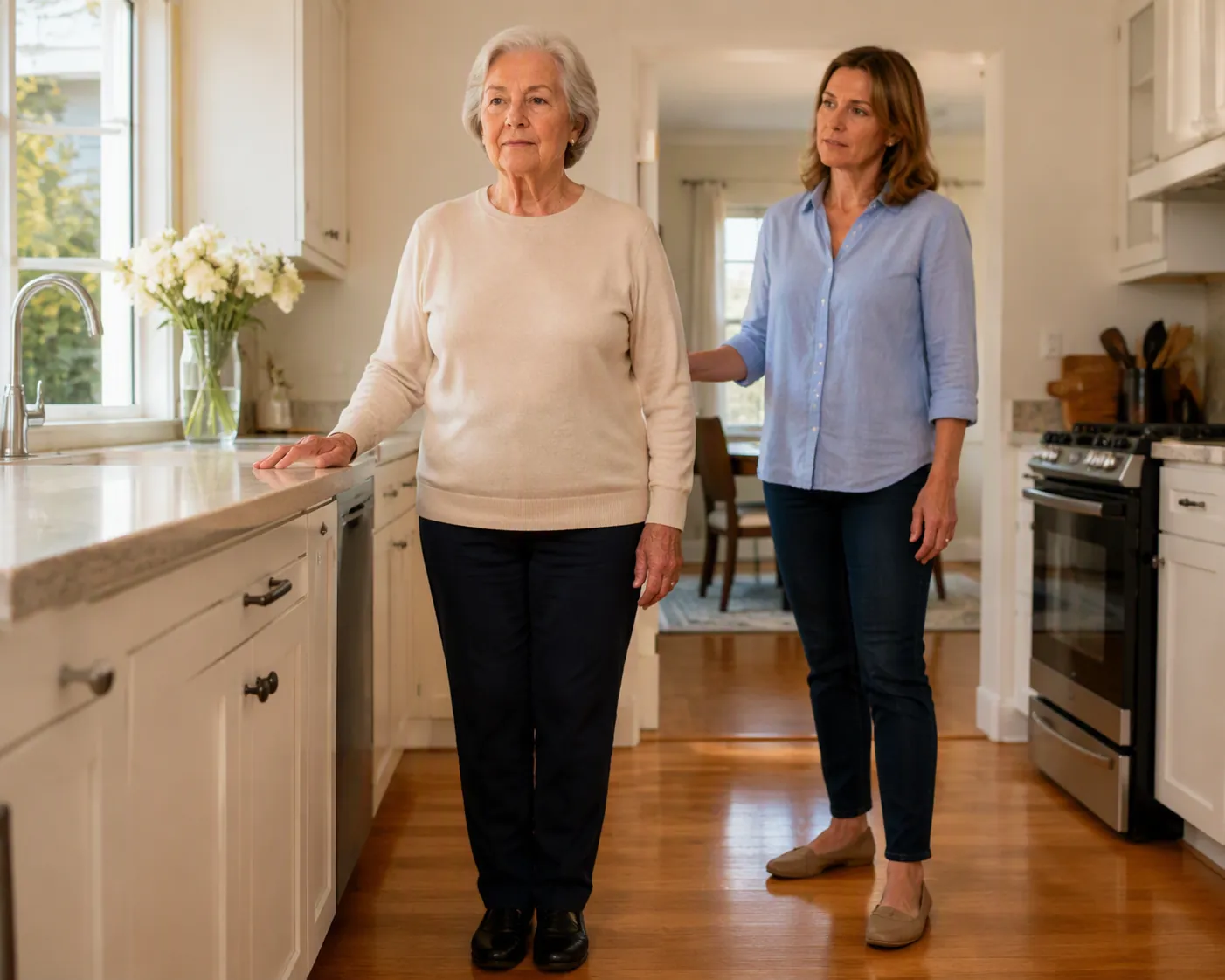
Johns Hopkins describes a home balance progression that moves from feet apart to feet together, then to one-foot positions and eyes-closed variants only as appropriate. Holds begin around 10 seconds and work toward 30 seconds, for five repetitions, twice daily, done in a corner or near a counter. [3] Mayo Clinic also uses supported weight shifts and single-leg balance progressions, building toward 30-second holds and using a table, counter, or chair for support; it advises getting provider approval first when balance problems are serious. [9]
| Balance position | How to use it | Do not progress if |
|---|---|---|
| Feet apart | Stand near the counter, touch down lightly as needed, and hold about 10 seconds before building longer | The person sways hard, grabs suddenly, or feels dizzy |
| Feet together | Bring the feet closer only when feet-apart holds are calm | The knees lock, breath is held, or fear spikes |
| Narrowed stance or one-foot practice | Use only with support close by and preferably someone nearby early on | The person cannot step out safely or needs to lunge for the counter |
| Eyes-closed variants | Reserve for people who are steady, cleared, and supervised | There is any uncertainty; vision removal makes the drill much harder |
A useful rule: the hand may hover, tap, or rest lightly on the counter, but the body should not be secretly hanging from it. If the person has to grip hard to survive the hold, return to the easier foot position. The success is not “no hands at all costs.” The success is a steadier body with symptoms quiet.
Phase 4: Turn exercise back into walking
Walking is the destination of this plan, not an afterthought. A person does not need better balance for its own sake; they need it to cross the bedroom at night, carry a cup from the sink, answer the door, and walk outside without shrinking their world.
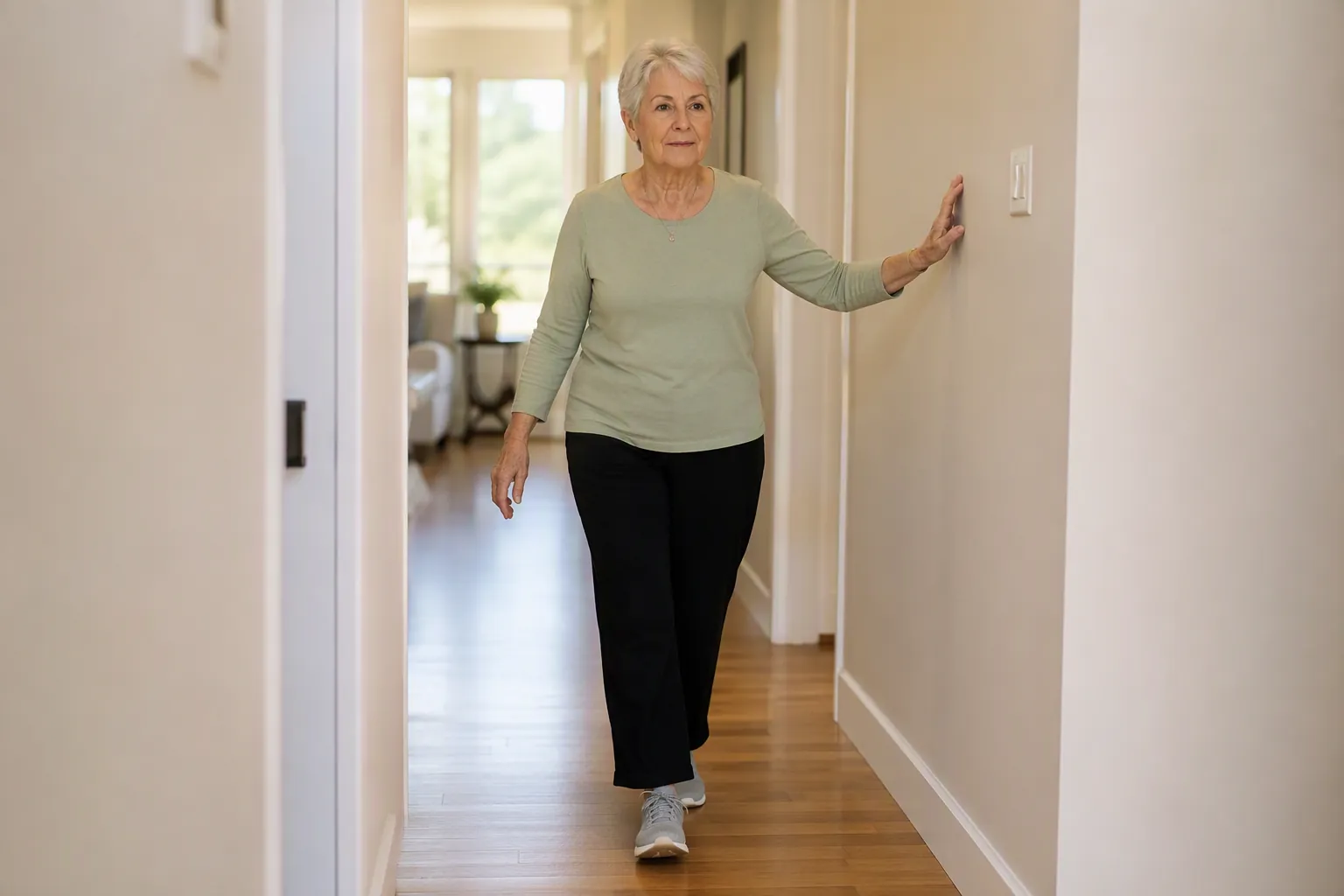
Start with short indoor walks on a clear route: chair to counter, counter to hallway, hallway back to chair. Add heel-to-toe walking only when ordinary walking is steady enough to make the narrower step safe. The CDC lists heel-to-toe walking and standing from sitting as examples of balance activities for older adults. Its long-term activity anchors are 150 minutes per week of moderate-intensity aerobic activity, muscle-strengthening activity on 2 or more days per week, and balance activities. [8]
Those CDC numbers are not a first-week demand after a fall. They are a horizon. In the early stage, a few short, calm walks through the home may be the right dose. Over time, walking can stretch into longer indoor routes, then safe outdoor routes, then the weekly activity pattern the person can actually keep.
Fear deserves attention here because it changes behavior. The CDC describes a cycle in which fear of falling can lead older adults to reduce activity, become weaker, and increase their risk of falling. [1] The answer is not cheerleading. It is controlled exposure: a clear path, a nearby support, a small walking target, and a stop point before fatigue scrambles the feet.
How to know whether to repeat, progress, or step back
Progress after a fall should be earned by quiet symptoms, not by impatience. Repeat the same phase when the person feels more cautious than sore, when the movement is improving but not automatic, or when a caregiver is not available for the next balance challenge. Progress when the current work is steady across more than one session, the person can breathe normally, and the movement looks controlled at the end of the set as well as at the beginning.
Step back when pain increases, dizziness appears, breathing feels wrong, fatigue changes the gait, or confidence drops sharply. Johns Hopkins and MedlinePlus both include stop rules around pain and symptoms during these kinds of home exercises. [3][4] A step back might mean using the chair arms again, returning from feet-together balance to feet-apart balance, shortening the walking route, or taking the exercise question back to a clinician.
If the home feels too cramped, borrow the same logic from a small-space routine: clear the floor first, use furniture that will not move, and keep the work close to support. A low-equipment setup is enough. The chair-and-counter mobility plan for seniors and the $0 small-space workout setup are useful companions when the issue is space rather than exercise selection.
A practical weekly shape after clearance
The safest weekly shape is usually not a long workout. It is short practice repeated often enough that daily movement stops feeling like a test. After clearance, one reasonable home pattern is seated mobility most days, sit-to-stand and simple leg strengthening several days per week, supported balance practice when someone or a counter is available, and short walks that gradually connect into normal household movement.
If the person already has a physical therapist’s plan, that plan wins. If they do not, use this staged order rather than grabbing the hardest balance drill from a list. The evidence base favors multicomponent work — strength, balance, and walking — but the home version still has to answer to the person in the room: Are they cleared? Are symptoms quiet? Is the chair sturdy? Is the counter close? Can they stop before fatigue makes the next step messy?
After medical clearance, home rehab is best treated as a staged return to ordinary movement. Start seated, strengthen around the chair, practice balance near support, and let walking become the measure that matters. Advance only while symptoms stay quiet, confidence improves, and the red flags remain absent.
References
- Facts About Falls — Centers for Disease Control and Prevention.
- Fall Pain: When to See a Doctor After a Fall — Rochester Regional Health.
- Fall Prevention Exercises — Johns Hopkins Medicine.
- Exercises to Help Prevent Falls — MedlinePlus.
- Evidence-Based Program: Otago Exercise Program — National Council on Aging.
- Physical Activity and Function in Older Age — American College of Sports Medicine.
- Exercise interventions for fall prevention in community-dwelling older adults: a systematic review and meta-analysis — 2023.
- Older Adults: Physical Activity Guidelines — Centers for Disease Control and Prevention.
- Balance exercises — Mayo Clinic.
What a small equipment investment adds
We don't have a build tagged to this exact tier yet. Browse all builds.
How often should you repeat this?
See our recovery and rest reference for citation-anchored rest-interval guidance.
Spot something off?
Tell us if a movement, tier assumption, or duration didn't match your experience.