
The Right Dose of Home Workouts to Improve Focus
Short, moderate exercise breaks during the workday can lift focus for about an hour, while a consistent weekly base builds longer-term attention gains. This dose-timed plan gives remote workers and students apartment-safe, no-equipment routines for improving concentration naturally.
- Equipment tier required
- none
- Duration
- 10-30 min
- Difficulty
- beginner
- Target area
- full body
- Space footprint needed
- about one yoga mat
- Noise level
- low
The useful question is not whether movement is “good for the brain.” It is whether standing up from a desk in a small apartment will help you read, write, code, study, or finish the next block of work without turning the break into another task you now have to recover from.
For home workouts to improve focus and concentration naturally, the dose matters more than the novelty of the routine. A short, moderate workout can be used tactically before a demanding work block, with the attention lift expected to be temporary — roughly up to about an hour afterward. Longer-term attention changes belong to a different clock: repeated training over roughly 12 weeks to 6 months, not one unusually virtuous Tuesday workout.[1]
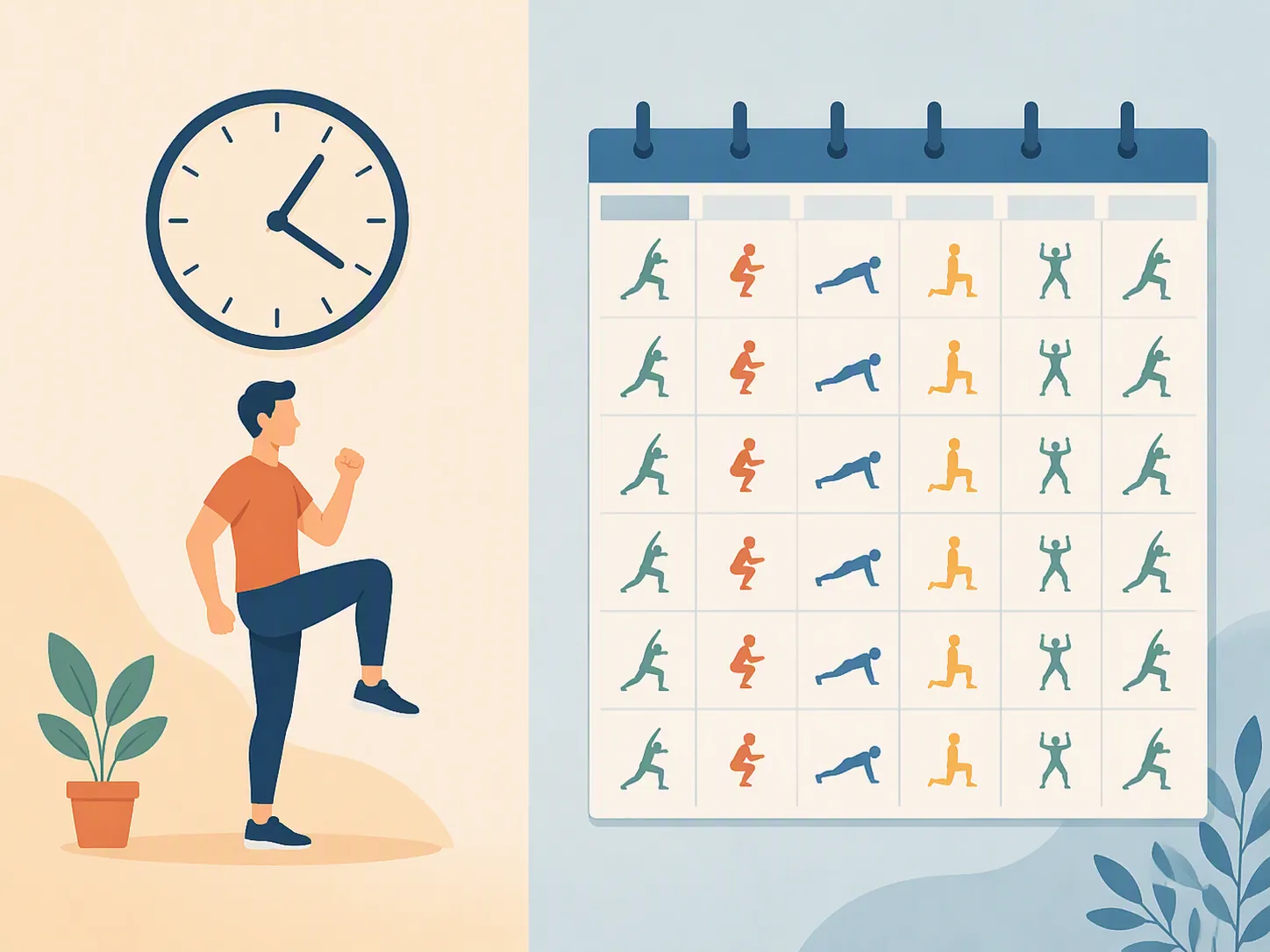
That split is freeing. You can use a 10- to 30-minute moderate session today because your next hour matters. You can also stop expecting that session to rebuild your concentration permanently. For that, the boring part — the weekly base you can repeat — has to exist.
| If you need… | Use this | Best timing |
|---|---|---|
| A quick reset before one focused block | 10-minute low-impact circuit | 5–15 minutes before starting the task |
| A stronger same-day focus break | 20-minute moderate walk, step-up, or low-impact interval session | Before reading, writing, studying, planning, or deep work |
| A cleaner transition back to the desk | 5-minute breathing or yoga-style bookend | Immediately after the workout |
| Longer-term concentration gains | A modest weekly base repeated for months | Most weeks, at an effort you can sustain |
The same-day clock: use movement before the work that needs attention
A focus workout is best placed before the block that needs focus, not after you have already spent the hour fighting your own attention. If your concentration usually slides at 2:30 p.m., the useful move is not to promise yourself a full workout after dinner. It is to put a moderate, low-friction movement break between the slump and the next thing you need to do.
Moderate is the important word. This is not a punishment circuit. You should feel warmer, more awake, and slightly out of breath, but still able to speak in short sentences. If you finish so drained that you need a shower, a snack, and 20 minutes of scrolling before you can work again, the workout may be fit for another purpose, but it has failed as a focus break.
A 10-minute apartment-safe circuit
Use this when you are foggy but cannot afford a long interruption. It needs no equipment, no jumping, and about the floor space of a yoga mat.
- Minute 1: easy marching in place, shoulders relaxed, arms swinging naturally.
- Minutes 2–3: bodyweight squats to a chair or couch height. Keep the pace steady rather than fast.
- Minutes 4–5: low step-ups on a sturdy step or stair. Alternate legs.
- Minutes 6–7: wall push-ups or desk push-ups, keeping the body straight and the movement controlled.
- Minutes 8–9: brisk marching, side steps, or quiet knee lifts.
- Minute 10: slow walk around the room while breathing through the nose if comfortable.
The step-up is useful in small rooms because it raises effort without impact noise. The same is true of chair squats. They ask more from the legs than casual pacing, but they do not require a downstairs neighbor to share your productivity experiment.
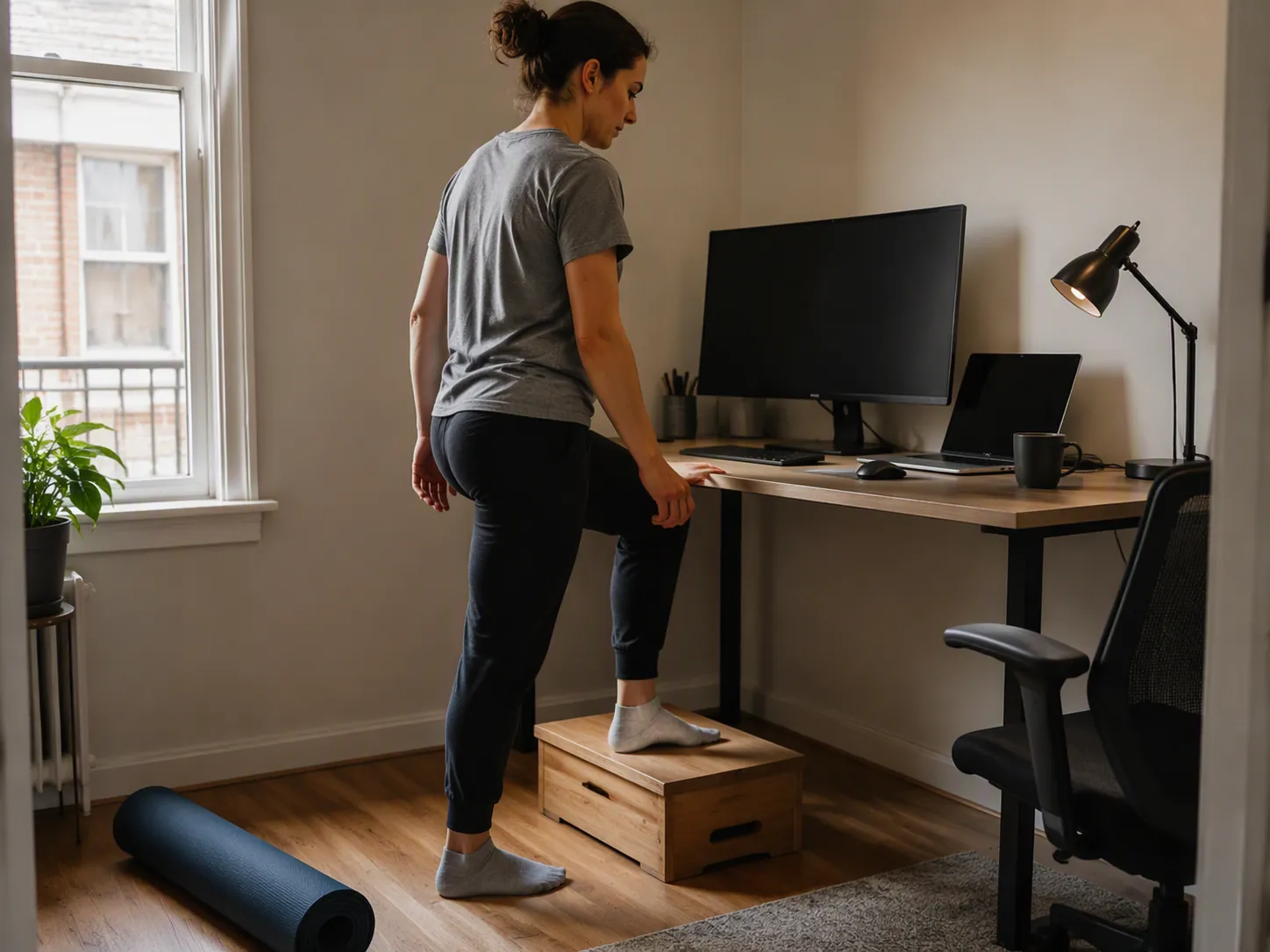
If squats bother your knees, reduce the depth and sit back to an actual chair. If step-ups feel awkward or noisy, replace them with marching, heel raises, or slow alternating reverse lunges only as far as you can control. The point is to reach moderate effort without turning the room into a gym or the break into a performance.
When 20 minutes makes more sense
Use the longer option before work that has a high switching cost: reading dense material, writing from scratch, preparing for an exam, reviewing numbers, or doing any task where the first 15 minutes are usually spent trying to become a person again. A 20-minute moderate session gives you more time to settle into effort without needing high intensity.
- Indoor walking route: walk briskly through your available space, turn slowly, and keep the pace even.
- Step-up session: alternate 1 minute of step-ups with 1 minute of easy marching for 20 minutes.
- Low-impact intervals: alternate 2 minutes of brisk marching or side steps with 1 minute of easier movement.
- Quiet shadow boxing: keep the feet mostly planted, move the arms at a moderate rhythm, and avoid twisting hard on the knees.
The 20-minute version should still leave you able to sit down and work soon afterward. If it becomes a maximal interval workout, the cost changes: more sweat, more breathlessness, more transition time, and sometimes more appetite for avoiding the task you supposedly trained for.
How to tell if the dose was right
The right same-day dose has a very plain signature: you return to the desk feeling more awake, not heroic. Your body is warm. Your breathing has changed but is settling. You can open the document, book, or problem set without needing a long emotional negotiation.
- Too easy: you feel exactly as foggy as before, and your body never really warmed up.
- About right: you feel alert, slightly energized, and ready to begin within a few minutes.
- Too hard: you need a long cooldown, feel scattered, or start bargaining for more recovery time.
This is where many home routines go wrong. They borrow the feeling of a workout designed for fitness progress and use it in a slot that needs cognitive readiness. Those are not always the same dose.
The 5-minute bookend that makes the break usable
A short breathing or yoga-style bookend is not the main engine of the focus effect here. Its job is simpler: it helps you cross back from movement to concentration without opening a new tab, checking messages, or letting the break sprawl.
- Minute 1: stand still or sit tall and let breathing slow down naturally.
- Minute 2: do a gentle forward fold or seated fold, with no forcing.
- Minute 3: open the chest with hands behind the back or arms wide against a wall.
- Minute 4: take slow breaths, making the exhale slightly longer than the inhale if that feels comfortable.
- Minute 5: sit down, write the first concrete action for the next work block, and start there.
That last minute matters. “Work on essay” is too vague. “Read pages 40–48 and mark three claims” gives the attention lift somewhere to land. The workout creates a window; the first task decides whether you use it.
The longer clock: build a weekly base you can repeat for months
The same-day focus break and the long-term training effect are related, but they are not the same promise. A single moderate bout may help attention for the next work period; measurable longer-term attention gains are described over repeated training windows of roughly 12 weeks to 6 months.[1] That difference should change how you plan.
For the weekly base, the best routine is the one that survives ordinary weeks: bad sleep, small rooms, weather, deadlines, laundry on the chair, and the fact that motivation often arrives after the first five minutes rather than before. A plan that requires perfect afternoons is not a plan for most people working or studying at home.
| Day type | Session | Purpose |
|---|---|---|
| Two or three workdays | 10-minute focus circuit before a demanding block | Same-day attention support |
| One or two flexible days | 20–30 minutes of moderate walking, step-ups, or low-impact intervals | Build the weekly base |
| Any day with mental fatigue but little time | 5-minute breathing or mobility bookend | Preserve the transition back to work |
| One full rest or very light day | Easy walking, stretching, or nothing formal | Keep the routine repeatable |
This is deliberately modest. The weekly base does not need to be impressive to be useful. It needs to be repeatable long enough for the longer clock to matter. If you keep missing a planned 45-minute session, shorten it before you intensify it. A completed 20 minutes on the floor you actually have beats an ideal workout that exists only in a calendar block.
Progress by reducing friction first
The easiest way to make a home routine harder is to add jumps, complicated moves, or equipment. That is not usually the best first move for focus. Start by making the routine easier to begin: keep shoes nearby if you use them indoors, choose one step-up surface, save one 20-minute audio track, and decide in advance which work block follows the session.
Only after the routine is happening consistently should you add more. Add 5 minutes to a moderate session. Add another weekly session. Make the step-up pace a little steadier. These changes preserve the basic dose. They do not turn the focus break into a fitness challenge that competes with the rest of the day.
Keep intensity from stealing the afternoon
Hard workouts have their place, but they are a poor default for a mid-workday concentration break in a small room. Higher intensity can bring more logistics: noise, sweat, recovery, shower time, and the small but real problem of returning to a desk while still feeling revved up. If the goal is attention, the session has to leave enough of the day intact to use that attention.
A quiet moderate session is less dramatic and more useful for this job. It can fit between meetings, before a study block, or after lunch without requiring a full reset of the room and the person in it.
Where to place workouts in a real workday
The cleanest placement is before cognitively expensive work. That may be obvious, but it is often the detail people miss. They exercise when they are finally free, then ask why it did not help the task that was already finished or abandoned.
| Situation | Better workout placement | Next action |
|---|---|---|
| Remote worker fading after lunch | 10-minute circuit before the next deep-work block | Open one document and work on the first defined task |
| Student rereading the same paragraph | 10–20 minutes of moderate movement before returning to the chapter | Read a short section and write notes immediately |
| Creative work feels scattered | 20-minute moderate walk or low-impact interval session | Draft without editing for the first block |
| Back-to-back calls leave no room | 5-minute breathing and mobility bookend | Use it as a transition, not as the main training session |
If your day is unpredictable, attach the workout to a condition instead of a clock: before the hardest reading, before the second writing block, before practice problems, before reviewing a long document. The trigger should be close to the work you want to protect.
A simple no-equipment focus routine
Use this as a default week, then adjust the days. The exact calendar matters less than keeping both clocks represented: short breaks for today’s focus, repeated moderate work for the months-long base.
- Monday: 10-minute circuit before the hardest work block.
- Tuesday: 20-minute moderate indoor walk, step-up session, or low-impact intervals.
- Wednesday: 10-minute circuit before study, writing, or planning.
- Thursday: 5-minute bookend only if the day is crowded, or 20 minutes moderate if there is room.
- Friday: 10-minute circuit before the final demanding block of the week.
- Weekend: one easy-to-moderate longer session if it helps consistency; skip it if it makes the plan feel like punishment.
The routine is intentionally plain because plain routines are easier to repeat in the same room where you answer emails, study, eat, and try not to trip over a chair. Squats, marching, step-ups, wall push-ups, walking, and quiet intervals are enough for the job. Flashier movements are only worth adding if they make the routine more sustainable, not because they look more like exercise.
Home workouts can improve focus naturally, but not as a single perfect workout that fixes concentration on command. For a workday slump, use a short moderate break before the next focused block and expect the benefit to be temporary. For deeper attention gains, repeat a manageable weekly base for months.
References
- Simon Cooper expert synthesis on exercise and concentration — The Conversation
What a small equipment investment adds
We don't have a build tagged to this exact tier yet. Browse all builds.
How often should you repeat this?
See our recovery and rest reference for citation-anchored rest-interval guidance.
Spot something off?
Tell us if a movement, tier assumption, or duration didn't match your experience.