
How Much Home Cardio Does Your Heart Actually Need?
How much home cardio does the heart actually need? An evidence-first breakdown of the 150-minute weekly minimum, what the dose-response data really shows, and how to turn that target into realistic small-space sessions at verifiable intensity.
- Equipment tier required
- none
- Duration
- 22 min
- Difficulty
- beginner
- Target area
- cardiovascular
- Space footprint needed
- small-space friendly
- Noise level
- low
For home cardio aimed at heart health, the minimum dose worth committing to is still the boring, useful one: 150 minutes a week of moderate-intensity aerobic activity, or 75 minutes a week of vigorous aerobic activity. The American Heart Association and CDC both use that threshold for adults, and it can be met at home without a treadmill, bike, subscription, or jumping routine.[1][2]
That number is not magic, and it is not the ceiling. In a 2026 British Journal of Sports Medicine analysis of 17,088 UK Biobank participants, reaching 150 minutes a week was associated with an 8–9% lower cardiovascular disease risk, while the largest reported association — greater than 30% lower risk — appeared around 560–610 minutes a week. Only 12% of participants reached that higher range.[3]
The practical reading is simple enough to act on without turning your living room into a punishment zone: make 150 verifiable minutes repeatable first. If your joints, schedule, sleep, and recovery tolerate more, add more easy-to-moderate minutes or short interval bouts. The higher-volume data is useful because it shows the curve kept moving in that population; it is not a personal order to chase ten hours a week.

What the 150-minute floor actually means
The 150-minute recommendation is a weekly total of moderate aerobic work. It does not require one long class, one specific machine, or perfectly even daily sessions. The CDC also allows the same target to be met with 75 minutes of vigorous activity, or an equivalent mix of moderate and vigorous work.[2]
This matters at home because the old mental model — “if I cannot do a real workout, it does not count” — is out of date. The 2018 Physical Activity Guidelines removed the previous 10-minute minimum for exercise bouts, meaning shorter bouts can contribute to the weekly total.[4] Marching hard for a few minutes between meetings, doing a low-step circuit while dinner is in the oven, or stringing together short stationary-bike blocks can all count if the intensity is real.
Harvard Health’s framing is also worth keeping close: the steepest health gains usually come from moving out of inactivity, not from already-active people adding heroic volume.[4] That is the part many headline versions of cardio advice manage to miss. For a beginner, the difference between zero and repeatable moderate movement is the first serious win.
| Weekly target | What it means at home | Useful translation |
|---|---|---|
| 150 minutes moderate | Brisk, sustainable cardio where talking is possible but not effortless | About 22 minutes per day, or several longer sessions |
| 75 minutes vigorous | Harder cardio where only short phrases are comfortable | Shorter sessions, but higher recovery cost |
| Mixed moderate + vigorous | A practical blend of steady work and brief harder bouts | Good fit for small-space routines when jumping is not required |
The 560–610-minute finding is interesting, not a dare
The 2026 BJSM/UK Biobank analysis is useful because it gives a dose-response view instead of stopping at the minimum. Researchers analyzed 17,088 participants and compared reported physical activity volume with cardiovascular disease outcomes. The reported association at the guideline level — 150 minutes a week — was an 8–9% lower cardiovascular risk. At 560–610 minutes a week, the association was greater than 30% lower risk.[3]
Two limits need to stay attached to that sentence. First, this was observational data, so it can show association, not prove that adding a specific number of minutes will cause the same risk reduction for a specific person. Second, only 12% of participants reached the 560–610-minute range.[3] A dose that uncommon should not be casually repackaged as the new normal for adults with jobs, caregiving, injuries, small apartments, or downstairs neighbors.
The better takeaway is that the 150-minute target is not where benefit necessarily stops. If you can already meet it comfortably, additional moderate work — often called zone 2 training in fitness settings — may be a sensible lever. At home, that might mean adding a quiet 15-minute walk-in-place block after dinner, extending a step-up session, or using an easy cycling session on a day that would otherwise be sedentary.

This is also where home cardio has an advantage. You do not need to protect a perfect 60-minute slot. Since short bouts count, the weekly dose can be assembled from pieces. What matters is whether enough of those pieces land at an intensity your heart recognizes as aerobic work.
Minutes only count if the intensity is honest
“150 minutes” is easy to write and surprisingly easy to fake. Leisurely wandering around the apartment while barely breathing harder is movement, and it may be better than sitting, but it is not automatically moderate cardio. The AHA defines moderate-intensity activity as about 50–70% of maximum heart rate and vigorous activity as about 70–85% of maximum heart rate.[5]
The common estimate for maximum heart rate is 220 minus age, and the AHA presents target heart-rate ranges using that formula.[5] For example, in a hypothetical case, a 40-year-old would have an estimated maximum heart rate of 180 beats per minute. Moderate intensity would roughly fall between 90 and 126 beats per minute, and vigorous intensity would roughly fall between 126 and 153 beats per minute. That is a rough guide, not a lab result.
Heart-rate formulas are population estimates, and individual maximum heart rate can vary meaningfully, sometimes by 15–20 beats per minute from estimates. Cleveland Clinic notes that some medications, including certain blood-pressure medications, can affect heart rate, which makes target zones less straightforward.[6] If you have a heart condition, take medication that changes heart rate or blood pressure, have symptoms during exercise, or have been told to limit exertion, get clinician guidance before using heart-rate targets as your main control system.
The talk test is the useful cross-check. Mayo Clinic describes moderate intensity as effort where you can talk but not sing; vigorous intensity is effort where you can say only a few words before needing to breathe.[7] This is especially helpful at home because watches lag, formulas are imperfect, and beginners often need a body-based signal before they trust the numbers.
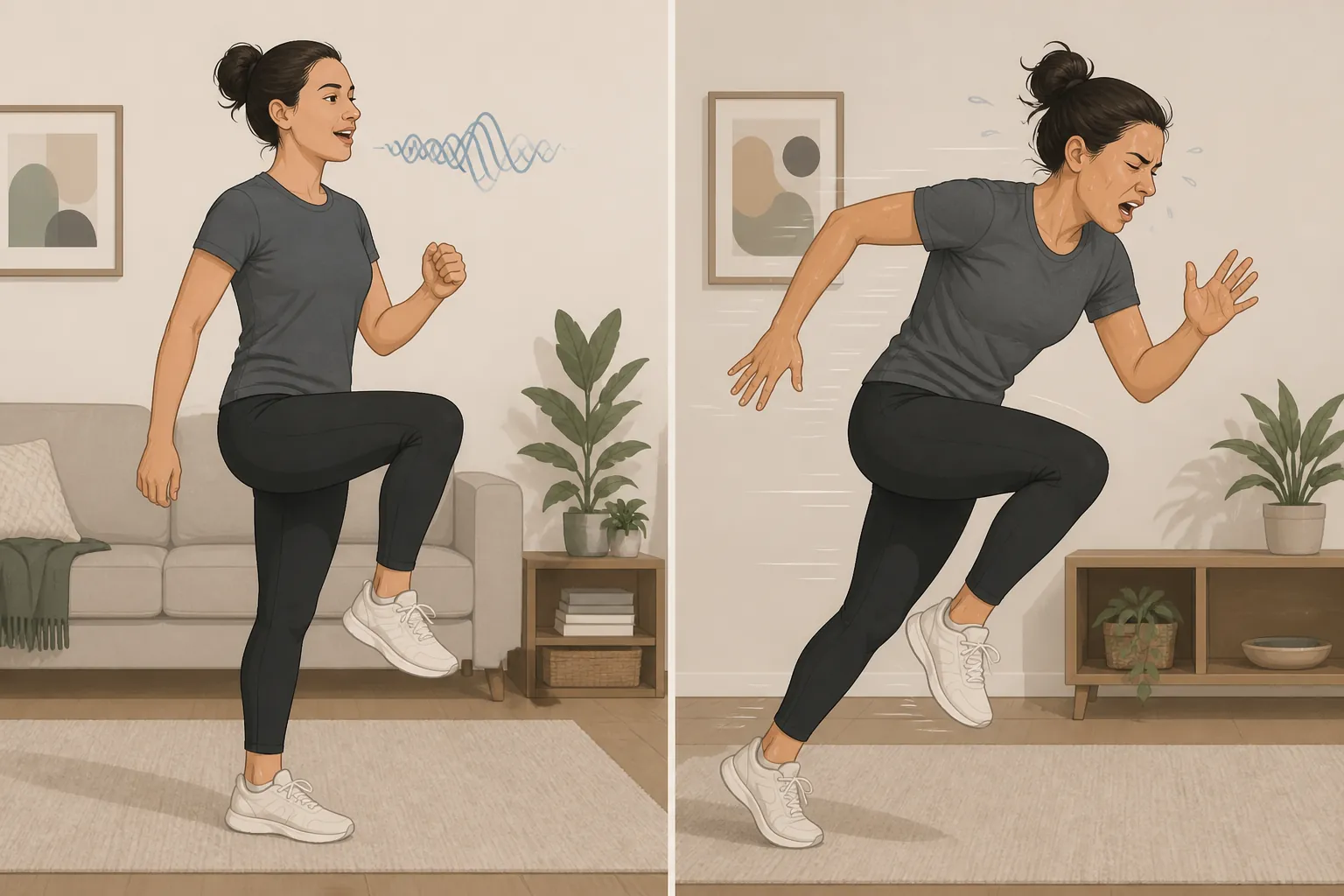
What moderate home cardio feels like
- Breathing is noticeably faster, but controlled.
- You can speak in full sentences, but singing would be uncomfortable.
- The pace feels sustainable for 10–30 minutes if the movement is joint-friendly.
- Examples may include brisk marching, low step-ups, dance-cardio basics, steady cycling, or a quiet low-impact circuit.
What vigorous home cardio feels like
- Breathing is hard enough that conversation breaks into short phrases.
- The work usually needs intervals or shorter blocks, not one casual continuous pace.
- You may need more recovery afterward than you would after moderate zone-2 work.
- Examples may include fast step intervals, hard cycling intervals, higher-tempo low-impact drills, or short bodyweight cardio bursts.
Mayo Clinic describes interval lengths ranging from about 20 seconds to 4 minutes, which fits home training well because the hard part can be brief and the recovery can be quiet.[7] A renter does not need burpees to reach vigorous effort. A fast low-step interval, shadow-boxing burst, or high-knee march without jumping can be enough if the breathing test and heart-rate response agree.
How to map the dose onto small-space sessions
Once the dose and intensity are clear, the weekly math is not complicated. Harvard puts the 150-minute target at roughly 22 minutes per day.[4] That is a clean average, but it is not the only workable layout. Many people do better with 3–5 home sessions a week, especially if one day is kept free from formal cardio so fatigue does not quietly pile up.
UC Davis Health’s beginner-friendly heart exercise plan uses a simple progression structure with walking and strength work across an 8-week plan, which is a useful reminder that the first job is not novelty; it is repeatability.[8] Healthline also notes that rest days can matter, particularly when cardio is intense or recovery is poor.[9]
| If your week looks like this | A realistic home-cardio dose map |
|---|---|
| You prefer daily rhythm | About 22 minutes of moderate cardio most days |
| You have only a few open windows | Three 50-minute moderate sessions, or four sessions around 35–40 minutes |
| You get bored with steady cardio | Mostly moderate sessions, with a few short vigorous intervals inside one or two workouts |
| You cannot jump or make noise | Brisk marching, low step-ups, cycling, shadow boxing, or quiet cardio circuits held at the right talk-test intensity |
| You are rebuilding from inactivity | Short bouts that accumulate across the day, then gradually lengthen as tolerance improves |
If you want the schedule rather than the evidence discussion, use Build a 150-Minute Heart-Healthy Cardio Week at Home as the companion plan. The point here is narrower: whatever schedule you choose should add up to the guideline dose and pass an intensity check.
What to add after 150 minutes becomes normal
The cleanest next step is usually more moderate work, not harder work. Extra zone-2-style minutes are easier to recover from than frequent vigorous intervals, and they fit the dose-response signal without requiring every session to become a test. A 10-minute add-on after a moderate workout, a short evening march, or an easy cycling block on a non-lifting day can raise weekly volume without making the plan fragile.
Short vigorous intervals still have a place, especially for people who enjoy them and recover well. They are best treated as a small ingredient. If a hard interval day makes the next two days disappear, the weekly dose may go down even though the single workout looked impressive.
Exercise can also affect common heart-health markers. Harvard Health reports that moderate aerobic exercise lowers systolic blood pressure by about 5–8 points on average.[10] That does not turn a home workout into medical treatment, and it does not replace medication or clinical care. It does explain why the weekly dose deserves more respect than the brand of machine under your feet.
FitAtHome is not a healthcare provider, and this article is for general fitness education. Stop exercising and seek medical guidance if you have chest pain, faintness, unusual shortness of breath, irregular heartbeat symptoms, or any warning sign that feels out of proportion to the workout. If you are managing a diagnosed condition, returning after a cardiac event, pregnant, or using medications that affect heart rate or blood pressure, get individualized advice before setting targets.
For most healthy adults starting at home, the practical judgment is steady rather than heroic: make 150 moderate minutes verifiable and repeatable. Add extra easy-to-moderate time when recovery and schedule allow. Use short intervals if they help, not if they wreck the week. Let the 560–610-minute finding be directionally encouraging context, not a mandate taped to your coffee table.
References
- American Heart Association Recommendations for Physical Activity in Adults — American Heart Association
- Adult Activity: An Overview — CDC
- 560-610 minutes of exercise a week needed for substantial heart benefits — BMJ Group, May 2026
- Updated exercise guidelines showcase the benefits to your heart and beyond — Harvard Health
- Target Heart Rates Chart — American Heart Association
- What To Know About Exercise and Heart Rate Zones — Cleveland Clinic
- Exercise intensity: How to measure it — Mayo Clinic
- Simple 8-week exercise plan for a healthy heart — UC Davis Health, February 2024
- How Often Should You Do Cardio Exercise? — Healthline
- The many ways exercise helps your heart — Harvard Health
What a small equipment investment adds
We don't have a build tagged to this exact tier yet. Browse all builds.
How often should you repeat this?
See our recovery and rest reference for citation-anchored rest-interval guidance.
Spot something off?
Tell us if a movement, tier assumption, or duration didn't match your experience.