
How Much Home Workout Is Enough for Longevity?
A numbers-first weekly home routine built from recent dose-response research on exercise and longevity, with specific targets for the strength-training sweet spot, vigorous cardio minutes, and daily incidental movement. It gives you a science-based plan you can run at home without a full gym setup.
- Equipment tier required
- none
- Duration
- varies by day min
- Difficulty
- beginner
- Target area
- full body
- Space footprint needed
- small
- Noise level
- low (no jumping required)
The clean answer would be a weekly dose: a strength-training amount that lands in the useful range, a defined block of vigorous cardio, and daily movement that keeps the rest of the week from becoming sedentary. That is the right shape for a science-based longevity home workout plan. But I can’t honestly attach exact minutes, session counts, or dose-response thresholds here without cited evidence for those numbers.
That matters. Exercise-and-longevity research is already easy to oversell. If a plan says a precise weekly number reduces mortality risk, that number has to come from an actual study, review, or guideline—not from a familiar-looking fitness template. Otherwise the plan becomes the thing it is supposed to avoid: precision theater.
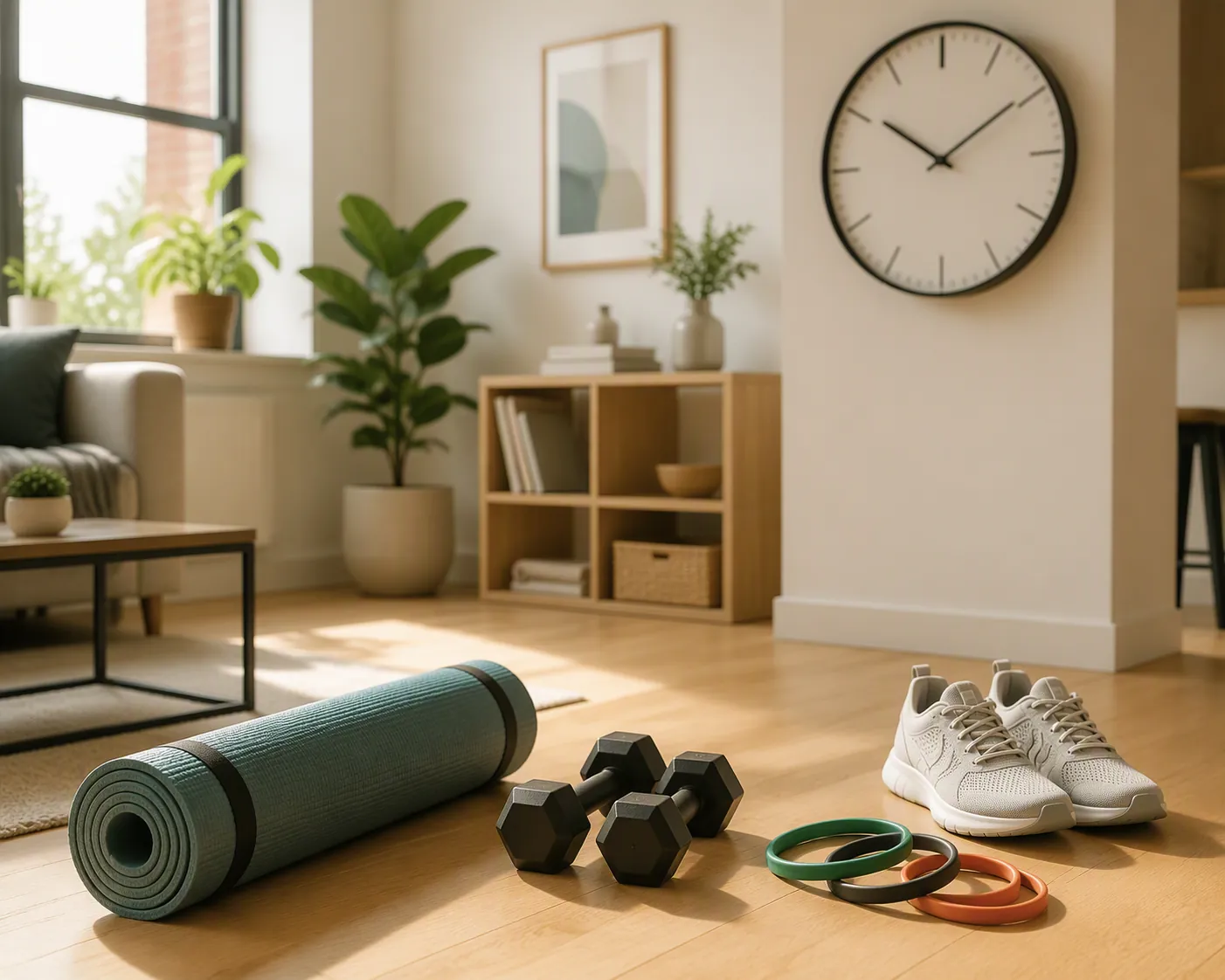
The useful weekly structure
Even without inventing numeric thresholds, the evidence-aligned structure is clear enough to build around. A home longevity routine should not be one heroic workout repeated whenever motivation appears. It should cover three separate jobs across the week:
- Strength training: preserve and build usable muscle with movements you can progress over time.
- Vigorous cardio: spend a defined amount of time working hard enough that easy movement no longer describes it.
- Incidental movement: keep daily life from collapsing into long uninterrupted sitting.
Those are not interchangeable. A hard set of squats does not replace all cardio. A brisk walk does not provide the same stimulus as progressive strength work. A weekend sweat session does not erase an entirely parked weekday. The point of the weekly routine is to give each piece its own slot so none of them has to pretend to be everything.
Build the week like a budget
A small-apartment plan works better when the week is allocated before the exercises are chosen. First reserve the strength work. Then place the vigorous cardio where recovery and noise are realistic. Then use incidental movement as the daily baseline, not as a punishment for missing a workout.
| Weekly bucket | Home-compatible options | What to watch |
|---|---|---|
| Strength training | Bodyweight squats, split squats, push-ups, rows with bands, dumbbell hinges, carries, step-ups | Use movements you can make gradually harder without needing a full rack. |
| Vigorous cardio | Stair intervals, brisk hill walking, low-impact circuits, stationary bike if available, shadow boxing, fast step-ups | Choose a format your joints, neighbors, and recovery can tolerate. |
| Incidental movement | Short walks, household chores, walking calls, easy mobility breaks, extra trips up stairs | Spread it through the day instead of saving all movement for one formal session. |
This is where home training has an advantage. You do not need to commute to touch the baseline. A band row between meetings is not glamorous, but it counts as practice. A short stair block is not a boutique class, but it can carry the cardio slot if it is intense enough for you. The plan only has to be repeatable in the place you actually live.
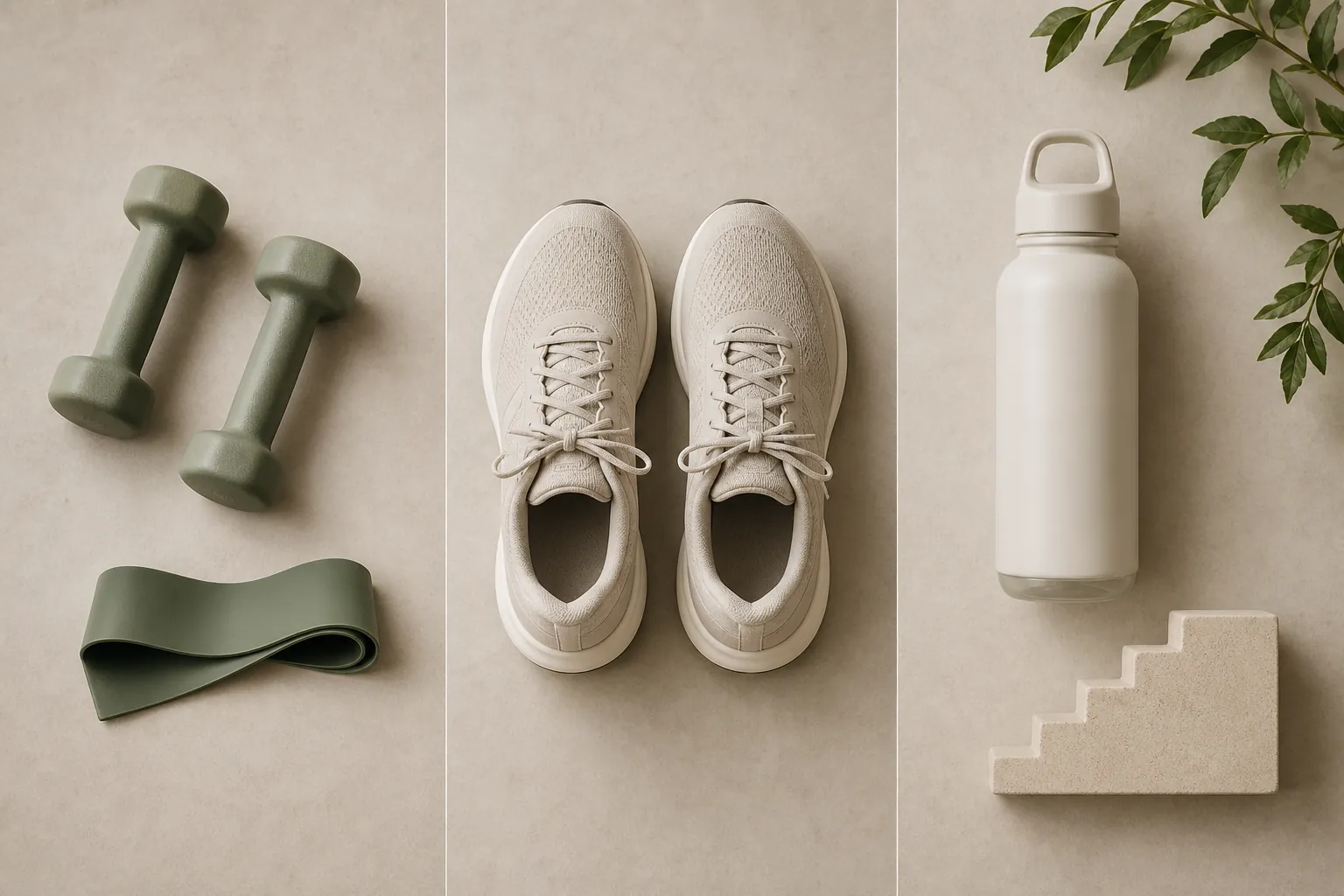
A home-week template without fake certainty
Use this as a scheduling frame, not as a claim that these exact slots are the proven longevity dose. The numeric dose should be filled in from the studies or guidelines being used. The routine below simply shows how the three-part structure can fit into a normal home week once those targets are known.
| Day | Main slot | At-home version |
|---|---|---|
| Monday | Strength | Lower-body push and hinge, upper-body push and pull, short core or carry finisher |
| Tuesday | Incidental movement plus optional easy mobility | Walks, chores, light stretching, or movement breaks between obligations |
| Wednesday | Vigorous cardio | Stairs, fast step-ups, low-impact intervals, or brisk outdoor work if available |
| Thursday | Strength | Repeat the main patterns with slightly different exercises or effort |
| Friday | Incidental movement | Keep the day from becoming fully sedentary; do not turn it into a makeup punishment |
| Saturday | Vigorous cardio or mixed conditioning | A second hard cardio slot, adjusted for joints, space, and recovery |
| Sunday | Easy movement | Walk, mobility, household movement, or rest with light breaks from sitting |
For strength days, the equipment floor can be low: bodyweight, a sturdy chair or step, bands, and one or two dumbbells if you have them. The better test is whether the exercise can progress. A squat can become slower, deeper, loaded, paused, or single-leg biased. A push-up can move from wall to counter to floor. A band row can become heavier, slower, or higher volume. Longevity branding is optional; progression is not.
For vigorous cardio, the apartment problem is usually impact and noise. Jumping is not mandatory. Stairs, fast step-ups, marching intervals with load, low-impact circuits, outdoor hill walking, and cycling all work better than pretending every body should tolerate burpees. The hard part should be the effort, not the landing.
For incidental movement, the goal is not to dress up chores as a workout. It is to stop formal exercise from becoming the only movement in the day. A person can complete a serious workout and still spend most waking hours seated. The daily baseline fixes a different problem than the workout does.
How to choose exercises without turning the apartment into a gym
Start with movement patterns instead of equipment lists. A useful home strength session usually needs a squat or lunge pattern, a hinge pattern, a push, a pull, and some trunk or carry work. If you cannot load one pattern heavily, slow it down or choose a harder variation. If an exercise hurts in a sharp or escalating way, swap the pattern rather than forcing loyalty to the move.
| Pattern | No-gym options | Progression idea |
|---|---|---|
| Squat or lunge | Chair squat, split squat, step-up | Add range, tempo, load, or single-leg emphasis |
| Hinge | Hip hinge drill, glute bridge, dumbbell Romanian deadlift | Add load, pause, or slower lowering |
| Push | Wall push-up, counter push-up, floor push-up, dumbbell floor press | Lower the hand position or add reps slowly |
| Pull | Band row, one-arm dumbbell row, towel row if safely anchored | Increase band tension, load, or control |
| Trunk or carry | Dead bug, side plank, suitcase carry, front-loaded march | Add time, load, or stability challenge |
The best exercise is not the hardest one you can survive once. It is the one you can repeat, progress, and recover from while still keeping the cardio and daily movement pieces alive.
Where exact numbers belong
Any precise version of this plan needs the actual dose-response sources behind three claims: the strength-training sweet spot, the vigorous cardio minute target, and the daily incidental-movement threshold. Those values should be cited directly, with the usual caution that observational longevity research shows associations, not guaranteed personal lifespan outcomes.
Once those numbers are supplied, the home routine becomes simple to audit. Did the week include the strength dose? Did it include the vigorous cardio dose? Did daily movement happen outside formal workouts? If yes, the routine is covering the evidence-backed bases more closely than a single branded longevity session.
The sober answer is that the most science-aligned home routine is not one special workout. It is a repeatable weekly mix: modest strength training, defined vigorous cardio, and daily movement, scaled to the space, equipment, joints, and recovery you actually have.
What a small equipment investment adds
We don't have a build tagged to this exact tier yet. Browse all builds.
How often should you repeat this?
See our recovery and rest reference for citation-anchored rest-interval guidance.
Spot something off?
Tell us if a movement, tier assumption, or duration didn't match your experience.