
How to Use Ilona Maher's Strength Principle at Home
Learn how to apply Ilona Maher's 'add weight each set' philosophy to your home gym workouts using adjustable dumbbells and a pull-up bar — no coach or full facility required.
- Equipment tier required
- $100-300
- Duration
- 30 min
- Difficulty
- beginner
- Target area
- full body
“If you can do it for one set, add weight for the next.” Maher described that as her No. 1 strength training tip in April 2026.[1] That does not mean she published an Ilona Maher diet and home workout routine, and it does not mean a pair of adjustable dumbbells turns an apartment into a rugby performance center. It means the transferable piece is progressive overload: the session has to ask for a little more when the last set proves you can handle it.
That is the useful part of Ilona Maher’s strength advice. It survives the dumbest home-gym problem: you did the first set, it moved well, and now nobody is standing there to tell you whether to go heavier.
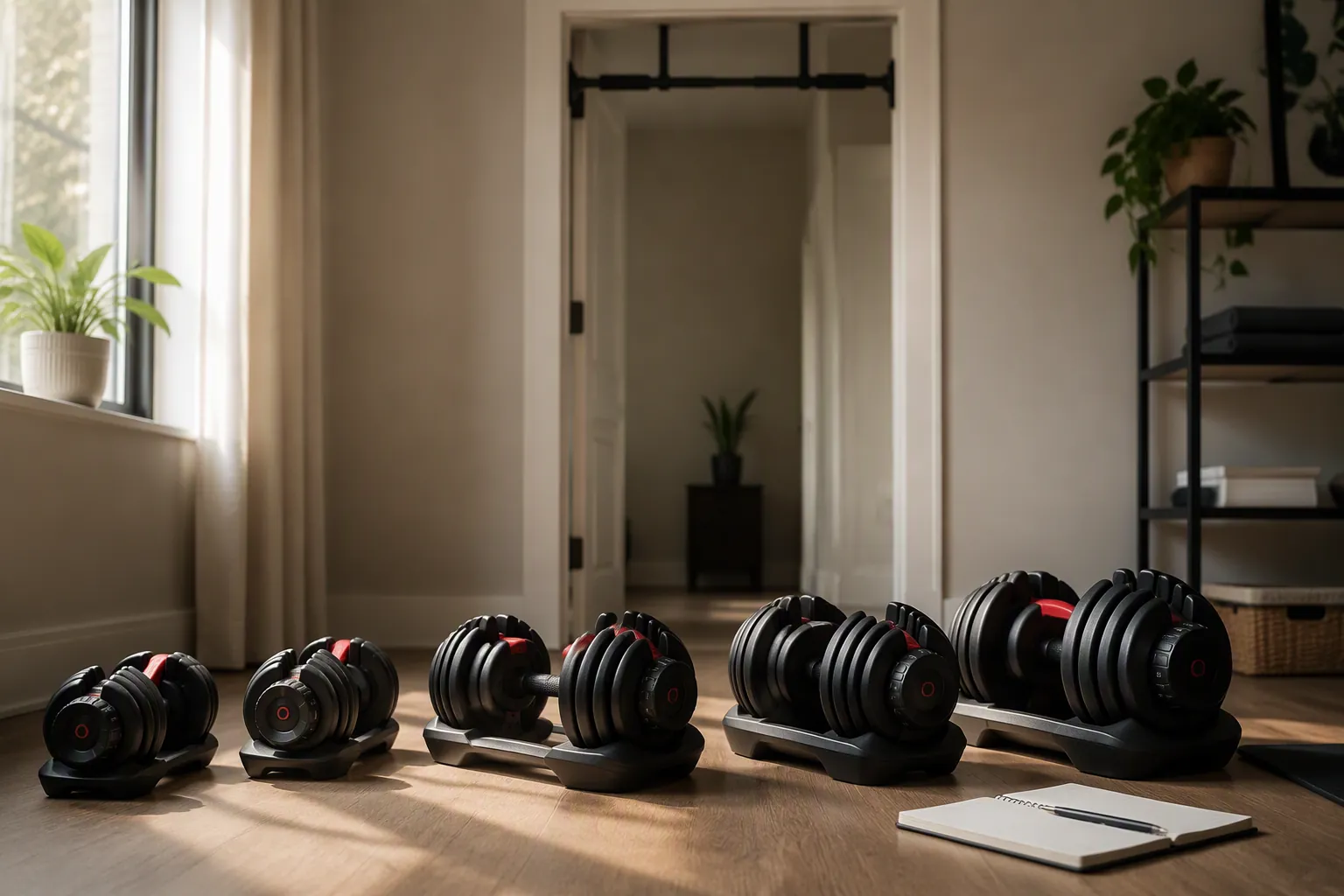
Maher has also described a weekly rhythm of training 4 to 5 days a week, with a typical session involving “some kind of lift and some kind of run.”[2] For a home trainee, that is best treated as a loose organizing pattern, not a promise that every week needs five perfect days. A compact version can be three or four lifting sessions, with running, intervals, walking, or conditioning placed where recovery allows.
Progressive Overload, Without a Coach Watching
Progressive overload means the body is gradually exposed to more training demand over time. At home, “more” does not always mean a bigger dumbbell. It can mean more load, more reps, a harder body position, a slower lowering phase, a longer pause, a cleaner range of motion, or less assistance from a band.
The mistake is treating every workout like a repeat performance. If the same dumbbells, same reps, same tempo, and same rest periods show up every week, the body has no clear reason to become stronger. Maher’s rule cuts through that: once a set proves the load is available to you, the next set should earn its place.
That still leaves a judgment call. Adding weight is only useful when the set is technically honest. Maher has emphasized form before load in discussing training, and the home version should keep that hierarchy.[2] If the dumbbell press turns into a half-rep shoulder shrug, or the split squat becomes a bounce off the back leg, the set did not qualify you to go heavier. It told you to hold the load, slow down, or stop the set earlier next time.
| What happened in the set | Next-set decision |
|---|---|
| All target reps were completed with stable form and no rushed final reps | Add weight if the dumbbell jump is reasonable |
| All target reps were completed, but the final reps were shaky | Repeat the same load and clean up the set |
| The next dumbbell setting is too large | Keep the load and make the set harder with tempo, pause, range, or reps |
| Bodyweight is already the load, as with pull-ups | Adjust assistance, reps, tempo, pauses, or added load |
| Form breaks before the target reps | Reduce load or assistance difficulty and log the limit |
A Home Session Built Around the Next Set
Start with equipment most compact setups can actually hold: adjustable dumbbells, a doorway pull-up bar, optional bands, and either a bench or a clear floor. In the FitAtHome Builds system, the lowest useful tier for this approach is not fancy; it is simply enough adjustable loading to make small jumps, a safe pulling option, and enough floor space for single-leg work. A bench expands pressing and rowing options, but it is not required for the core idea.
The session format is simple: choose a movement, pick a starting load you know you can control, perform the first working set, then make one decision before the next set. Do not decide the whole workout in advance if your log already tells you the first set is too easy or too sloppy.
| Session piece | Home-gym version | Progression target |
|---|---|---|
| Lower-body strength | Bulgarian split squat or goblet squat | Heavier dumbbells, cleaner depth, slower lowering |
| Upper-body pull | Pull-ups, band-assisted pull-ups, or inverted rows if available | Less band help, more reps, slower reps, or added load |
| Upper-body press | Dumbbell floor press or bench press | Heavier dumbbells, stronger pause, controlled lockout |
| Upper-back volume | One-arm dumbbell row or chest-supported row if a bench is available | Heavier load, longer top hold, stricter torso position |
| Conditioning | Short run, intervals, brisk incline walk, or low-impact conditioning | Repeatable effort that does not wreck the next lift |
For readers who like seeing how pro-athlete training can be translated without pretending the home gym is the same environment, the same logic applies in our NFL training camp home workout translation: keep the training principle, change the tools, and stop copying the parts that depend on a team facility.
How to Choose the First Weight
The first working set should be heavy enough to demand attention but light enough to leave room for a second decision. If the target is 8 reps, the opening set should not be a grind from rep 3. It should feel like a real set that still gives you a chance to add load, tighten form, or extend the range on the next one.
A practical home rule: start with the heaviest load you can move for the target reps while keeping 2 or 3 clean reps in reserve. If that phrase feels too abstract, use the video test. If you watched the set back with the sound off, would the last rep still look like the first rep, only slower? If yes, you probably earned a progression. If not, the next set has to be cleaner before it becomes heavier.
When the Dumbbell Jump Is Too Big
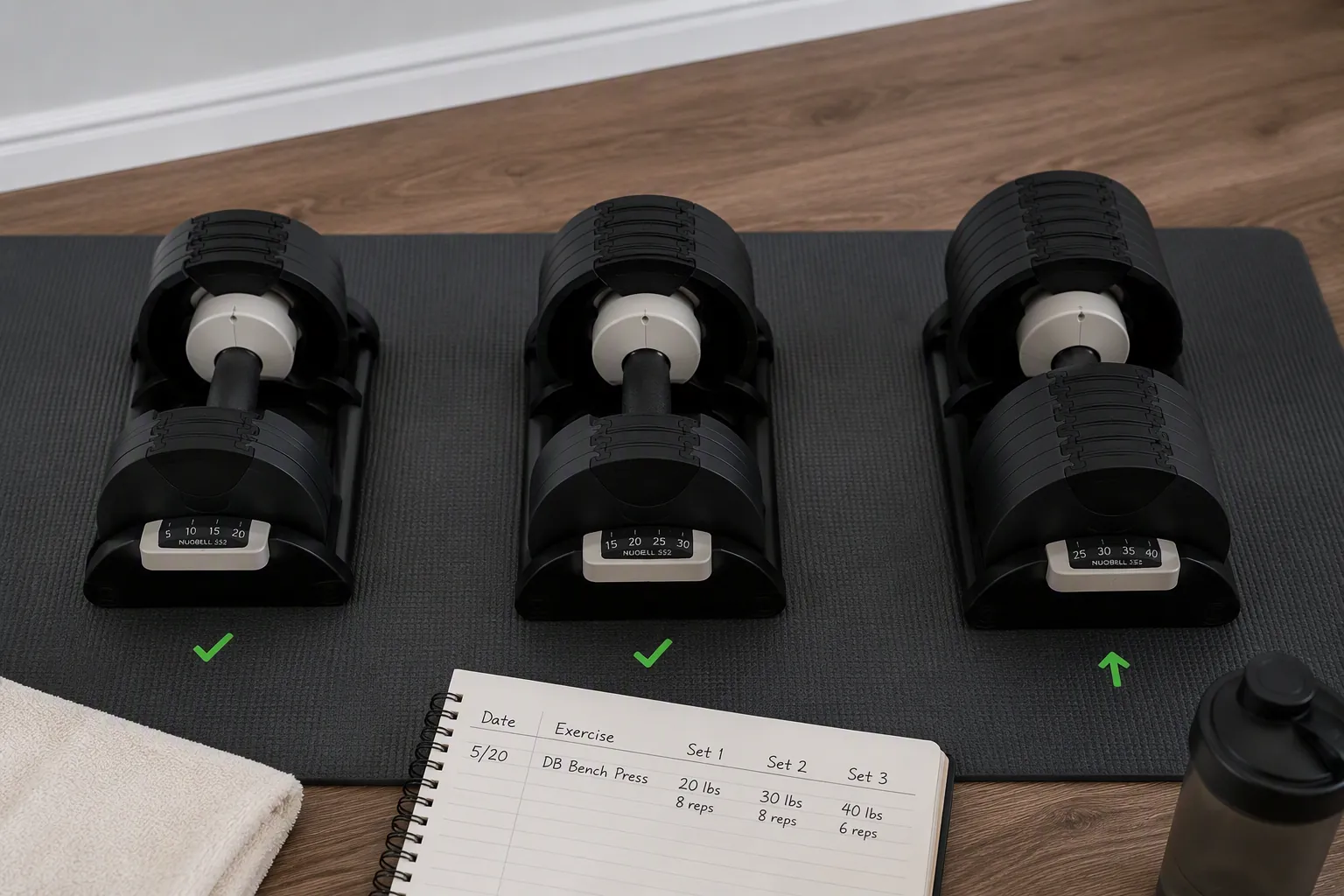
Adjustable dumbbells often jump in chunks that are bigger than your joints want on a given day. That is where home trainees stall, then assume the program stopped working. The answer is not to force the jump. The answer is to make the same weight more demanding until the next setting becomes realistic.
- Add a 3-second lowering phase before you add load.
- Pause for 1 second at the hardest position, such as the bottom of a split squat or the chest-level position of a row.
- Add 1 or 2 reps while keeping the same form standard.
- Use a longer range of motion only if the joint position stays controlled.
- Reduce assistance on bodyweight movements before adding external load.
Translating the Named Movements
Maher has discussed movements including Bulgarian split squats, pull-ups, presses, and rows in public training coverage.[2] Those are not magic rugby exercises. They are useful because they load big patterns with equipment a home trainee can reasonably own: single-leg strength, vertical pulling, horizontal pressing, and rowing.
Bulgarian Split Squat
This is the home-gym lower-body workhorse because one pair of dumbbells can feel heavy fast when one leg is doing most of the work. Set the back foot on a couch, bench, or stable step. Keep the front foot far enough forward that the knee can track without the whole rep collapsing into the toes.
Use Maher’s rule across sets. A hypothetical progression could look like this: bodyweight for 8 each side to check balance, then light dumbbells for 8, then heavier dumbbells for 6 to 8 if the front leg stays in control. If the heavier setting turns the rep into a fall-and-catch, go back down and use a slower lowering phase. The goal is not to prove toughness to the furniture. The goal is to make the leg do measurable work.
Pull-Ups
Pull-ups are where “add weight each set” needs translation, because bodyweight is already loaded on the bar. If you cannot yet do clean pull-ups, the progression is less assistance: a stronger band on the first set, a lighter band on the next, then slow negatives or top holds once the band stops doing the work for you.
If you can do pull-ups, earn the next set by adding a rep, slowing the lowering phase, pausing at the top, or eventually holding a dumbbell between the feet if your setup allows it safely. Doorway bars have limits; do not treat them like commercial gym rigs. The progression has to respect the equipment as much as the muscles.
Floor Press or Bench Press
A dumbbell floor press works when you do not have a bench. The floor shortens the range of motion, which can be useful for shoulder control and safe solo training. A bench opens more range, but it also asks for better control at the bottom.
For the first set, choose a pair you can press without twisting or bouncing the upper arms off the floor. If the set is clean, move up. If the next jump is too much, hold the same load and add a pause with the upper arms lightly touching the floor before pressing. That pause makes the same dumbbells more honest.
Rows
Rows are easy to make heavy and easy to cheat. A one-arm dumbbell row can become a hip twist with a dumbbell attached unless the torso position is fixed. Put one hand on a bench, couch edge, or stable support, brace hard, and pull the elbow toward the hip rather than yanking the weight toward the shoulder.
Progress the row by load first if the position stays quiet. If the heavier dumbbell makes the shoulder roll forward or the torso rotate, stay at the same weight and add a top hold. The top hold is useful because it exposes whether the back is controlling the dumbbell or merely catching it for a split second.
A Week That Uses Maher’s Rhythm Without Pretending to Be Her Program
Maher’s reported rhythm of “some kind of lift and some kind of run” gives home trainees a useful template, but the exact frequency depends on recovery, schedule, and training history.[2] A small-space week can be built around three strength sessions and two optional conditioning days. Four lifting days also works if the sessions are shorter and recovery is good.
| Day | Focus | Main decision |
|---|---|---|
| Day 1 | Lower body plus pull | Can the split squat or pull-up variation progress after set 1? |
| Day 2 | Run or conditioning | Can effort stay repeatable without hurting Day 3? |
| Day 3 | Press plus row | Can pressing load increase while rows stay strict? |
| Day 4 | Rest, mobility, or easy walk | Can joints and grip recover? |
| Day 5 | Full-body strength | Can one lower-body and one upper-body movement beat the log? |
| Day 6 | Optional run or intervals | Can conditioning support training instead of stealing from it? |
| Day 7 | Rest | Can the next week start with usable energy? |
The conditioning piece should not be used to punish the lifting. If the goal is strength, a run that makes the next lower-body session worse has to be adjusted. That might mean shorter intervals, an easier pace, a brisk walk, or moving conditioning away from the hardest leg day.
What to Write Down
A home trainee without a coach needs a log more than a complicated template. The log does not need to be beautiful. It needs to tell the truth quickly enough that the next set is obvious.
- Exercise: the exact variation, such as “rear-foot-elevated split squat” or “band-assisted pull-up.”
- Load or assistance: dumbbell weight, band level, or bodyweight note.
- Reps per set: write each set separately instead of averaging the workout.
- Form note: one short phrase, such as “left side unstable” or “pause clean.”
- Next action: add load, repeat, slow tempo, reduce band help, or lower the weight.
If you want a more device-heavy approach to tracking sets and trends, our Garmin Cirqa home gym workout test is the better place to look. For this routine framework, a notebook still beats memory.
A Simple Log Example
| Movement | Set 1 | Set 2 | Set 3 | Next time |
|---|---|---|---|---|
| Bulgarian split squat | 25 lb dumbbells x 8 each side, clean | 30 lb dumbbells x 8 each side, clean | 35 lb dumbbells x 6 each side, right side shaky | Start at 30 lb, repeat 35 lb only if control improves |
| Pull-up | Medium band x 6 | Light band x 5 | Light band x 4 with slow lowering | Keep light band and build reps before removing assistance |
| Dumbbell floor press | 35 lb dumbbells x 10 | 40 lb dumbbells x 8 | 40 lb dumbbells x 8 with pause | Try 45 lb only if setup is safe |
| One-arm row | 45 lb x 10 each side | 50 lb x 10 each side | 55 lb x 8, torso rotated | Repeat 50 lb with top hold |
Those numbers are hypothetical, not Maher’s numbers and not a benchmark. The point is the decision trail. Each line tells you whether the next set deserved more load, more control, or less ego.
Where Diet Fits, and Where It Does Not
The search phrase “Ilona Maher diet and home workout routine” bundles two things that should not be treated the same way here. The training principle is available: Maher has publicly described adding weight across sets and training for strength.[1][2] A sourced, repeatable home diet plan from Maher is not part of the available material for this article.
That matters because diet claims become sloppy fast when they borrow authority from an athlete without evidence. The practical boundary is simple: this routine can help you train for measurable strength progress at home. It should not be dressed up as Maher’s personal nutrition system.
The Performance Standard
Maher’s public framing is performance first. In the same March 2026 coverage, she said, “I go for strength,” while discussing training and body composition.[2] That is the part worth preserving at home, especially for anyone worried that strength training has to be filtered through appearance talk before it counts.
You cannot replicate Maher’s coaching environment, season demands, or elite loading with adjustable dumbbells and a doorway bar. You can replicate the governing habit: make the first set prove what the second set should ask for. If the log shows heavier, cleaner, slower, or more controlled work over time, the home version is doing its job.
References
- Ilona Maher Shares Her No. 1 Strength Training Tip for Success in the Gym — SI.com, Apr 2026
- Ilona Maher reveals how to get 'rugby thighs' at the gym — New York Post, Mar 2026
What a small equipment investment adds
We don't have a build tagged to this exact tier yet. Browse all builds.
How often should you repeat this?
See our recovery and rest reference for citation-anchored rest-interval guidance.
Spot something off?
Tell us if a movement, tier assumption, or duration didn't match your experience.