
Do You Need a Gym for Injury Rehab Exercises at Home?
If you're recovering from a minor injury or recently finished physical therapy, you can run an effective rehab plan at home with resistance bands and bodyweight exercises — no gym membership or new equipment required. This starter explains the four exercise categories clinical rehab programs use, how to progress them on a pain-guided basis, and the low-cost setup that covers it all.
- Equipment tier required
- $0-100
- Duration
- 15 min
- Difficulty
- beginner
- Target area
- full body
- Space footprint needed
- 1 square meter
- Noise level
- Low
No, you do not need a gym for injury rehab exercises at home if you are dealing with a mild injury or continuing a program a clinician already gave you. Home rehab usually does not fall apart because you lack a cable machine. It falls apart because the plan has no structure, no pain rule, or so many exercises that the paper ends up on the kitchen counter for three weeks.
This is education for minor, recovering, or post-physical-therapy situations, not a diagnosis. If pain is worsening, persistent, unfamiliar, or not behaving the way your clinician said it should, the useful home exercise is the one you pause while you get checked. If you are rehabbing after surgery, fracture, major ligament injury, or a condition with specific restrictions, the clinician’s protocol wins; for that kind of boundary-setting, start with injury-specific guidance such as safe L1 fracture recovery exercises or a post-op plan like knee surgery recovery exercises at home.
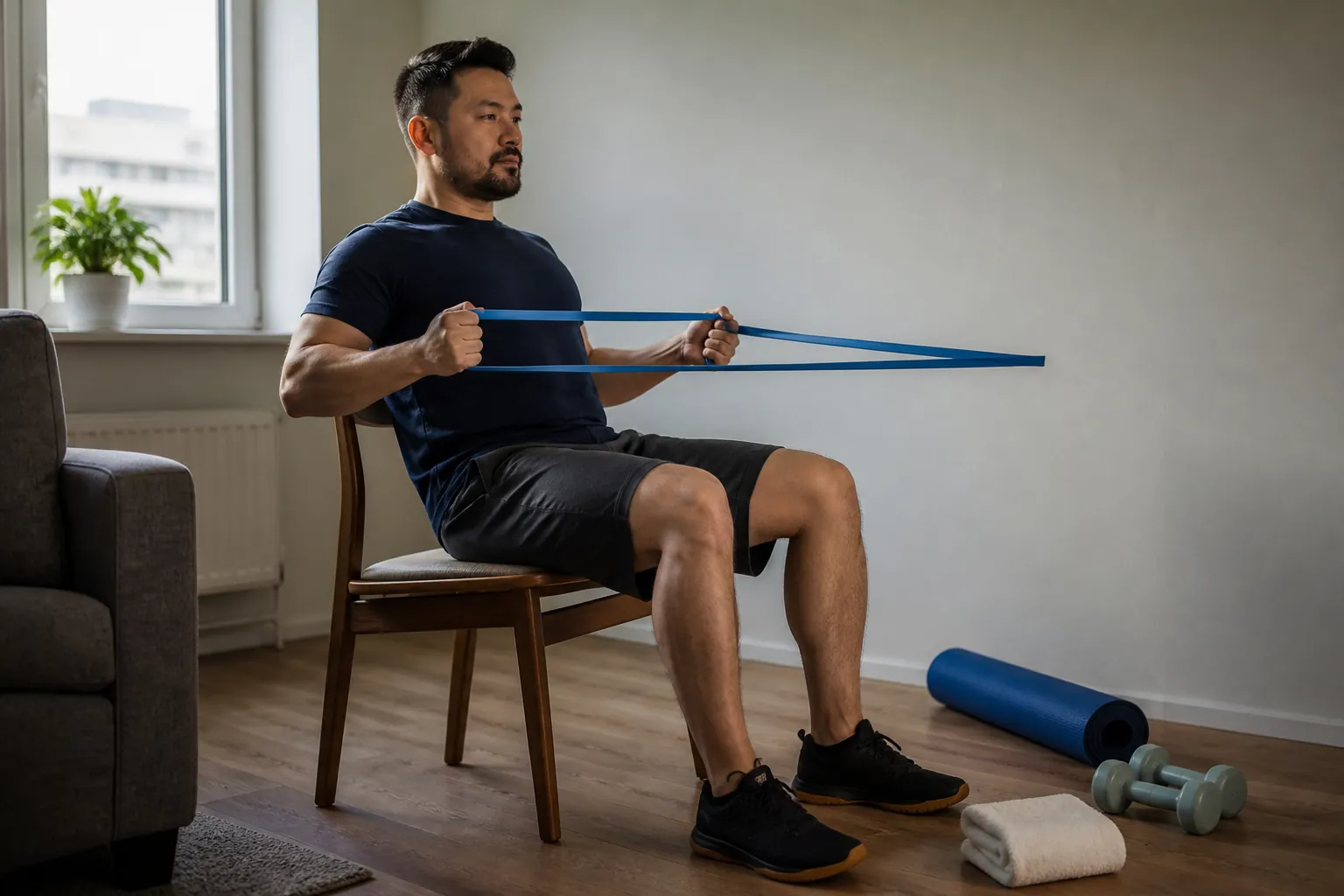
The gym is not the deciding variable
The equipment anxiety is understandable. Rehab advice often looks clinical until it quietly assumes a spare room, machines, and a schedule that belongs to someone without laundry, neighbors, or a day job. The evidence does not justify treating a resistance band as a consolation prize.
The 2026 ACSM resistance-training position stand, summarized for physiotherapists by Physiopedia Plus, synthesized 137 systematic reviews involving more than 30,000 participants and reported that home-based tools such as bands and bodyweight can be effective for strength, hypertrophy, and physical function; it also emphasized that the largest step is often going from no resistance training to some resistance training. The same summary notes an analysis of more than 38,000 participants that found no increased risk of serious adverse events, including among older adults [1].
A 2019 systematic review and meta-analysis by Lopes and colleagues looked more directly at the band-versus-equipment question. Across 8 randomized controlled trials with 224 participants, elastic resistance produced strength gains that were not significantly different from conventional resistance equipment for upper- or lower-limb training [2]. That does not mean every injury can be self-managed with a band. It does mean the cheap tool is not automatically the weak link.
A $0–100 home setup is enough for the starter version
For FitAtHome, the $0–100 tier is a practical organizing label, not a research finding. The research supports the training value of bands, bodyweight, and light loads; the pricing tier is simply a way to keep the setup honest for an apartment.
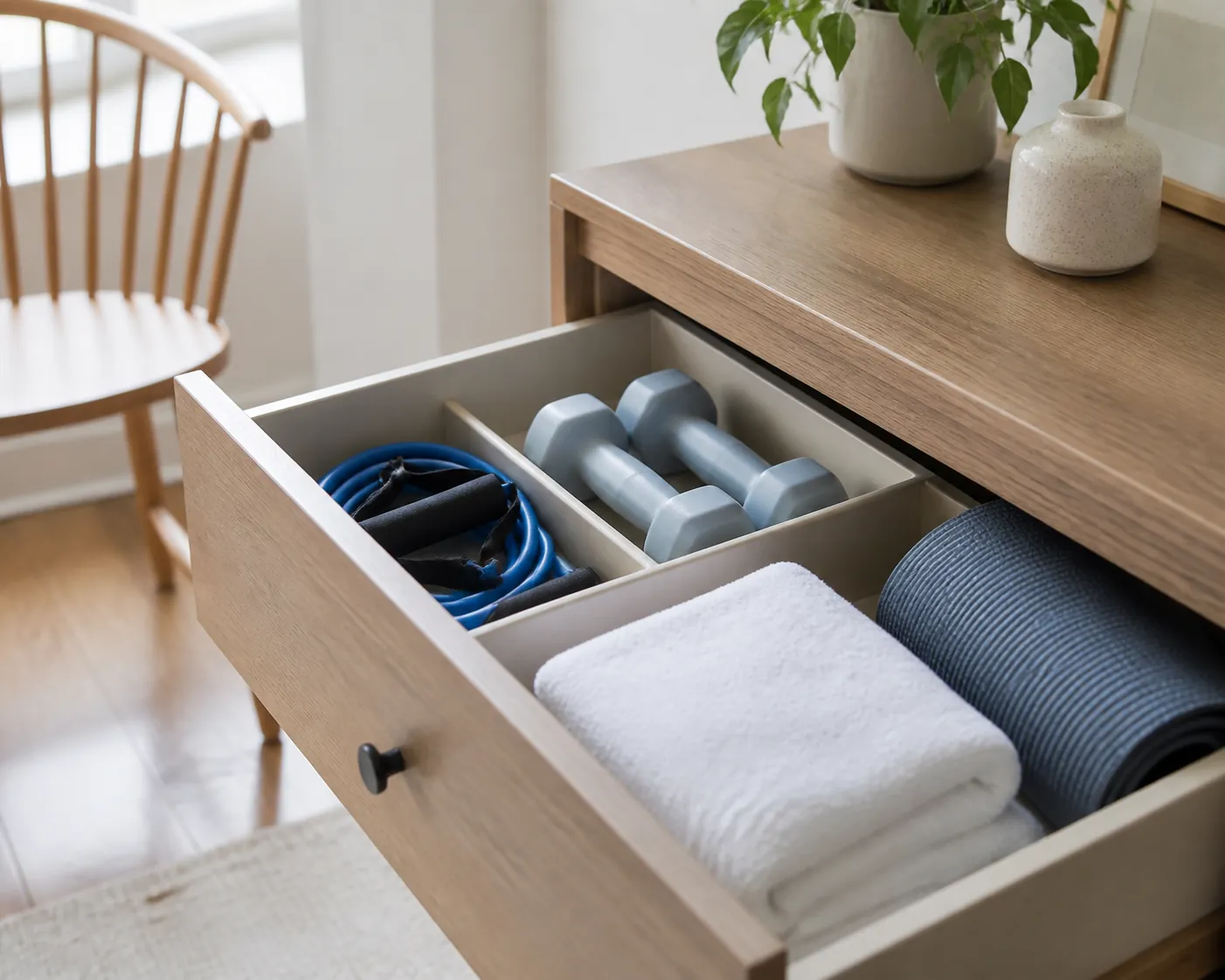
- Bodyweight: enough for many range-of-motion drills, isometrics, balance work, and early strength progressions.
- A sturdy chair: useful for seated work, balance support, sit-to-stand variations, and keeping exercises from turning into floor logistics.
- A towel: useful for assisted movement, gentle stretching, and positioning.
- One or two elastic bands: the most space-efficient way to add progressive resistance.
- A mat or folded blanket: comfort, not magic.
- Optional light dumbbells: convenient if you already own them, not required before you start.
That kit fits in a drawer and uses about one square meter of floor. If you need a quiet, neighbor-friendly version of the same idea, the quiet apartment workout shows the same low-friction equipment discipline without turning every session into a shopping list.
The useful home rehab structure has four jobs
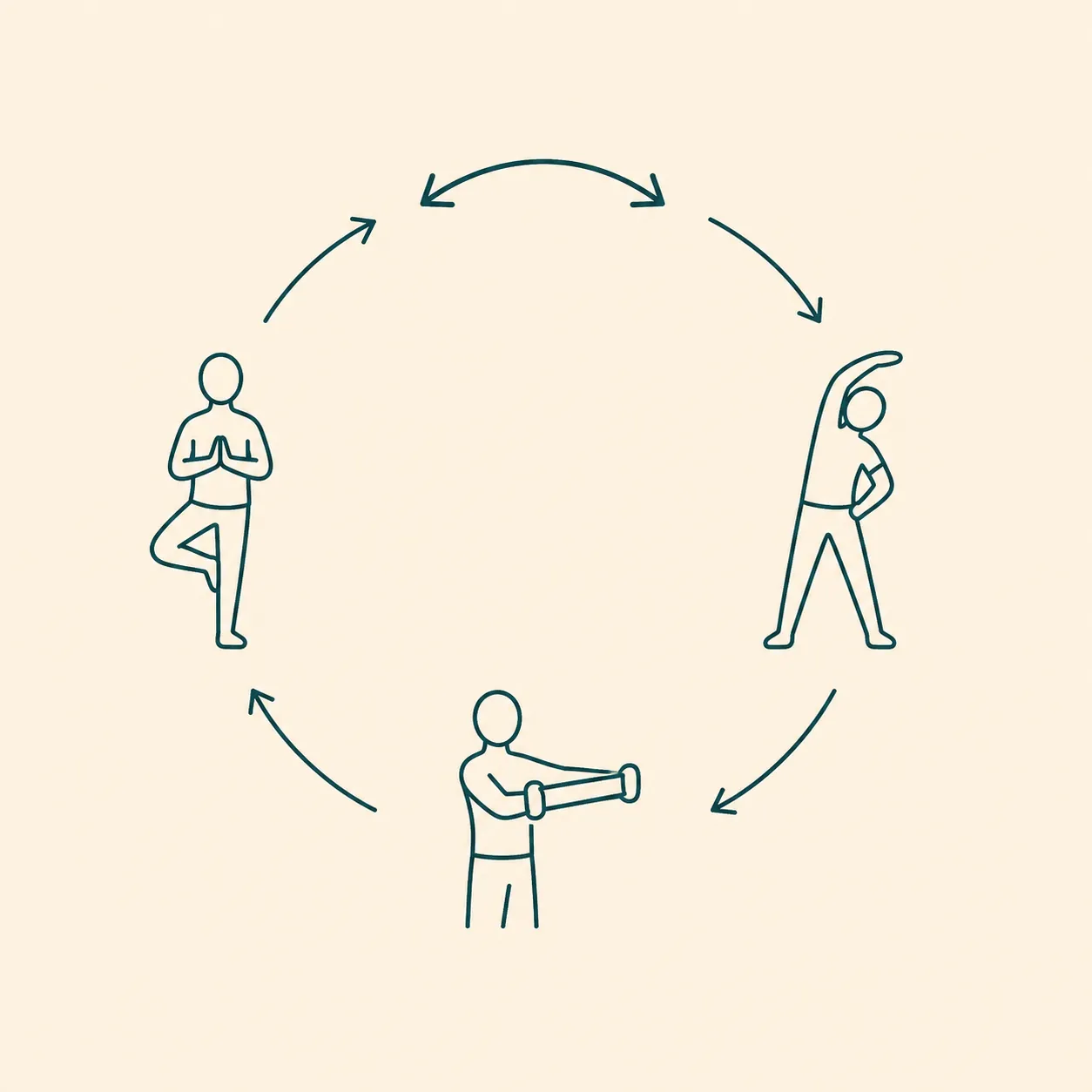
A decent home plan is not a pile of twenty ankle, knee, shoulder, and back exercises. It has jobs to do. Kaiser Permanente’s sprained ankle rehab page organizes exercises into range of motion, stretching, strengthening, and balance/control, and tells readers to ease off if they have more than mild pain [3]. The AAOS Foot and Ankle Conditioning Program similarly uses a 4- to 6-week program, suggests 3 to 5 days per week, includes a 5- to 10-minute warm-up, lists modest equipment such as a towel, elastic band, chair, or no equipment, and states, “You should not feel pain during an exercise” [4].
Those are ankle and foot/ankle sources. They should not be inflated into a universal protocol for every body part. What they do provide is a sensible skeleton for mild home rehab: restore movement, use flexibility work when appropriate, rebuild strength, and retrain control.
| Category | What it is trying to restore | Small-space version | Pain-guided guardrail |
|---|---|---|---|
| Range of motion | A tolerable path of movement | Slow joint movements, assisted movement with a towel, gentle repeated motion | Stay in a range that does not increase symptoms beyond mild discomfort |
| Stretching or flexibility | Comfortable length and position tolerance | Towel stretch, wall-supported stretch, floor or chair-supported position | Do not force a stretch through pain |
| Strengthening | Capacity to produce and tolerate force again | Bodyweight, elastic band, light dumbbell, controlled tempo | Reduce resistance, range, or volume if pain rises during or after |
| Balance or control | Coordination, steadiness, and confidence under low load | Chair-supported single-leg stance, slow weight shifts, controlled step patterns | Use support before you need it, not after you wobble into furniture |
Range of motion comes before loading the problem hard
Range-of-motion work is the unglamorous part where you remind the joint or muscle that it can move without being threatened. For a mild ankle sprain, that might look like slow ankle circles or moving the foot up and down. For a stiff shoulder or knee, the exact drill changes, but the job is similar: find the tolerable movement window and visit it often enough that it stops feeling foreign.
This is also where home rehab can go wrong by trying to act like training too early. If the first motion already produces more than mild pain, adding a band does not make the session more serious. It just adds load to a pattern your body is already refusing.
Stretching is useful when it matches the problem
Stretching is not a moral requirement before every rehab exercise. It belongs when limited flexibility, guarded movement, or position intolerance is part of the issue. A towel can assist a calf stretch. A wall can support a hip or chest stretch. A chair can make a hamstring or ankle position less dramatic than getting on and off the floor.
The rule is boring and useful: do not chase intensity. If you are stretching around workouts or dealing with back tightness, timing and dose matter more than turning the stretch into a test of pain tolerance; that is the point of this separate guide on when to do back tightness stretches.
Strengthening is where the band earns its drawer space
Strengthening is the category people most often outsource to a gym in their heads. At home, the resistance can come from a band, your bodyweight, a light dumbbell, a backpack, or a slow tempo. The important part is that the tissue gets a dose it can tolerate and recover from, then eventually a little more.
That progression does not need to be fancy. You can add a few repetitions, choose a slightly firmer band, slow the lowering phase, or increase the range only if symptoms stay within the rules you were given. If pain appears during the exercise, or the area feels clearly worse afterward, the next session should be smaller: less range, less resistance, fewer sets, or a return to range-of-motion work.
Balance and control are not just for athletes
Balance work is easy to skip because it does not look like exercise until it exposes exactly what is missing. After an ankle sprain, the foot may need to relearn steadiness. After time away from training, the trunk and hips may need to coordinate again before harder work feels normal.
A chair-supported single-leg stance, slow weight shifts, or controlled step patterns can be enough at first. The chair is not cheating; it is the difference between practicing control and practicing panic. If you want more balance-oriented core work that still fits a small home setup, the paddle boarding core workout at home uses the same idea without requiring a board or a gym.
The shorter plan is often the better home plan
A long rehab list can feel more complete. It is also easier to abandon. Reviews of home-exercise adherence report nonadherence as high as 50% and note that people prescribed 2 exercises complied better than those prescribed 8 [5][6]. That is not a character flaw. It is a design problem.
For a mild, general home starter, choose the fewest exercises that cover the jobs you actually need. If a clinician gave you a specific list, use that list. If you are building a conservative plan for a minor issue, start with two to four exercises rather than trying to represent every category perfectly on day one.
| If your main issue is... | Start with... | Add later if tolerated... |
|---|---|---|
| Stiffness and guarded movement | One range-of-motion drill and one gentle flexibility drill | Light strengthening after motion feels more available |
| Weakness after symptoms have calmed | One range-of-motion drill and one strengthening drill | A second strengthening angle or slightly firmer band |
| Wobbliness or loss of confidence | One easy strength drill and one chair-supported balance drill | Less hand support, longer holds, or slow step patterns |
| Post-PT maintenance | The clinician’s priority exercises, not a new internet menu | Only the progressions your symptoms and instructions allow |
The home advantage is not that you can do everything. It is that you can remove setup friction. A band looped near the chair, a towel on the same shelf, and a two-exercise card you can finish before the coffee gets cold will beat a perfect eight-exercise plan that requires clearing the living room.
How to progress without pretending pain is data you can ignore
Pain-guided progression is not the same as fear-guided avoidance. It means you use symptoms to choose the next dose. Kaiser’s ankle rehab instruction to ease off when pain is more than mild and AAOS’s instruction that an exercise should not be painful are intentionally plain because they have to work in real homes, not just clinics [3][4].
- If the exercise feels easy and symptoms do not flare afterward, repeat it for a few sessions before changing anything.
- If it stays tolerable, progress one variable: a few more reps, one more set, slightly more range, a firmer band, or slower control.
- If pain rises above mild, reduce the variable you just changed.
- If symptoms are worsening or not settling, stop treating the plan like a willpower problem and get clinical guidance.
This is why “best exercise” lists are less useful than they look. The same band row, heel raise, bridge, or step pattern can be appropriate, too easy, too hard, or irrelevant depending on the injury stage and your symptoms. The exercise name matters less than the dose and the rule for changing it.
A small starter template
Use this as a structure, not a diagnosis. Fill it with the exercises your clinician assigned, or with very gentle versions appropriate to a mild issue that is already improving.
- Warm up for a few minutes with easy walking, marching in place, or gentle movement.
- Do one range-of-motion drill for the affected area.
- Add one flexibility drill only if stiffness is part of the problem.
- Do one strengthening drill with bodyweight, a band, or a light load.
- Add one balance or control drill if steadiness, coordination, or confidence is part of the issue.
- Write down what you changed: reps, band, range, pain response, or whether you backed off.
That may look too small if you are used to workouts being measured by sweat. Rehab is measured by whether the movement becomes more tolerable, the load becomes more repeatable, and the plan survives normal life.
What you do not need to solve today
You do not need to buy a balance board before you can stand near a chair. You do not need a cable stack before you can use an elastic band. You do not need a full mat station before you can do seated or standing work. And you definitely do not need a new eight-exercise routine every time a search result makes a different body part sound urgent.
You need the boundary first: mild injury or clinician-cleared home work only. Then you need a short plan that covers the right jobs: range of motion, appropriate flexibility, strengthening, and balance or control. Then you need a pain rule strict enough to stop you from escalating a bad idea and simple enough that you will actually use it.
A gym can be useful later. It is not the entrance fee for starting injury rehab exercises at home.
References
- New ACSM Resistance Training Guidelines: What Physiotherapists Need to Know — Physiopedia Plus
- Effects of training with elastic resistance versus conventional resistance on muscular strength: A systematic review and meta-analysis — Brazilian Journal of Physical Therapy, 2019
- Sprained Ankle: Rehabilitation Exercises — Kaiser Permanente
- Foot and Ankle Conditioning Program — OrthoInfo, American Academy of Orthopaedic Surgeons
- A systematic review exploring the validity and reliability of self-report adherence scales for home-based exercise programmes — JMIR mHealth and uHealth, 2018
- Adherence to Home Exercise Programs — Physiopedia
What a small equipment investment adds
Cable Machine Alternatives That Save Space and Money
Compare the best cable machine alternatives for home gyms – from resistance bands and pulley systems to suspension trainers and compact digital units – and find the right option for your space and budget.
Small Treadmill Buying Guide: 7 Critical Specs to Check Before You Buy
A cross-category spec primer for apartment and small-space dwellers comparing walking pads, ultra-compact folding treadmills, and full-size folding treadmills. Learn the concrete thresholds for motor HP, deck length, noise, warranty, and subscription lock-in so you can compare apples to apples.
How to Practice Basketball at Home Without Noise Complaints
Learn how to run a full basketball workout in a small apartment without noise complaints. This guide covers no-dribble handling drills, wall form shooting, and silent ball options that let you train without disturbing neighbors.
How often should you repeat this?
See our recovery and rest reference for citation-anchored rest-interval guidance.
Spot something off?
Tell us if a movement, tier assumption, or duration didn't match your experience.