
Jessica Biel's Full-Body Dumbbell Workout You Can Do at Home
Jessica Biel's 4-move dumbbell complex is surprisingly practical for home gyms. This article breaks down the exact exercises, weights, and scaling options so you can do the same full-body workout with just one pair of dumbbells.
- Equipment tier required
- $0-100
- Duration
- 20 min
- Difficulty
- intermediate
- Target area
- full body
- Space footprint needed
- Small (4-5 ft clear floor strip)
- Noise level
- Low (no jumping)
The home-copyable version is this: shoulder press, reverse lunge, split-stance row, and single-leg Romanian deadlift; 10 reps per side where the move is unilateral; 3–4 total rounds; 60–90 seconds of rest between rounds; and Jessica Biel reportedly using 10lb dumbbells for rounds 1–2, 15lb dumbbells for round 3, and occasionally 20lb dumbbells for the final round, in a complex shared by trainer Ben Bruno and tested by Tom’s Guide [1]. If you came here looking for a Jessica Biel dumbbell full body workout at home, that is the useful core—not a vague “celebrity strength secret,” but a short sequence with reps, rest, and load progression attached.
| Exercise | Reps | How it runs |
|---|---|---|
| Dumbbell shoulder press | 10 reps | Start the complex standing, then keep the dumbbells in hand for the next move. |
| Reverse lunge | 10 reps per side | Step back rather than forward, which makes it easier to contain in a small room. |
| Split-stance row | 10 reps per side | Hinge and row from a staggered stance before moving into the final hinge pattern. |
| Single-leg Romanian deadlift | 10 reps per side | Finish with the most balance-demanding movement, then rest 60–90 seconds before the next round. |
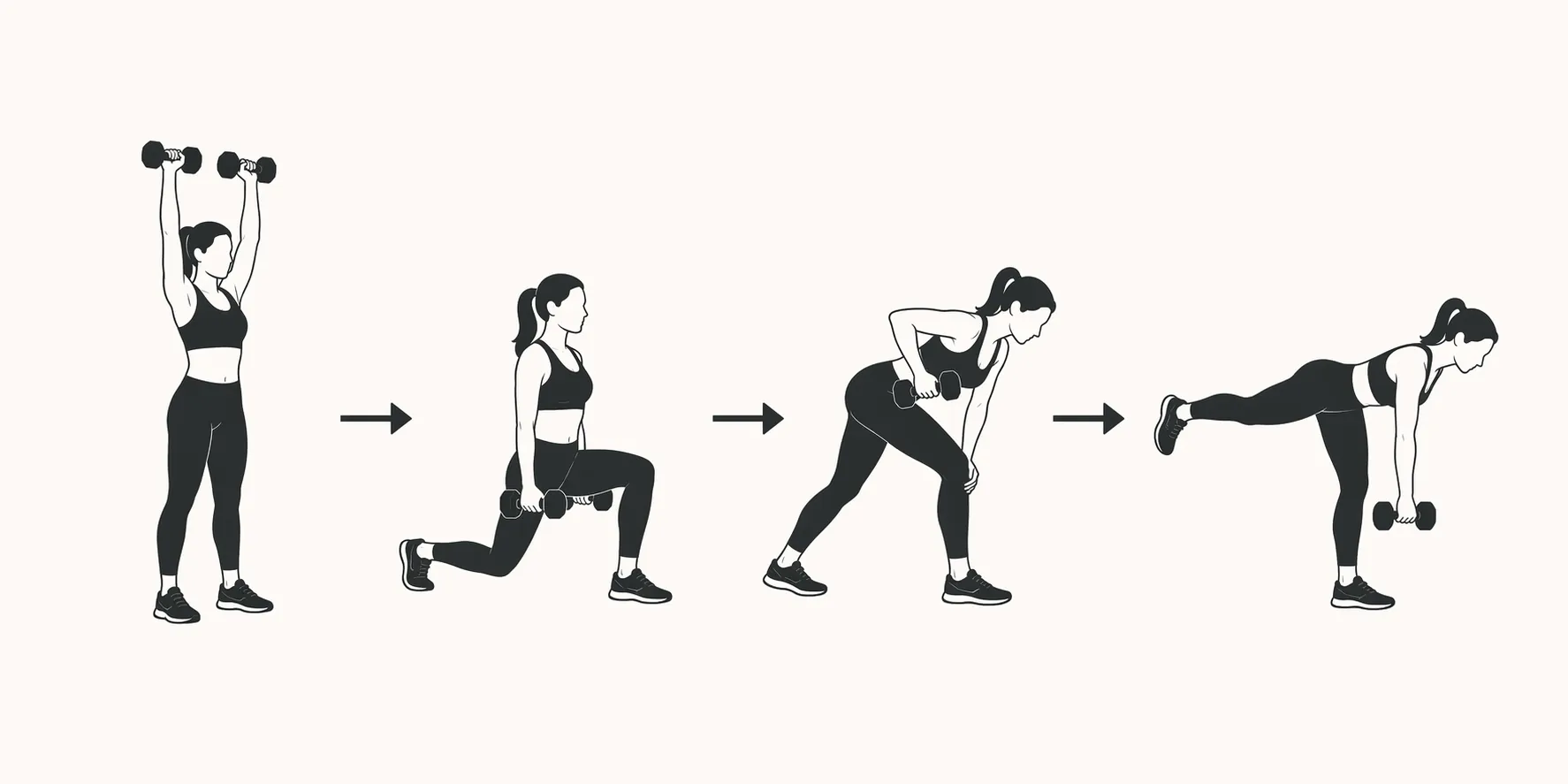
The most important detail is that this is a complex. You are not doing three leisurely sets of shoulder presses, then resetting the room, then deciding what comes next. The dumbbells stay with you while the movement pattern changes: press, lunge, row, hinge. That is why the weights look moderate on paper and still have a way of making the room feel warmer by the second round.
Why one pair of dumbbells can be enough
The clever part is not that the workout uses exotic exercises. It is that the sequence asks one pair of dumbbells to cover upper-body pushing, single-leg knee-dominant work, upper-body pulling, and a hip hinge. Fit&Well’s trainer commentary on complex-style training makes the key point: moving through exercises with limited rest keeps muscles under tension while raising heart rate, so the session can feel like strength work and conditioning at the same time [2].
That also explains why Biel’s reported loading matters. She did not choose one heroic pair and force every movement to obey it. The documented progression starts with 10lb dumbbells for the first two rounds, moves to 15lb for the third, and only sometimes reaches 20lb for the last round [1]. For a home exerciser, that is a useful permission slip: the right weight for a dumbbell complex is usually lighter than the weight you could row or deadlift in isolation.
If you own only one fixed pair, choose the pair by the weakest link in the chain. For many people, that will be the shoulder press or the single-leg RDL, not the reverse lunge. A pair that is perfect for rows can become too much once the shoulders are already tired and the final hinge asks for balance.
- If 10 presses are already a grind, use lighter dumbbells or start bodyweight for the lower-body moves.
- If the rows feel easy but the single-leg RDL gets wobbly, do not raise the load yet. Clean up the hinge first.
- If you are buying adjustable dumbbells, a lighter-to-moderate range is more useful for this routine than one heavy fixed pair. Biel’s best-documented complex uses 10–20lb dumbbells, while a separate reported dumbbell session included a 30lb load for a different move, so do not treat 30lb as required for this workout [5].
How to make it work in a small living room
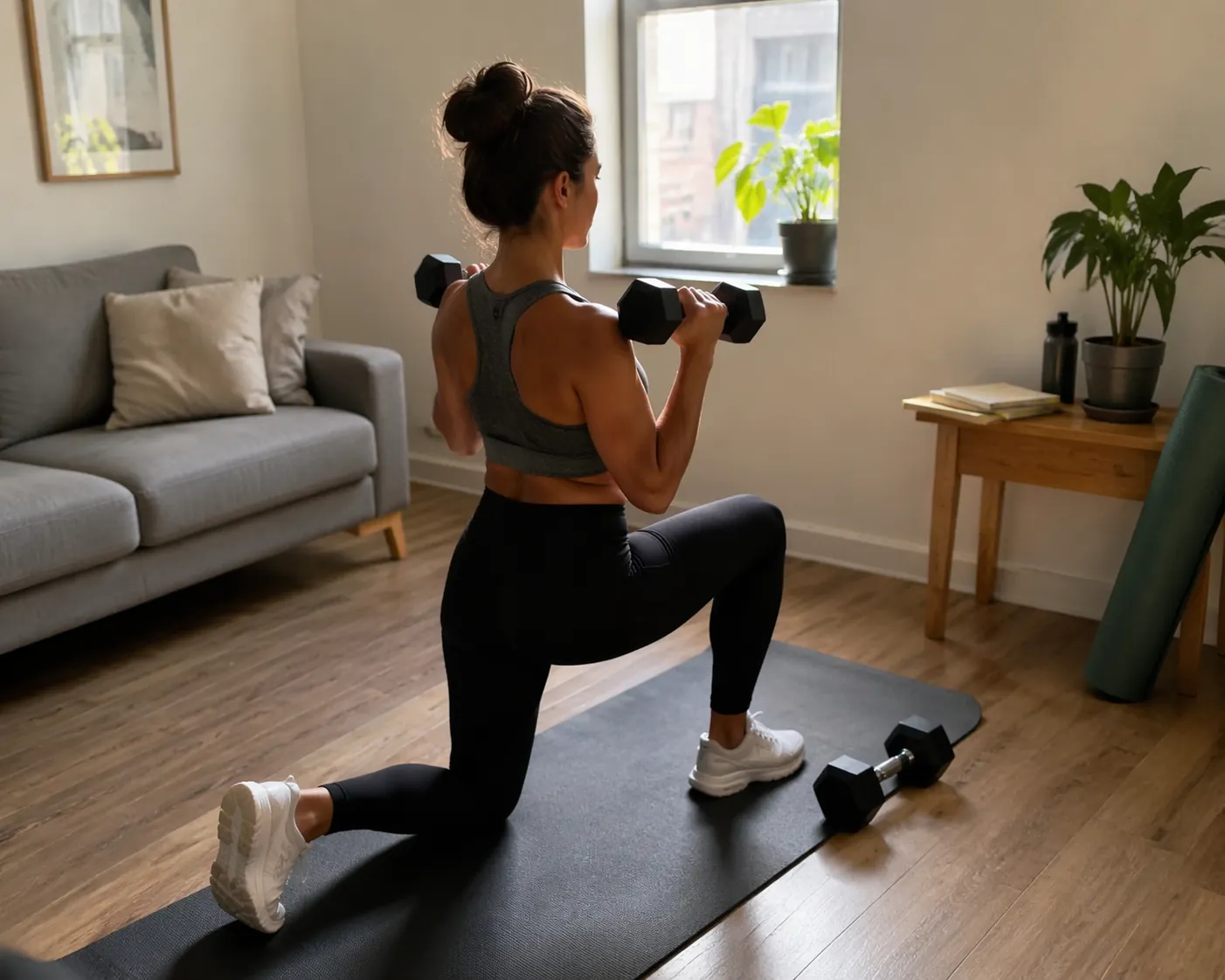
You need more discipline than square footage. Clear a strip of floor long enough for a reverse lunge and a single-leg hinge, put the dumbbells where you can pick them up without stepping around furniture, and treat the mat as your boundary. The reverse lunge is friendlier to apartments than a walking lunge because the travel happens backward and returns to the same spot.
The Tom’s Guide test matters here because it was not a polished celebrity reel. A non-celebrity writer completed the workout and reported the practical difficulty of the session, which is the bridge most people need between “Jessica Biel does this” and “I can try this after moving the coffee table” [1].
Move notes once fatigue starts to show
- Shoulder press: Start each round with control. If you have to arch hard or turn every rep into a push press, the pair is too heavy for the complex.
- Reverse lunge: Use a repeatable step length. In a tight apartment, mark your back-foot landing mentally so you do not keep drifting into the couch or the wall.
- Split-stance row: This is where sloppy reps sneak in. Keep the hinge steady and row the dumbbells rather than jerking them up because you are breathing hard.
- Single-leg RDL: This is the technical bottleneck. If balance fails before your hamstrings or glutes are doing useful work, scale the movement instead of turning it into a hopping drill.
The beginner version I would actually use
The easiest mistake is trying to copy the 3–4 round version exactly on day one. The exercises are familiar, but the continuous format changes the price of each rep. A beginner version should preserve the order and the full-body idea while removing the two things most likely to punish form: too many rounds and too much balance demand.
| If this is your situation | Use this version |
|---|---|
| You are new to dumbbell complexes | Do 2 rounds instead of 3–4. Keep the 60–90 second rest, and add more rest if form is clearly deteriorating. |
| You only own one light pair | Use the same pair throughout and make the reps crisp. Do not rush the transitions just to make the weights feel harder. |
| The reverse lunge feels unstable | Shorten the range slightly or use bodyweight lunges while holding the dumbbells only for the press, row, and hinge. |
| The single-leg RDL is the limiting factor | Swap it for a bilateral dumbbell Romanian deadlift. You still train the hip hinge without making balance the main event. |
| Your grip is giving out before your legs or back | Set the dumbbells down between exercises for a few breaths. That is no longer the exact complex, but it is a better home workout than a sloppy one. |
The bilateral RDL swap is the most important exit ramp. The single-leg version is a good exercise, but it asks for hinge mechanics, hip control, foot stability, and patience at the same time. If you are learning alone, a two-leg hinge lets you train the same broad pattern with fewer ways to lose the rep.
How to progress without turning it into a different workout
Progression does not have to mean grabbing the heaviest dumbbells in the house. Biel’s reported version already gives a simple model: repeat the same complex, then raise the load in later rounds only when the earlier rounds stay controlled [1]. That is a cleaner progression than loading every move equally and hoping the hardest one survives.
- First, make 2 rounds smooth with the same pair.
- Then move to 3 rounds before chasing heavier dumbbells.
- After that, increase only the final round if your press and hinge still look like the first round.
- Keep the rest window honest. Turning 60–90 seconds into five minutes changes the conditioning feel of the complex.
This is also where an adjustable pair earns its floor space. A compact set that lets you move in small jumps gives you more options than owning one pair that is too heavy for presses and too light for lower-body work. If you train in an apartment, the best equipment is not just the equipment you can lift; it is the equipment you can change quickly, store without rearranging the room, and set down quietly.
Where it fits in a normal training week
This does not need to become a daily challenge. Fit&Well reported that Biel trains with weights 2–3 times per week, sometimes once, alongside Pilates and cardio [2]. That is a more useful template than pretending one dumbbell complex has to carry an entire fitness life by itself.
Ben Bruno has also described a broader full-body philosophy and intensity scaling around Biel’s training, which fits the way this complex is built: moderate loads, multiple movement patterns, and enough effort to matter without needing a rack of equipment [3]. For a home user, this routine makes the most sense as one full-body strength-conditioning day, or as a short session when the alternative is skipping because the gym is unrealistic.
Do not merge every Jessica Biel workout into this one
There are other reported Biel dumbbell sessions, and they should stay separate. Fit&Well discusses a different 5-move complex variation with goblet squats, single-leg triceps extensions, single-leg RDLs, bird dog rows, and single-leg hip thrusts [2]. Women’s Health UK covered a separate 6-exercise full-body strength formula in March 2026, and Yahoo/Woman&Home reported a 7-step dumbbell workout aimed at strength and mobility [4][5].
Those sessions are useful context, but they are not interchangeable parts of one master routine. The 4-move complex is the best home template here because it has the clearest public parameters: four moves, documented reps, documented rest, and a documented weight progression. Once those details disappear, the workout becomes much harder for a regular person to reproduce responsibly.
Verdict for home training
Jessica Biel’s 4-move dumbbell complex works as a practical dumbbell-only full-body session. Not because it is magically superior to every other home workout, and not because celebrity training automatically transfers to a living room. It works as a home template because the parts are unusually clear: one pair of dumbbells at a time, a small footprint, 10-rep blocks, 3–4 rounds, 60–90 seconds of rest, and a load progression that shows how to make moderate weights feel serious without pretending every move needs the same pair.
References
- I tried the 4-move dumbbell workout Jessica Biel never skips for full-body strength – here's what happened — Tom's Guide
- Jessica Biel's trainer reveals how she works out when she's juggling work life and mom life — Fit&Well
- How Jessica Biel Got Her Sculpted Arms & Back: Trainer Ben Bruno Reveals All — HOLA.com, Jan 2026
- Jessica Biel's simple formula for building full-body strength at 44 – and 6 exercises behind her results — Women's Health UK, March 2026
- Jessica Biel's PT shares 7-step workout with dumbbells to improve strength and mobility — Yahoo / Woman&Home
What a small equipment investment adds
Cable Machine Alternatives That Save Space and Money
Compare the best cable machine alternatives for home gyms – from resistance bands and pulley systems to suspension trainers and compact digital units – and find the right option for your space and budget.
Small Treadmill Buying Guide: 7 Critical Specs to Check Before You Buy
A cross-category spec primer for apartment and small-space dwellers comparing walking pads, ultra-compact folding treadmills, and full-size folding treadmills. Learn the concrete thresholds for motor HP, deck length, noise, warranty, and subscription lock-in so you can compare apples to apples.
How to Practice Basketball at Home Without Noise Complaints
Learn how to run a full basketball workout in a small apartment without noise complaints. This guide covers no-dribble handling drills, wall form shooting, and silent ball options that let you train without disturbing neighbors.
How often should you repeat this?
See our recovery and rest reference for citation-anchored rest-interval guidance.
Spot something off?
Tell us if a movement, tier assumption, or duration didn't match your experience.