
Joan Collins' Anti-Aging Home Exercise Routine for Seniors
Discover the 12-minute Royal Canadian Air Force XBX program, a no-equipment exercise routine Joan Collins has reportedly used for decades. This progressive 48-level workout helps seniors build strength, mobility, and balance at their own pace.
- Equipment tier required
- none
- Duration
- 12 min
- Difficulty
- beginner
- Target area
- full body
- Space footprint needed
- small (mat-sized)
- Noise level
- low impact
The Joan Collins anti aging home exercise routine for seniors is best understood as a practical question, not a beauty secret: what can an older adult do at home, without equipment, that keeps the body able to bend, stand, reach, balance, and keep going? Collins, now 93, is often held up as proof that long-term movement matters, and recent coverage of her vitality emphasizes daily physiotherapy, Pilates, and swimming rather than one exclusive miracle workout.[1] Other reporting has linked her to the Royal Canadian Air Force XBX plan, a 12-minute women’s fitness routine from the 1960s; Helen Mirren’s connection to the RCAF 5BX/XBX approach is more directly credited in fitness history coverage.[2]
That honesty matters. XBX should not be sold as the only thing Joan Collins does, or as a way to look like anyone else at 93. Its value is plainer and more useful: it gives seniors a short, no-equipment, progressive routine that can start at a very low level and still leave room to improve.
The 12-minute routine itself
XBX stands for “Ten Basic Exercises.” It was developed by the Royal Canadian Air Force as the women’s counterpart to the better-known 5BX men’s program. Before release, it was tested on more than 600 women of varying ages and fitness levels, and the program later sold more than 20 million copies worldwide.[2]
The attractive part, especially for a senior exercising at home, is not military nostalgia. It is the design. The session stays at 12 minutes. The exercises use body weight. The floor area can be small. The level changes, not the time commitment.
| Order | XBX exercise | What it asks of an older body |
|---|---|---|
| 1 | Toe touching | Forward bending, hamstring and back mobility |
| 2 | Knee raising | Hip flexion, standing control, balance |
| 3 | Lateral bending | Side-body mobility and trunk control |
| 4 | Arm circling | Shoulder range and overhead comfort |
| 5 | Sit-ups | Abdominal strength and getting up from the floor |
| 6 | Chest and leg raising | Back and hip extensor strength |
| 7 | Side leg raising | Hip strength used in walking and balance |
| 8 | Push-ups | Upper-body pushing strength; often modified from the knees |
| 9 | Leg lifting | Core and hip control |
| 10 | Running and jumping in place | Cardio, coordination, and impact tolerance; often changed to marching |
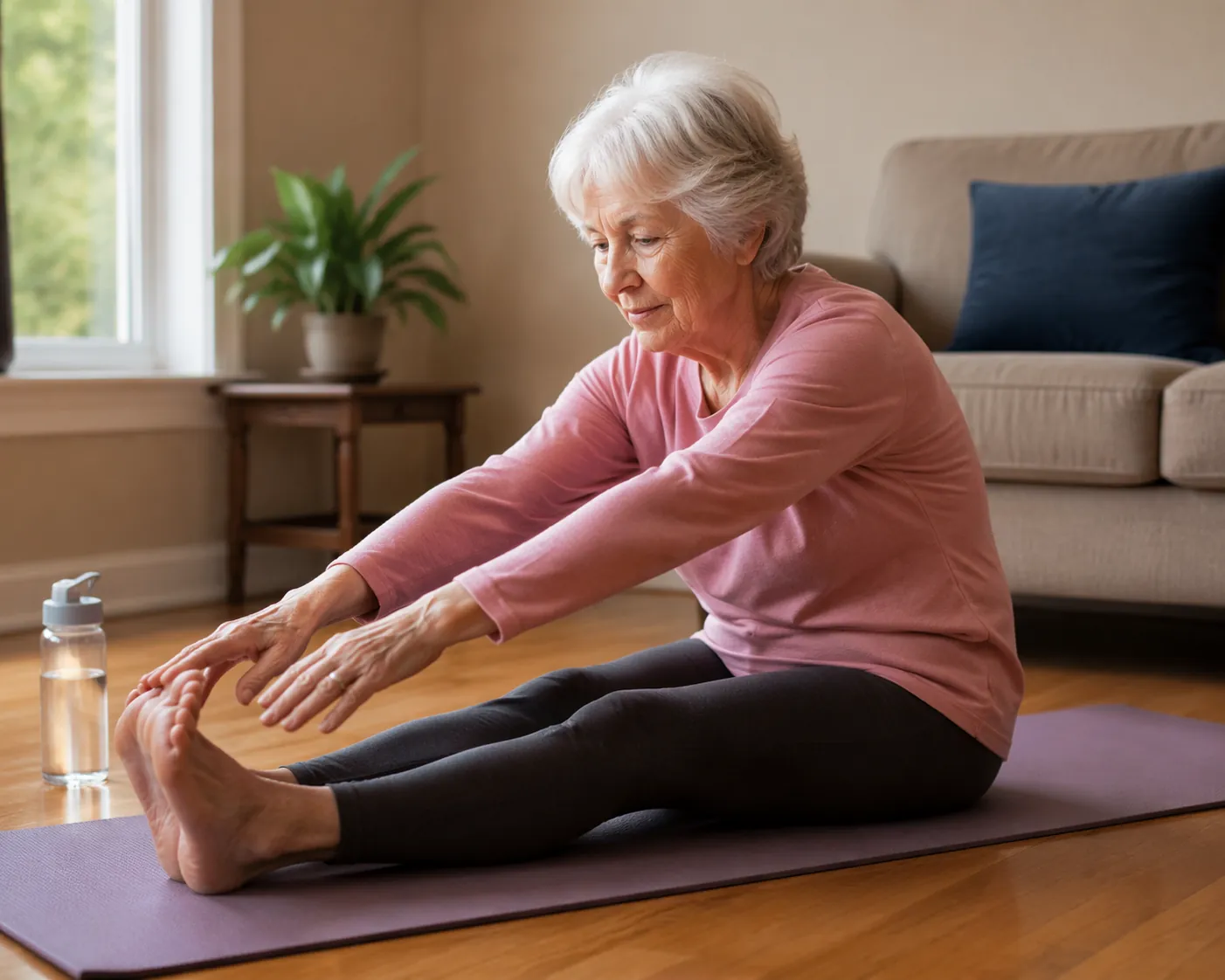
Look at that list without the glamour attached and it becomes almost domestic. It covers the movements that tend to shrink first when life gets smaller: bending forward, lifting a knee, rotating the shoulders, bracing the middle, pushing the body away from the floor, and moving fast enough to raise the heart rate.
Why the 48 levels matter more than the celebrity name
The best feature of XBX is its progression system. The program is organized into four charts, labeled A, B, C, and D. Each chart has 12 levels, giving 48 levels in all. The 12-minute length stays fixed while the work becomes harder through more repetitions and more demanding variations.[2]
That structure is unusually respectful to a beginner. A frail 80-year-old does not need to pretend to be fit enough for the middle of the program. She can begin at Chart A, Level 1. A stronger 65-year-old can also use the same system without being trapped forever in a beginner routine. The chart does not scold either woman; it simply gives each of them a place to stand.
This is where many short workouts fail older adults. They promise to be quick, then hide the real difficulty in movements that assume strong wrists, mobile hips, quick balance reactions, and easy floor work. XBX is still exercise, and parts of it may need changing, but the charted ladder gives a senior permission to start lower than pride might prefer and progress only when the body is ready.
- The time stays predictable: 12 minutes, not a workout that quietly grows into 45.
- The space stays modest: a mat-sized area is enough for most of the routine.
- The equipment barrier disappears: no machine, subscription, weights, or app is required.
- The progression is visible: the next level is written down instead of guessed.
- The starting point can be humble: the lowest level still belongs to the same program.
For seniors who want a broader look at exercising at home without expensive gear, the companion guide Stay Fit at Home Like Joan Collins Without Expensive Gear fits well beside XBX because it treats home exercise as a daily habit rather than a shopping project.
How a senior should modify XBX at home
The original XBX plan was not written as a modern clinical program for every older adult with arthritis, osteoporosis, joint replacements, dizziness, or heart disease. Anyone with those concerns should get medical guidance before starting. For many seniors, the sensible version is not the hardest version. It is the version that can be repeated tomorrow.
| Original movement | Senior-friendly starting option | Why the change helps |
|---|---|---|
| Toe touching | Reach toward shins, a chair seat, or a raised surface | Keeps the forward bend without forcing the back or hamstrings |
| Knee raising | Hold a chair or wall and lift one knee at a time | Adds balance support while training hip lift |
| Sit-ups | Use a smaller curl-up, hands to thighs, or skip floor sit-ups at first | Reduces strain while building trunk control gradually |
| Push-ups | Do knee push-ups or wall push-ups | Keeps upper-body pushing work without requiring a full plank |
| Running and jumping in place | March in place, step-touch, or low heel lifts | Raises the heart rate with less impact |
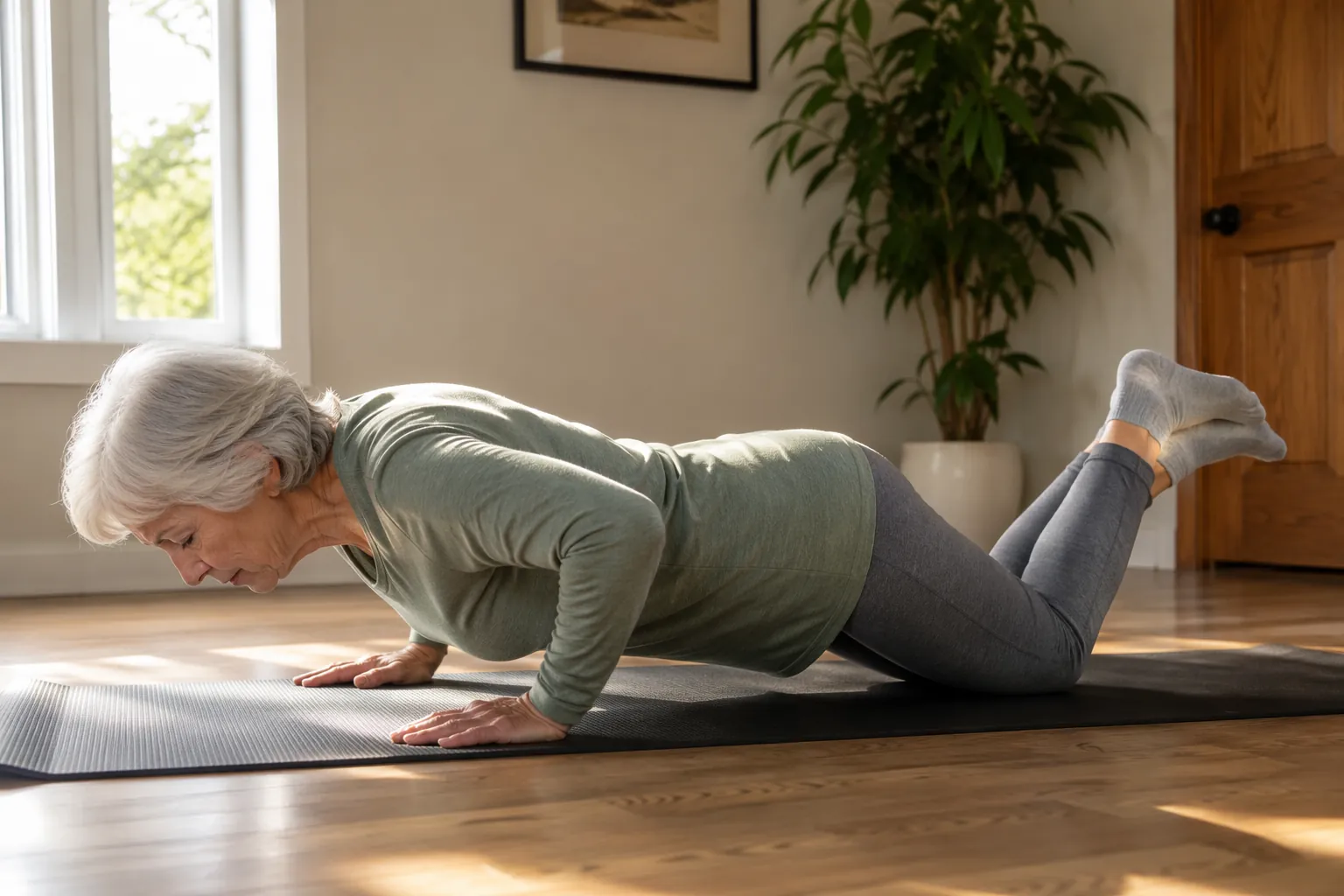
Knee push-ups deserve special mention because they are not a consolation prize. For an older adult, the useful question is whether the movement builds the strength needed to push up from a chair, steady the body with the arms, and get off the floor if necessary. A knee push-up, a wall push-up, or a hands-on-counter push-up can all serve that purpose when chosen honestly.
The last XBX exercise also needs judgment. Running and jumping in place may be fine for some seniors, but it is not the price of admission. Marching in place can keep the rhythm of the routine while lowering impact. A person with balance concerns can march beside a wall or sturdy chair. A person who tires quickly can march for shorter bouts inside the same 12-minute frame.
A slower start is not a failure of the program. It is how the program becomes usable. Some seniors will need a few minutes of gentle walking around the room before the 12 minutes begin. Others may need to practice floor transitions separately before trying the floor exercises in sequence. The fixed duration is helpful, but it should not be treated as a command to rush stiff joints first thing in the morning.
Where XBX fits beside modern activity guidelines
The CDC recommends that adults 65 and older aim for 150 minutes a week of moderate-intensity aerobic activity, muscle-strengthening activity at least two days a week, and balance work as part of their weekly routine.[3] XBX by itself, done for 12 minutes daily, adds up to 84 minutes a week. That does not meet the full aerobic recommendation on its own, but it can contribute strength, mobility, balance practice, and some heart-rate work depending on the level and modifications.
A practical week might pair XBX with walking or swimming. A simple example is 12 minutes of XBX daily plus a 20-minute walk three times a week. That combination brings the weekly movement total to 144 minutes, close to the CDC’s 150-minute target while also preserving regular strength practice. A slightly longer walk, another short walk, or a swim can close the gap without turning the plan into a second job.
For readers who want the larger framework, A 3-Pillar Home Exercise Plan for Healthy Aging is a useful next layer because it separates strength, cardio, and mobility instead of pretending one short routine can do everything.
A sensible way to start Chart A
The safest starting rule is boring and dependable: begin below what you think you can do. Use Chart A, Level 1 unless there is a clear reason not to. Stay there until the routine feels controlled, not merely completed. The body should not be bargaining with the floor halfway through the sit-up section or staggering through the final marching section just to protect a number on a chart.
- Use a chair, wall, or countertop for balance whenever standing work feels uncertain.
- Change full push-ups to knee, wall, or counter push-ups from the beginning.
- Change running and jumping to marching if impact, leakage, foot pain, or balance makes jumping unwise.
- Pause between exercises if needed, then return to the sequence without treating the pause as a defeat.
- Move up a level only when the current level feels repeatable on an ordinary day, not only on a very good day.
This is also where home exercise beats many well-equipped intentions. A senior does not need to drive anywhere, reserve a machine, or learn a screen. A mat, a wall, and a clear patch of floor are enough to begin. If later the routine starts to feel too narrow, light dumbbells, resistance bands, or a stability ball can be added through a separate plan, but they are not needed on day one. For that later stage, How to Choose a Compact Home Gym is a more sensible read than buying equipment before the habit exists.
What XBX can and cannot promise
“Anti-aging” is a troublesome phrase when it is made to mean a face, a dress size, or a celebrity headline. Used carefully, it can mean preserving the physical capacities that make later life larger: standing from a low chair, carrying groceries, climbing stairs, turning without fear, reaching a shelf, getting down to the floor and back up again.
XBX has no special claim to reverse aging, and the available material does not justify calling it Joan Collins’ exclusive personal routine. Collins’ own recent coverage points more strongly to daily physiotherapy, Pilates several times a week, and swimming as part of her current practice.[1] The XBX connection is better treated as reported and compatible: a short, disciplined, home-based routine in the same spirit as the steady maintenance she describes.
The stronger celebrity link belongs to Helen Mirren’s credited use of the RCAF 5BX/XBX tradition, and even there the lesson is not that a military booklet guarantees vitality. The lesson is that a simple plan can survive for decades when it is short, repeatable, and progressive.[2]
That is enough. In 2026, seniors are surrounded by programs that ask for equipment, passwords, subscriptions, tracking, and enthusiasm they may not have at 7 a.m. XBX asks for 12 minutes, a little floor space, and enough patience to start at the level that is actually safe. It is not magic, and it is not necessarily Joan Collins’ only routine. But its no-equipment design, tested history, and unusually gradual 48-level progression make it one of the rare vintage fitness systems that still makes sense for older adults starting at home.
References
- Joan Collins reveals the surprising trick behind her incredible vitality at 93, HELLO!
- The 12-Minute Military Workout That Took Over the World, Physical Culture Study
- Older Adult Activity: An Overview, Centers for Disease Control and Prevention
What a small equipment investment adds
We don't have a build tagged to this exact tier yet. Browse all builds.
How often should you repeat this?
See our recovery and rest reference for citation-anchored rest-interval guidance.
Spot something off?
Tell us if a movement, tier assumption, or duration didn't match your experience.