
Leg Workouts at Home: Three Complete Routines by Equipment Tier
A structured guide for beginners and intermediates who want to train their legs at home without guessing — organized into three equipment tiers (bodyweight, resistance bands, dumbbells), with muscle group coverage maps, sets and reps, form cues, and clear progression logic between tiers.
- Duration
- 45 min
Why Home Leg Day Is Harder Than It Looks
Most people who skip leg day at home aren't lazy. They're stuck. They open a browser, find a list of ten exercises, do a few sets with no clear structure, and stop — because nothing tells them whether they trained their hamstrings, how hard they should push, or what to do differently next week.
The problem isn't motivation. It's that home leg training is genuinely under-structured compared to upper-body work. Push-ups give you an obvious progression path. Squats and lunges feel less clear — especially when you're not sure which muscles are actually working, or whether what you're doing is enough to produce results.
This article is organized differently from the typical exercise list. It gives you three complete workouts — one for each equipment tier you might realistically own — with the muscle-group coverage and honest gaps mapped out for each. You'll know what you're training, what you're missing, and when it's worth adding equipment.
What Your Legs Actually Need: A Quick Muscle Group Map
Your lower body is built around four major muscle groups. Each one has different movement requirements, and a well-designed leg routine needs to address all four — not just the ones that are easiest to train without equipment.
| Muscle Group | Primary Function | Best Movement Pattern | Bodyweight Gap? |
|---|---|---|---|
| Quadriceps | Knee extension, squat depth | Squats, lunges, step-ups | No — squats and lunges load quads well |
| Glutes | Hip extension, hip abduction | Hip hinges, bridges, squats | Partial — bilateral bridges are limited; single-leg and banded versions help |
| Hamstrings | Knee flexion, hip extension | Hip hinge (RDL), leg curl | Yes — this is the real gap; hip hinges require load to be effective at moderate reps |
| Calves | Plantarflexion (pushing off the ball of the foot) | Calf raise | No — single-leg calf raises are challenging enough bodyweight |
The hamstring gap is the most important thing to understand before choosing a tier. The Romanian deadlift — the most effective hamstring exercise in this guide — requires load to work. Without resistance, the hip-hinge movement becomes a balance drill, not a strength stimulus. Resistance bands partially address this through constant-tension movements like kickbacks; dumbbells solve it properly through the loaded RDL.
Tier 1 — The Bodyweight Leg Workout
This routine covers quads, glutes, and calves well. Hamstring loading is limited — that's an honest constraint of bodyweight training, not a flaw in the routine. If you're starting here, the goal is to build a movement foundation and progress toward unilateral exercises before considering equipment.
Do 3 sets of 10–15 reps per exercise. On the last set of each exercise, push to within 1–2 reps of failure — that's what drives adaptation. Rest 60–90 seconds between sets.
| Exercise | Sets × Reps | Muscles Targeted | Key Form Cue |
|---|---|---|---|
| Bodyweight Squat | 3 × 10–15 | Quads, glutes | Knees track over toes; sit back into hips, not forward onto knees |
| Reverse Lunge | 3 × 10–12 each leg | Quads, glutes | Step back so front shin stays roughly vertical; rear knee lowers toward floor |
| Lateral Lunge | 3 × 10 each side | Quads, adductors, glutes | Push hips back as you step out; keep the non-working leg straight |
| Glute Bridge | 3 × 12–15 | Glutes, hamstrings (limited) | Drive through heels; squeeze glutes at the top and hold 1 second |
| Single-Leg Glute Bridge | 3 × 10 each leg | Glutes, core stability | Keep hips level; non-working leg stays bent and lifted |
| Calf Raise | 3 × 15–20 | Calves (gastrocnemius, soleus) | Full range — heel all the way down, rise onto the ball of the foot |
The Key Progression: Bulgarian Split Squat
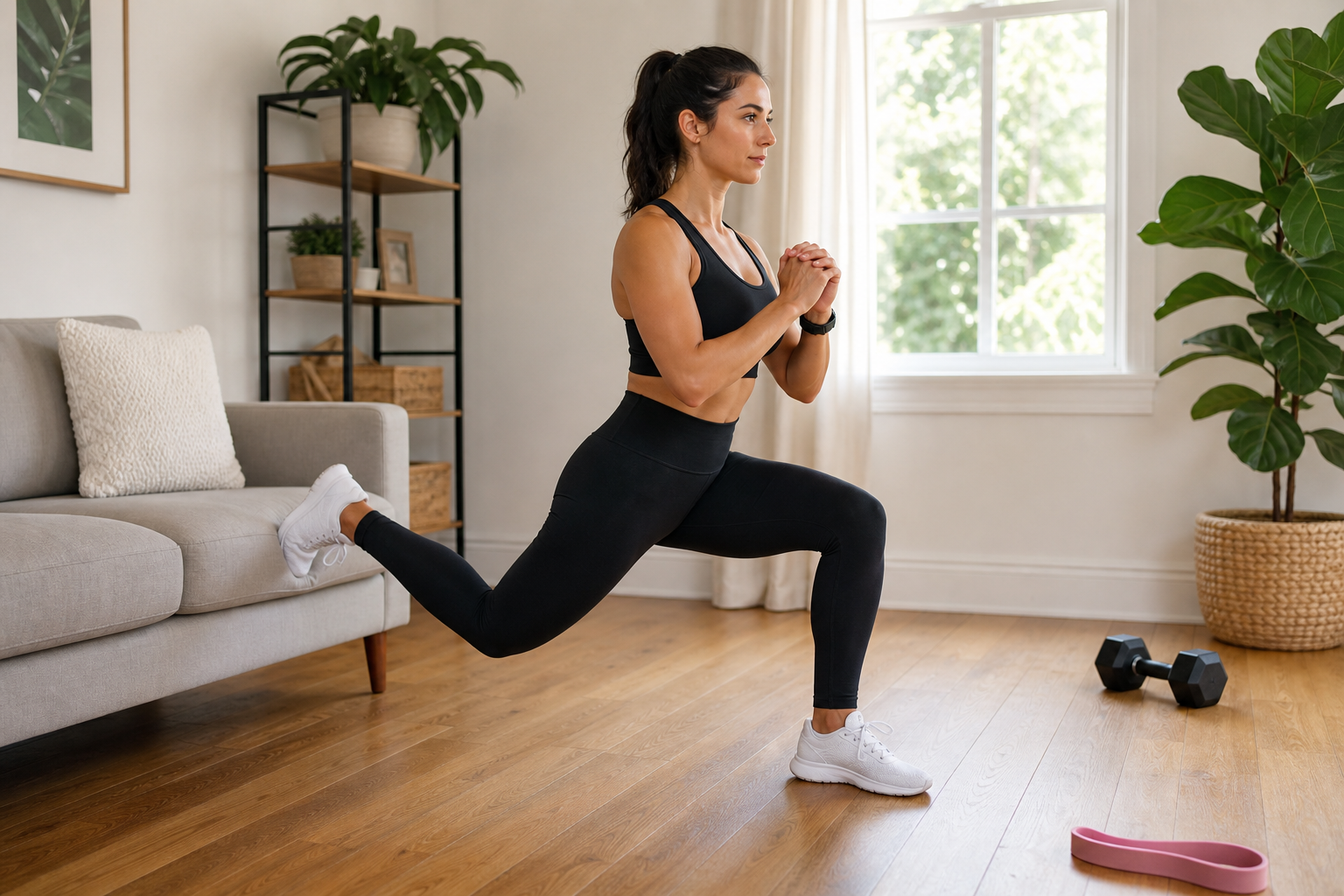
Once you can complete 15 reps of the bodyweight squat and reverse lunge with good form and no real struggle, it's time to introduce the Bulgarian split squat. This is the most important unilateral progression in bodyweight leg training — it nearly doubles the load on the working leg compared to a standard squat, and it's achievable with nothing more than a couch or a low chair.
- Stand about two feet in front of a couch or chair, facing away from it.
- Place the top of one foot on the surface behind you.
- Lower your back knee toward the floor, keeping your front shin as vertical as possible.
- Drive through your front heel to return to the start. Keep your torso upright throughout.
What Tier 1 Covers — and Where It Stops
Tier 1 trains your quads and glutes effectively, and your calves adequately. The single-leg glute bridge adds some posterior chain work, but it's not a genuine hamstring-loading exercise — the hip extension at that range of motion is primarily glute-driven. If you want to train your hamstrings properly, you'll need to move to Tier 2 or Tier 3.
Tier 2 — Adding Resistance Bands
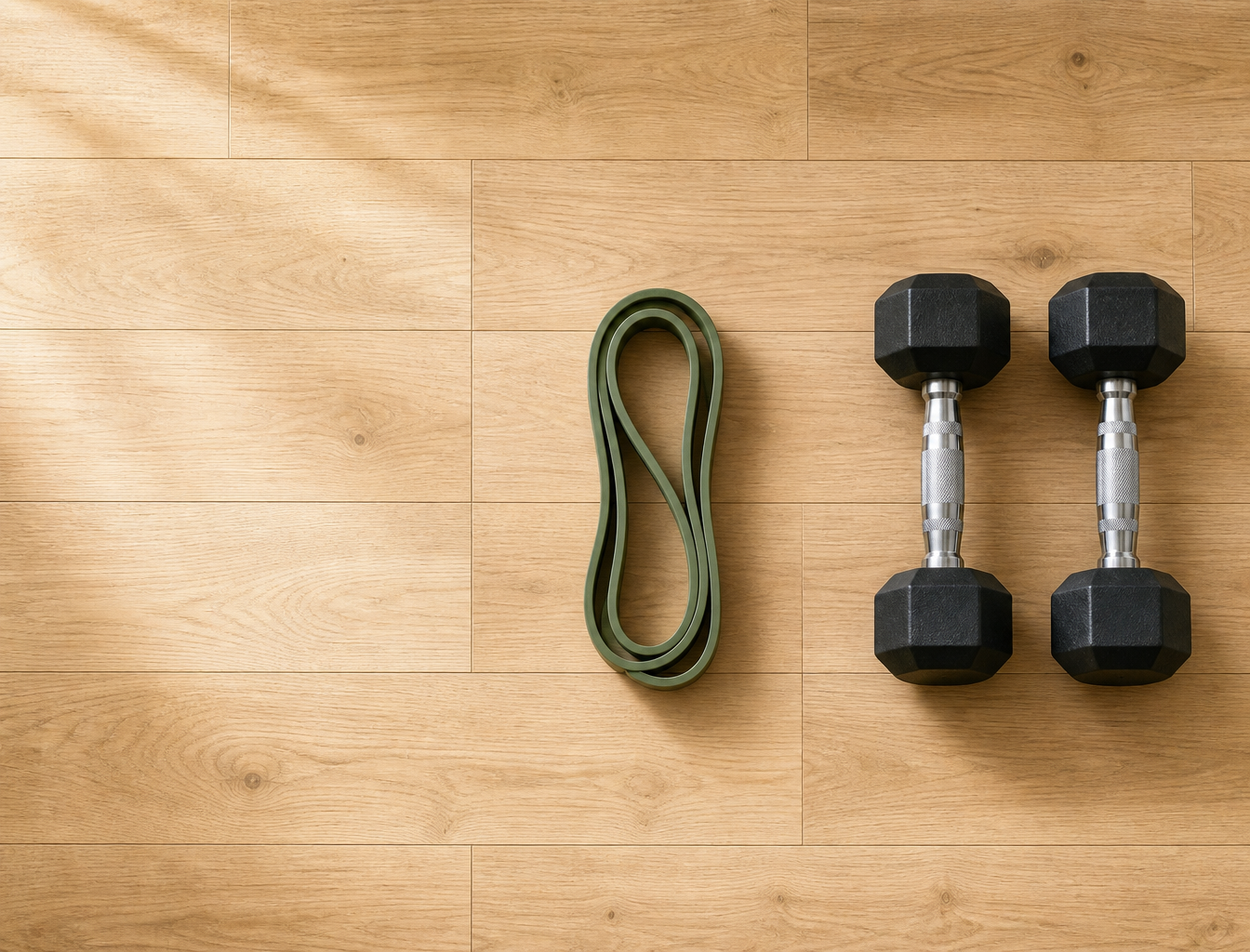
A looped resistance band — the kind that costs $15–30 and fits in a drawer — changes what's possible for home leg training in two specific ways: it adds constant tension to glute and hip-abductor movements that bodyweight can't replicate, and it makes hip-hinge variations genuinely useful for posterior chain work.
The key word is constant tension. Unlike a dumbbell, which only loads a movement at the point of maximum leverage, a band maintains resistance throughout the full range — including the top of a glute bridge, where the glutes are most activated. That's a meaningful difference for glute development.
Research on resistance bands finds they can produce similar strength gains to conventional equipment for single-joint exercises when the resistance is well-matched — but they are not a full substitute for free weights in heavy multi-joint lower-body work. Use them to fill the gaps bodyweight leaves, not to replace a dumbbell routine.
| Exercise | Sets × Reps | Muscles Targeted | Band Placement | Key Form Cue |
|---|---|---|---|---|
| Banded Glute Bridge | 3 × 12–15 | Glutes (constant tension) | Loop just above knees | Push knees outward against band throughout; squeeze glutes at top |
| Banded Lateral Walk | 3 × 12 steps each direction | Gluteus medius, outer thighs | Loop just above knees or around ankles | Stay in a quarter-squat; keep tension in the band at all times — don't let feet come too close together |
| Banded Squat | 3 × 12–15 | Quads, glutes | Loop just above knees | Band adds a knee-tracking cue — push knees out against it as you descend |
| Banded Glute Kickback | 3 × 12 each leg | Glutes, hamstrings (posterior chain isolation) | Loop around ankles | Hinge slightly forward at the hip; drive one leg back and up in a controlled arc — avoid arching your lower back |
| Banded Clamshell | 3 × 15 each side | Gluteus medius, hip external rotators | Loop just above knees | Lie on your side with hips stacked; rotate the top knee up like a clamshell opening — keep feet together |
The banded kickback is the closest Tier 2 gets to genuine hamstring isolation. It's not a substitute for a loaded Romanian deadlift, but it does target the posterior chain in a way that pure bodyweight cannot. Think of it as a bridge — useful, but with clear limits.
Tier 3 — The Dumbbell Leg Workout
Dumbbells solve the hamstring problem. The Romanian deadlift — the most important exercise in this tier — loads the hamstrings through a hip-hinge pattern that genuinely challenges the posterior chain in a way neither bodyweight nor bands can match for compound work. If you're going to invest in one piece of home gym equipment for leg training, a pair of adjustable dumbbells is it.
Do 3 sets of 8–12 reps per exercise. When the last few reps of a set feel easy — not just manageable, but genuinely easy — that's the signal to add weight. Increase by 2–5 lbs at a time.
| Exercise | Sets × Reps | Muscles Targeted | Key Form Cue |
|---|---|---|---|
| Romanian Deadlift (RDL) | 3 × 10–12 | Hamstrings, glutes | Drive hips backward as far as you can while keeping your back flat — you should feel a stretch in your hamstrings, not tension in your lower back |
| Goblet Squat | 3 × 10–12 | Quads, glutes, upper back | Hold one dumbbell vertically at chest height; elbows inside knees at the bottom |
| Bulgarian Split Squat (with dumbbells) | 3 × 8–10 each leg | Quads, glutes, hamstrings | Hold a dumbbell in each hand; same form as the bodyweight version — front shin vertical, torso upright |
| Dumbbell Step-Up | 3 × 10 each leg | Quads, glutes | Step onto a sturdy surface (18–24 inches); drive through the heel of the elevated foot, not the trailing leg |
| Alternating Forward Lunge | 3 × 10–12 each leg | Quads, glutes, hamstrings | Hold dumbbells at sides; step forward so the front thigh reaches parallel; push back through the front heel |
| Dumbbell Calf Raise | 3 × 15–20 | Calves | Hold dumbbells for added load; full range — heel below the step if possible, rise fully onto the ball of the foot |
Weight Selection for Beginners
If you're new to dumbbell training, start lighter than you think you need to. For most beginners, a light pair in the 8–15 lb range is enough to make the goblet squat and lunges challenging. The Romanian deadlift typically needs more weight than the squat variations — most people can handle 15–25 lbs per hand once they have the movement pattern. The right weight is one where the last 2–3 reps of a set require genuine effort but don't break your form.
How to Progress Between Tiers — and When to Upgrade
The decision to move from one tier to the next should be driven by a specific muscle-group gap, not by general boredom or a vague sense that you want more challenge. Boredom is solved by adding reps, shortening rest, or introducing harder exercise variations within the same tier. A genuine training gap — where a muscle group is consistently under-loaded and you can feel it — is the signal to upgrade.
| Situation | What to Do First | When to Upgrade Tier |
|---|---|---|
| Tier 1 squats and lunges feel easy at 15 reps | Introduce the Bulgarian split squat; reduce rest to 45 seconds | Only if Bulgarian split squat also becomes easy at 12–15 reps |
| Tier 1 glute bridges feel easy at 15 reps | Progress to single-leg glute bridge; add a 2-second hold at the top | Move to Tier 2 banded glute bridge if single-leg version plateaus |
| Hamstrings feel consistently under-worked at Tier 1 | This is a structural gap — bodyweight hip hinges can't fully address it | Move to Tier 2 (banded kickbacks) or Tier 3 (RDL) to fill the gap |
| Tier 2 banded exercises feel too easy even with heaviest band | Increase band resistance if possible; add reps to 20+ | Move to Tier 3 — you've outgrown what bands can load for multi-joint work |
| Tier 3 exercises feel easy at 12 reps | Add weight by 2–5 lbs; do not increase reps beyond 15 for strength focus | No tier to upgrade to — continue progressive overload within Tier 3 |
Weekly Frequency and Volume: How Much Leg Training You Actually Need
Volume — the total number of hard sets you do per muscle group per week — matters more than how many days you train. Research suggests a minimum of around 4 hard sets per muscle group per week to see strength gains, with 10 or more sets per week associated with better hypertrophy outcomes. For most home exercisers, two leg sessions per week is the practical target that hits both the minimum and the optimal range.
Whether you do those sets in one longer session or two shorter sessions doesn't matter much — when total weekly volume is equated, the results are similar. If your schedule only allows one leg day per week, make it a full session with 4–5 exercises rather than cutting it short.
| Training Goal | Minimum Sets Per Muscle Group Per Week | Practical Session Structure |
|---|---|---|
| Maintain strength / general fitness | 4 hard sets | 1 session × 4–5 exercises, 3 sets each |
| Build strength | 4–6 hard sets | 1–2 sessions × 3–4 exercises, 3 sets each |
| Build muscle (hypertrophy) | 10+ hard sets | 2 sessions × 5–6 exercises, 3 sets each |
Warm-Up: What to Do Before You Start
A 5–10 minute dynamic warm-up is enough before any of the three tier workouts. The goal is to raise tissue temperature in the specific muscles you're about to train and rehearse the movement patterns — not to exhaust yourself before the main session.
- Leg swings — forward/back and side to side, 10 each direction per leg. Hold a wall for balance if needed.
- Hip circles — 10 slow circles each direction per hip. Stand on one leg and draw large circles with the raised knee.
- Bodyweight squats — 10 reps at a slow, controlled tempo. Focus on depth and knee tracking, not speed.
- Walking lunges — 10 steps total, alternating legs. Keep your torso upright and step long enough to feel a hip flexor stretch on the rear leg.
- Glute bridge holds — 2 reps of a 5-second hold at the top. This activates the glutes before any bridge or hinge work.
FAQ: Common Questions About Home Leg Training
How often should I train legs?
Twice per week is the practical target for most people. If your schedule only allows one session, make it a complete one — 5–6 exercises, 3 sets each. Research suggests that when total weekly volume is equated, once-a-week and twice-a-week training produce similar results. Frequency matters less than total sets.
Does running count as leg training?
Not for the purposes of building lower-body strength or muscle. Running is primarily an endurance activity. Once your body adapts to the demands of your running routine, it won't continue to develop meaningful strength or muscle mass. The movement patterns also don't match — running is a repeated single-leg push, while the exercises in this guide train hip hinge, squat, and lateral movement patterns that running doesn't address. Run if you enjoy it, but count it as cardio, not leg training.
How long before I see results?
Strength improvements — the ability to do more reps or handle more load — typically show up within 2–4 weeks of consistent training. These early gains are largely neurological: your nervous system gets better at recruiting the muscles you already have. Visible muscle changes take longer, usually 6–12 weeks of consistent training and adequate sleep and nutrition. The most important variable is consistency — two sessions per week, every week, beats occasional intense sessions.
Can I actually build muscle with bodyweight only?
Yes — with two important qualifications. First, you need to train close to failure. Sets of 10 squats that feel easy won't build muscle. Sets of 15 where the last 2–3 reps require real effort will. Second, the hamstring limitation is real. Pure bodyweight training can build your quads, glutes, and calves reasonably well, but it cannot load your hamstrings effectively through a hip-hinge pattern. If hamstring development matters to you, a $20 resistance band or a basic set of dumbbells will make a meaningful difference.
What a small equipment investment adds
We don't have a build tagged to this exact tier yet. Browse all builds.
How often should you repeat this?
See our recovery and rest reference for citation-anchored rest-interval guidance.
Spot something off?
Tell us if a movement, tier assumption, or duration didn't match your experience.