
How to Use the Mediterranean Diet for Home Fitness Weight Loss
Learn how to adapt the Mediterranean diet for weight loss while doing home workouts. This practical guide shows how to eat for fat loss and muscle preservation without complex meal prep or supplements.
- Equipment tier required
- none
- Duration
- 30 min
- Difficulty
- beginner
- Target area
- full body
The hard part of using the Mediterranean diet for home fitness weight loss is not finding pretty recipes. It is coming off a bodyweight circuit, a dumbbell session, or a resistance-band workout and eating in a way that creates a calorie deficit without making dinner feel like punishment. The diet can help, but only when it is treated as a repeatable grocery pattern: vegetables, legumes, fruit, whole grains, fish, poultry, eggs, yogurt, and measured amounts of the richer foods that make Mediterranean meals taste good.
That last part matters. Olive oil, feta, nuts, and cheese are not fake health foods, but they are also not calorie-free because they appear in a Mediterranean meal. For someone training at home, the useful version of this diet is built around volume, protein, and enough consistency to repeat on a normal weekday.
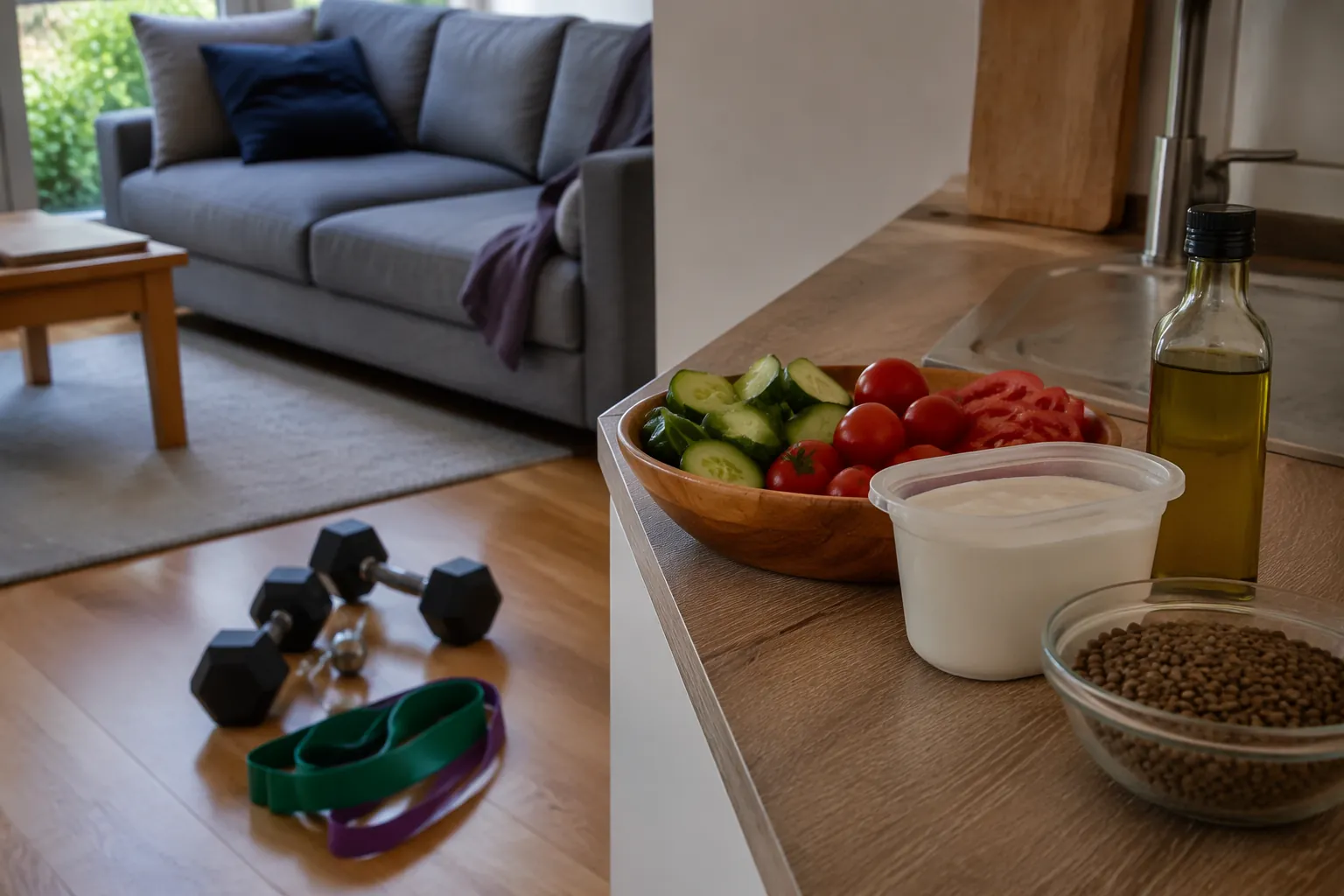
The calorie-density lever is where this diet becomes practical
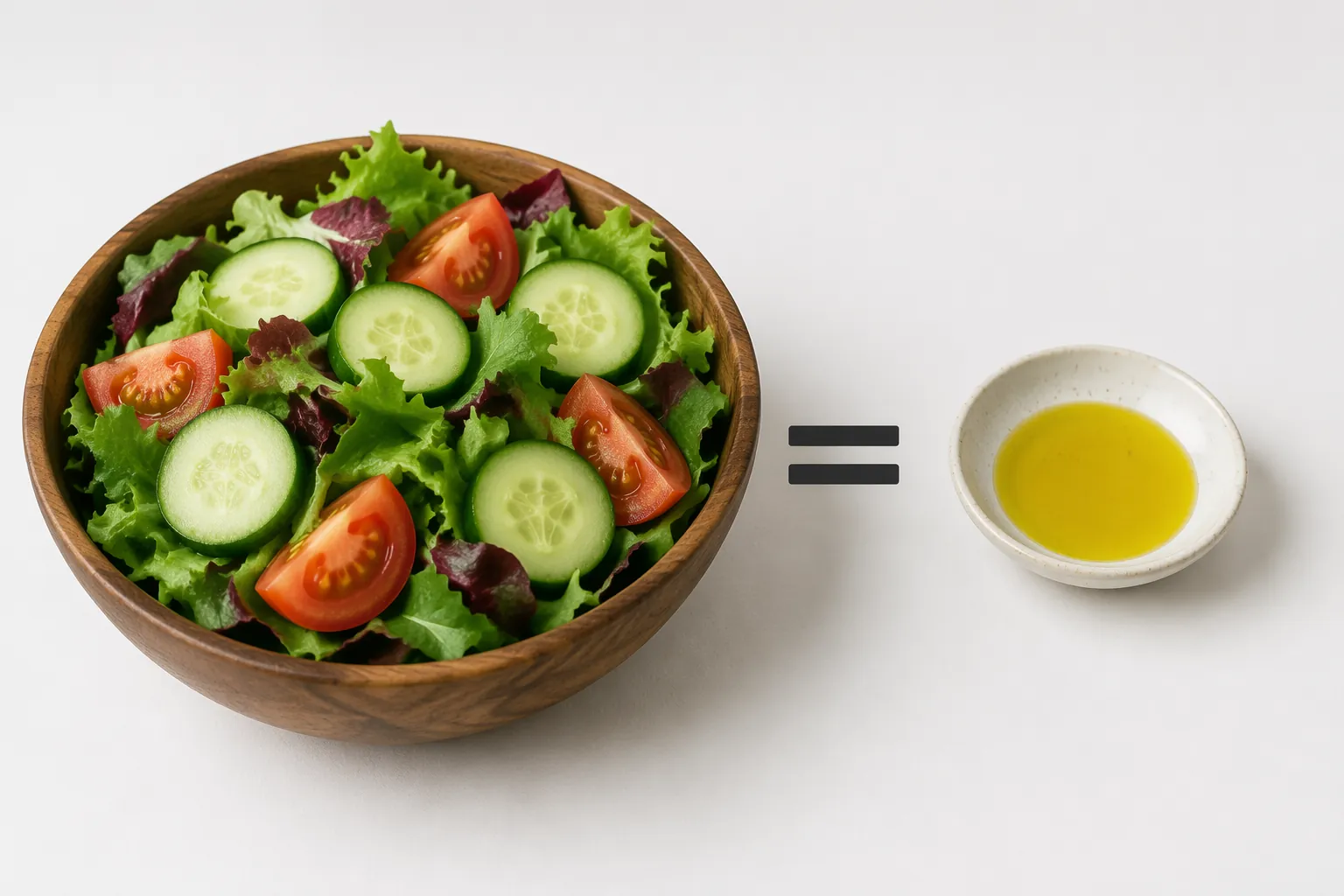
Weight loss still needs an energy deficit. The Mediterranean pattern helps because many of its basic foods take up a lot of plate space for relatively few calories. Mayo Clinic Diet lists cucumber at 0.15 calories per gram, tomato at 0.18, lentils at 1.10, quinoa at 1.20, grilled chicken at 1.65, feta at 2.60, and olive oil at 8.80 calories per gram.[1]
That one comparison explains more than most diet rules. A large bowl led by cucumber, tomato, greens, lentils, and chicken can be filling while staying moderate in calories. The same bowl can turn into a maintenance meal, or even a surplus meal, when the heaviest items are poured or scattered on without attention.
| Food | Calories per gram | How to use it in a weight-loss meal |
|---|---|---|
| Cucumber | 0.15 kcal/g | Use freely for volume, crunch, and plate size |
| Tomato | 0.18 kcal/g | Use freely in salads, bowls, eggs, and tuna plates |
| Lentils | 1.10 kcal/g | Use as a filling carb-protein base |
| Quinoa | 1.20 kcal/g | Use as a measured grain base, not the whole bowl |
| Grilled chicken | 1.65 kcal/g | Use as a lean protein anchor |
| Feta | 2.60 kcal/g | Use for flavor in a smaller amount |
| Olive oil | 8.80 kcal/g | Measure or deliberately drizzle; do not free-pour |
A renter-friendly version of this does not need a recipe. Start with a big low-calorie base: chopped cucumber, tomatoes, greens, roasted vegetables, fruit, or a bagged salad mix. Add a moderate amount of lentils, beans, farro, quinoa, or whole-grain bread. Then add protein. Finish with the calorie-dense foods for taste: olive oil, feta, olives, nuts, avocado, or tahini. The order is the point. If the oil and cheese lead the meal, the bowl may still be Mediterranean, but it may not be a weight-loss meal.
What the weight-loss evidence can and cannot promise
The Mediterranean diet has enough weight-loss evidence to take seriously. A Harvard Health summary of a 2016 review in the American Journal of Medicine reported that, across five clinical trials with 998 participants, people following a Mediterranean diet lost 9 to 22 pounds over one year. The results were comparable to low-carb diets and better than low-fat diets in that review.[2]
That range is not a promise for a person doing squats next to the couch three nights a week. It tells us the pattern can work over time when people adhere to it. The home-fitness version still has to solve the same old problems: portions, protein, snacks, weekends, and whether the meals are simple enough to repeat when the sink is full.
Protein has to be chosen on purpose
Home workouts are still training. Push-ups, split squats, rows with bands, dumbbell presses, hinges, step-ups, and loaded carries all give your body a reason to keep muscle. Food has to back that up. A Mediterranean meal can be high in protein, but it does not become high-protein automatically just because it includes chickpeas and olive oil.
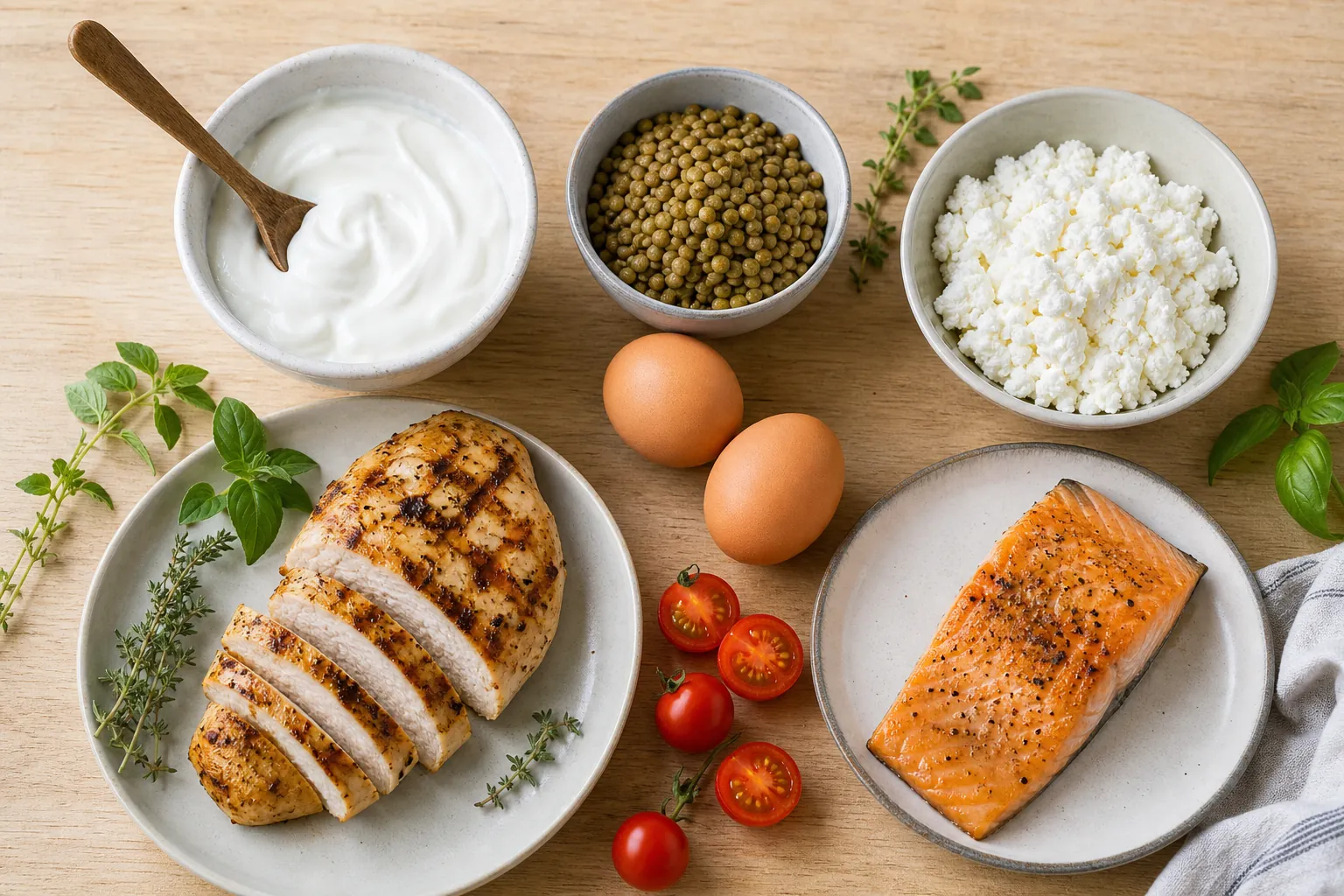
For people trying to preserve muscle during weight loss, a commonly used sports-nutrition target is about 1.6 to 2.2 grams of protein per kilogram of body weight per day.[3] That target is not unique to the Mediterranean diet. The useful point is that Mediterranean-style foods can help you reach it without meal-replacement shakes if you build meals around protein anchors.
| Protein anchor | Approximate protein from the research brief | Easy use at home |
|---|---|---|
| Greek yogurt | 15–20 g per cup | Breakfast with berries and oats, or a post-workout bowl |
| Lentils | 15–18 g per cup | Add to salads, soups, grain bowls, or eggs |
| Chicken breast | 47–53 g per 8 oz | Cook once, use in bowls, wraps, and plates |
| Salmon | 40–47 g per 8 oz | Pair with farro, vegetables, or salad |
| Eggs | 12 g per 2 large eggs | Use with tomatoes, greens, beans, or whole-grain toast |
| Cottage cheese | 24 g per cup | Use as a quick protein side or savory snack |
This is where many “clean eating” attempts go sideways. A plate of vegetables, olive oil, pita, and a small crumble of feta may look disciplined, but it can leave a home exerciser short on protein. That matters more during weight loss because the calorie deficit already makes recovery harder. If the workout includes any kind of resistance training, the meal should usually have an obvious protein source, not just a protein garnish.
A Mediterranean-style breakfast can be Greek yogurt, berries, oats, and a few nuts. Lunch can be a lentil-and-chicken salad with tomatoes, cucumber, greens, and a measured olive oil dressing. Dinner can be eggs with vegetables and beans, salmon with farro, or cottage cheese beside a tomato-cucumber plate and whole-grain toast. None of those meals require a special supplement. They do require deciding where the protein is coming from before the plate is finished.
The MedWeight study is useful here because it connects protein intake with weight-loss maintenance in a Mediterranean-diet context. In that study of 565 people, weight-loss maintainers averaged 0.98 grams of protein per kilogram of body weight, compared with 0.82 grams per kilogram among regainers, a difference reported as statistically significant.[3]
That does not prove that protein alone caused maintenance. It also came from a Greek population, where familiarity with Mediterranean eating may be higher than it is for many U.S. readers switching from a standard American diet. Still, it is a useful warning: the Mediterranean pattern works better for weight control when it is not treated as bread, oil, and vegetables with protein appearing whenever convenient.
A simple plate formula for home workout days
The easiest way to make this diet usable is to stop looking for perfect Mediterranean meals and build repeatable plates. The formula below is not a medical prescription or a macro plan. It is a way to keep the calorie-density and protein problems visible when you are hungry after training.
- Start with volume: cucumber, tomato, greens, zucchini, peppers, mushrooms, berries, melon, or other fruits and vegetables.
- Add a protein anchor: Greek yogurt, eggs, fish, poultry, cottage cheese, lentils, beans, or a combination.
- Add a measured carb if needed: lentils, beans, farro, quinoa, oats, potatoes, or whole-grain bread.
- Use calorie-dense flavor deliberately: olive oil, feta, nuts, olives, tahini, or avocado.
- Repeat the meals that are easiest to assemble, even if they are not impressive.
A lunch bowl built this way might be mostly chopped cucumber, tomato, greens, and peppers, with lentils and chicken doing the real work, then feta and olive oil used for flavor. A smaller-fridge version might be Greek yogurt, fruit, oats, and eggs later in the day. A no-cook option might be tuna, greens, tomatoes, beans, and whole-grain toast. These meals are not glamorous, which is part of their value. They are hard to ruin and easy to repeat.
The dense foods are not banned. They just need jobs. Olive oil can make a bowl satisfying. Feta can make vegetables taste like an actual meal. Nuts can help breakfast last longer. The mistake is treating those foods as unlimited because they are associated with a healthy pattern. At 8.80 calories per gram, olive oil is doing something very different from cucumber at 0.15 calories per gram.[1]
Workout timing does not need to become a second hobby
If your workout is a normal home session, meal timing can stay simple. The Academy of Nutrition and Dietetics gives pre-workout examples that fit a Mediterranean-style pattern, including Greek yogurt with berries and oats or whole-grain toast with nut butter eaten one to four hours before exercise. For a smaller snack 30 to 60 minutes before training, a banana is enough for many people.[4]
After training, the same source lists options such as tuna salad with greens, salmon with farro, or Greek yogurt with fruit within 60 minutes of exercise.[4] That is as complicated as this needs to be for most home exercisers. Eat close enough to the workout that energy and recovery are covered, but do not let timing distract from the larger issues of daily calories and total protein.
Where home fitness fits into the evidence
There is a reasonable synergy between Mediterranean eating and fitness, but the evidence should not be stretched into something it is not. A meta-analysis summarized by the American Society for Nutrition included 30 studies with 36,807 adults and found that higher Mediterranean diet adherence was associated with higher cardiorespiratory fitness, musculoskeletal fitness, and overall physical fitness, independent of sex, age, BMI, and smoking status.[5]
That supports the idea that the diet can sit well alongside training. It does not prove that eating lentils and salmon directly improves a resistance-band program in a studio apartment. The home-fitness angle is an adaptation: the same eating pattern that can support weight loss and general fitness is being applied to the equipment and time many people actually have.
For that adaptation to work, the workout still needs progressive effort. A Mediterranean meal will not make random movement behave like a structured plan. But when the training is consistent, the diet has a useful role: it makes the calorie deficit less miserable and gives you enough normal food options to recover.
What to keep in the kitchen
A small kitchen does not need a full Mediterranean pantry. It needs a few foods that can become meals quickly. The best staples are the ones that solve more than one problem: Greek yogurt gives protein and breakfast; lentils give fiber, carbs, and some protein; eggs cook fast; canned tuna or salmon can become lunch; tomatoes and cucumbers turn a plate into real volume.
- Cold staples: Greek yogurt, cottage cheese, eggs, salad greens, cucumbers, tomatoes, berries, cooked chicken, feta.
- Shelf-stable staples: lentils, beans, oats, canned tuna or salmon, whole-grain bread or wraps, farro or quinoa, olives.
- Flavor staples: olive oil, vinegar, lemon, herbs, garlic, pepper, mustard, tahini, small portions of nuts.
The practical test is whether the food can become a meal when motivation is low. If the only plan is a complicated baked fish recipe, takeout will win. If the fridge has yogurt, eggs, cooked chicken, lentils, tomatoes, cucumbers, and greens, the Mediterranean pattern survives an ordinary week.
The version that actually helps weight loss
The useful version of the Mediterranean diet for a home exerciser is not a vacation plate and not a purity test. It is a structure: high-volume foods first, protein on purpose, starches matched to appetite and training, and calorie-dense fats and cheeses used with intent.
That structure fits home fitness because it does not require a supplement shelf or a meal-prep personality. It lets someone finish a workout on the floor, make a normal meal, and keep the deficit from feeling tiny. The diet is useful because it makes repeatable weight loss easier while still feeding the muscle you are trying to keep with bands, dumbbells, or bodyweight training.
References
- Mediterranean diet for weight loss: calorie density and satiety hacks, Mayo Clinic Diet, 2025.
- Mediterranean diet beats low-fat diet for long-term weight loss, Harvard Health.
- Protein intake and weight loss maintenance: the MedWeight study, British Journal of Nutrition.
- Timing Your Pre- and Post-Workout Nutrition, Academy of Nutrition and Dietetics.
- Can a Mediterranean Diet Improve Physical Fitness?, American Society for Nutrition.
What a small equipment investment adds
We don't have a build tagged to this exact tier yet. Browse all builds.
How often should you repeat this?
See our recovery and rest reference for citation-anchored rest-interval guidance.
Spot something off?
Tell us if a movement, tier assumption, or duration didn't match your experience.