
Misty Copeland-Inspired Ballet Workout for Small Spaces
A 20-minute Misty Copeland-inspired ballet routine for small spaces — chair as barre, no jumps, no equipment, with honest calorie and strength expectations.
- Equipment tier required
- none
- Duration
- 20 min
- Difficulty
- beginner
- Target area
- legs
- Space footprint needed
- 6x6 feet
- Noise level
- low
Yes: a 6x6-foot apartment corner is enough for a real ballet-style home workout if the routine is built around controlled standing work, a sturdy chair, and floor exercises instead of jumps. This Misty Copeland-inspired ballet workout for a small space uses a chair as a barre, keeps the noise downstairs-neighbor-friendly, and does not require a mirror, a portable barre, sliders, weights, or any branded prop.
The “inspired” part matters. This is not an official Copeland-endorsed home program. It is a practical 20-minute session built from two documented anchors: SELF reported that Copeland does 20 relevés on each foot every morning, and Sports Illustrated excerpted five exercises from her book Ballerina Body—Walk, Dégagé, Seaweed, Rond de Jambe, and Stretch.[1][2]
The 20-minute small-space routine at a glance
| Time | Move | What you do |
|---|---|---|
| 0:00–2:00 | Chair setup + warm-up | Place the chair, check floor space, stand tall, breathe, gently bend and straighten the knees, and roll through the feet. |
| 2:00–4:00 | Relevés | Rise onto the balls of the feet and lower with control; build toward 20 on each foot, using the chair as needed. |
| 4:00–6:00 | Pliés | Small knee bends in parallel or a comfortable first position, keeping heels grounded and knees tracking over toes. |
| 6:00–8:00 | Dégagés | Brush one foot out and in without lifting high; front, side, and back if space allows. |
| 8:00–10:00 | Rond de jambe | Draw a small half-circle on the floor with one toe, then reverse direction. |
| 10:00–12:00 | Arabesque / attitude work | Extend one leg behind you, then bend it slightly; keep the range low and the torso quiet. |
| 12:00–13:00 | Floor Walk | Move to the mat for a beginner-friendly floor adaptation of the Ballerina Body sequence. |
| 13:00–14:30 | Floor Dégagé | Extend and return one leg at a time while lying down, keeping the pelvis heavy. |
| 14:30–16:00 | Seaweed | Use slow, wavelike movement through the spine and legs rather than speed. |
| 16:00–17:30 | Floor Rond de Jambe | Draw controlled circles or arcs with one leg, then switch sides. |
| 17:30–20:00 | Stretch | Finish with gentle hamstring, hip, calf, and back release—only after the body is warm. |
Keep the whole session quiet. There are no jumps, no traveling combinations, and no reason for a heel to thud into the floor. If a movement gets noisy, make it smaller.
Set up the chair like you actually live above someone
Use a sturdy hip-height dining chair, a heavy kitchen chair, or a counter. A rolling desk chair is not a barre; it is a small accident waiting for better lighting. Put the chair on a surface where it will not slide, and position it so you can extend one leg to the front, side, and back without kicking a coffee table, bed frame, pet bowl, or radiator.
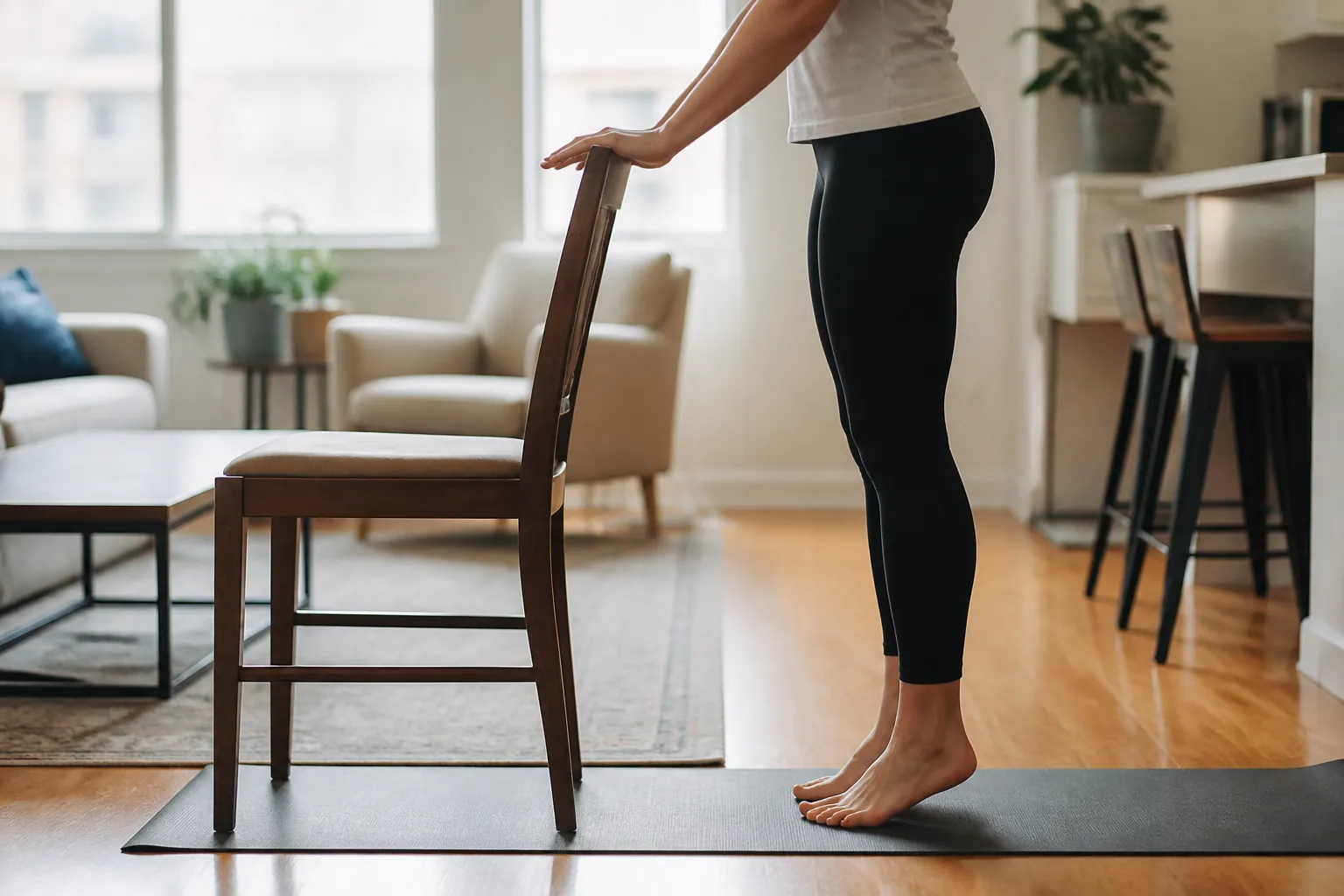
Cleveland Clinic’s barre guidance is a useful guardrail here: barre is generally low-impact, can use a chair for support, and should be done without forcing turnout or pushing through pain.[3] That last point is not cosmetic. If your hips do not comfortably rotate into a ballet first position, stand in parallel, meaning both feet point forward like train tracks. If a tiny turnout feels natural, use it, but do not crank the feet outward and hope the knees forgive you later.
Apartment-friendly home workout advice often lands in the same place: use what is stable, keep the footprint small, and choose low-impact movement when neighbors are part of the equation. Apartment Therapy points home exercisers toward compact mat-based setups, Physique57 notes that a chair or countertop can stand in for a barre, and Business Insider’s small-apartment workout guidance emphasizes avoiding noisy impact when you share floors and walls.[4][5][6]
- Space: about 6x6 feet is enough if you can stand beside the chair and lie down on a mat.
- Surface: a yoga mat is helpful for floor comfort, but do standing work on whatever surface lets your feet feel secure.
- Support: keep fingertips or a full hand on the chair. Letting go is optional, not the graduation ceremony.
- Range: small is fine. In ballet-style work, a clean two-inch movement is often more useful than a dramatic shape you cannot control.
- Pain rule: muscle effort is expected; joint pain, pinching, or sharp pulling means stop and adjust.
Minutes 0–12: standing work at the chair
0:00–2:00 — Warm up where you stand
Stand facing the chair with both hands resting lightly on the top edge. Put your feet in parallel, hip-width or slightly narrower. Soften the knees, stack ribs over hips, and let the shoulders drop away from the ears.
- Take four slow breaths without lifting the shoulders.
- Bend and straighten the knees eight times, keeping the heels down.
- Roll through the feet: lift heels, lower heels, then gently lift toes.
- Shift weight right and left without letting the chair take your whole body weight.
There is no need to stretch cold. Use these two minutes to tell your calves, ankles, hips, and balance system that they are about to work.
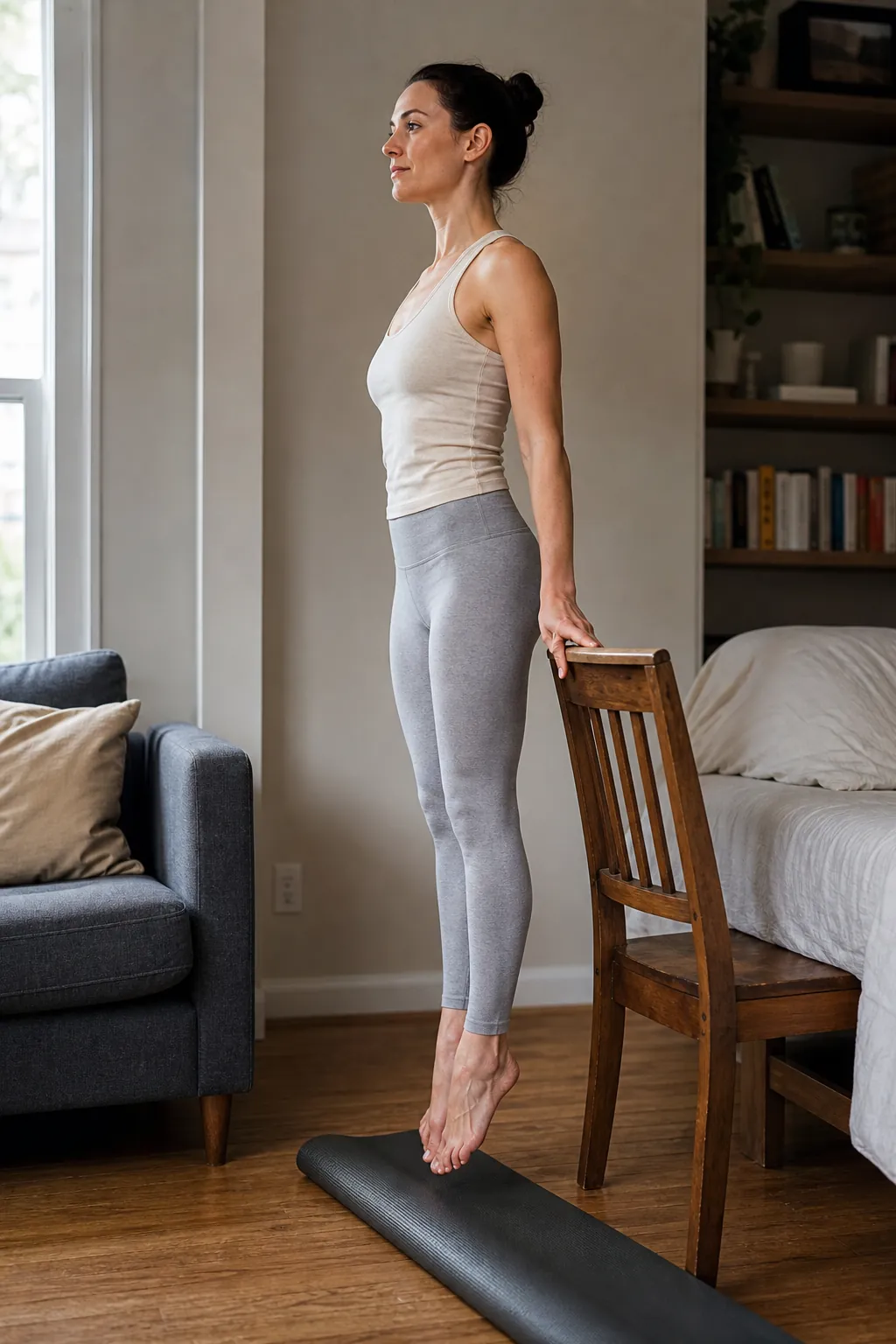
2:00–4:00 — Relevés
A relevé is simply a controlled rise onto the balls of the feet. Copeland’s reported morning habit—20 relevés on each foot—is the cleanest piece of source material for this routine because it is concrete and repeatable.[1]
- Start with both feet parallel and both hands on the chair.
- Rise slowly onto the balls of both feet for a count of two.
- Pause for one count without gripping the toes.
- Lower the heels for a count of three, as if you are trying not to make a sound.
- Do 10 with both feet, then try 10 with more weight on the right foot and 10 with more weight on the left.
If single-leg relevés feel steady, work toward 20 on the right and 20 on the left. If your ankles wobble, keep both feet down and use a slower lower. Wobbling is information, not failure.
4:00–6:00 — Pliés
A plié is a knee bend. For a beginner in a small apartment, it should look almost boring: heels down, knees bending over the toes, torso upright, chair close enough that you never have to grab.
- Do 8 small pliés in parallel.
- If a natural turnout feels comfortable, place heels close together and toes slightly apart; do 8 more.
- Hold the bottom of the last plié for three slow breaths, then straighten without snapping the knees.
Small range means you bend only as far as your knees can track cleanly. If the arches collapse, the knees cave in, or the hips pinch, come higher.
6:00–8:00 — Dégagés
Dégagé means the working foot brushes away from the floor and returns. You are not kicking. You are sliding the toes away with enough control that the standing leg has to organize itself.
- Stand sideways to the chair with the inside hand resting on it.
- Brush the outside foot forward, point the toes lightly, then close it back under you. Do 8.
- Brush the same foot to the side and back in. Do 8.
- Brush the same foot behind you only as far as your pelvis can stay level. Do 8.
- Turn around and repeat with the other leg.
The standing knee stays soft. The working toes may barely leave the floor. That is enough.
8:00–10:00 — Rond de jambe
For rond de jambe, draw a small arc with the toes on the floor. Imagine the toe tracing from front to side to back, then reversing from back to side to front. The circle does not need to be large; the point is to keep the hips quiet while the leg moves.
- Right leg: 4 slow arcs front-to-back, then 4 back-to-front.
- Left leg: 4 slow arcs front-to-back, then 4 back-to-front.
- Keep one or both hands on the chair if the standing ankle starts searching for the room.
10:00–12:00 — Arabesque and attitude
Stand facing the chair. Extend the right leg behind you with the toes touching the floor. This is the apartment version of arabesque: low, long, and controlled. Lift the leg only a few inches if your back stays comfortable. Then bend the working knee slightly, keeping the thigh turned toward the floor rather than twisting the whole pelvis open; that is your beginner attitude shape.
- Right side: 6 low arabesque lifts, then 6 small attitude bends and extends.
- Left side: repeat the same pattern.
- Make the standing leg do the work. If the lower back takes over, lower the leg.
Minutes 12–20: the Ballerina Body-inspired floor sequence
Sports Illustrated’s excerpt from Copeland’s Ballerina Body includes five named exercises: Walk, Dégagé, Seaweed, Rond de Jambe, and Stretch.[2] The versions below are beginner-friendly small-space adaptations using those names and the same floor-work spirit. You need only enough room to lie on your mat.
12:00–13:00 — Walk
Lie on your back with knees bent and feet on the mat. Keep the ribs heavy and the back of the pelvis settled. Slowly “walk” the feet a few inches away from you—right, left, right, left—then walk them back in. Keep it smooth enough that the mat does not scrape across the floor.
13:00–14:30 — Floor dégagé
Stay on your back. Extend one leg along the floor, point the toes gently, then draw it back in. Do 8 on the right and 8 on the left. If your hip flexors grip or your lower back arches, bend the working knee slightly or make the slide shorter.
14:30–16:00 — Seaweed
Think of this as a slow mobility interval, not a trick. From your back, let both knees fall a little to one side, return to center, then fall a little to the other side. Add the arms only if there is room. Keep the movement wavelike and easy through the spine.
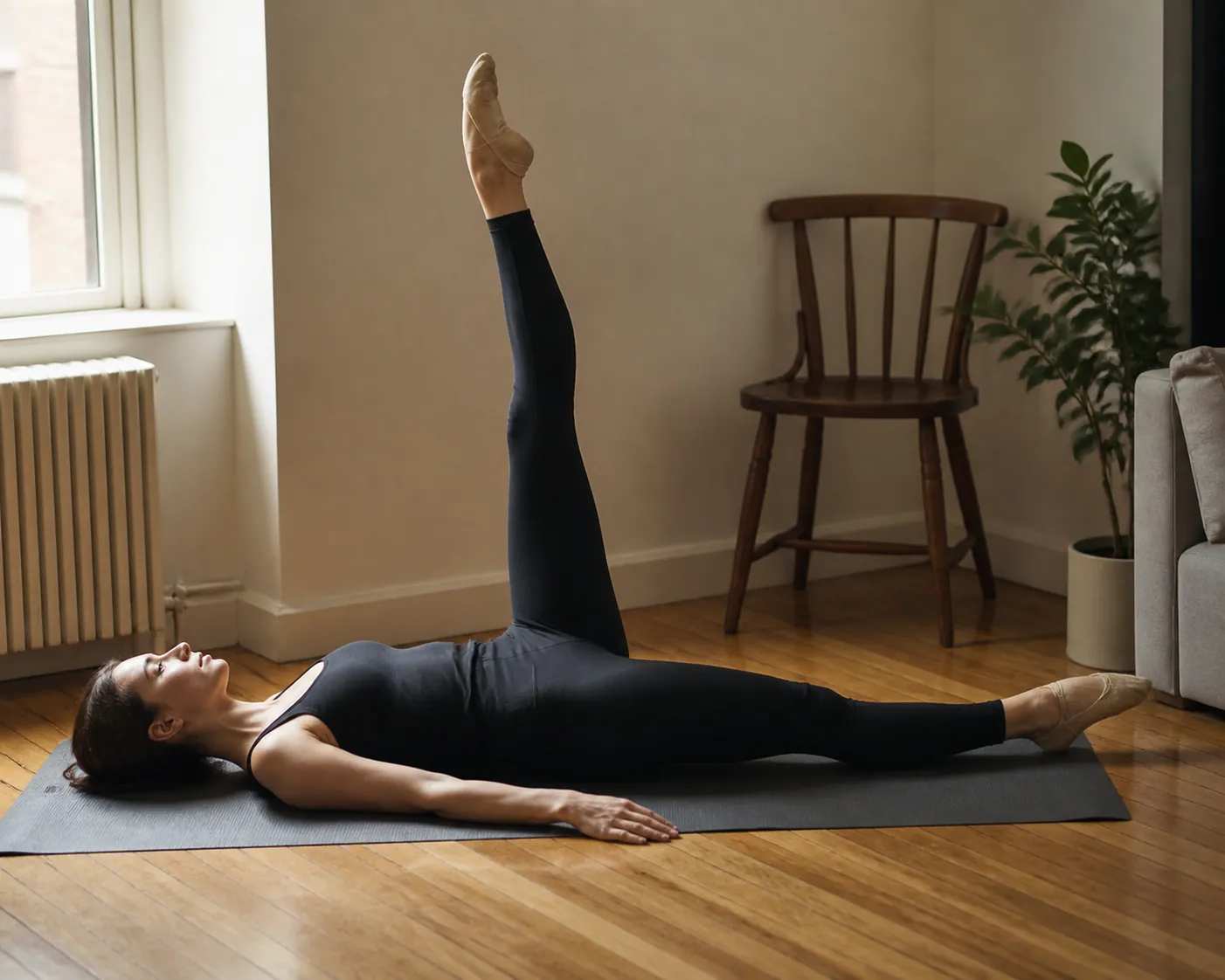
16:00–17:30 — Floor rond de jambe
Extend the right leg upward or on a low diagonal—whichever lets your pelvis stay still. Draw 4 small circles one way and 4 the other. Switch legs. The smaller the circle, the easier it is to feel whether the trunk is doing its job instead of rocking along for drama.
17:30–20:00 — Stretch
Now stretch, because now you are warm. Hug one knee toward the chest, switch sides, then extend one leg toward the ceiling with the knee as bent as it needs to be. Finish with a gentle calf stretch against the floor or wall and a relaxed forward fold while seated. Nothing here should feel forced. If you are yanking on the leg to create a better-looking line, you have left the workout and entered a negotiation your hamstrings did not agree to.
What this workout is actually good for
This routine is best understood as low-impact strength and coordination practice. The standing work asks the ankles and calves to control rising and lowering. Pliés and dégagés ask the hips and thighs to work through range without impact. Rond de jambe and floor work add coordination, posture awareness, and trunk control. Cleveland Clinic describes barre as low-impact and strength-focused, with balance and posture among the commonly discussed benefits, while still emphasizing pain-free movement and appropriate support.[3]
There is also a reasonable balance argument, but it should stay reasonable. A Nutcracker.com round-up discusses research on adult ballet, balance, and slip responses, including work involving trained or recreational dancers.[9] Those findings are interesting, especially for why repeated dance patterns may challenge balance and motor control, but they do not prove that a beginner doing 20 minutes beside a sofa will get the same results as trained dancers.
The same caution applies to barre-fitness research. Healthline summarizes a small 2023 study of 35 women in connection with barre training, which is useful as a supporting signal but too small to turn into a sweeping promise about every home routine.[7] If this workout helps you feel steadier, more upright, and more coordinated after several weeks, that is a meaningful result. It just does not need to be inflated into studio-window mythology.
Calories: modest, variable, and not the main point
Harvard Health’s calorie table lists “fast, ballet, twist” at about 180 calories in 30 minutes for a 125-pound person, 216 for a 155-pound person, and 252 for a 185-pound person.[8] That gives useful context, but it is not a direct estimate for this routine. This session is 20 minutes, beginner-friendly, no-jump, and intentionally quiet, so its calorie burn will likely be modest and will depend on body size, pace, range, rest, and how much support you use.
That does not make it useless. It makes it the wrong tool for someone who wants a hard cardio session in disguise. If you want a tougher no-equipment session after this, use a different format rather than pretending slow relevés are sprints. FitAtHome’s preseason double session at home and PFL fighter workout at home are better continuations when you want a harder small-space, no-equipment day.
How often to do it, and how to progress
For beginners, 2–3 barre sessions per week is a sensible ramp, and Healthline gives that same 2–3 sessions-per-week starting point in its barre guidance.[7] That is enough frequency to practice the patterns without making your calves file a complaint after day one.
- Week 1: keep both hands on the chair, use parallel feet, and make every range smaller than you think you need.
- Week 2: slow the lowering phase of relevés and pliés before adding more repetitions.
- Week 3: try one hand on the chair for some movements, but return to two hands when balance gets messy.
- Week 4 and beyond: add cleaner range, longer pauses, or a second round of selected moves before making the workout longer.
Music can help with pacing, especially if you tend to rush the lowering part of every movement. A steady playlist from FitAtHome’s country workout songs by BPM works better than guessing tempo from whatever is playing in the next apartment. And if your main problem is simply finding a yoga-mat-sized corner when the weather traps you indoors, the same small-footprint logic carries into small-space workouts for bad weather.
A chair and a mat are enough to start. The realistic payoff is quiet, low-impact strength, balance practice, cleaner coordination, and a little satisfaction from repeating a movement until it feels organized—not a secret celebrity program, not a high-calorie burn guarantee, and not a reason to buy anything.
References
- The Simple Exercise Misty Copeland Does 40 Times Every Morning, SELF
- Misty Copeland's guide to a Ballerina Body, Sports Illustrated
- What Is Barre (and What Are the Benefits)?, Cleveland Clinic
- Apartment Pilates Essentials, Apartment Therapy
- 3 Tips When Doing Barre Workouts at Home, Physique57
- How to workout in small apartment without annoying neighbors, Business Insider
- What Is a Barre Workout?, Healthline
- Calories burned in 30 minutes of leisure and routine activities, Harvard Health
- Why Adult Ballet May Be One of the Smartest Workouts for Aging Bodies, Nutcracker.com
What a small equipment investment adds
We don't have a build tagged to this exact tier yet. Browse all builds.
How often should you repeat this?
See our recovery and rest reference for citation-anchored rest-interval guidance.
Spot something off?
Tell us if a movement, tier assumption, or duration didn't match your experience.