
NFL Training Camp Home Workout With No Equipment Required
Run a legitimate NFL training-camp conditioning workout at home using just bodyweight exercises, even in a small apartment. This article breaks down the five exercises NFL athletes use and shows how volume progression and smart intensity adjustments build camp-level work capacity with zero gear.
- Equipment tier required
- none
- Duration
- 20 min
- Difficulty
- beginner
- Target area
- full body
- Space footprint needed
- small
- Noise level
- low
Training-camp pressure, living-room rules
NFL training camps are open in late July 2026, which makes this the right moment for a useful version of the camp idea: hard conditioning, no gym, no turf, no sled, no sprint lane, and no jumping around like you forgot someone lives downstairs. The goal of this NFL training camp home workout is not to imitate every part of a pro camp. It is to take five NFL-sourced bodyweight moves and organize them with enough volume, rest discipline, and intensity control that they feel like conditioning instead of a casual hotel-room circuit. [1]
The five moves come from an NFL.com piece by strength coach Brett Fischer: push-ups, sidelye-ups, matrix lunges, single-leg squats, and tricep chair dips. Fischer framed them as home or travel exercises for football players, which is exactly the useful lane here: credible football-adjacent work that does not require equipment or open space. [2]
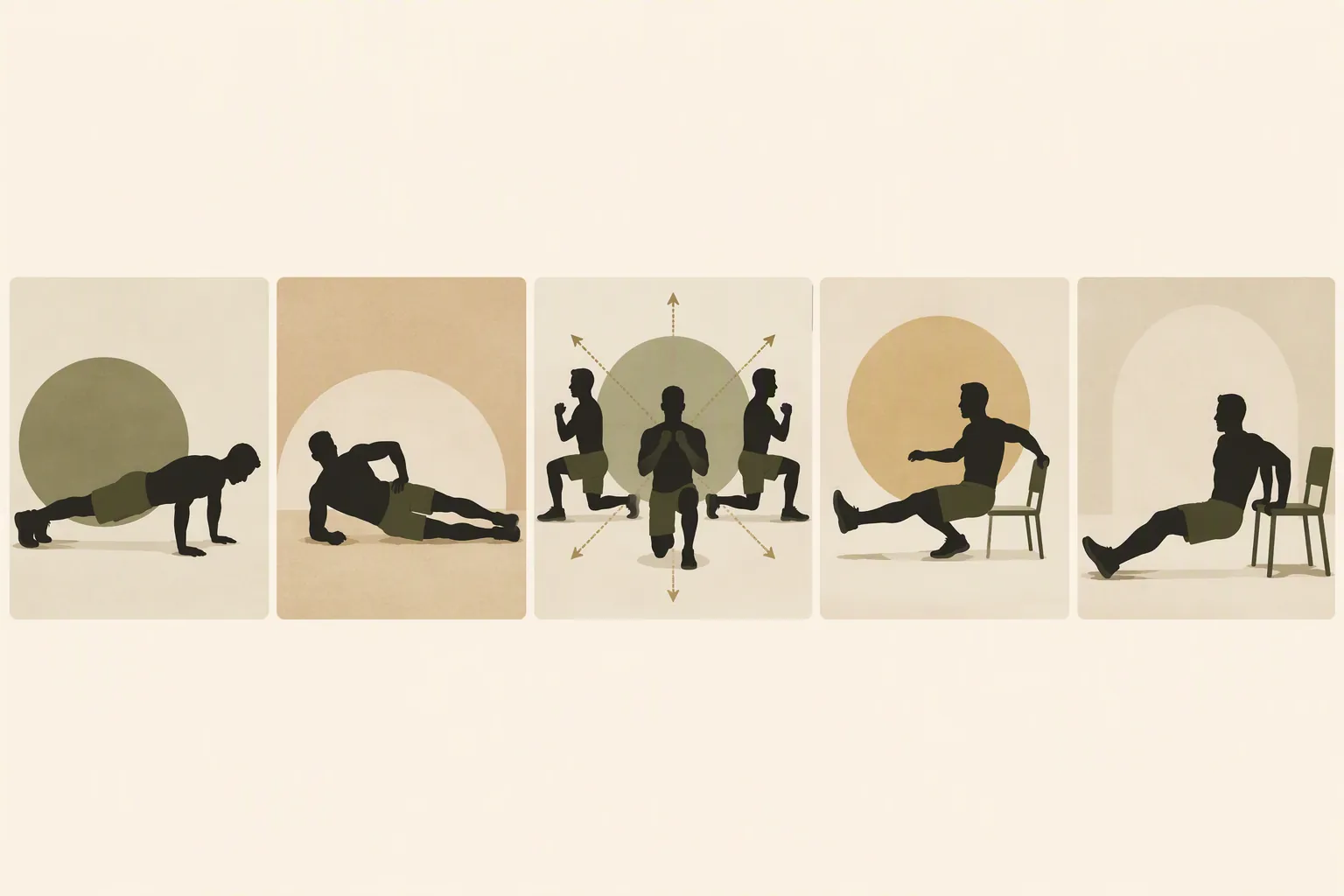
Each exercise earns its spot for a different reason. Push-ups train upper-body pushing endurance. Sidelye-ups give the hips and trunk a lateral-stability job. Matrix lunges make the legs handle different angles instead of only straight-ahead reps. Single-leg squats expose left-right control. Tricep chair dips add more pressing endurance when the chest and shoulders are already tired.
| Exercise | Why it belongs in the circuit | Apartment rule |
|---|---|---|
| Push-ups | Upper-body pushing endurance under fatigue | Hands stay planted; no hand-release clapping or impact variation |
| Sidelye-ups | Hip and trunk stability for lateral control | Move slowly enough that the hip never drops into the floor |
| Matrix lunges | Multi-angle leg strength for change-of-direction demands | Step quietly, own the bottom position, return without stomping |
| Single-leg squats | Unilateral leg control and balance | Use a wall touch if needed; do not crash into a chair or couch |
| Tricep chair dips | Pressing and triceps endurance after push-ups | Use only a stable chair or sofa edge; never a rolling chair |
That last column matters. Plenty of “no equipment” workouts quietly assume a garage slab, a bench, or permission to rattle the floor. This one should fit in roughly the amount of space you can clear by nudging a coffee table back and making peace with the fact that your lunge stance will be measured, not heroic.
First, make the five exercises quiet and repeatable
Before the circuit gets hard, it has to be runnable. A workout that only works when you are fresh, perfectly warmed up, and alone in a house is not a good apartment workout. For this session, every rep should pass three tests: no impact noise, no furniture wobble, and no form breakdown that forces you to stop for reasons other than conditioning.
Push-ups
Set the hands just outside shoulder width, brace the ribs down, and lower under control. The apartment mistake is turning fatigue into floor noise: hips sag, chest drops, elbows flare, and the last few reps become little collapses. Keep the descent quiet. If full push-ups fade too early, elevate your hands on a stable sofa arm or countertop. If they are too easy, slow the lowering phase or pause briefly near the bottom instead of adding a noisy explosive variation.
Sidelye-ups
Lie on one side with the body long and stacked. Drive through the lower forearm or hand position you can control, lift the hips, and keep the torso from rolling open. This is not a speed exercise. The value is in making the outside hip, obliques, and shoulder stabilize while breathing stays under control. If the full version feels sloppy, shorten the lever by bending the knees. If it feels easy, hold the top for a beat and lower slowly.
Matrix lunges
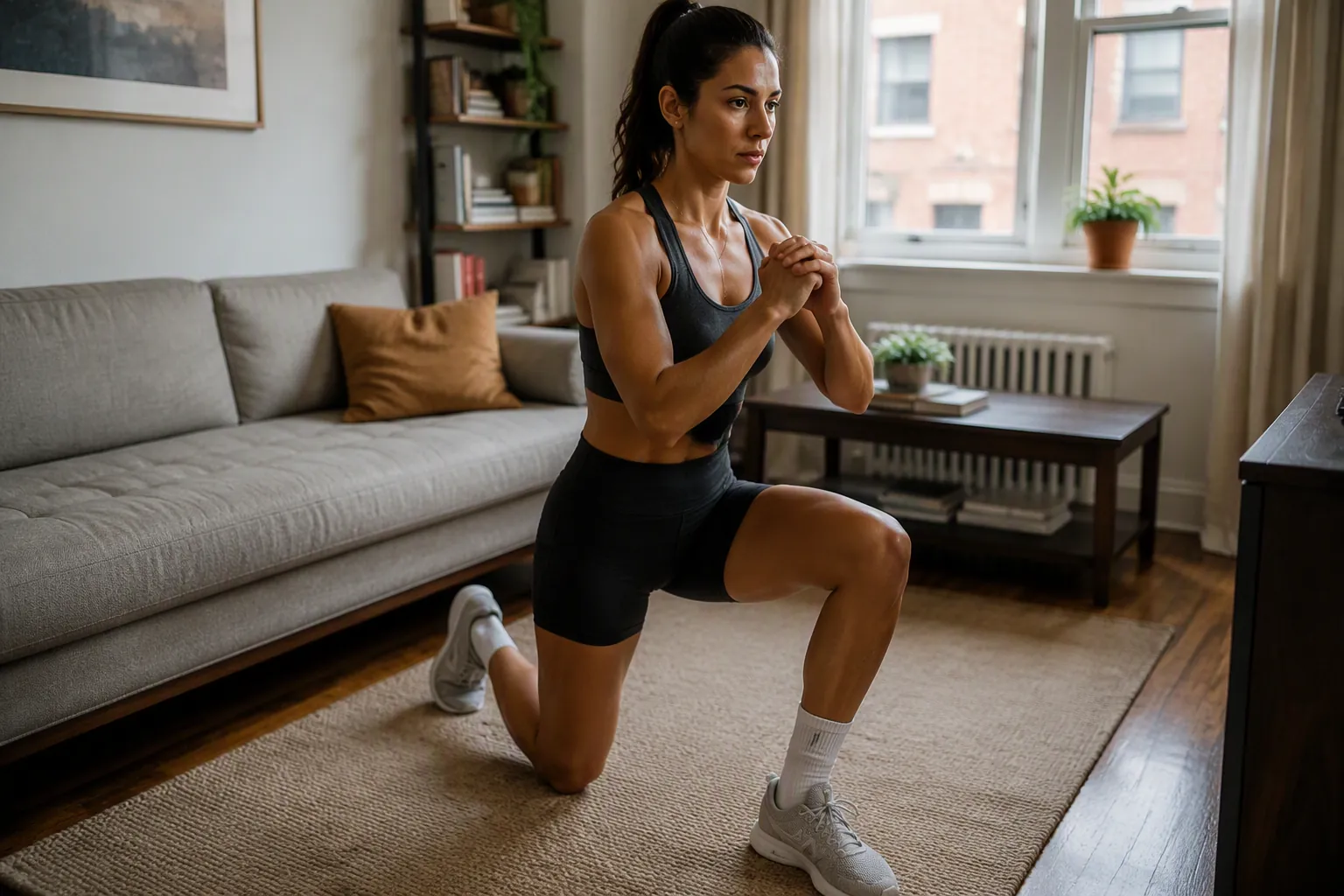
A matrix lunge is where this starts to feel less like a generic calisthenics list. Instead of repeating only forward lunges, step into several angles: forward, diagonal, lateral, and reverse patterns as your space allows. The stance does not need to be huge. What matters is that the knee tracks cleanly, the foot lands softly, and you push back to the start without a thud.
In a tight room, use a compact matrix: forward lunge, reverse lunge, side lunge, and diagonal-back lunge on each side. If the coffee table is close, shrink the step and increase the tempo control. If your knees dislike lateral depth, reduce the range and keep the hip loaded instead of forcing a dramatic stretch.
Single-leg squats
Single-leg squats should not become a balance circus. Stand tall, lightly touch a wall or doorframe if needed, and lower as far as you can while keeping the heel grounded and the knee controlled. Most people will get more from a shallow, clean single-leg squat than from diving into a crooked pistol squat and bouncing out of the bottom.
If the movement is too difficult, use a controlled single-leg sit-back toward a sofa or chair, treating the seat as a target rather than a place to collapse. If it is too easy, slow the descent, pause at the lowest controlled point, or add a small range-of-motion increase before adding reps.
Tricep chair dips
Use a stable chair, sofa edge, or other solid household surface. Hands grip the edge, shoulders stay down and back, elbows bend behind you, and the torso stays close to the support. A rolling office chair does not count. A wobbly dining chair does not count. If you cannot set up the dip safely, substitute close-grip push-ups and keep the same rep target.
Dips are easy to overdo when the shoulders are already tired from push-ups. Keep the range pain-free and stop the set when the shoulders start drifting forward. The conditioning comes from accumulating good work, not from grinding through ugly reps because the timer is judging you.
The runnable camp circuit
Clear a small square of floor, set a timer, and warm up for a few minutes with easy squats, hip hinges, arm circles, plank walkouts, and slow reverse lunges. The warm-up should make the first round smoother, not steal the session.
| Move | Baseline work | Quiet-space note |
|---|---|---|
| Push-ups | 8–15 reps | Elevate hands if the last reps stop being controlled |
| Sidelye-ups | 8–12 reps per side | Hold the top briefly; lower without dropping |
| Matrix lunges | 2–4 reps per angle per side | Use smaller angles if space is tight |
| Single-leg squats | 5–8 reps per side | Use fingertip wall support before form breaks |
| Tricep chair dips | 8–15 reps | Use a stable chair or substitute close-grip push-ups |
Run the moves in that order for 2 to 3 rounds the first time. Rest 30 to 45 seconds between exercises and 60 to 90 seconds between rounds. If that sounds too generous, good — the first session is for finding the version you can repeat without turning the final round into negotiation.
The order is intentional. Push-ups raise the upper-body demand early. Sidelye-ups ask the trunk and hips to stabilize before lunges start pulling you through angles. Matrix lunges then drive the heart rate up without jumping. Single-leg squats force control under fatigue. Dips finish the pressing work when the arms are already warm.
A legitimate score is simple: rounds completed, reps completed, rest used, and whether the session stayed quiet. If you finished 3 rounds but needed to stomp out of every lunge and crash into the dip setup, that is not a better score than 2 clean rounds.
Use the 90-to-53 cut as the progression
NFL training camp starts with large rosters and ends with the regular-season roster limit, commonly described as the cut from 90 players to 53. Training-camp conditioning also has consequences: players who fail conditioning tests can face extra conditioning work. That is useful context, as long as it stays in its lane. Your living-room workout is not an NFL camp, but the pressure can shape the progression. [3]

| Phase | Workout target | How it gets harder |
|---|---|---|
| Report to camp | 2–3 clean rounds | Learn the movements, choose modifications, keep rest honest |
| Roster gets crowded | 3–4 rounds | Add total reps or one extra round before cutting rest too aggressively |
| Earn the 53 | 4–5 rounds or a density test | Tighter rest, slower tempo, stricter reps, less room for sloppy transitions |
The cleanest way to progress is not to make every exercise harder at once. First, finish the low end of the rep ranges for every move. Then build toward the top end. Then add a round. Only after that should you cut rest. Reduced rest is powerful, but if you use it too early, it turns the circuit into a form leak.
Phase 1: report to camp
Run this phase for as long as it takes to make the workout feel organized. Use 2 to 3 rounds, stay in the middle of the rep ranges, and rest long enough that the next movement starts cleanly. This is where you decide whether push-ups need elevation, whether single-leg squats need wall support, and whether your chair-dip setup is actually safe.
- Use 30–45 seconds between moves.
- Use 60–90 seconds between rounds.
- Stop every set with at least one clean rep left.
- Track the exact modification used for each move.
Phase 2: roster gets crowded
Now the workout earns its conditioning label. Keep the same five exercises, but add total work. That can mean one more round, a few more reps per set, or a slightly larger lunge matrix. The best choice is the one that raises the heart-rate demand without making the neighbors part of the workout.
A good Phase 2 session might use 3 to 4 rounds, 30 seconds between moves, and 60 to 75 seconds between rounds. Push-ups and dips can climb toward the high end of their ranges. Sidelye-ups can add a longer top hold. Lunges can use more angles. Single-leg squats can move a little deeper if the knee and hip stay organized.
Phase 3: earn the 53
This phase is not about inventing harder-looking exercises. Keep the same list and make the rules stricter. Use 4 to 5 rounds, 15 to 30 seconds between moves, and 45 to 60 seconds between rounds. Or set a fixed clock and see how much clean work you can complete without changing the standards.
The quietest intensity lever is tempo. Lower push-ups for three controlled counts. Hold the top of each sidelye-up. Pause in the bottom of the lunge before returning. Descend slowly on single-leg squats. Control the bottom of dips. Tempo makes bodyweight feel heavier without adding a backpack, bands, or noise.
| If the circuit feels too easy | Use this lever first |
|---|---|
| You finish all rounds and breathing recovers quickly | Add reps within the listed ranges |
| You hit the top of every rep range cleanly | Add one round |
| You complete the added round without form loss | Reduce rest by 10–15 seconds |
| You still need more challenge but cannot add noise | Slow the lowering phase or add pauses |
| Only one side is limiting you | Start each unilateral move on the weaker side and match reps |
A weekly setup that does not wreck the rest of your training
Run the circuit 2 or 3 times per week, leaving at least a day between hard attempts. If you lift, run, play rec sports, or already have a demanding routine, use the lower end. If this is your main conditioning work, 3 weekly sessions can work as long as the middle session is not always a max-effort test.
| Day | Session style | Purpose |
|---|---|---|
| Session 1 | Standard circuit | Build clean volume |
| Session 2 | Tempo or technique version | Increase control without chasing exhaustion |
| Session 3 | Progression attempt | Add reps, add a round, or reduce rest |
Do not test everything every session. If Monday is a rep increase, Wednesday can be a cleaner tempo day, and Friday can be the rest-reduction attempt. That keeps the workout from becoming five exercises performed worse and worse under a louder timer.
What this does — and what it does not prove
There is a real precedent for NFL players doing home-based preparation. ESPN reported in 2020 on a voluntary NFL/NFLPA offseason home-workout plan, which supports the narrow point that home training has existed inside a pro-football context. It does not mean your apartment circuit is equivalent to a team strength program, and it should not be sold that way. [4]
The useful claim is smaller and stronger: these five bodyweight moves can be arranged into a demanding conditioning circuit for a small space. You can progress volume. You can compress rest. You can make unilateral work stricter. You can use tempo to raise difficulty without jumping, sprinting, or buying gear.
Bodyweight training also has a ceiling. At some point, push-ups, lunges, and dips may stop giving you a meaningful strength challenge unless you keep stretching the session longer and longer. When the circuit becomes mostly a time-management problem, it is reasonable to add simple loading.
That does not mean jumping straight to a garage gym. If the bodyweight version stops moving the needle, look at a small upgrade path like compact home gym budget builds or a first-purchase guide to small-space exercise equipment. Resistance bands, a sandbag, or one adjustable implement can extend progressive overload without turning the living room into a storage unit.
For now, run the circuit quietly. Track rounds, reps, and rest. Progress one lever at a time. If the bodyweight version still has teeth, there is no prize for buying equipment early.
References
What a small equipment investment adds
We don't have a build tagged to this exact tier yet. Browse all builds.
How often should you repeat this?
See our recovery and rest reference for citation-anchored rest-interval guidance.
Spot something off?
Tell us if a movement, tier assumption, or duration didn't match your experience.