
An NFL Training Camp Workout Routine for Your Home Gym
Learn what a real NFL training camp day looks like under current CBA rules, and how to adapt its structured, phased approach into a home workout you can do with minimal equipment.
- Equipment tier required
- $0-100
- Duration
- 70 min
- Difficulty
- intermediate
- Target area
- full body
- Noise level
- low
Search for an NFL training camp workout routine and you usually get the fun part first: sprints, sleds, route breaks, catches, collisions, somebody yelling through the last rep. Real camp starts much more boring than that. Under the current NFL-NFLPA structure, the first day of training camp is meetings and physicals, and the next four days are an acclimation period with helmets only and no more than 3.5 hours on the field per day.[1][2]
That matters for a home gym. If NFL teams with full staffs, GPS tracking, athletic trainers, cold tubs, practice fields, and giant humans do not open camp by going full-speed in pads twice a day, a person with adjustable dumbbells, bands, a bench, and a living-room lane should not treat “train like a pro” as permission to empty the tank on day one.
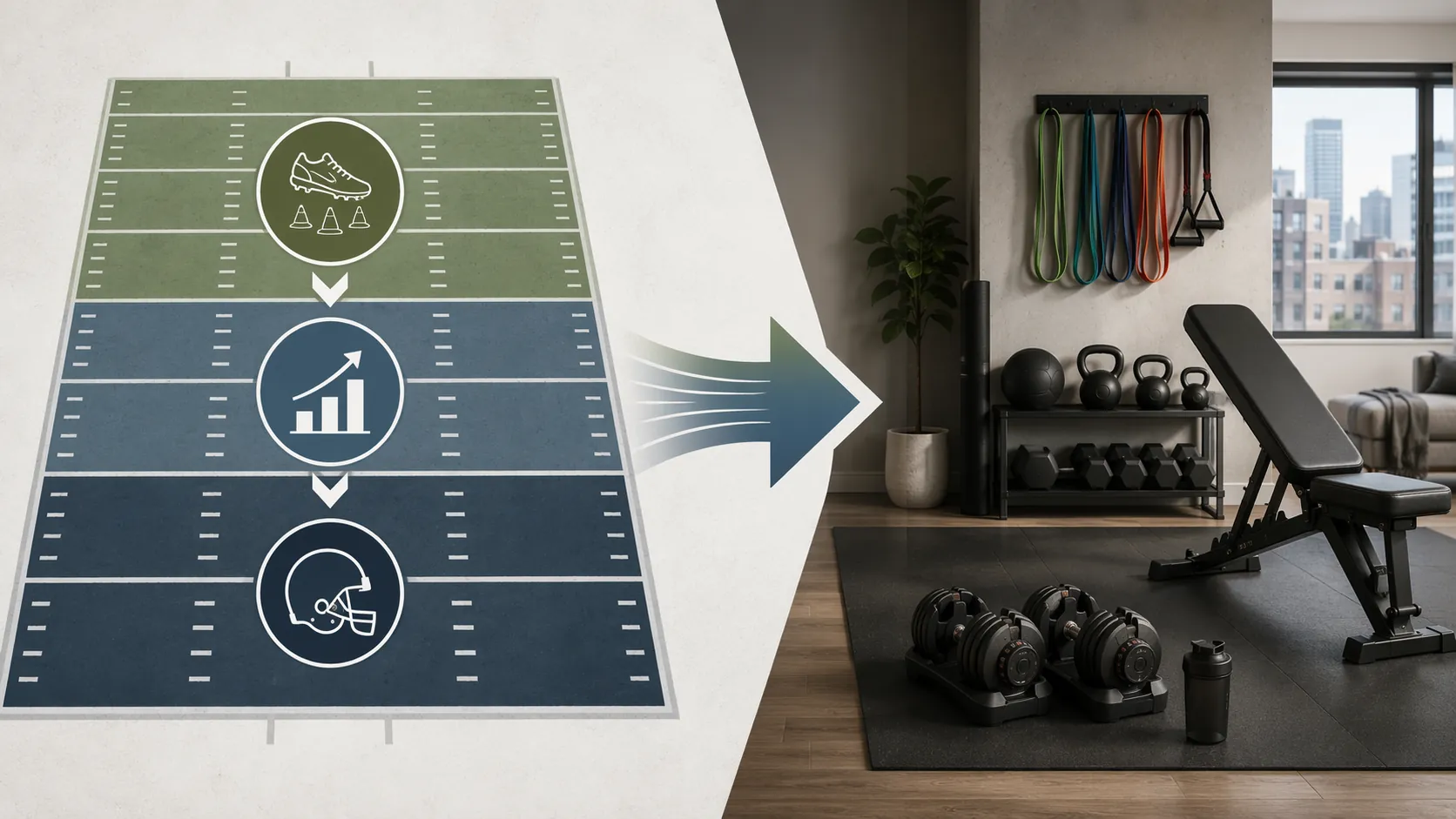
The useful part to copy is the structure: phased loading, limited exposure, balanced training qualities, and planned recovery. The drills are the last thing to borrow, because most of them were built for a roster, a field, a coach watching the rep, and a medical staff waiting nearby.
What Real Training Camp Rules Change
The modern camp rulebook is the best antidote to the highlight-reel version. Since the 2011 CBA, NFL teams have not been allowed to run two-a-day padded practices. Current camp rules allow a maximum of 4 hours of on-field work in a day, and if there is a second session, it must be a walk-through.[2]
Even before camp, the voluntary offseason program is staged. Phase One lasts two weeks and is limited to strength and conditioning plus rehabilitation. Phase Two lasts three weeks and adds individual and group instruction without live contact. Phase Three lasts four weeks and includes OTAs with 7-on-7, 9-on-7, and 11-on-11 work, still without live contact.[1]
The exact daily schedule still varies by team and coach. The CBA gives limits and constraints, not one universal practice template. But those limits reveal the important principle: intensity is earned through exposure, not assumed because the sport is violent.
| NFL structure | Home-gym translation |
|---|---|
| Meetings and physicals before real field work | Check readiness, soreness, space, and exercise options before loading hard |
| Five-day acclimation period | Use a ramp-up week before the hardest sessions |
| Helmets-only buildup | Practice movement quality before adding speed, load, or fatigue |
| No two-a-day padded practices | Do not stack two hard lower-body or full-body sessions in one day |
| Walk-throughs and capped on-field time | Keep low-intensity skill, mobility, and recovery work separate from hard intervals |
Build the Home Version Around Four Jobs
A football-shaped home routine does not need a turf strip or a blocking sled. It needs each session to know its job. For most home gym users, the four jobs are strength and power, speed and agility, conditioning and endurance, and mobility and recovery.
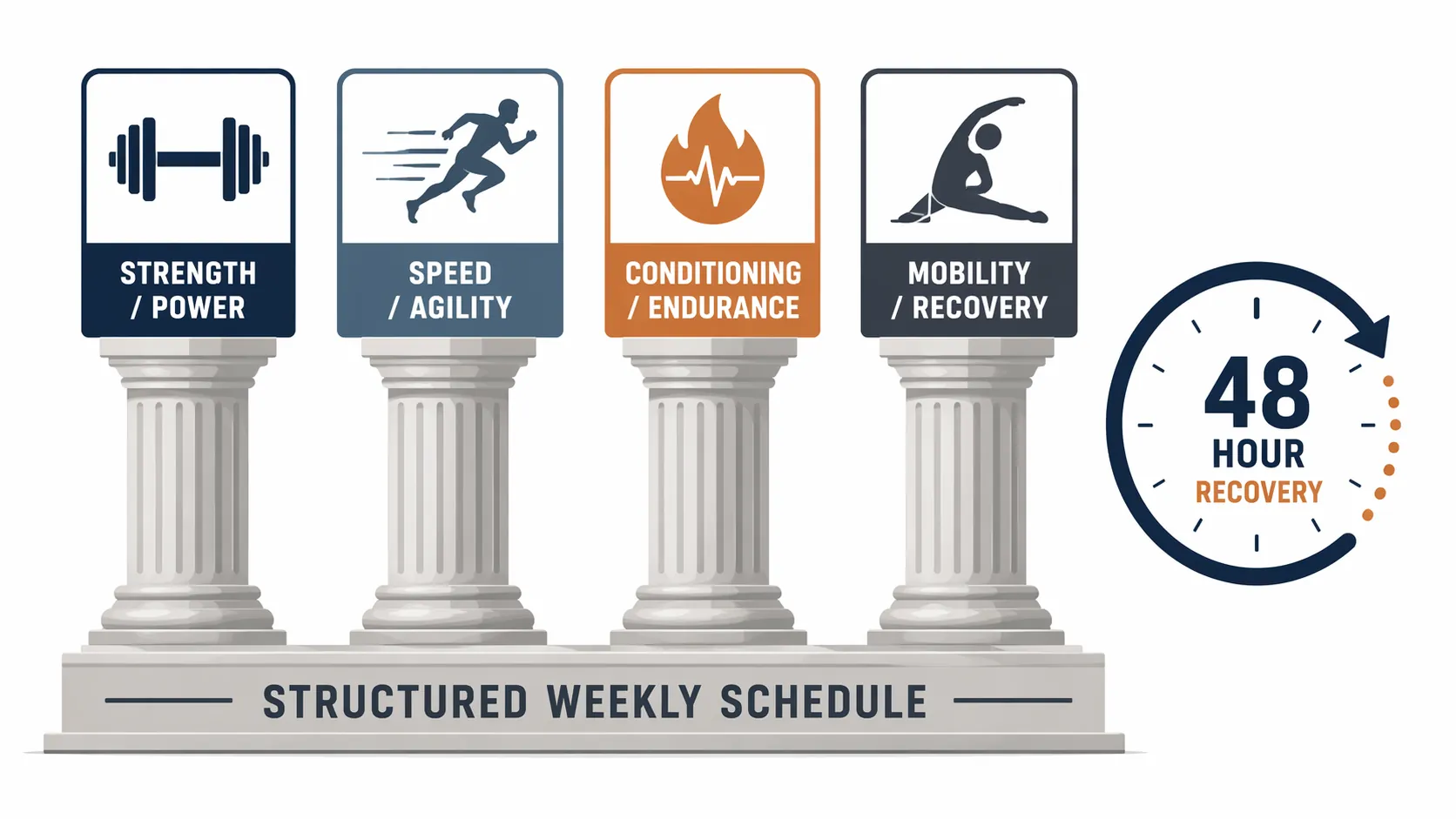
Strength and power are where dumbbells, bands, and bodyweight do most of the work. Think squats, split squats, hinges, rows, presses, loaded carries, jumps only if your floor and joints can handle them, and crisp low-rep power moves before fatigue makes them sloppy. If you need a more general base before making the football version, start with a home gym exercise routine built for the equipment you own and then layer the camp-style sequencing on top.
Speed and agility at home should be quiet, short, and controlled. A five-yard shuffle in a hallway, a three-step acceleration into a deceleration, a band-resisted first step, or a cone pattern made with shoes on the floor transfers better than pretending your apartment is a practice field. The goal is clean force into the floor, not an Instagram ladder drill that shakes the downstairs ceiling.
Conditioning is where the NFL inspiration is easiest to misuse. An average NFL play lasts about four seconds, and an average game contains 153 plays, so the sport asks for repeated high-output bursts with resets, not one endless puddle of sloppy fatigue.[3] The home version should train repeatability: short work, enough rest to keep quality high, then another rep that still looks athletic.
Mobility and recovery are not the soft extras. They are part of why the hard work can happen again. Brett Fischer’s NFL.com bodyweight routine also gives a useful guardrail for home users: allow a 48-hour recovery window between high-intensity sessions for the same muscle group.[4] That single rule will save more home routines than another set of burpees.
A Five-Day Acclimation Block for a Small Space
Before the hard week, run a home version of acclimation. This is not a deload because you are scared of training. It is a systems check: joints, shoes, floor, equipment, rest periods, exercise substitutions, and whether your conditioning plan still looks like football once your heart rate rises.
| Day | Focus | Home-gym work |
|---|---|---|
| Day 1 | Readiness and setup | Mobility screen, light walking, band activation, equipment layout, no hard lifting |
| Day 2 | Movement quality | Bodyweight squat, hip hinge drill, push-up, row pattern, low-speed shuffle |
| Day 3 | Light strength | Dumbbell goblet squat, dumbbell row, elevated push-up, dead bug, easy carries |
| Day 4 | Controlled speed | Short accelerations, deceleration practice, matrix lunges, light band work |
| Day 5 | Practice rhythm | Brief full session at moderate effort, stopping with reps in reserve |
This block is especially useful if you train in an apartment or garage corner. Clear the lane before you care about the drill. If the space itself is the limiting factor, an apartment dweller’s compact home gym setup or a shortlist of small space home exercise equipment will do more for the routine than adding a complicated drill you cannot perform safely.
The Main Home Training Camp Session
Once the ramp-up week feels clean, use this as the main workout. Run it two or three times per week, but do not place two high-intensity lower-body versions on back-to-back days. Keep the clock honest. Camp-style training is demanding because the quality is high, not because every block turns into a punishment circuit.
| Block | Time | Work |
|---|---|---|
| Warm-up and movement prep | 8–10 minutes | Easy jump rope or marching, hip mobility, thoracic rotations, band pull-aparts, bodyweight squats |
| Power primer | 6–8 minutes | Low-volume jumps, fast band rows, med-ball substitute such as explosive push-up variations if appropriate |
| Strength | 20–25 minutes | Dumbbell squat or split squat, dumbbell hinge, dumbbell row, push-up or dumbbell press, carry or core hold |
| Speed and agility | 8–12 minutes | Three-step starts, lateral shuffle to stick, backpedal to break, controlled deceleration |
| Conditioning | 10–15 minutes | Short burst intervals with full resets; stop before mechanics fall apart |
| Recovery | 5–10 minutes | Breathing, hip flexor stretch, hamstring mobility, calves, light band shoulder work |
For the strength block, keep the pairings simple. A lower-body lift plus an upper-body pull. A hinge plus a press. A carry plus a trunk exercise. If you do not own a bench, the no-bench full-body dumbbell workout is a better model than forcing bench-press substitutions that do not fit your room.
A useful first pass looks like this: goblet squat for 3 sets, dumbbell Romanian deadlift for 3 sets, one-arm row for 3 sets, push-up or floor press for 3 sets, and a suitcase carry or plank variation for 2 to 3 rounds. Stay one or two reps away from failure during the first two weeks. If the reps slow down badly, the set is already over for this purpose.
Fischer’s NFL.com bodyweight list gives good no-gym options when equipment is limited: push-ups, sidelye ups, matrix multi-angle lunges, single-leg squats, and tricep chair dips.[4] Those are not magic football exercises. They are useful because they cover pushing, trunk control, single-leg strength, and angle changes without needing a facility.
How Hard Should It Feel?
During acclimation, most sets should feel like practice. During the main block, the strength work can become challenging, but the power and speed work should stay sharp. Conditioning can sting, but it should not wreck the next strength session. If your knees cave in on lunges, your shuffle turns into stumbling, or your push-ups lose position, you are no longer training the quality you came for.
This is also where combine-transformation stories need to be handled carefully. In one NFL.com article, Clif Marshall described specific combine-prep examples from programs such as Ignition, EXOS, and XPE, including prospects gaining 14 pounds of muscle or improving a 40-yard dash by 0.3 seconds.[5] Those figures are program examples from a narrow pre-draft setting, not a promise that a home trainee can reproduce the same changes with adjustable dumbbells after work.
Conditioning That Looks More Like Football
The mistake is taking “football conditioning” to mean long, frantic HIIT. Football has fatigue, but the repeat effort profile is built around brief violent work followed by a reset. A four-second play does not mean every interval must be exactly four seconds; it means quality bursts and repeatability deserve more attention than grinding through a 20-minute circuit with melting mechanics.[3]
| Option | Work | Rest | Use when |
|---|---|---|---|
| First-step repeats | 3–5 seconds | 25–40 seconds | You have a short lane and want acceleration practice |
| Shuffle-stick repeats | 4–6 seconds | 30–45 seconds | You want lateral control and deceleration |
| Dumbbell power circuit | 6–10 seconds per move | 40–60 seconds | You have no running space |
| Bodyweight repeat series | 10–15 seconds | 45–75 seconds | You need low-equipment conditioning with cleaner reps |
A bodyweight repeat series might use five crisp push-ups, a short lateral shuffle, two matrix lunges per side, then a full reset. That is different from doing push-ups, lunges, dips, and squats until the room spins. One trains repeated output. The other mostly tests how long you can tolerate bad positions.
If you are bigger, newer, or returning after time off, be more conservative with jumping and hard deceleration. NFL linemen averaged 314 pounds in the Under Armour-cited University of Idaho research, which is a reminder that football bodies are not one size or one training response.[3] The home routine should fit the body doing it, not the smallest skill player in a training-camp clip.
A Weekly Layout That Respects Recovery
A realistic home week should leave 48 hours before repeating high-intensity work for the same muscle group.[4] That does not mean you sit still between hard days. It means the work changes character.
| Day | Session |
|---|---|
| Monday | Main training camp session: lower-body strength, upper push-pull, short burst conditioning |
| Tuesday | Walk-through: mobility, easy band work, low-speed footwork, breathing |
| Wednesday | Main session variation: hinge emphasis, rows, carries, controlled agility |
| Thursday | Recovery or easy aerobic work |
| Friday | Short athletic session: power primer, lighter full-body strength, repeat sprint-style intervals |
| Saturday | Optional walk-through, stretching, technique practice |
| Sunday | Off |
The walk-through days are where a lot of home trainees get impatient. They want the padded practice feeling every time. But a walk-through lets you rehearse stance, foot angles, bracing, deceleration, and shoulder position without adding another recovery debt. That is not wasted time; it is what lets the hard session stay hard.
If your equipment grows, the plan can grow without changing its logic. A bench adds pressing and supported rowing options. More dumbbell load expands the strength ceiling. A bike or rower can help conditioning when impact needs to come down. For a staged buildout, use a home gym workout plan that grows with your equipment; if you are buying from scratch, an under-$1,000 home gym guide keeps the gear decision tied to actual training rather than wish-list camp cosplay.
What Not to Copy
Do not copy the volume of a rostered athlete. Do not copy a drill that needs a coach’s eye, a field, or contact. Do not turn every session into a conditioning test. Do not assume soreness means the workout was more authentic.
The economic pressure around real camp is also not a model for a home routine. Under the 2020 CBA, training camp per diem ranges from $1,700 to $2,900 per week depending on experience, and unexcused absence fines can reach $50,000 per day.[6] That tells you camp is a workplace with consequences, not a wellness challenge you should imitate emotionally.
The better imitation is quieter: start with acclimation, separate hard days from walk-through days, train strength before fatigue ruins positions, make conditioning repeatable, and leave enough recovery to come back sharper. NFL training camp is intense because it is structured. The safest home version keeps that part and leaves the padded fantasy alone.
References
- NFL-NFLPA offseason workout program rules, NFLPA
- Training camp (National Football League), Wikipedia
- Football Training: How NFL Players Train for the Season, Under Armour
- No Gym, No Problem: Five Bodyweight Exercises, NFL.com
- How NFL prospects train for the combine, NFL.com
- NFL Collective Bargaining Agreement 2020, NFLPA, 2020
What a small equipment investment adds
Cable Machine Alternatives That Save Space and Money
Compare the best cable machine alternatives for home gyms – from resistance bands and pulley systems to suspension trainers and compact digital units – and find the right option for your space and budget.
Small Treadmill Buying Guide: 7 Critical Specs to Check Before You Buy
A cross-category spec primer for apartment and small-space dwellers comparing walking pads, ultra-compact folding treadmills, and full-size folding treadmills. Learn the concrete thresholds for motor HP, deck length, noise, warranty, and subscription lock-in so you can compare apples to apples.
How to Practice Basketball at Home Without Noise Complaints
Learn how to run a full basketball workout in a small apartment without noise complaints. This guide covers no-dribble handling drills, wall form shooting, and silent ball options that let you train without disturbing neighbors.
How often should you repeat this?
See our recovery and rest reference for citation-anchored rest-interval guidance.
Spot something off?
Tell us if a movement, tier assumption, or duration didn't match your experience.