
How Nikki Hiltz Built Her 1500m Training Routine
An inside look at Nikki Hiltz's weekly training architecture — from double-threshold sessions and altitude-based aerobic conditioning to the strength and recovery practices that powered her American record and Olympic 1500m final.
- Equipment tier required
- none
- Duration
- 60 min
- Difficulty
- advanced
- Target area
- full body
The tempting version of Nikki Hiltz’s 1500m training routine would be a single workout: one monster session, one set of splits, one clean answer for why they became faster. That version is also the least useful.
The more interesting contradiction is that Hiltz’s best 1500m racing has come from a system that looks less like a hunt for more anaerobic speed and more like an aerobic-strength rebuild. Hiltz went from a 4:42 high school 1600m runner to an NCAA runner-up, then hit the familiar professional plateau around age 26 before moving to Flagstaff and changing the engine. The later results were not small: a 4:16.35 American record in the mile, a 3:55.33 1500m, a U.S. Olympic Trials win, and an Olympic 1500m final appearance.[1]
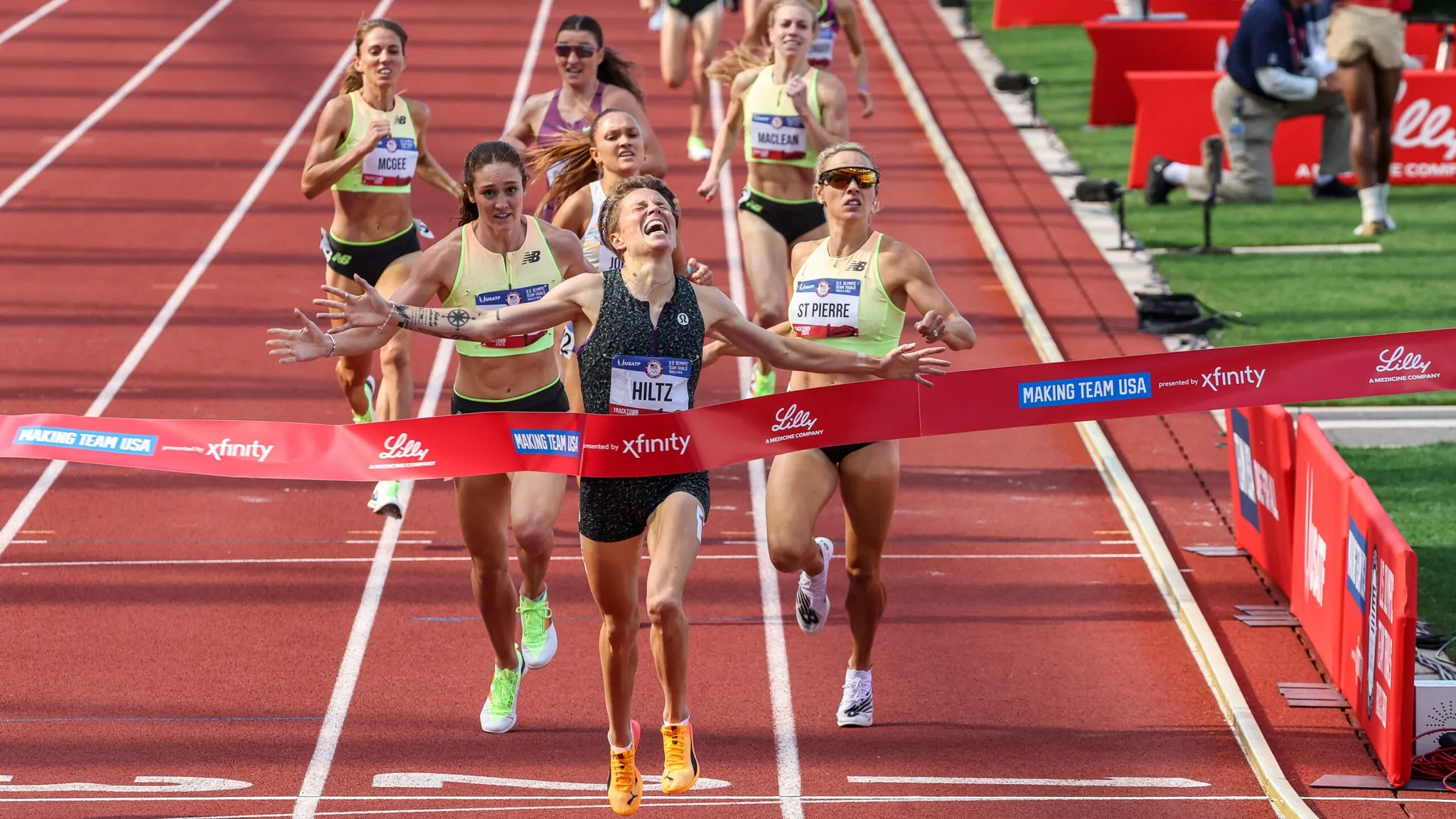
That arc matters because most runners who search for “nikki hiltz 1500m training routine” are not really asking for celebrity trivia. They want to know what changed. The evidence points most strongly toward altitude-based aerobic durability: repeated threshold work, a stable weekly rhythm, strength training that supports the running rather than competes with it, and enough psychological steadiness to keep showing up for a demanding pattern without turning every rep into a trial.
The Week Is the Workout
The best public window into Hiltz’s current training architecture is the COROS weekly template published in June 2026. It reflects the program under Juli Benson after Hiltz’s early-2025 coaching move from Mike Smith, and it should be treated as a general shape rather than a literal logbook. That caveat matters. Athletes do not live inside tidy graphics. But the pattern is still revealing because the same basic week repeats from base training into peak season, with paces changing more than the structure.[2][1]
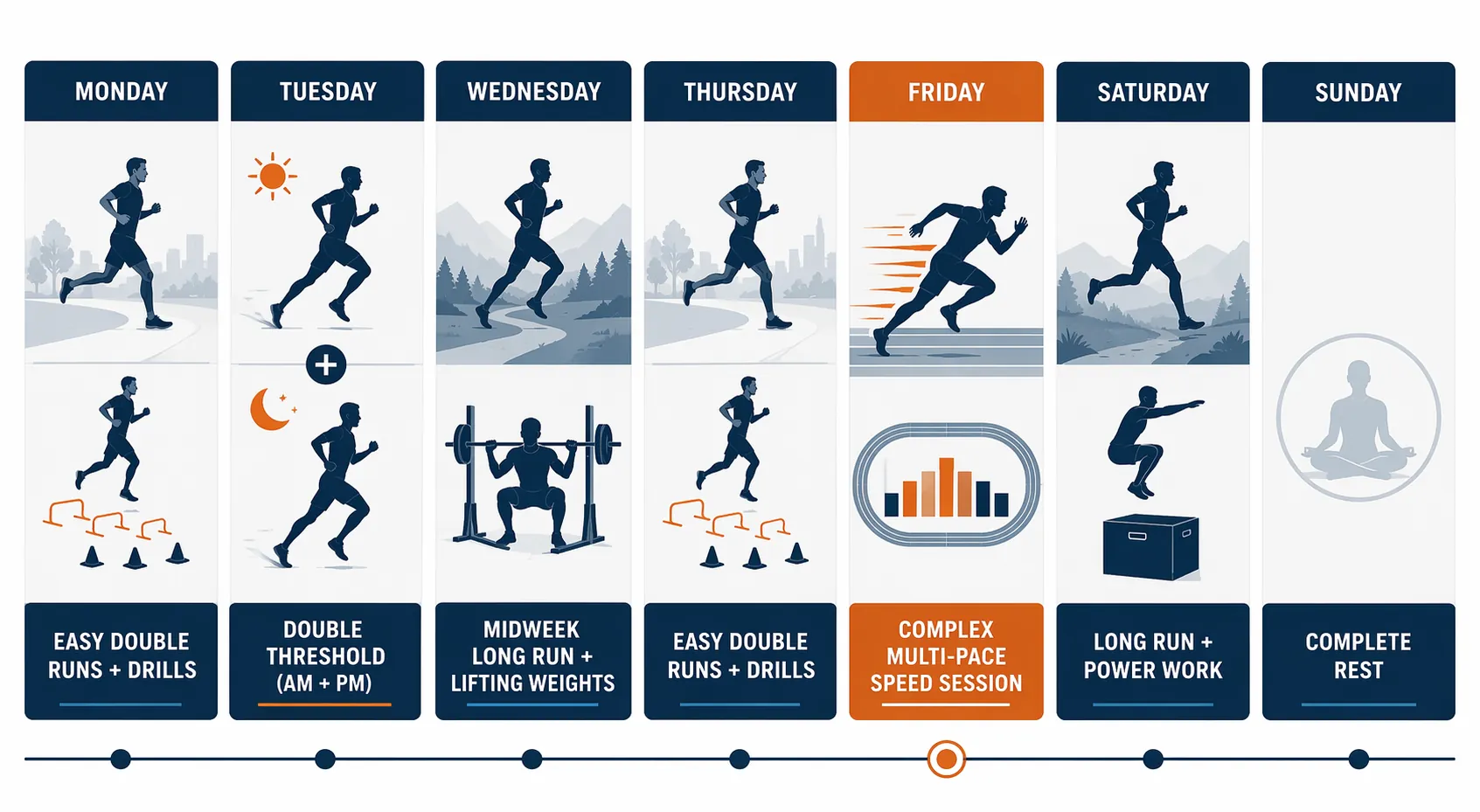
| Day | Main Work | What It Contributes |
|---|---|---|
| Monday | Easy double runs plus drills | Volume, rhythm, and technical touches without forcing intensity |
| Tuesday | Double-threshold sessions, morning and afternoon | Aerobic strength, lactate control, and repeatable work capacity |
| Wednesday | Midweek long run plus lifting | Durability and strength support after the main aerobic-quality day |
| Thursday | Easy double runs plus drills | Absorption before the hardest race-specific session |
| Friday | Complex multi-pace workout | 1500m-specific gear changes, speed under fatigue, and racing response |
| Saturday | 14-mile long run plus power work | Aerobic volume and neuromuscular support |
| Sunday | Complete rest | A true stop in the system, not a hidden cross-training day |
That table is the first thing to understand. Tuesday and Friday are not two versions of the same hard day. They solve different problems. Tuesday raises the aerobic ceiling and teaches the body to manage lactate at high but controlled intensity. Friday asks for tactical speed: changing gears inside reps, touching multiple paces, and preparing for the kind of uneven racing that does not care what pace your watch predicted.
The easy doubles on Monday and Thursday are easy for a reason. They create room for the two true quality days. Wednesday and Saturday carry strength and long-run work, but they are not trying to steal the headline. Sunday is completely off, which may be the least glamorous and most adult piece of the whole week.[2]
Tuesday: Double Threshold, Not Just a Long Tempo With Better Branding
Hiltz’s Tuesday is the part people will want to copy, and it is the part most likely to punish them if they copy it badly. The public template describes a morning threshold session around 6 x mile, followed later by an afternoon session around 4 x mile. The work is roughly around 5:20 per mile with 1-minute recoveries, accumulating about 8 to 12 miles of Zone 4 work across the day.[2]

Splitting the work is the point. A single huge threshold session can become a survival contest. Two controlled sessions allow more total work near the target intensity while reducing the chance that the last third of the session turns into sloppy overreach. The morning session creates the aerobic demand. The afternoon session asks whether the athlete can return, settle, and produce again without needing race-day adrenaline.
The 1-minute recoveries also change the meaning of the workout. This is not an easy continuous tempo run dressed up as intervals. The recoveries are short enough that the session keeps pressure on lactate clearance and rhythm. The athlete gets just enough space to maintain quality, not enough space to turn every mile into a fresh start.
Flagstaff makes the stress harder to interpret from sea level. Hiltz’s altitude base is around 7,000 feet, where a pace that looks merely fast on paper carries a different cost. The lesson is not “run 10 miles of threshold at Hiltz’s pace.” The lesson is that the 1500m can be limited by how much high-end aerobic work an athlete can absorb and repeat, not only by how fast they can sprint for 200 meters.[1][2]
For a serious recreational runner, the translation is smaller and less theatrical: find a threshold load you can repeat, split it if appropriate, and keep the recoveries honest. If you do not use a watch, a simple session log can still capture pace, recovery, perceived effort, and whether the second half stayed controlled; FitAtHome’s guide to tracking workouts without a smartwatch is useful for that kind of basic accountability.
Friday: The Race-Specific Day Is Messier on Purpose
If Tuesday is controlled pressure, Friday is controlled disorder. The COROS description presents Friday as the hardest day of the week, built around complex multi-pace repetitions rather than a clean “12 x 400” session. Some workouts include up to 8 different paces, with gear changes inside reps to mimic the surges of Diamond League-style racing.[2]
That distinction is important for 1500m runners. A race rarely asks for one even metronome effort. It asks an athlete to cover a move, relax after covering it, avoid panic when the rhythm changes, and still have another gear late. A session with multiple paces inside the same workout teaches a different skill than pure repetition. The athlete is not only producing speed; they are learning to access speed after previous changes have already cost something.
This is where Hiltz’s system resists the lazy “aerobic training made them fast” summary. The week still includes race-specific work. It just does not appear to be the breakthrough ingredient in isolation. Friday works because Tuesday, the easy doubles, the long run, and the rest day give it a body that can handle complexity. Without that aerobic base, multi-pace work becomes another way to rehearse falling apart.
The Women’s Running “K workout” feature gives another look at Hiltz’s preference for work that blends speed, stamina, and control rather than separating them into neat bins.[3] That is consistent with the public weekly template: the goal is not just to hit fast splits, but to hold form and decision-making while the body is moving through different gears.
The Easy Days Are Load-Bearing
Monday and Thursday are easy double days with drills. On paper, they look like filler. In practice, they are what stop the week from becoming two hard sessions floating in space. They maintain frequency, add low-intensity mileage, and preserve the feeling of running without asking the athlete to prove anything.
That last part is not soft. A runner who makes every day emotionally expensive eventually starts negotiating with the whole plan. Hiltz’s training only makes sense if the easy days are allowed to be easy and the drills are allowed to be technical rather than competitive. The boring parts protect the expensive parts.
Wednesday’s midweek long run and Saturday’s 14-mile long run keep the aerobic chassis growing around the threshold work. Saturday also includes power work, which makes it more than a mileage deposit. The long run is not being used as a heroic Sunday grind because Sunday is reserved for complete rest.[2]
Strength Training Fits Around the Running, Not Over It
Hiltz’s strength rhythm is specific without being mysterious: lifting on Wednesday and Saturday, with heavier compound work emphasized in the base phase and a shift toward plyometric and explosive work as racing becomes more central.[1]
That timing is sensible. Wednesday places lifting after the Tuesday threshold load rather than before it. Saturday pairs power work with the long run day, keeping the true recovery day clean. In base training, heavier compound lifts can build general strength. Closer to racing, explosive work becomes more relevant because the 1500m demands stiffness, coordination, and speed that can be accessed when tired.
Mobility sits in the same support category. Hiltz has shared mobility work publicly, including exercises featured by Runner’s World, but the useful takeaway is not that one mobility circuit explains an American record. It is that the gym and mobility pieces appear to serve the repeatability of the running week, not distract from it.[4]
The Psychological Routine Makes the Physical Routine Possible
A weekly schedule like this can look clean from the outside and feel very different from inside the athlete’s head. Hiltz began working with a sports psychologist in December 2023, built a 100-day meditation streak using Ten Percent Happier, journaled daily, and used phone-based affirmations.[5]
That material deserves more than the usual “mental side of the sport” nod. Double-threshold training is repetitive. Altitude training can make paces feel strange. A race-specific Friday can expose an athlete’s fear of not having the gear they want. Without a way to steady the mind, the week starts becoming a series of verdicts: fit or unfit, ready or not ready, good athlete or fraud.
The psychology work does not prove a direct cause for any single performance. The supported claim is narrower and still meaningful: Hiltz built mental habits alongside the training shift, and those habits help explain how a demanding, repetitive system could hold together through pressure.[5]
What Changed After the Plateau
The pro plateau around age 26 is the part of Hiltz’s arc that should make a lot of good runners sit up. Plenty of athletes respond to stagnation by adding sharper workouts, harder finishes, or more proof-of-fitness sessions. Hiltz’s public development story points instead toward the Flagstaff overhaul under Mike Smith, where altitude and aerobic strength became central before the later coaching move to Juli Benson.[1][2]
That does not mean one coach, one altitude camp, or one threshold method owns the whole breakthrough. Hiltz’s current COROS template reflects Benson’s post-early-2025 program, while the larger developmental change began earlier in Flagstaff.[2][1] The honest reading is that the pieces line up across time: bigger aerobic capacity, repeated threshold exposure, race-specific complexity, strength support, and recovery discipline.
The racing results then make more sense. A 1500m runner who can tolerate more aerobic pressure has more choices late. They can cover moves with less panic. They can run fast without spending every bit of anaerobic currency too early. They can arrive at the final lap with the feeling that the race has been expensive, not catastrophic.
How to Translate Hiltz’s Routine Without Copying It
The responsible translation starts with the week, not the workout. Before borrowing double threshold, a runner should be able to answer a less exciting question: what does a repeatable seven-day rhythm look like when the hard days, easy days, strength work, and full rest day all have jobs?
- Build two clearly different quality days: one controlled aerobic-strength day and one faster race-specific day.
- Keep easy days easy enough that they preserve the next workout instead of quietly damaging it.
- Treat threshold volume as something to earn gradually, not something to download from an elite altitude template.
- Place strength training where it supports the running week rather than blunting the key sessions.
- Protect at least one true recovery window instead of filling every blank space with extra work.
A recreational miler or 5K runner might begin with one threshold session and one controlled faster session each week, then add volume only when the current load is repeatable. A hypothetical threshold day could use shorter repeats, longer recoveries, or less total volume than Hiltz’s Tuesday. The principle is repeatable lactate-control work; the prescription depends on the athlete.
If you do use a tracker, the important data is not just the best split. It is whether the pace stayed controlled, whether recovery was short enough to preserve the stimulus, whether the next day stayed easy, and whether the same kind of week can be repeated. FitAtHome’s fitness tracker compatibility guide can help if you are choosing a device mainly to log workouts rather than chase notifications.
The Sunday piece is also worth copying in spirit. Hiltz’s public week uses complete rest, not a secret extra workout.[2] For athletes training around jobs, heat, family schedules, or poor sleep, recovery is often the first thing stolen and the last thing blamed. If sleep is the limiting factor, start with the basics before adding another session; FitAtHome’s guide to sleeping without AC and recovering faster from workouts is more relevant to most runners than another elite interval set.
Hiltz’s routine is useful because it is not a magic session. It is a system where the parts explain each other: Tuesday builds the aerobic strength to make the week bigger, Friday teaches that strength to survive race chaos, lifting supports the chassis, and complete rest keeps the whole thing from becoming a dare.
References
- Nikki Hiltz Training — Coach Saltmarsh, updated through mid-2026
- Nikki Hiltz Training — COROS, June 2026
- Nikki Hiltz’s Essential Workout — Women’s Running
- Mobility Exercises Nikki Hiltz — Runner’s World
- The Secret to Nikki Hiltz’s Big Breakthrough — Outside
What a small equipment investment adds
We don't have a build tagged to this exact tier yet. Browse all builds.
How often should you repeat this?
See our recovery and rest reference for citation-anchored rest-interval guidance.
Spot something off?
Tell us if a movement, tier assumption, or duration didn't match your experience.