
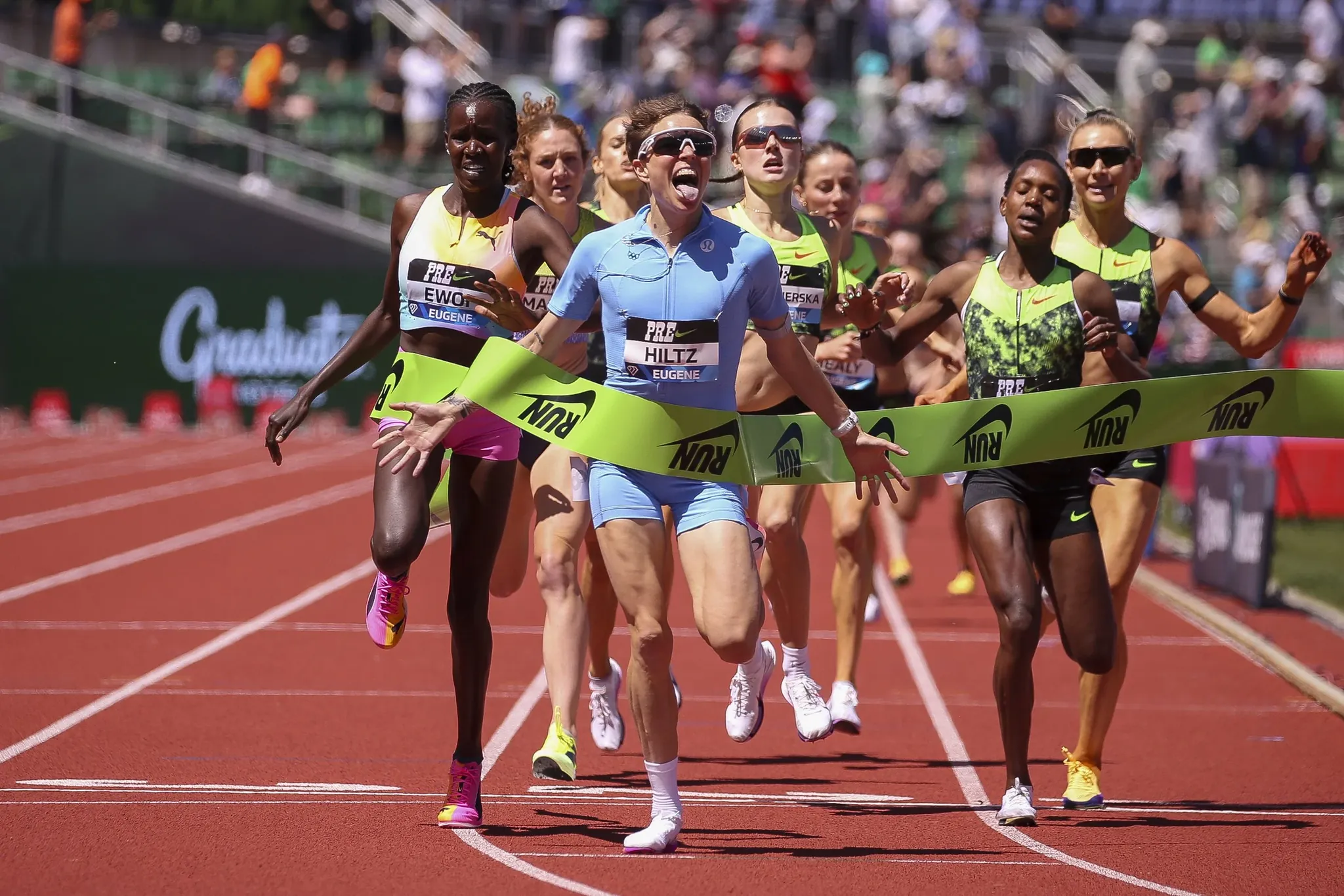
The Training Behind Nikki Hiltz's Pre Classic 1500m Win
Discover the seven-day training cycle Nikki Hiltz used to defeat Faith Kipyegon at the 2026 Pre Classic. This article breaks down her threshold sessions, track workouts, and strength routine so you can adapt the structure to your own training.
- Equipment tier required
- none
- Duration
- 45 min
- Difficulty
- intermediate
- Target area
- full body
Search for Nikki Hiltz’s Pre Classic 1500m workout and it is tempting to expect one session: the sharp ladder, the secret threshold day, the last confidence workout before beating Faith Kipyegon. That is the wrong place to put your weight. The more useful answer is a week, repeated often enough that race day did not have to be invented from scratch.
The clearest public look at that week comes from Hiltz’s COROS training log, published in a branded partnership. That matters: the data are presented through a sponsor’s story, but the sessions themselves are drawn from Hiltz’s own log. The spine is consistent: about 70 miles per week at roughly 7,000 feet in Flagstaff, a Tuesday double-threshold day, a Friday complex track session, strength on Wednesday and Saturday, and a real rest day. The same skeleton carries from base training into peak season; the paces change more than the architecture does.[1]
The Week Matters More Than the One Workout
A 1500m runner has to live in a strange middle ground. The race is short enough that rhythm changes, positioning, and a finishing kick matter. It is long enough that a runner who treats every hard day like a time trial eventually pays for it. Hiltz’s week handles that tension by separating the jobs.
| Day | Main purpose | What the public log shows |
|---|---|---|
| Tuesday | Aerobic strength without racing the workout | Double threshold: 6 x mile in the morning, 4 x mile in the afternoon, Zone 4 by feel, 1-minute rest |
| Wednesday | Strength support after the big aerobic day | Gym work, heavier in base training |
| Friday | Race-specific control and gear changes | Complex track sessions built around 300-600-800 ladder patterns with mid-rep pace changes |
| Saturday | Strength and athleticism | Second strength day, shifting more toward plyometric work in season |
| Rest day | Absorb the work | Treated as a fixed part of the routine, not a loose suggestion |
That table is the part most recreational runners should stare at before they ask about splits. Hiltz is not stacking random hard days. Tuesday carries the aerobic load. Friday teaches the body to change gears when already working. Strength sits close enough to matter, but not so chaotically that it hijacks the running. Rest is not what happens if the week goes badly; it is one of the planned sessions.
The altitude and mileage also need to stay in the frame. Seventy miles per week in Flagstaff is not a decoration around the workouts. It changes the recovery cost of everything. A runner training before work, lifting in a spare room, and sleeping like a normal adult with obligations cannot just shrink the intervals and pretend the same load has been preserved.
Tuesday: Double Threshold Without Turning It Into a Race
The Tuesday session is the one most runners will want to copy and the one most likely to go wrong. Hiltz’s log shows 6 x mile in the morning and 4 x mile in the afternoon, each with 1 minute of rest, run in Zone 4 by feel.[1] That is a lot of controlled work, not a challenge to prove fitness in the first rep.
The point is volume at a strong but repeatable effort. The short rest keeps the session honest. If the pace is too hot, there is nowhere to hide by rep four, and there is definitely nowhere to hide when the afternoon session arrives. That design is useful because it punishes ego early enough to teach restraint.
For a non-elite runner, the first adaptation is not to find Hiltz’s pace. It is to preserve the shape: controlled intervals, short recovery, no finish-line theater. A lower-volume version might be one threshold set in the morning or evening, or two smaller sets separated by several hours only if the athlete already recovers well from doubles. The workout should leave the next day possible. If Wednesday becomes survival jogging and a skipped lift, Tuesday was too expensive.
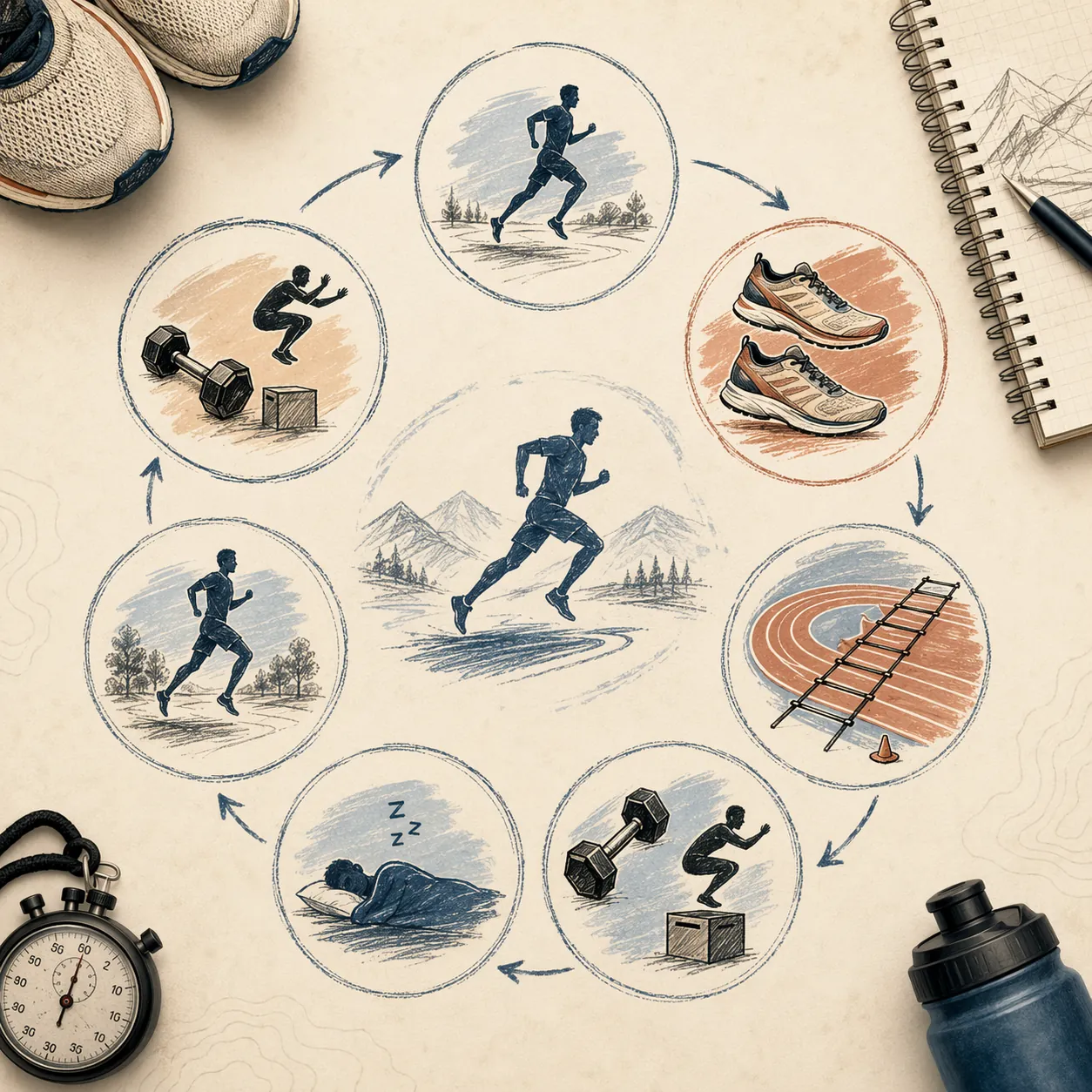
This is also where the weekly rhythm protects the athlete from over-reading one day. Tuesday can stay controlled because Friday exists. Friday can stay sharp because Tuesday already handled a large aerobic job. When one workout tries to be everything, it usually becomes too hard to repeat.
Friday: Ladders That Teach Gear Changes
Hiltz’s Friday work is more visibly connected to the 1500m: complex track sessions using 300-600-800 ladder patterns, with pace changes inside the reps.[1] That last detail is the useful one. A straight set of fast 400s can build fitness, but the 1500m rarely unfolds as tidy, identical pieces. Someone presses. Someone slows the pack. Someone moves before the bell. The body has to respond without panicking.
Mid-rep gear changes teach that response in a way a simple split sheet cannot. A runner might open controlled, squeeze the middle, then change again near the end. The session asks for speed, but also for steering. That distinction matters for adult runners because most of us have a bad habit of calling any hard track session “race-specific” once the watch says we ran fast.
The home version does not require a perfect track. A flat road loop, a marked path, or a treadmill can carry the same idea if the runner uses effort changes instead of obsessing over exact distance. The workout becomes: settle, change, control, finish. If the last rep turns into flailing, the session has drifted away from what made the original useful.
The K-Workout Is a Confidence Tool, Not the Whole System
The famous K-workout belongs later in the conversation. Women’s Running described it in 2021 as a session Hiltz used about 10 days before a championship: 3 x 1K in 3:15 to 3:20 with a 200m jog, 4 minutes rest, 2 x 150m strides, one hard 1K around 2:40, 90 seconds rest, then a fast 500m.[2]
Those are historical paces from 2021, not a public record of current Pre Classic fitness. The structure is the part worth keeping: controlled work first, a reset, a hard but specific test, then a short fast finish. It is a rehearsal for confidence and composure close to a major race. It is not evidence that one heroic workout explains a 2026 win.
If you adapt it, reduce both the number of hard pieces and the intensity gap. The danger is not that the session is complicated. The danger is that it feels exciting, so runners run the first three reps too hard and turn the final pieces into a proof-of-suffering exercise. Near a goal race, that is an expensive way to learn something you probably already knew.
Strength and Mobility Are Part of the Routine
The strength work in Hiltz’s week is not tacked on when motivation is high. COROS describes Wednesday and Saturday strength sessions, with heavier lifting emphasized in base training and a shift toward more plyometric work in season.[1] Hiltz also gives the blunt runner’s version of why it stays in: “Every time I accidentally skip a weight session, some little niggle pops up.”[1]
That quote lands because it is not glamorous. Strength is not being sold as a secret speed hack. It is the maintenance that lets the running happen again next week. For runners training out of small spaces, that is good news. The target is not to recreate a professional weight room; it is to keep the body prepared for the amount of running and speed you are asking from it.
Hiltz’s publicly shared mobility warmup is also simple enough to recognize: cat camel, cobra dog, inverted bicycle, tick tock, donkey kick, and donkey whip, done for 8 reps each for 1 set.[3] The value is not novelty. It is that the hips, spine, and trunk get a consistent pass before harder work starts.
A 2025 TRACK All-Access video also shows med-ball push-up variations in Hiltz’s gym routine.[4] For a compact home setup, a medicine ball, mat, a pair of dumbbells or kettlebells, and a small plyometric-friendly area can cover a surprising amount of the supporting work. If space and budget are the limiter, this guide to building a small-space home gym under $500 is a more practical starting point than waiting for perfect equipment.
How to Adapt the Skeleton Without Copying the Mileage
The exact Pre Classic taper week is not publicly documented, and there is no need to pretend otherwise. The useful public material is the repeatable training pattern leading into Hiltz’s racing, not a reconstructed final-week script. For most runners, the adaptation should start with fewer miles, fewer total reps, and more respect for recovery.
- Keep one controlled threshold day, but cut the volume before cutting the rest. The session should feel repeatable, not like a race.
- Use one faster session to practice changing gears, not just running evenly hard from the gun.
- Place strength where it supports the week. If lifting ruins the next quality run, reduce the load or move the session.
- Treat mobility as preparation, especially before threshold, track, and plyometric work.
- Protect the rest day. Moving it is sometimes necessary; quietly deleting it usually shows up later.
A runner on 25 to 35 miles per week might only need one threshold session and one lighter gear-change workout. A runner on 40 to 55 miles might split threshold volume occasionally, but only if easy days stay easy and sleep is not being treated as optional. The principle is not to imitate altitude mileage. It is to stop letting every hard day compete for the same recovery budget.
The Pre Classic result was dramatic because Hiltz beat the runner who has defined the event for years. The training lesson is deliberately less dramatic. Copy the skeleton, not the mileage. Borrow the intent, not the splits. Treat strength, mobility, and rest as part of the workout routine, not the accessories you add after the “real” training is done.
References
- Nikki Hiltz Training, COROS, June 2026.
- Nikki Hiltz Essential Workout, Women’s Running, 2021.
- Mobility Exercises Nikki Hiltz, Runner’s World.
- TRACK All-Access YouTube video, TRACK All-Access, 2025.
What a small equipment investment adds
We don't have a build tagged to this exact tier yet. Browse all builds.
How often should you repeat this?
See our recovery and rest reference for citation-anchored rest-interval guidance.
Spot something off?
Tell us if a movement, tier assumption, or duration didn't match your experience.