
A 6-Week No-Equipment Program to Train Like a UFC Fighter
This 6-week bodyweight program shows you how to build genuine UFC-level conditioning at home with zero equipment, using sport-specific training methods backed by research. It covers the concrete weekly plan for aerobic base, explosive power, and fight-specific movement patterns, while honestly explaining what home training can and cannot achieve.
- Equipment tier required
- none
- Duration
- 30 min
- Difficulty
- beginner
- Target area
- full body
- Space footprint needed
- 2x2m minimum, 3x3m preferred
- Noise level
- Moderate (jump modifications available)
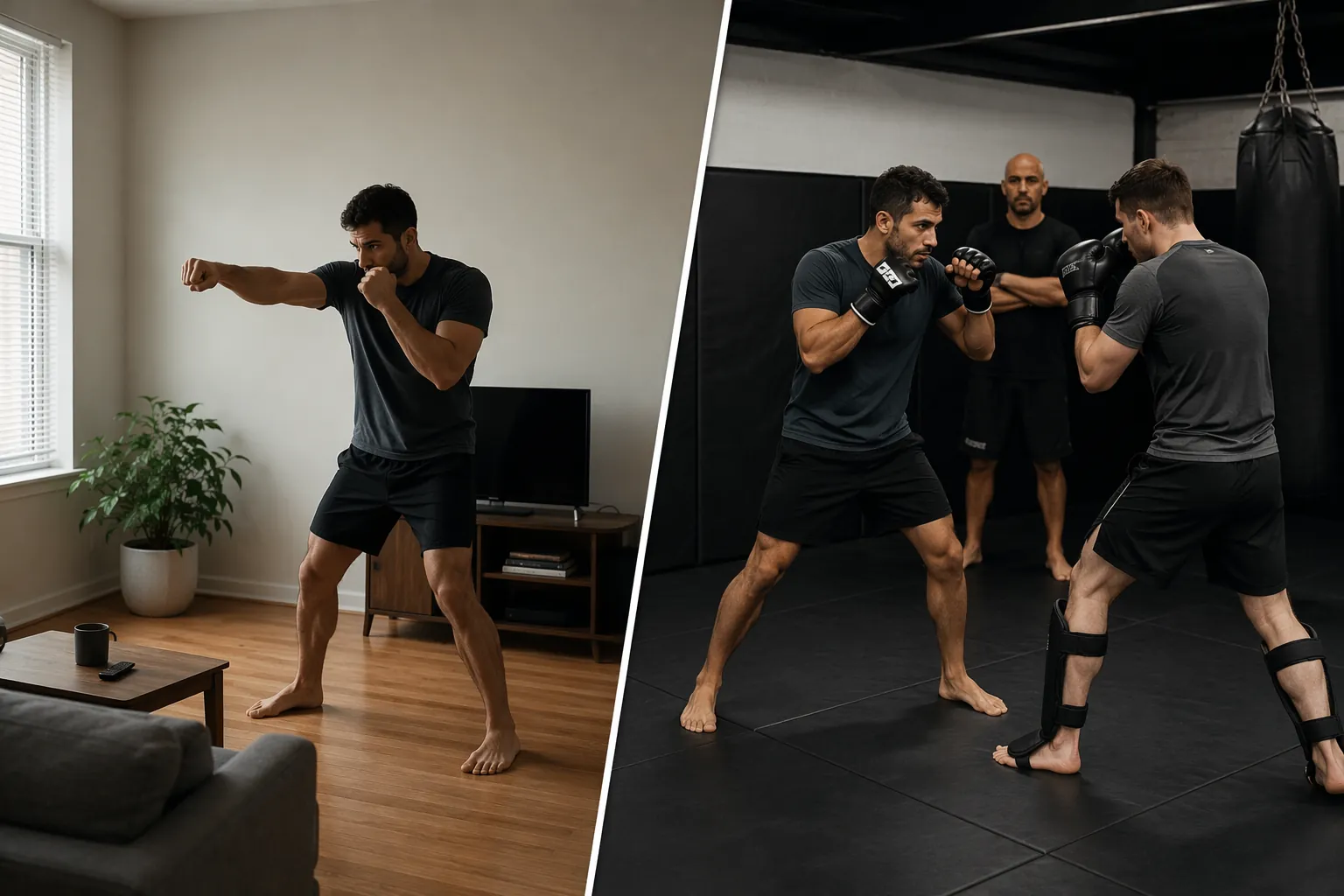
If you are searching for how to train to become a UFC fighter at home, the honest answer has two parts. You can build a serious MMA conditioning base in your living room: better repeat-effort endurance, cleaner fight-shaped movement, more explosive hips and legs, and enough training discipline to stop treating “fighter workout” as code for random suffering. You cannot become fight-ready at home alone. Fighting requires another resisting human, a coach who can correct you, and enough live contact to learn timing, distance, and composure.
That boundary matters because the useful home version is still worth doing. A beginner who walks into a real MMA gym after six weeks of structured shadow boxing, sprawls, technical stand-ups, penetration steps, shrimping, and controlled conditioning circuits is not magically a fighter. But they are less lost, less gassed, and usually less embarrassed by basic movement demands.
What “UFC-Style” Can Mean at Home
At home, “UFC-style” should mean conditioning and movement patterns that resemble MMA demands. It should not mean pretending shadow boxing is the same as striking a person who hits back, or that a burpee circuit teaches you how to wrestle.
The home program below trains four qualities:
- Aerobic base: the ability to recover between hard exchanges and repeat rounds without falling apart.
- Anaerobic capacity: the ability to surge hard for short bursts, then keep moving.
- Explosive power: fast hip extension, leg drive, level change, and floor-to-feet movement.
- Fight-specific movement patterns: shadow boxing, sprawls, penetration steps, shrimping, and technical stand-ups.
Those categories are not gym-class vocabulary pasted onto MMA. They decide what you do on Monday, how hard Wednesday should feel, and why Friday is not just “more sweat.”
The Evidence Favors Specific Work, Not Random Punishment
The strongest reason to avoid generic HIIT here is a 2018 study on well-trained mixed martial arts athletes. In four weeks, a low-volume sport-specific strength and conditioning program improved estimated VO2max by 13%, bench press 1RM by 16%, back squat by 20%, and takedown speed by 22%; a high-volume circuit training group produced no improvements in the tested outcomes. [1]
That does not mean a beginner should expect the same 13–22% jumps. The participants were national-level fighters with about four professional bouts, so the study does not directly describe a new apartment trainee. The useful lesson is narrower and better: in MMA conditioning, work that matches the sport can beat work that merely feels brutal. [1]
The six-week plan here uses that logic with a no-equipment template: shadow boxing rounds, wrestling-based floor movement, sprawls, burpees, mountain climbers, squat jumps, push-up variations, and progressive weekly volume. The practical structure is adapted from a published six-week bodyweight MMA home workout plan, while keeping the equipment line at zero. [2]
Before Week 1: Clear the Space and Set the Rules
You need less room than most people assume. A 2x2m clear floor space is enough for stationary shadow boxing, sprawls, mountain climbers, push-ups, squat jumps, shrimping in short segments, and technical stand-ups. A 3x3m space lets you add fuller footwork, angle changes, and more natural entries. [2]
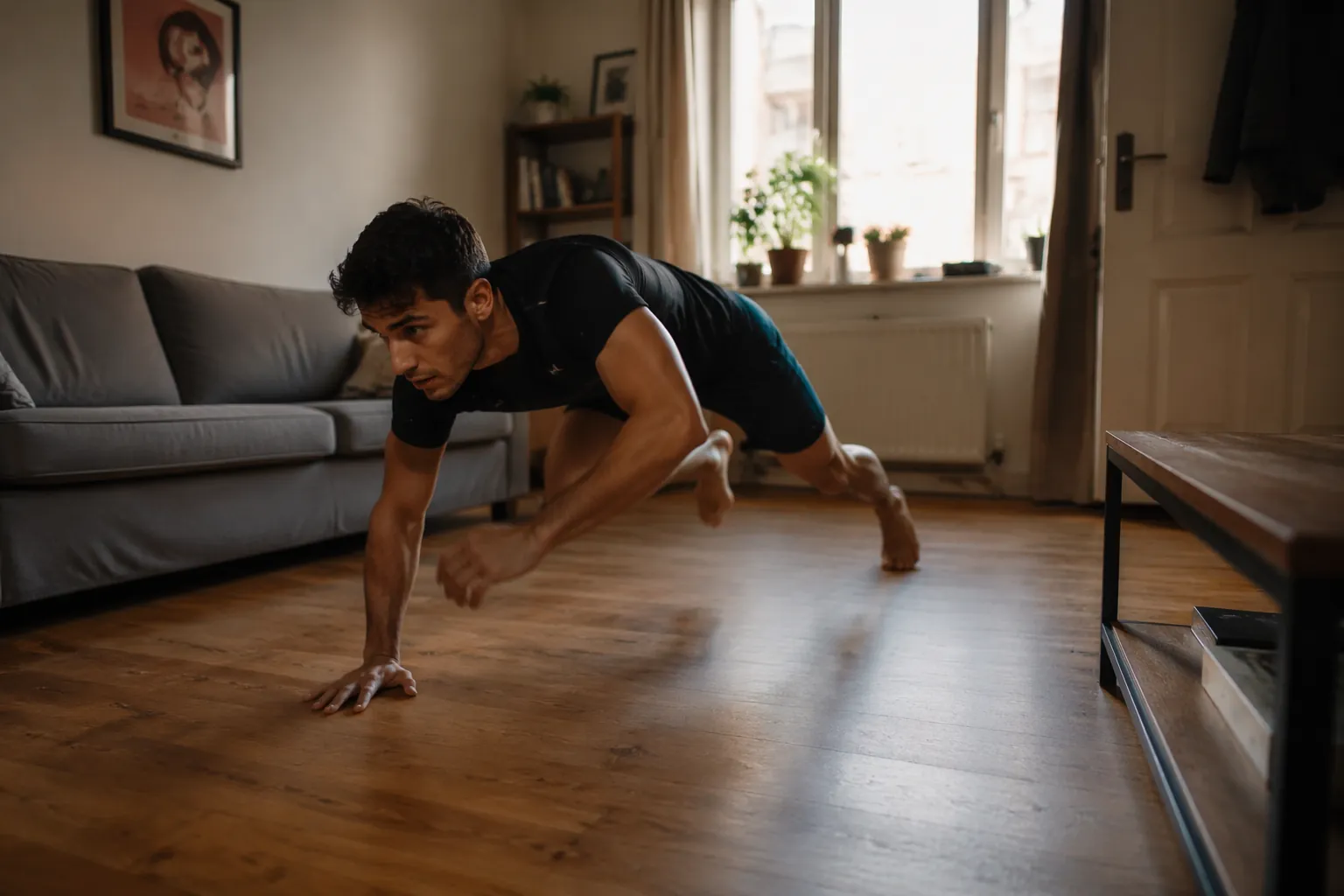
If you live above someone, train the jumps as “quiet power.” Land through the full foot, bend the knees, and stop the set when you can hear yourself stomping. If a movement cannot be made quiet, scale it before you pretend noise is intensity.
Use effort instead of gadgets. On easy work, you should pass the talk test: you can speak in short sentences. On hard intervals, use RPE 8–9 on a 10-point effort scale: you can push, but you are not losing shape or making panic faces at the carpet.
| If you have | Use it for | Avoid |
|---|---|---|
| 2x2m | Stationary shadow boxing, sprawls, push-ups, mountain climbers, squat jumps, short shrimping, technical stand-ups | Big lateral footwork, long shots across the room, uncontrolled jump volume |
| 3x3m | Shadow boxing with pivots, penetration step entries, angle exits, sprawl-to-stand sequences | Drifting into furniture or turning every round into footwork chaos |
The 6-Week No-Equipment Program
Train three days per week. A simple rhythm is Monday, Wednesday, and Friday, or Tuesday, Thursday, and Saturday. Keep at least one day between the harder sessions. If you are already lifting, running, or practicing martial arts, do not stack this program on top of everything and call the wreckage discipline.
Each session has the same skeleton: warm-up, skill-shaped movement, conditioning rounds, and cooldown. The weekly progression changes the number of rounds, the density of work, and the complexity of movement rather than just adding more exercises.
| Week | Main Target | Session Structure | Intensity |
|---|---|---|---|
| 1 | Learn positions and build repeatable rhythm | 3 sessions: 3 shadow boxing rounds, 2 movement circuits, light technical stand-up practice | Mostly RPE 5–7; finish with clean reps left |
| 2 | Add volume without rushing | 3 sessions: 4 shadow boxing rounds, 3 movement circuits, more sprawl and shrimp transitions | RPE 6–8; hard work stays technically controlled |
| 3 | Introduce stronger bursts | 3 sessions: 4 rounds with short flurries, 3 conditioning circuits, squat jumps and push-up variations | RPE 7–8; last circuit is hard but not sloppy |
| 4 | Make movements more fight-shaped | 3 sessions: 5 rounds, sprawl-to-stand sequences, penetration step entries, higher-density circuits | RPE 7–9; recover enough to keep posture |
| 5 | Peak repeat-effort conditioning | 3 sessions: 5–6 rounds, mixed striking and wrestling movement, shorter rests in selected blocks | RPE 8–9 on hard rounds; easy parts stay easy |
| 6 | Consolidate and test without turning reckless | 2 build sessions plus 1 benchmark session using Week 1 movements at higher quality and output | RPE 7–9; no max-effort testing with broken mechanics |
Week 1: Make the Movements Boring Before They Get Hard
Week 1 is not a fitness audition. It is where you learn whether your “fight stance” collapses after 40 seconds, whether your sprawl lands like a dropped refrigerator, and whether you can stand up from the floor without posting your hand in a dangerous place.
| Block | Work |
|---|---|
| Warm-up | 5 minutes: neck and shoulder circles, hip hinges, air squats, inchworms, light bouncing in stance |
| Shadow boxing | 3 x 2-minute rounds; 60 seconds rest. Round 1: jab-cross only. Round 2: add slips. Round 3: add basic level changes. |
| Movement circuit | 2 rounds: 6 sprawls, 8 mountain climbers per side, 6 technical stand-ups per side, 20-second plank |
| Floor movement | 3 minutes easy: shrimp left, shrimp right, sit-through position changes if space allows |
| Cooldown | 3–5 minutes: nasal breathing, hip flexor stretch, child’s pose, gentle thoracic rotation |
Your standard this week is repeatability. A sprawl should send the hips back and down without smashing the knees. A technical stand-up should keep one hand protecting your head and one leg ready to frame distance. Shadow boxing should look like you are aiming at a person, not swatting humidity.
Week 2: Add One Layer, Not Five
Keep the same three-session rhythm and add volume. Shadow boxing moves to 4 x 2-minute rounds. The movement circuit moves to 3 rounds. Rest stays honest: 60 seconds between shadow rounds, 90 seconds between circuits if you need it.
| Session | Focus | Conditioning Circuit |
|---|---|---|
| Day 1 | Striking rhythm and quiet sprawls | 6 sprawls, 10 mountain climbers per side, 8 push-ups, 6 technical stand-ups per side |
| Day 2 | Penetration step mechanics | 8 penetration steps per side, 8 squat-to-knee-drive reps per side, 20-second bear crawl hold, 6 push-ups |
| Day 3 | Sprawl, recover, return to stance | 5 sprawl-to-stand reps, 10 mountain climbers per side, 8 reverse lunges per side, 20-second plank |
For penetration steps in a small room, do not dive across the floor. Change level, step between an imaginary opponent’s feet, bring the trail leg under you, and recover stance. If you only have 2x2m, reset after every rep.
Week 3: Start Training the Surge
Week 3 introduces short bursts inside the rounds. This is where the program starts to feel more like a fight conditioning session and less like a calisthenics list.
Do 4 x 3-minute shadow boxing rounds. Every 30 seconds, add a 5-second burst: fast straight punches, a level change, or a sprawl and return to stance. The burst should be sharp enough to change your breathing, not so wild that your feet tangle.
| Block | Work |
|---|---|
| Circuit A | 3 rounds: 8 burpees or step-back burpees, 10 push-ups, 12 mountain climbers per side, 8 squat jumps |
| Circuit B | 3 rounds: 8 penetration steps per side, 6 sprawls, 6 technical stand-ups per side, 20-second hollow hold |
| Optional finisher | 2 minutes easy shadow boxing, nasal breathing if possible |
Choose the burpee version by landing quality. If the full burpee turns into a sagging push-up and a stomp jump, use a step-back burpee and stand tall. Regression is not softness here; it is how you keep the right muscles doing the work.
Week 4: Connect the Pieces
By Week 4, stop treating the drills as separate islands. A useful sequence now looks like this: jab-cross, level change, penetration step, sprawl, technical stand-up, reset stance. Slowly first, then with intent.
| Session | Main Round | Secondary Work |
|---|---|---|
| Day 1 | 5 x 3-minute shadow boxing rounds with one level change every 20–30 seconds | 3 rounds: 6 sprawls, 10 push-ups, 10 squat jumps, 20-second plank |
| Day 2 | 4 x 3-minute wrestling movement rounds: penetration step, sprawl, technical stand-up, shrimp | 3 rounds: 12 mountain climbers per side, 8 reverse lunges per side, 8 push-up shoulder taps per side |
| Day 3 | 5 x 3-minute mixed rounds: strike, shoot, sprawl, stand | 2–3 rounds easy-to-moderate, stopping before form breaks |
This is also the week to watch your ego. A real gym would give you a coach, a partner, and immediate consequences for bad posture. At home, you have to supply some of that discipline yourself. Film one round from the side if you can. Look for dropped hands, knees caving inward on jumps, and lazy returns to stance.
Week 5: Peak the Conditioning, Keep the Skill Shape
Week 5 is the hardest week. It is not the week to add a weighted vest, invent new moves from social media, or chase soreness. The job is to repeat fight-shaped work under fatigue.
| Day | Rounds | Hard Block |
|---|---|---|
| Day 1 | 6 x 3-minute shadow boxing rounds; 45–60 seconds rest | After rounds 2, 4, and 6: 5 sprawls + 10 mountain climbers per side |
| Day 2 | 5 x 3-minute movement rounds; 60 seconds rest | Every round includes penetration steps, sprawls, shrimping, and technical stand-ups |
| Day 3 | 5 x 3-minute mixed rounds; last minute of each round is high output | 3 rounds: 8 burpees, 10 push-ups, 8 squat jumps, 6 technical stand-ups per side |
Use the talk test to keep the easy parts easy. Between rounds, you should gradually regain enough breath to speak a short sentence. If you are still bent over and silent when the next round starts, extend the rest or cut the next round. Conditioning improves when the work is repeatable, not when every session becomes a failed survival test.
Week 6: Test the Program, Not Your Pain Tolerance
Week 6 has two build sessions and one benchmark. The build sessions look like lighter versions of Week 5: 4–5 rounds, crisp movement, no grinding. The benchmark is simple enough to repeat later without turning it into theater.
| Benchmark | How to Do It | What to Record |
|---|---|---|
| 3-round shadow boxing test | 3 x 3-minute rounds, 60 seconds rest; include strikes, level changes, sprawls, and resets | RPE each round, whether footwork stayed clean, whether hands returned to guard |
| 5-minute movement density test | Rotate through 3 sprawls, 3 technical stand-ups per side, 6 mountain climbers per side, 3 squat jumps | Rounds completed with good form, not total chaos reps |
| Recovery check | One minute after the benchmark, use the talk test | Can you speak in short sentences without gasping? |
Compare this to Week 1 by quality first. Cleaner stance after fatigue, faster floor-to-feet movement, quieter landings, and better breathing control count. More reps only matter if they came from better output, not worse technique.
How Hard Each Session Should Feel
Most home programs fail in one of two directions: they are too casual to change anything, or they are so frantic that the trainee learns bad movement at high heart rate. Stay between those errors.
| Session Type | Target Feel | Use This Check |
|---|---|---|
| Skill-shaped shadow boxing | RPE 5–7 | You can speak a short sentence between combinations |
| Hard conditioning circuit | RPE 8–9 | You can continue, but only by focusing |
| Recovery or warm-up movement | RPE 3–5 | Breathing is controlled and nasal breathing may be possible |
| Too hard | RPE 10 | You lose posture, stop thinking, or need long unscheduled rest |
If you miss a session, do not cram it into the next day. Continue with the next scheduled workout. If you miss a full week, repeat the previous completed week. The program is short, but it still needs spacing to work.
Movement Standards That Matter in a Small Apartment
A cramped room punishes lazy movement. That can be useful. You cannot hide behind long runs, heavy bags, or a big mat. Every rep either respects the space or turns into furniture management.
- Shadow boxing: keep your feet under you, return hands to guard, and aim combinations at a consistent imaginary target.
- Sprawl: hips move back first; chest does not collapse; recover to stance before the next rep.
- Penetration step: change levels before stepping; do not reach with your head; reset if space is tight.
- Shrimping: push through the foot, move the hips, and avoid dragging yourself with the shoulders.
- Technical stand-up: keep one hand available to protect or frame, post safely, and stand without turning your back.
- Squat jumps: land quietly; if you cannot, switch to fast bodyweight squats.
If you want a single-session version for a day when you cannot follow the whole plan, use Train Like a UFC Fighter in a Small Apartment as a companion routine. Treat it as a workout, not a substitute for the six-week progression.
Why the Plan Is Simple on Purpose
Elite training is often less exotic than its branding. UFC.com has presented high-level preparation through simple foundational ideas rather than novelty for its own sake. [3] That fits this program: repeat useful shapes, progress them gradually, and stop chasing exercises that only look intense from across the room.
Strength principles from fighter-oriented programs still matter, even when you remove barbells and machines. Pushing, squatting, hinging, bracing, rotating, and producing force from the ground remain the backbone; the difference is that this version expresses them through push-up variations, squat jumps, sprawls, level changes, and floor transitions. [5]
The missing piece is external resistance and contact. Bodyweight work can take you far enough to build the engine. It cannot teach you how your jab changes when someone parries it, how your shot feels against hips that sprawl, or how tired you get when another person is leaning on you.
When to Add Equipment
Do the six weeks first if you truly have no equipment. After that, equipment should solve a specific problem rather than decorate the room. A jump rope can help rhythm and footwork if your floor and neighbors allow it. Hand wraps and gloves make sense before bag work. A heavy bag changes conditioning because impact, distance, and recoil enter the session.
Heavy-bag home protocols often use timed striking rounds, including round-based formats taught by fighters such as Chris Camozzi. [4] That is a useful next layer, but only if your space, mounting option, lease, and noise tolerance can handle it. A badly hung bag in a small apartment is not a training upgrade; it is a maintenance request waiting to happen.
If you are deciding what can fit without wrecking your space or budget, use a constraint-first guide like How to Choose a Compact Home Gym That Works for Your Space, Budget, and Noise Tolerance. The right order is not “buy fighter gear, then become serious.” It is “train consistently, then buy the tool that removes the next real bottleneck.”
What Six Weeks Can and Cannot Give You
After six weeks, a realistic win is better conditioning, cleaner movement vocabulary, and more confidence entering a beginner class. You should know how to shadow box without flailing, sprawl without crashing, stand up technically, manage hard intervals, and recover between rounds.
The next step toward becoming an actual fighter is coached partner work. Not a harder solo circuit. Not another month of burpees with a more violent playlist. A gym gives you distance, timing, resistance, correction, and the uncomfortable education of another person refusing to cooperate.
References
- The Effect of Short-Term Sport-Specific Strength and Conditioning Training on Physical Fitness of Well-Trained Mixed Martial Arts Athletes — PMC6090403
- MMA Home Workout Plan: 6 Weeks of No-Equipment Combat Conditioning — 369MMAfit
- Elite UFC training made simple — UFC.com
- The MMA Workout You Can Do at Home — Verywell Fit
- The UFC workout program to get built like a fighter — Muscle & Fitness
What a small equipment investment adds
We don't have a build tagged to this exact tier yet. Browse all builds.
How often should you repeat this?
See our recovery and rest reference for citation-anchored rest-interval guidance.
Spot something off?
Tell us if a movement, tier assumption, or duration didn't match your experience.