
How to Follow Parker Valby's Pro Transition Plan at Home
Recreational home runners can adapt Parker Valby's high-mileage replacement strategy using affordable, small-space equipment by replacing 'junk miles' with intense cross-training sessions, not easy recovery work. This article provides a scaled weekly blueprint, equipment alternatives, and the key principles that make the method work.
- Equipment tier required
- $100-300
- Duration
- 30-60 min
- Difficulty
- intermediate
- Target area
- legs
- Space footprint needed
- small
- Noise level
- low
The useful question is not whether a home runner can duplicate Parker Valby’s life. You probably cannot copy her coaching, recovery, strength support, or access to pro-level equipment. The better question is whether the Parker Valby pro transition training plan for home runners has a transferable skeleton: a few carefully chosen run days, a large amount of hard non-impact aerobic work, and a refusal to pad the week with low-value miles.
The best public blueprint still comes from reporting on Valby’s collegiate structure, not a fully published current professional schedule under Mark Coogan. That matters. What follows is not a leak of her present training log; it is the reported pattern that made runners pay attention in the first place.
| Day | Reported Valby structure | What a home runner should notice |
|---|---|---|
| Monday | Arc Trainer double: about 60 minutes plus 60 minutes | A non-running aerobic load big enough to replace real mileage, not a gentle recovery spin |
| Tuesday | Hard workout on the track or grass | One of the week’s true running-stress days |
| Wednesday | Arc Trainer single: about 75 minutes | Another substantial aerobic day with reduced impact |
| Thursday | Arc Trainer about 60 minutes, with optional track work | A flexible day, but still not filler |
| Friday | Running | A second or third running-stress exposure |
| Saturday | Off or cross-training | A pressure-release point in the week |
| Sunday | Long run capped around 13 miles, or about 90 minutes of cross-training | The long aerobic stimulus is preserved while the run itself is capped |
The headline number is easy to remember: roughly 25 to 40 running miles, with 4 to 7 hours of threshold-to-hard cross-training layered around those run days.[1][2] The part many recreational runners miss is that the cross-training was not a soft side dish. Valby has described her heart rate as being higher on the Arc Trainer than during running, a detail also echoed in coverage of her training background.[1][3]
That heart-rate detail is the guardrail for the whole adaptation. If the home version turns into three jogs plus several easy pedals while watching television, it may still be healthy movement, but it is no longer the same training idea. Valby’s pattern replaced extra pounding with controlled aerobic suffering. The replacement work had a job.

What transfers from Valby’s plan, and what does not
The transferable part is the weekly architecture. A runner keeps a small number of high-value run exposures, then uses non-impact equipment to hold or build aerobic load without asking the bones, tendons, and feet to absorb every minute of training as running.
The non-transferable part is the assumption that the same volume, machine, or intensity distribution will fit a recreational runner. Valby was an elite athlete working inside a coached environment. Her case is an example, not a controlled study, and the public evidence is still essentially n=1 elite material rather than a peer-reviewed template for injury-prone apartment runners.
For a home runner, the cleanest translation is this: keep the run days deliberate, remove the least useful extra miles, and make the cross-training hard enough to count. That does not mean every session becomes a race. It means the cross-training must create a real cardiovascular stimulus, especially on the days it is standing in for mileage.
A scaled home week
This is an adaptation, not Valby’s schedule. The point is to preserve the shape: two or three run days, two or three hard cross-training days, one flexible day, and one real release valve. If you currently run five or six days a week and keep getting hurt, the reduction in run frequency may feel suspiciously low. The workload comes back through effort, not through more footstrikes.
| Day | Home-runner version | Effort target |
|---|---|---|
| Monday | 30 to 45 minutes spin bike, elliptical, rower, or aqua jogging | Steady-to-threshold; controlled, not conversational the whole time |
| Tuesday | Run workout: short intervals, hills, tempo segments, or a structured progression | The week’s main quality run |
| Wednesday | 30 to 60 minutes low-impact cross-training | Aerobic work with sustained pressure |
| Thursday | Optional short easy run or cross-training session | Use this as a flexible day, not an ego day |
| Friday | Easy run or moderate run | Comfortable enough to protect Sunday |
| Saturday | Off, mobility, strength, or short easy cross-training | Low pressure |
| Sunday | Long run, or longer low-impact session if bones or tendons are irritated | Aerobic endurance without forcing mileage |
A cautious starting point is 30-minute cross-training sessions, then building toward 45 to 60 minutes over several weeks if the body is absorbing the work. That scaling note is not sourced from Valby’s personal plan; it is a practical way to avoid copying elite volume before the connective tissue, sleep schedule, and life schedule are ready.
The Sunday decision deserves special respect. In Valby’s reported setup, the long run was capped around 13 miles, with a 90-minute cross-training option also appearing in the weekly pattern.[1][2] For a home runner, the cap is often more important than the number. A 7-mile long run that lets you train again next week is more useful than a 12-mile long run that turns the next ten days into damage control.
If you run only two days
Two run days can still work if they are chosen carefully. One day carries quality: intervals, hills, tempo, or controlled faster running. The other carries endurance: a long run or moderate aerobic run. The cross-training days then need to do more than circulate blood. They are where you accumulate the aerobic work that your legs are not ready to absorb as mileage.
If you run three days
Three run days gives most recreational runners a more familiar rhythm: one quality day, one easy or moderate day, and one long run. The mistake is adding two more easy runs because the week looks too empty on paper. In this model, the bike, elliptical, rower, or pool session is not a placeholder. It is where the additional aerobic load lives.
How hard the cross-training has to be
The simplest home test is whether the session would embarrass the phrase “active recovery.” During the working portions, breathing should be deliberate. You should be able to control the effort, but not drift through it. On a spin bike, that may mean enough resistance that cadence alone cannot fake the workout. On a rower, it means avoiding sloppy high-stroke flailing and holding pressure through the drive. On an elliptical, it means using resistance and incline instead of just swinging the handles.
Heart rate can help, but it is not magic. Valby’s own comparison between Arc Trainer effort and running heart rate is self-reported, not a lab finding that automatically applies to every runner.[1][3] Some people show different heart-rate responses on bikes, rowers, ellipticals, and in the pool. The better standard is repeatable effort: can you hold a hard aerobic session today, recover, and come back for the next planned run?
- A replacement session should feel like training, not like a cooldown.
- A recovery session should stay easy on purpose and should not pretend to replace a workout.
- A hard cross-training day should not be placed where it ruins the next key run.
- If form collapses on the rower, bike, or elliptical, the intensity is no longer controlled.
This is where many home versions fail. The runner removes miles, adds machine time, but never raises the machine work above comfortable. That may reduce injury risk simply because the total stress fell, but it also changes the training stimulus. Valby’s reported pattern is interesting because the aerobic load stayed serious while impact was reduced.
You do not need the same Arc Trainer
The Arc Trainer became the symbol of Valby’s method, but the machine is not the entire method. It worked for her because it allowed hard aerobic training with less running impact. That gives home runners room to adapt.
A new commercial Arc Trainer can sit in a price tier that makes no sense for most apartments. Life Fitness official pricing and mid-2026 equipment reporting put pro-style setups well beyond normal home-runner budgets, while used Arc Trainers are commonly discussed in the roughly $500 to $2,000 range depending on condition, model, and local availability.[4][5] Valby’s broader home-gym environment has been described as retailing above $35,000, which is useful context mostly because it keeps the rest of us honest.[4]
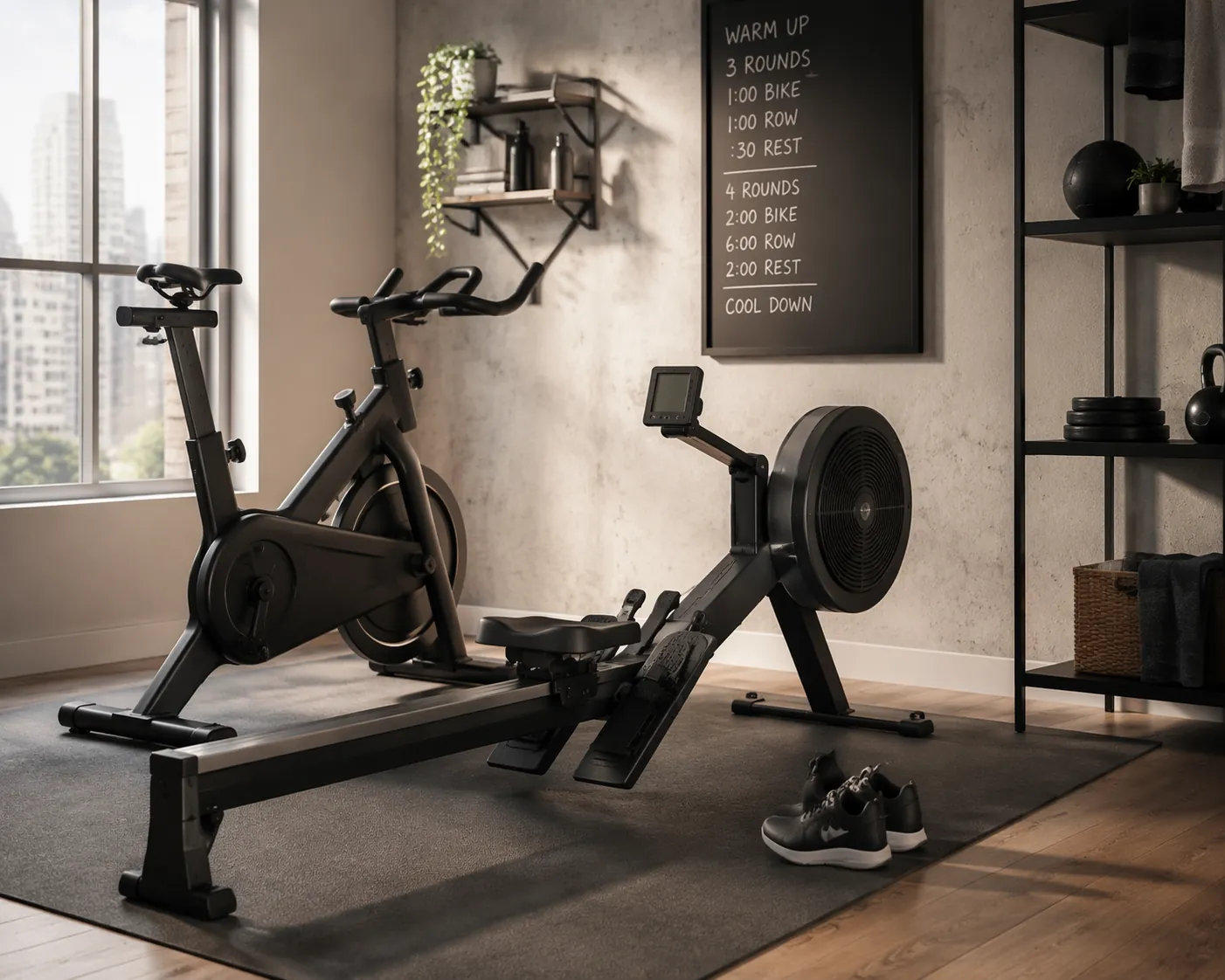
If you have the space and find a used Arc Trainer locally, fine. But a smaller home setup can still follow the logic. For broader home-equipment budget comparisons, the site’s budget-tier equipment guide is the better place to compare categories. Here, the question is narrower: can the tool support hard, repeatable, low-impact aerobic work?
| Equipment | Typical mid-2026 budget range | Best use in a Valby-style home adaptation | Main limitation |
|---|---|---|---|
| Used Arc Trainer | $500 to $2,000 | Closest mechanical substitute for the original reported setup | Large footprint, local-market dependence, maintenance risk |
| Spin bike | $200 to $500 | Small-space threshold intervals and steady hard aerobic work | Easy to underload if resistance stays too low |
| Elliptical | $300 to $800 | Low-impact aerobic work that feels more run-adjacent than cycling | Cheap models may wobble or limit resistance |
| Rower | $200 to $700 | High-output aerobic sessions with strong posterior-chain demand | Technique can become the limiter before fitness |
| Aqua jogging belt | $25 to $50 | The lowest-impact option if pool access exists | Requires water access and enough patience to work hard without ground contact |
The spin bike is often the most realistic apartment answer. It is compact, usually quieter than a treadmill, and easy to scale by resistance. The danger is that cadence can become theater. If the pedals are flying with almost no resistance, the session is not replacing much running stress; it is just occupying the calendar.
A rower can be brutally effective, but it demands restraint. Many runners yank with the arms, round the back, and turn a threshold session into a technique problem. If rowing is your tool, begin with shorter controlled blocks and let clean mechanics decide the ceiling.
An elliptical can be a good middle ground if the machine is stable enough to let you push resistance. The cheaper the unit, the more you need to test whether it can handle actual training intensity. A machine that feels fine for 15 easy minutes may feel completely different during 45 minutes of sustained work.
Aqua jogging is the least glamorous and often the most joint-forgiving, but it is only practical if pool access is easy. It also exposes whether you understand effort. Without speed feedback or scenery, you have to create the pressure yourself.
The patience piece is not optional
The tempting move is to run fewer days for two weeks, feel fresher, then start adding miles back immediately. That is how a smart architecture turns into the same old gamble. Coach Will Palmer has emphasized that Valby’s running mileage was planned to increase over years, not weeks, a point also discussed in coverage around her transition.[6][7]
That patience is the difference between using cross-training as a bridge and using it as permission to rush. If the home version works, it will probably feel almost too controlled at first. The run days become easier to absorb. The cross-training carries more of the aerobic burden. The weekly rhythm stops depending on whether your shins, feet, or knees tolerate one more easy run.
A practical rule: add only one stressor at a time. Do not lengthen the long run, raise the bike intensity, add another run day, and begin hill repeats in the same block. The body does not care that those changes live in different categories on your spreadsheet. It receives them as total stress.
What the navicular fracture does and does not prove
Valby’s injury history should keep the story grounded. Secondary reports and coaching commentary have described a navicular fracture timeline beginning in early 2025, with a comeback by May 2026.[6] Coach Saltmarsh has argued that her established cross-training skill helped shorten what could have become a lost year into roughly a six-month competitive return window.[6]
That is a strong supporting case for the value of already knowing how to train hard without running. It is not proof that this method prevents stress fractures. In fact, the fracture is the necessary caution inside the whole discussion: reducing running impact does not eliminate skeletal stress, and elite-level training still carries risk.
For a recreational runner, the lesson is not to self-rehab a bone injury with a bike or rower. The lesson is to build aerobic options before injury forces the issue. If pain changes your gait, localizes sharply, worsens with impact, or persists, that is no longer a training-plan puzzle.
A cautious yes for home runners
Yes, a home runner can adapt the useful part of Valby’s reported model without buying a pro gym machine. The clearest version is simple: run two or three days, make those run days count, replace low-value extra mileage with hard low-impact aerobic work, and keep one day flexible enough that the week can bend before the body breaks.
The equipment can be modest. A spin bike, elliptical, rower, used Arc Trainer, or aqua jogging belt can all serve the idea if the effort is honest and repeatable. The plan stops being comparable when cross-training becomes passive filler, when mileage returns faster than the body can adapt, or when “reduced impact” gets mistaken for “no risk.”
References
- Runner’s World reporting on Parker Valby’s weekly training, Runner’s World.
- Women’s Health reporting on Parker Valby’s weekly training, Women’s Health.
- The Phillipian reporting on Parker Valby’s training background, The Phillipian.
- Life Fitness official pricing, Life Fitness.
- Garage Gym Reviews home exercise equipment pricing coverage, Garage Gym Reviews.
- Coach Saltmarsh commentary on Parker Valby’s navicular fracture comeback, Coach Saltmarsh.
- CITIUS Mag coverage of Parker Valby’s transition and Coach Will Palmer’s training comments, CITIUS Mag.
What a small equipment investment adds
We don't have a build tagged to this exact tier yet. Browse all builds.
How often should you repeat this?
See our recovery and rest reference for citation-anchored rest-interval guidance.
Spot something off?
Tell us if a movement, tier assumption, or duration didn't match your experience.