
How to Train Pickleball at Home When You Can't Get to a Court
This 30-day progressive home training plan rotates through movement fundamentals, paddle control, conditioning, and game-pattern drills so you can maintain or improve your pickleball skills without stepping on a court.
- Equipment tier required
- none
- Duration
- 20 min
- Difficulty
- beginner
- Target area
- full body
- Noise level
- low
You have a month without reliable court time. Maybe the courts are booked, the weather is useless, or your schedule only opens up after the lights go off. That does not mean the next 30 days become a waiting room. A good pickleball home workout, no court needed, should give you something specific to do today, then build on it tomorrow.
The need is real. SFIA reported that 24.3 million Americans played pickleball in 2025, a 171% increase over three years, and the practical consequence is easy to feel: more players competing for the same evening and weekend court windows.[1] If you already play, the problem is not motivation. It is rhythm. Miss enough sessions and your split step gets lazy, your paddle path gets vague, and the first few games back feel like you are negotiating with your own feet.
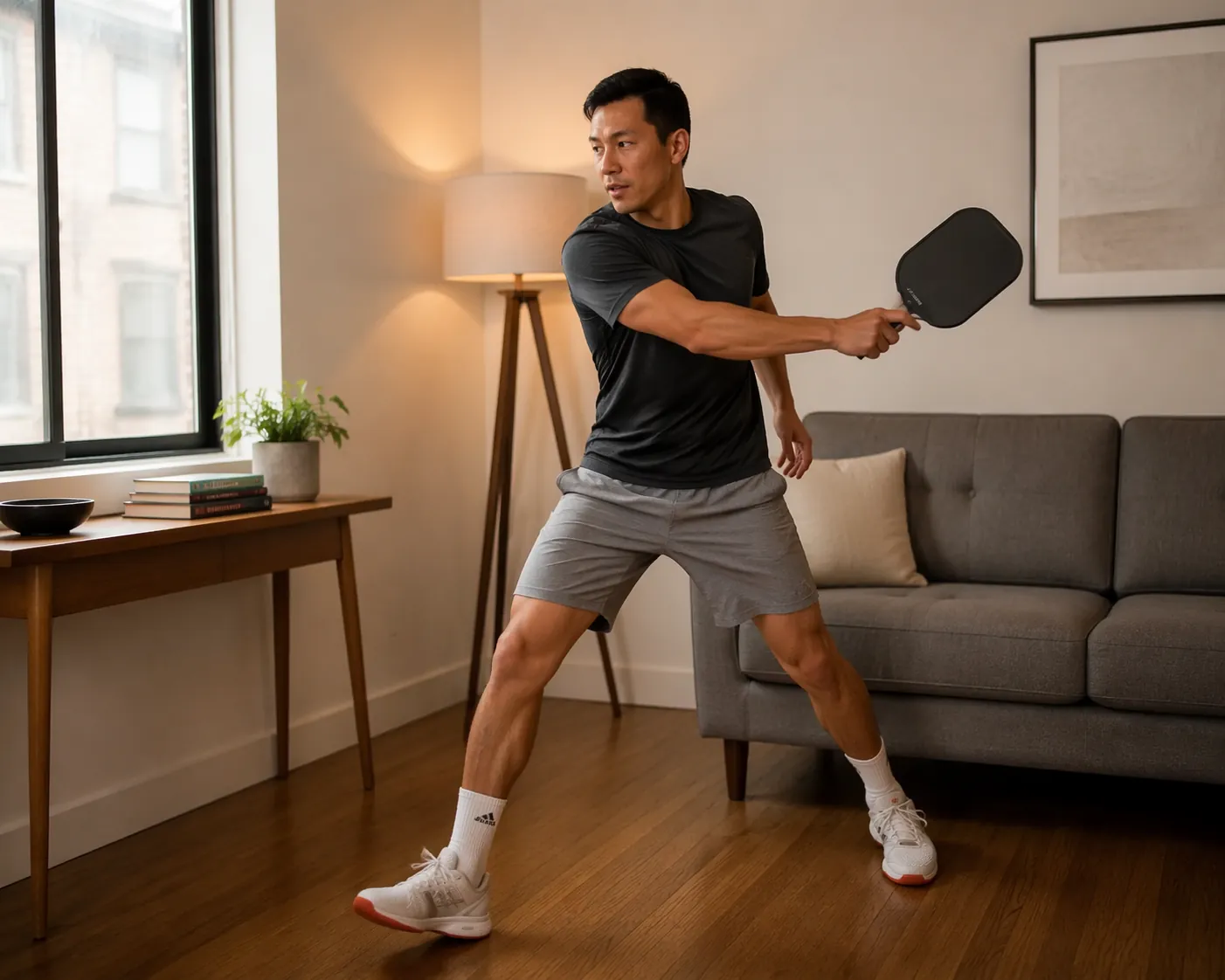
This plan assumes you have a paddle, a small clear area, and 15–20 minutes a day. It does not assume a garage court, a ball machine, or a downstairs neighbor who enjoys repeated jumping. Complete beginners can still use it, but Week 2 may need a few extra days because paddle-control work makes more sense once the basic grip and swing shapes feel familiar.
If you only need a single session on a busy day, use the 20-minute pickleball home workout for small spaces as a substitute. This article is different: it is a 30-day progression. A single workout keeps the habit warm; a progression gives your movement, mechanics, and conditioning something to adapt to.
The 30-day plan at a glance
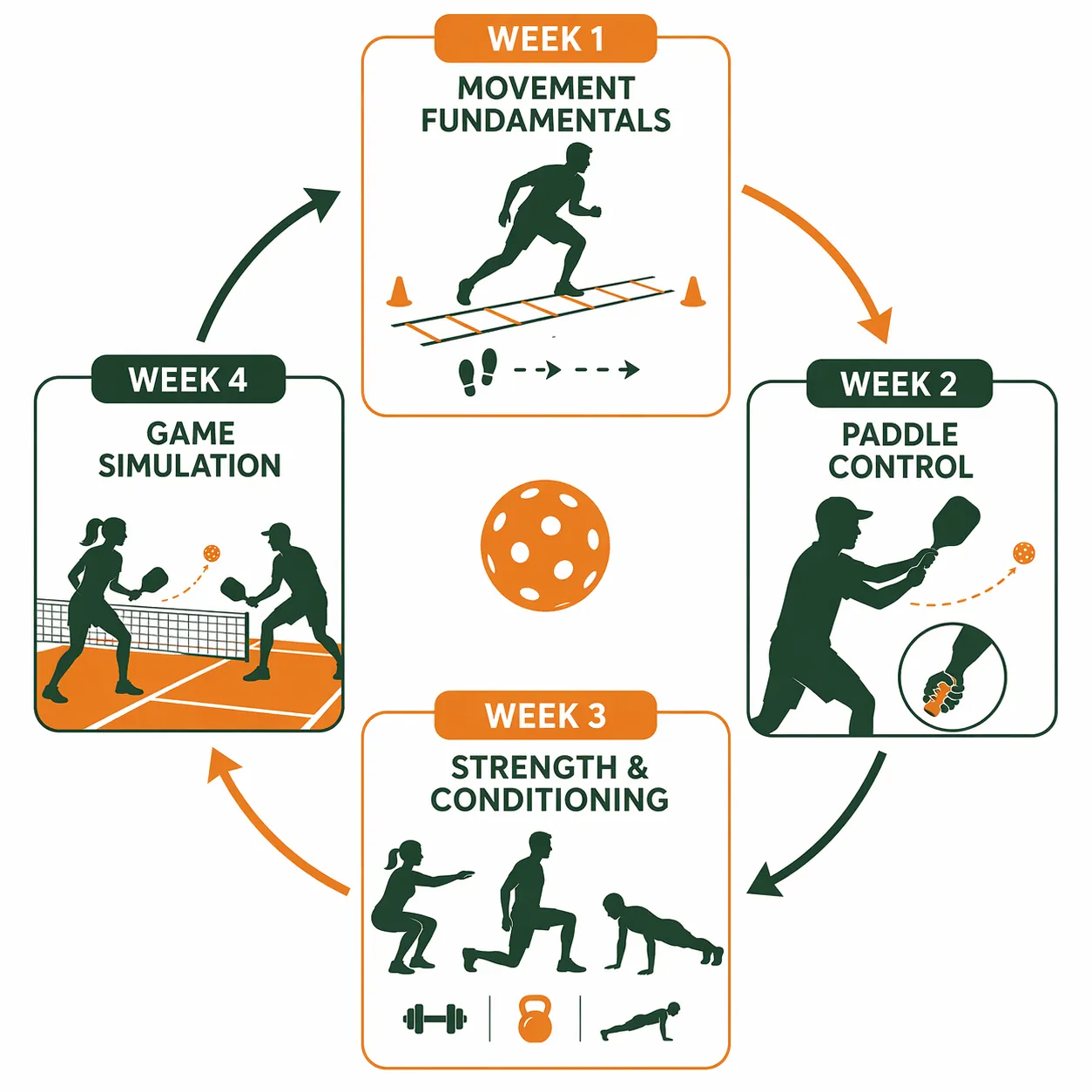
The plan rotates four priorities: movement fundamentals, paddle control, strength and conditioning, and integrated game-pattern simulation. Each session starts with two minutes of easy mobility and ends with one minute of slow breathing or gentle stretching. The work in the middle is the part that changes.
| Day | Focus | 15–20 minute session |
|---|---|---|
| 1 | Movement baseline | Athletic stance holds, split-step timing, short lateral shuffles, and a simple balance check on each leg. |
| 2 | Movement | Forward-back recovery steps, kitchen-line imagination drill, and quiet reset steps after each movement. |
| 3 | Paddle mechanics | Slow forehand and backhand shadow swings with hip turn before the arm, then compact ready-position resets. |
| 4 | Movement + paddle | Split step, two lateral steps, shadow dink, recover to ready position. Alternate forehand and backhand sides. |
| 5 | Conditioning base | Bodyweight squat, reverse lunge, plank, calf raise, and easy shuffle intervals. |
| 6 | Paddle mechanics | Serve motion, return motion, and third-shot-drop shadow patterns at half speed. |
| 7 | Recovery + test | Light mobility, then record baseline measures: controlled shuffles in 30 seconds, plank hold, and 10 slow shadow swings per side on video. |
| 8 | Footwork precision | Lateral shuffle patterns with smaller steps, cross-step recovery, and stop-with-balance holds. |
| 9 | Paddle control | Forehand and backhand shadow dinks, paddle-face awareness, and reset-to-ready reps. |
| 10 | Paddle control | Shadow volleys, block resets, and compact punch motions without over-swinging. |
| 11 | Movement + paddle | Approach, split step, shadow volley, backpedal recovery, and reset. |
| 12 | Conditioning | Squat-to-calf-raise, reverse lunge, side plank, glute bridge, and quiet lateral step intervals. |
| 13 | Paddle sequence | Serve, return, third-shot-drop, kitchen reset, and dink pattern rehearsed slowly. |
| 14 | Recovery + review | Mobility, easy shadow swings, and video comparison with Day 7. |
| 15 | Strength | Lower-body circuit: squat variations, reverse lunges, calf raises, and balance holds. |
| 16 | Core + control | Plank series, dead bug, side plank, then slow shadow swings while keeping posture stable. |
| 17 | Agility conditioning | Low-impact shuffle intervals, diagonal recovery steps, and controlled deceleration. |
| 18 | Strength + paddle | Lunge-to-ready-position, squat-to-shadow-volley, calf-raise-to-overhead-ready work. |
| 19 | Conditioning | Timed bodyweight circuit with quiet feet: squat, lunge, plank, calf raise, and lateral step. |
| 20 | Paddle under fatigue | Short conditioning block, then 10 minutes of slow shadow swings while maintaining clean form. |
| 21 | Recovery + test | Repeat Day 7 measures and note which number improved without sacrificing control. |
| 22 | Game pattern | Serve, recover, return-read, third-shot-drop, move in, split step, dink. |
| 23 | Defensive pattern | Opponent drives, you split, block reset, shuffle, reset again, then recover to neutral. |
| 24 | Transition-zone pattern | Approach from baseline, stop before contact, shadow reset, move in only after balance. |
| 25 | Kitchen exchange | Dink crosscourt, recover middle, speed-up read, block, reset, and re-dink. |
| 26 | Conditioning + pattern | Short strength circuit followed by two imagined rally sequences at controlled speed. |
| 27 | Pressure rehearsal | Play out imagined 0–0–2, 8–8, and game-point patterns with deliberate resets. |
| 28 | Recovery + video | Light movement and a clean full sequence on video: serve through kitchen exchange. |
| 29 | Return-to-court primer | Low-volume movement, half-speed swings, and short point-pattern rehearsals. |
| 30 | Final test | Repeat Day 7 and Day 21 measures, then run three complete game-pattern sequences with no rushed steps. |
Week 1: make the room feel like pickleball space, not gym space
The first week is not about getting tired. It is about making your feet obey pickleball rules in a small area: split before you move, arrive under control, hit from balance, and recover before the next ball would be coming. Those are not generic agility ideas. They are the difference between reaching a dink with your arm and arriving early enough to choose a shot.
Start every movement rep from a ready position: knees soft, paddle in front, weight balanced enough that you could move either direction. From there, use short shuffles rather than long lunging steps. In an apartment, this also keeps the drill quieter and safer. You are not trying to cover a real court. You are training the first step, the brake, and the reset.
A simple Week 1 movement block can look like this: split step, shuffle two steps right, hold balance, shuffle back to center, split step again, shuffle two steps left, hold balance. Then repeat the same idea forward and backward. If your coffee table is pushed against the wall and you only have a narrow lane, reduce the step count and make the stop cleaner. The stop matters more than the distance.
If you like visual targets, lay down painter’s tape, socks, or a folded towel as a ladder substitute. An actual agility ladder can help, but it is not required; the useful part is having marks that tell your feet where to land. If you do want a dedicated setup, an agility-ladder alternative is enough for this plan because the goal is controlled foot placement, not sprint training.
PB5star reports that consistent footwork practice can improve lateral speed by up to 15%, but that figure should be treated as a vendor-side claim, not a guarantee.[4] The more useful expectation for this plan is simpler: after a week, your first step should feel less random, and you should be able to stop without your upper body drifting past your feet.
Your Week 1 checkpoint
- Can you split step quietly without jumping high?
- Can you shuffle both directions without crossing your feet by accident?
- Can you stop, hold balance, and keep your paddle in front?
- Can you repeat the same pattern at the end of the session, not just when fresh?
Week 2: shadow swings need a job
Shadow swinging gets dismissed because it can look like pantomime. Done badly, it is. Done with a clear sequence, it teaches your body the order of the shot. Inside the Den’s analysis of pickleball shadow drills emphasizes hip engagement, with hip rotation preceding arm movement in the swing pattern.[2] That is the point of Week 2: hips before arm, paddle face before speed, recovery before the next imaginary ball.
Use half speed first. On a forehand shadow dink, turn the hips slightly, let the paddle travel on a compact path, finish small, and return to ready position. On a backhand dink, keep the paddle in front longer than feels dramatic. On volleys, shorten the motion even more. The living room is actually useful here because it punishes big swings. If the paddle keeps threatening a lamp, the swing is probably too large for a kitchen exchange anyway.
TopspinPro recommends 10 minutes of shadow swinging every other day as a frequency that can produce noticeable improvement.[5] In this plan, that becomes the backbone of Week 2: not endless reps, just regular exposure to the same mechanics. The order stays consistent: ready position, foot adjustment, hip engagement, paddle path, finish, reset.
Do not rush to full-speed serve motions. Most no-court swing work should be slow enough that you can feel whether the paddle face is changing. For a serve, rehearse the motion as a relaxed chain rather than a slap. For a return, rehearse a compact unit turn and a controlled finish. For a third-shot drop, make the swing smaller than your ego wants it to be.
If you have a safe wall and a foam ball, you can add accuracy-specific work from Can You Improve Pickleball Accuracy at Home? 5 Drills Tested. Keep that as an add-on, not a replacement. The point of this 30-day plan is that it still works when you cannot hit a ball at all.
A 10-minute Week 2 paddle block
- Two minutes: ready-position resets. Bring the paddle back to the same neutral spot after every imaginary contact.
- Two minutes: forehand and backhand dinks. Keep the finish short and the lower body quiet.
- Two minutes: block volleys. Pretend the ball is coming fast and your job is to absorb, not swing.
- Two minutes: serve and return motions at half speed.
- Two minutes: serve, recover, third-shot-drop shadow sequence.
Record 10 swings from the side on Day 7 or Day 14 if you can. You are not looking for a perfect coaching video. You are looking for obvious leaks: arm starting before the body, paddle dropping behind you, head moving too much, or a finish that leaves you late to recover.
Week 3: build the body that survives longer rallies
Week 3 is where the plan starts to feel more like a workout, but it should still serve pickleball. The Picklr connects conditioning work such as squats, lunges, planks, and calf raises to the demands of longer rallies, court coverage, cardiovascular fitness, agility, and injury prevention.[3] That is the filter. If an exercise does not help you stay low, move repeatedly, decelerate, or hold posture under fatigue, it does not need much room in this plan.
The basic circuit is simple: squat, reverse lunge, plank, calf raise, lateral step. The progression is what makes it useful. First, learn the positions. Then add time. Then pair the movement with a paddle reset. By Day 20, you should be able to do a short conditioning block and still shadow swing without your mechanics falling apart.
| Exercise | Pickleball transfer | Small-space cue |
|---|---|---|
| Bodyweight squat | Helps you stay low through kitchen exchanges and repeated ready positions. | Stop before your knees or back change shape just to get lower. |
| Reverse lunge | Supports reaching and recovering without collapsing forward. | Step back softly and return to balance before the next rep. |
| Plank | Trains trunk stability so your paddle path does not wobble under fatigue. | Use a mat if wrists or elbows need padding. |
| Calf raise | Builds lower-leg endurance for split steps, small adjustments, and repeated resets. | Rise and lower under control instead of bouncing. |
| Lateral step interval | Keeps court-coverage patterns alive without needing court distance. | Quiet feet matter more than speed. |
A yoga mat is useful for planks and floor work, especially if you are training on hard flooring. Resistance bands can add load later, but do not add them until the bodyweight version stays quiet and controlled. More resistance with sloppy posture is just a faster way to rehearse the wrong shape.
For noise-sensitive homes, swap jumps for heel lifts, use step-outs instead of bounds, and keep all shuffles low. The quiet pickleball home workout drills guide is a better companion if your main constraint is the neighbor downstairs rather than your own conditioning.
How to progress Week 3 without equipment
- Add one round before you add speed.
- Add a longer balance hold before you add harder variations.
- Pair one strength move with one paddle reset: squat, ready position; lunge, ready position; calf raise, ready position.
- Stop a set when your knees cave, your trunk twists, or your paddle drops below a useful ready position.
If you want extra cardio on non-pickleball days, use a separate general plan such as the 4-week progressive cardio-at-home training plan. Keep the pickleball sessions clean, though. Fatigue is useful only if you can still move like a player.
Week 4: rehearse points, not isolated tricks
Week 4 is where the home plan stops feeling like separate drills. You still are not pretending the living room is a court. You are rehearsing decisions in order: serve, recover, read, move, hit, reset. The space stays small, but the sequence starts to resemble the way a point asks for one action after another.
Take the serve pattern. Stand in your starting spot, rehearse a smooth serve motion, recover to ready position, split step, shadow a third-shot drop, move forward under control, split again, then shadow a dink. The important part is not the imaginary ball flight. It is that you stop rushing from one shape to the next. On court, the rushed player is usually the player who arrives late even when the ball is slow.
For a defensive pattern, imagine an opponent driving at you. Split, block with a short paddle path, absorb the contact, shuffle to recover, and reset again. Do not make this theatrical. The block should be boring. If the paddle flies behind your shoulder, you are practicing panic, not defense.
The transition-zone pattern is the one many recreational players need most. Start near your imaginary baseline. Move forward, but stop before the hit. Shadow a reset from balance. Only then move in again. This teaches the habit that saves points: you do not earn the kitchen line by sprinting through the ball; you earn it by arriving in pieces without giving away your posture.
| Pattern | Rehearsal sequence | What to watch |
|---|---|---|
| Serve plus third shot | Serve motion, recover, split, third-shot-drop shadow, move in, reset. | Do you recover after the serve or admire it? |
| Return plus approach | Return shadow, forward steps, split, block volley, ready position. | Do you stop before the imagined contact? |
| Defensive reset | Split, block, shuffle, reset, block again. | Does the paddle stay compact when the imagined ball is fast? |
| Kitchen exchange | Dink, recover middle, read speed-up, block, re-dink. | Can you return to neutral without standing upright? |
| Pressure point | Choose a score, rehearse the first four shots, then reset breathing. | Does the score make you speed up for no reason? |
This is also the week to use short notes. After each session, write one line: “feet rushed,” “paddle stayed compact,” “lost balance moving forward,” or “better reset after lunge.” The note should be about repeatable behavior, not mood. “Felt good” is pleasant. “Stopped before contact on transition reps” is useful.
Track just enough to know whether the plan is working
You do not need a spreadsheet with 14 tabs. Track three things on Days 7, 21, and 30: a controlled lateral-shuffle count in 30 seconds, a plank hold with clean posture, and a short video of 10 shadow swings per side. The first tells you whether your feet are getting more repeatable. The second tells you whether your posture has support. The third tells you whether your mechanics survive the month.
The shuffle count only matters if the stops are honest. If you slap your feet around the room and drift into furniture, the number is noise. Count only reps where you start balanced, move under control, and return to ready position. The plank hold only counts while your hips and shoulders stay organized. The video only helps if you compare the same angle each time.
If Day 30 looks cleaner but not dramatically faster, that is still a good result. Home training is best at preserving rhythm, refining patterns, and improving the pieces that usually break when you get tired. It cannot fully replace reading a live opponent, adjusting to ball spin, or handling the weird half-volley that dies at your feet.
What to do when you finally get back on court
Do not spend the first session proving you still have power. Spend the first 10 minutes checking whether the month transferred: split step before contact, recover after the serve, stop in the transition zone, keep the volley compact, and use your legs instead of reaching for every dink. The first game back is not a verdict on the plan. It is feedback on which home patterns held up under a real ball.
A month away from courts does not have to become a month of decay. If you follow the progression, track a few repeatable measures, and return with cleaner movement and more deliberate mechanics, you have done more than wait. One workout maintains momentum. A progressive 30-day plan gives the body and brain something to adapt to.
References
- SFIA Report Confirms Over 24 Million Americans Playing Pickleball, Pickleball.com
- Shadow Pickleball Drills Hip Engagement, Inside the Den
- Pickleball Workouts: Conditioning Exercises to Improve Your Game, The Picklr
- How Can You Practice Pickleball Without a Wall, PB5star
- How to Practice Pickleball Alone and Love It, TopspinPro
What a small equipment investment adds
We don't have a build tagged to this exact tier yet. Browse all builds.
How often should you repeat this?
See our recovery and rest reference for citation-anchored rest-interval guidance.
Spot something off?
Tell us if a movement, tier assumption, or duration didn't match your experience.