
Can You Get a Real Workout from Ping Pong in a Small Space?
A structured no-table ping pong workout using wall rallies, ghost drills, and shadow footwork delivers a genuine cardio session in just 6×6 feet of floor space. This article proves you can burn 250–350 calories per hour without a full table or a partner.
- Equipment tier required
- none
- Duration
- 24 min
- Difficulty
- beginner
- Target area
- full body
- Space footprint needed
- 6x6 ft
- Noise level
- moderate
No table, no partner, and only enough apartment floor to step a couple of feet left or right is not the usual sales pitch for ping pong. It is, however, enough to test the idea. A ping pong at home workout in a small space can be real cardio if it is built as a timed solo session: wall rallies, shadow footwork, self-fed drops, ball-bouncing control, and short serve reps on any safe flat surface.
The useful threshold is simple: clear about a 6-foot-by-6-foot patch of floor. Several home-practice guides describe solo table-tennis drills that work without a full table, including wall practice, ghost drills, footwork patterns, and compact apartment setups; shadow footwork can be even tighter, around a 4-foot-by-4-foot area if the steps are controlled.[1][2][3]
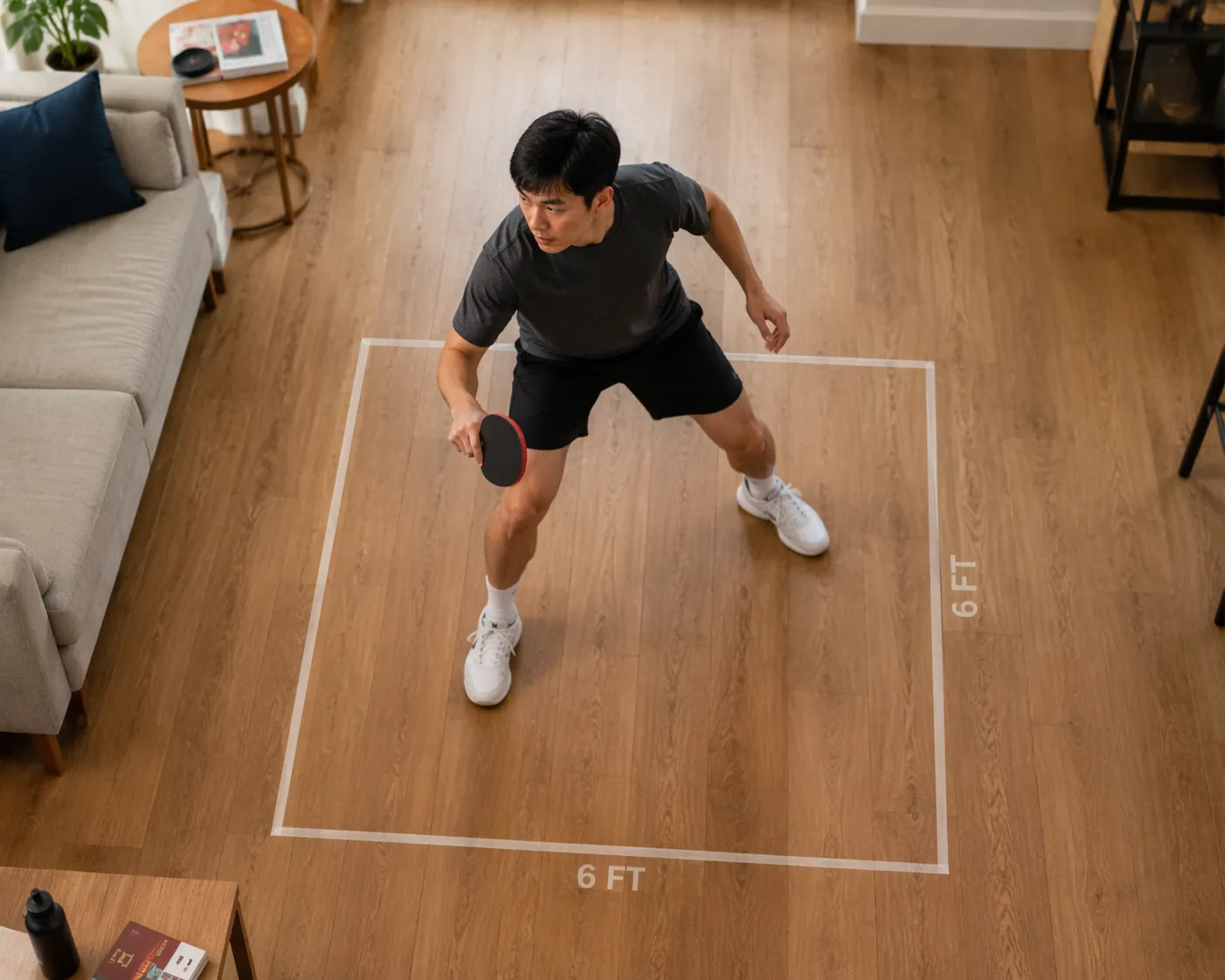
That does not mean idly tapping a ball for 20 minutes is suddenly a training plan. The workout starts to count when the paddle is only part of the job and the legs do enough work to keep breathing and heart rate up. A typical recreational table-tennis estimate for a 150-pound person is about 272 calories per hour, while more competitive play is often estimated around 400 to 500 calories per hour.[4][5] For a no-table apartment routine, 250 to 350 calories per hour is a reasonable working range if the session is interval-based, but it should be treated as an estimate, not a promise.
The difference between playing with a ball and doing the workout
The small-space version has to replace what a table normally gives you: rhythm, direction changes, recovery pressure, and a reason to move after every stroke. A wall can give you rhythm. Self-fed drops can give you reaction. Shadow footwork can give you lateral work. Serve practice can give you precision between harder intervals. None of those pieces is special on its own; the useful part is how they are arranged.
A decent beginner session can fit inside 20 to 30 minutes. The exact timing can change, but the body of the workout should alternate skill drills with footwork instead of letting every minute become stationary wrist flicking.
| Block | What you do | Why it matters |
|---|---|---|
| Warm-up | Easy paddle taps, arm circles, small side steps | Raises temperature without chasing the ball around the room |
| Wall rally intervals | Hit against a wall for timed rounds, resetting quickly after misses | Creates repeated strokes and light reaction pressure |
| Shadow footwork | Move side to side, forward and back, with forehand and backhand swings | Makes the legs carry the workout instead of the wrist |
| Self-fed drops | Drop the ball, let it bounce, move into position, and hit or catch-reset | Adds reaction and positioning without a partner |
| Serve or control practice | Use a desk, counter, or floor-safe target for controlled reps | Keeps the session technical while heart rate comes down slightly |
One clean way to run it is 40 seconds of work and 20 seconds of reset for each drill, repeated in rounds. If that sounds too tidy for a living room, it is still better than the usual apartment-cardio drift: start strong, get bored, check the phone, then decide the workout was “active enough.”
Wall rallies are useful only if you make yourself move
Wall practice is the obvious no-table drill because it gives the ball somewhere to come back from. Stand several feet from a clear wall, hit softly enough to control the rebound, and use the time after each contact to reset your feet. Home table-tennis guides commonly recommend wall practice as a solo method because it can build timing and repetition without a partner.[1][2]
For fitness, the mistake is standing square to the wall and letting the arm do everything. Instead, treat each hit as a reason to take a small recovery step. Hit forehand, recover to center. Hit backhand, recover to center. If the ball floats, step in. If it rebounds wider, shuffle across. The rally can be ugly and still useful if the feet keep answering the ball.
This is also where apartment reality shows up. A ping pong ball against drywall is not thunderous, but repeated wall strikes can still be irritating, and ball bouncing on a hard floor can travel downward. If the wall drill is noisy, move it earlier in the day, use a less resonant wall, stand on a rug or mat, or replace part of the block with shadow strokes. The quiet version is less charming, but it keeps the workout from becoming a neighbor problem.
Shadow footwork is where the heart rate usually comes from
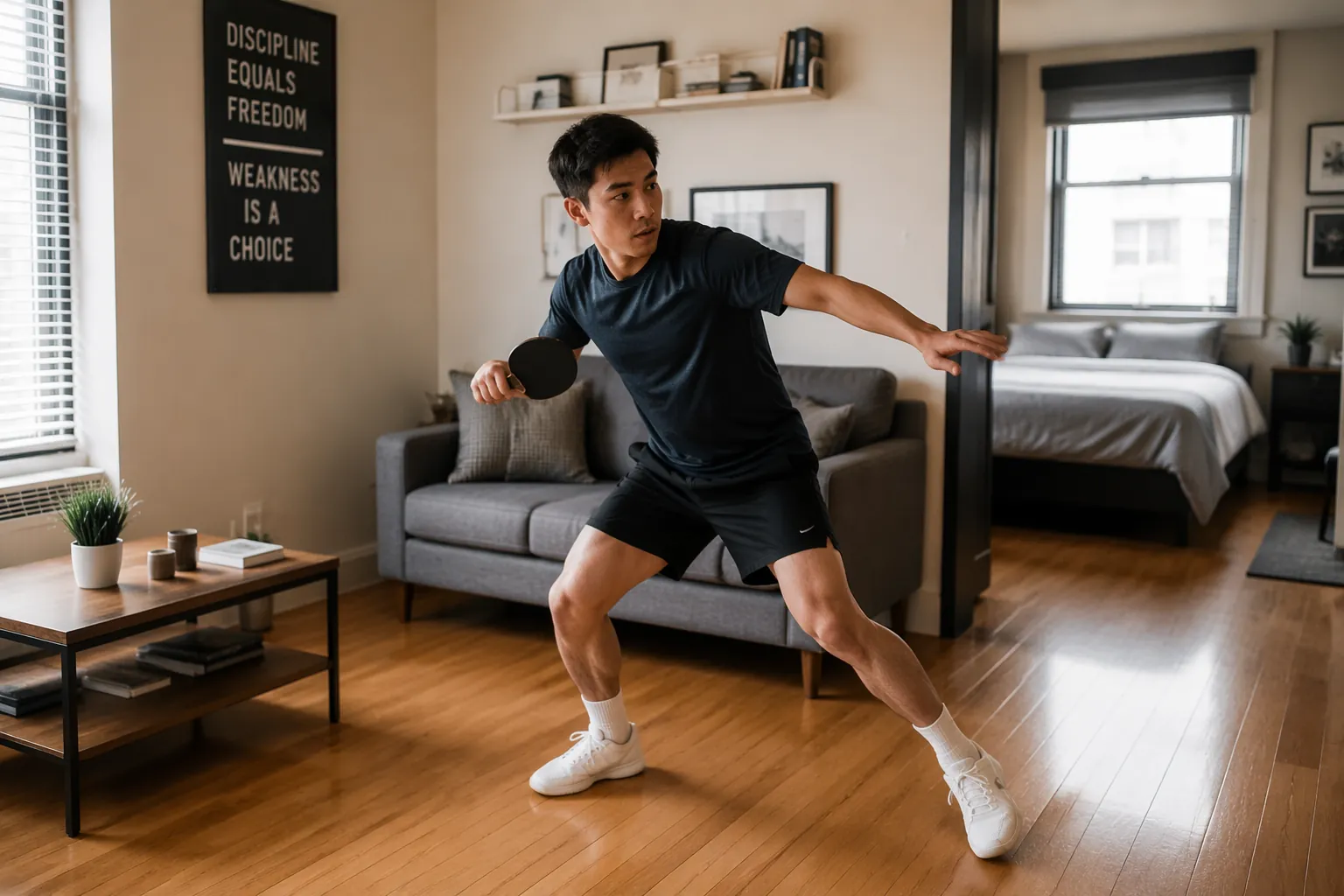
The least glamorous drill may be the most important one. Shadow footwork means moving through table-tennis patterns without needing the ball to behave: side shuffle, split step, forehand swing, recover, backhand swing, recover. Solo-practice resources describe ghost or shadow drills as a way to rehearse movement and stroke mechanics when practicing alone.[1][2][3]
In a 6-by-6-foot space, keep the steps short and springy rather than lunging to the edges. A practical pattern is three imaginary positions: left, center, right. Move left and swing, return center, move right and swing, return center, then take two small forward-back steps as if adjusting to a short ball. The paddle makes it feel like ping pong; the repeated change of direction makes it feel like exercise.
This block is also the easiest to scale. Beginners can slow the steps and focus on balance. Fitter readers can use shorter rests, add a deeper athletic stance, or alternate forehand-heavy and backhand-heavy rounds. No extra equipment improves this part very much; a timer does more than a gadget.
Self-fed drops and ball control keep it from becoming plain calisthenics
A self-fed drop is exactly what it sounds like: hold the ball, drop it, let it bounce, move into position, and strike it, catch it, or direct it toward a safe target. It is not as smooth as a partner feed, but it forces a small read-and-react moment. That little delay matters because it prevents the session from becoming a memorized dance with a paddle in hand.
Ball-bouncing drills fill the same gap at lower intensity. Bounce the ball on the paddle while walking in a small square, switch forehand and backhand sides, then add a squat or side step every few contacts. If the ball flies under the couch every third attempt, reduce the ambition. The point is continuous control, not proving you can juggle.
Serve practice belongs in the easier minutes. Use a table, desk, countertop, or floor-safe target only if it does not risk damage. Keep the reps short: toss, serve, recover, repeat. It will not carry the cardio load, but it gives the session a skill element and lets breathing come down before the next harder footwork or wall-rally block.
A small-space session that actually has a pulse
For someone starting from zero, the first goal is not a heroic hour. It is proving that a paddle-and-ball routine can stay continuous for long enough to feel like exercise. This 24-minute version uses the same few drills repeatedly, because variety is less important than not stopping every time the ball misbehaves.
- 3 minutes: warm up with easy paddle taps, shoulder circles, ankle rolls, and small side steps.
- 4 minutes: wall rallies in 40-second work / 20-second reset intervals.
- 4 minutes: shadow footwork, alternating left-center-right movement with forehand and backhand swings.
- 4 minutes: self-fed drops, moving into position before each hit or catch-reset.
- 3 minutes: serve or control practice on a safe surface or target.
- 4 minutes: repeat the hardest block from earlier, usually wall rallies or shadow footwork.
- 2 minutes: cool down with slow footwork, gentle swings, and breathing recovery.
If the session feels too easy, increase the density before increasing the drama: shorten rests, make the footwork cleaner, or add another round. If it feels chaotic, slow the ball down and keep the feet moving between misses. The workout should not depend on maintaining a beautiful rally.
Why the calorie estimate is plausible, not guaranteed
The 250-to-350-calorie estimate makes sense only when the no-table routine borrows the active parts of table tennis: repeated strokes, quick resets, lateral movement, and short recovery windows. Recreational table tennis is commonly estimated around 272 calories per hour for a 150-pound person, while competitive play is often placed higher, around 400 to 500 calories per hour.[4][5] A solo apartment session sits between “casual tapping” and actual match play depending on how much the legs are involved.
For aerobic training, the more useful test is whether the session gets you working around 70% to 85% of your estimated maximum heart rate during the harder blocks. That range is commonly used as a vigorous aerobic training zone, but a paddle does not magically put you there. Shadow footwork might. Wall rallies might. Standing still and bouncing a ball on the paddle probably will not.
There is supportive health context for table tennis, but it should be kept in its lane. A 2026 Nature study by Lin and colleagues reported that 12 weeks of supervised table-tennis training improved single-leg balance, reaction time, and grip strength in previously sedentary adults aged 55 to 65.[6] That is useful evidence that table-tennis training can challenge coordination and physical function in a specific supervised group. It does not prove that every unsupervised renter doing wall rallies at night will get the same outcomes.
What a full table would change, and why it is not required here
A full table gives better ball paths, real serves and returns, and a much more authentic version of the sport. It also asks for the kind of room many apartments simply do not have. Competitive table-tennis space recommendations are far larger than a living-room patch; practical casual setups can be tighter, but still demand a table, clearance, and storage that a studio renter may not want to negotiate.
The no-table routine gives up realism on purpose. It is not trying to preserve formal technique perfectly. It is trying to turn the cheapest pieces of the sport into a repeatable indoor cardio session. Later, a mini table or ball robot could make sense for someone who enjoys the format enough to build around it, but they are not the entry fee.
The apartment checks before you start
The best test is physical, not theoretical. Stand in the cleared area and take two quick steps left, two quick steps right, one step forward, and one step back. If furniture, lamps, pets, or a low coffee table turn that into a negotiation, the space is not ready yet.
- Use a clear 6-by-6-foot area if possible; keep shadow-only work smaller when space is tight.
- Choose a wall or target that will not mark, dent, or echo through the building.
- Wear shoes or use a surface that lets you pivot without slipping.
- Avoid hard late-night bouncing if someone lives below you.
- Keep spare balls nearby so one bad rebound does not stop the interval.
Anyone returning from injury or a long layoff should be more conservative with lateral shuffles and quick pivots. Recovery timelines vary, and the safest version may start with shadow strokes, slower steps, and shorter rounds before adding reaction drills. Readers easing back into movement can pair this with broader recovery guidance such as building a home routine after injury.
So yes: a paddle and ball can be enough to start a real small-space cardio workout. The condition is that the workout lives in the interval design and the footwork, not in the ping pong label. If the session keeps you moving, makes you breathe harder, and fits inside the patch of floor you actually have, the small-space version has done its job.
References
- How to Practice Table Tennis Alone, Aosom
- How to Practice Ping Pong Alone? Yes, It’s Possible!, SANWEI
- Entrenamiento de ping pong en casa: guía práctica, vsport-tt
- 12 Health Metrics That Improve With Regular Ping Pong Play, SPIN
- Hoe gezond is tafeltennis?, Heemskerk
- Lin et al. 2026 table tennis training study, Nature, 2026
What a small equipment investment adds
We don't have a build tagged to this exact tier yet. Browse all builds.
How often should you repeat this?
See our recovery and rest reference for citation-anchored rest-interval guidance.
Spot something off?
Tell us if a movement, tier assumption, or duration didn't match your experience.