
How Your Home Cycling Training Compares to Pogacar's
This article quantifies the real gap between Tadej Pogacar's training volume, power, and recovery and what a home cyclist can achieve on a smart trainer, then identifies which gaps are bridgeable with smart training alone.
- Equipment tier required
- $100-300
- Duration
- 60 min
- Difficulty
- intermediate
- Target area
- full body
The cleanest Tadej Pogacar training comparison for home cycling starts with the most unpleasant number: his reported Zone 2 is around 320–340 watts for five hours.[1] For a competitive amateur with an FTP near 3.5 W/kg, that “easy” ride can sit above threshold.[2][3]
That is the part nobody should soften. The gap is enormous. It is also not the most useful part of the comparison. A rider training 6–10 hours per week on a smart trainer cannot copy Pogacar’s engine, racing history, or staff-supported recovery environment. But the home rider can still reclaim a surprising amount of performance by fixing the boring parts: repeatable aerobic work, adequate carbohydrate intake, torque work, strength training, and recovery that is planned instead of hoped for.
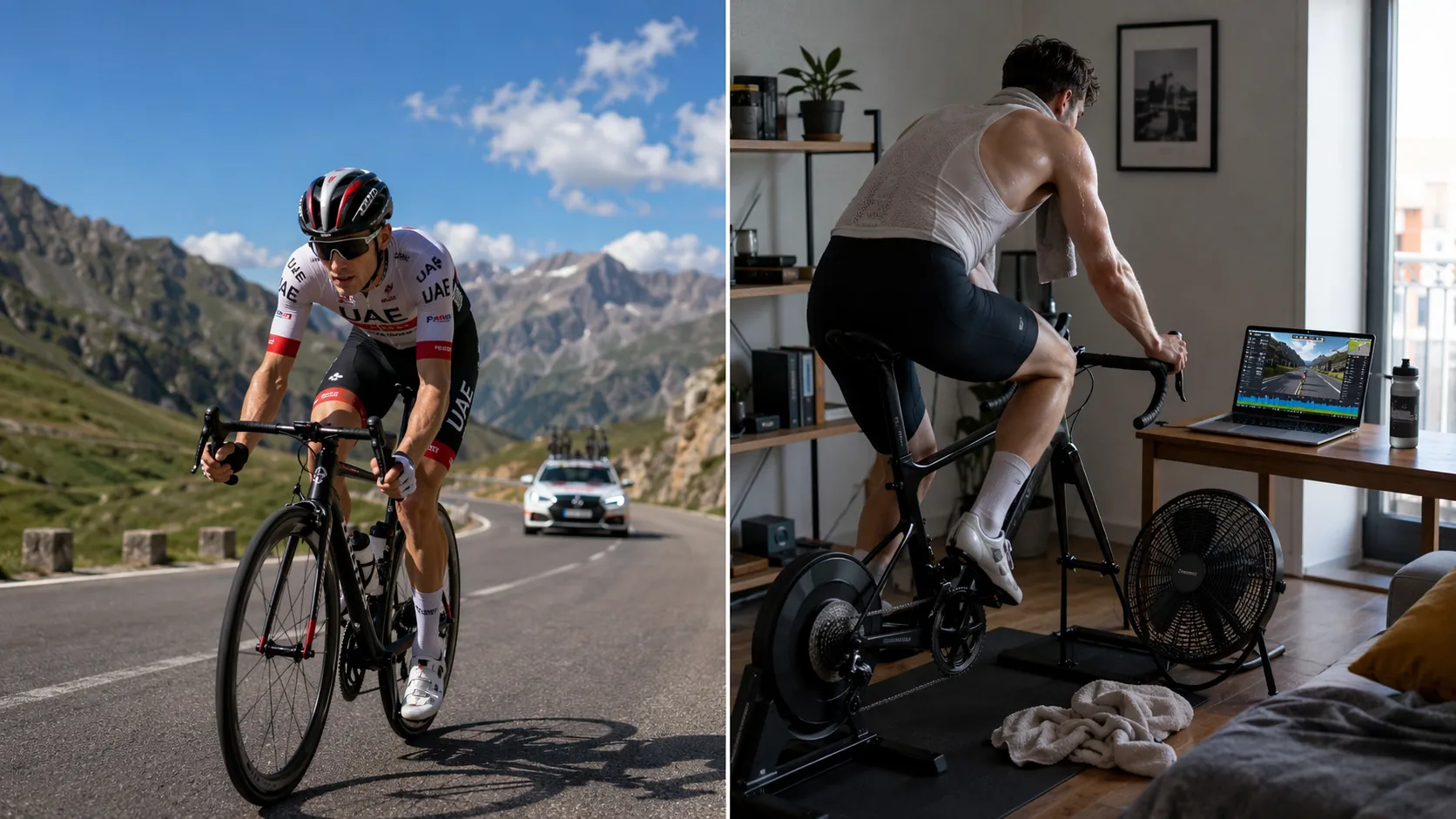
The comparison ledger: what is fixed, what is trainable
Pogacar’s exact FTP, VO2 max, weekly hours, and private training files are not public lab disclosures. The numbers below come from secondary reporting, team-insider comments, and reported estimates. They are useful because they describe the scale of the gap, not because they let anyone reverse-engineer a Tour de France winner.
| Training factor | Reported Pogacar / pro benchmark | Serious home cyclist reality | Can smart-trainer work narrow it? |
|---|---|---|---|
| Power ceiling | Pogacar’s FTP has been estimated around 6.6 W/kg.[2] | A competitive Cat 3 amateur is around 3.5 W/kg.[3] | Only partly. Structured training can raise FTP, but this is where talent, years, body composition, and elite physiology dominate. |
| Zone 2 power | Reported Zone 2: 320–340W for about five hours.[1] | For many strong amateurs, that power is near or above FTP. | Yes, in relative terms. The home rider should train Zone 2 by percentage of their own FTP, not by copying the wattage. |
| Weekly volume | UAE riders are reported by Jeroen Swart to train roughly 15–20 hours per week.[4] | USA Cycling describes serious amateurs around 8–12 hours per week.[5] | Partly. Indoor work is denser, and USA Cycling gives a rough guideline that one indoor hour can equal about 1.5 outdoor hours in stimulus, but it is not a magic conversion.[5] |
| Fueling | Pros target at least 60–90g carbohydrate per hour during hard training and racing, according to Swart’s comments reported by Cyclingnews.[6] | Many amateurs sit closer to 30–40g per hour, leaving sessions under-fueled.[6] | Yes. This is one of the easiest gaps to shrink immediately because it requires planning, not genetic luck. |
| Durability | Swart has said Pogacar loses less than 1% of fresh performance after 4,500 kJ of work.[6] | Many amateurs fade sharply after roughly 3,000–3,500 kJ.[6] | Partly. Long Zone 2, low-cadence torque intervals, gym work, and better fueling can improve late-session output, though the elite ceiling remains out of reach. |
| Recovery environment | A pro has training planned around food, sleep, massage, travel support, and no normal workday. | A home rider trains around work, family, neighbors, shared rooms, and limited daylight. | Partly. You cannot recreate a team environment, but you can stop treating recovery as leftover time. |
| Indoor transfer | Pogacar-specific home-trainer data is not public. | The home rider can control wattage, cadence, temperature, interval timing, and fueling with unusual precision. | Yes, for aerobic, threshold, torque, and heat-adaptation sessions. No, for bunch skills, descending, road handling, and race positioning. |
Do not copy the watts. Copy the relative work.
The reported 320–340W Zone 2 figure is useful because it kills fantasy transfer quickly.[1] A home cyclist does not need a “Pogacar Zone 2 ride” in absolute watts. They need their own Zone 2 ride, executed honestly, often enough, and fueled well enough that the next ride is not compromised.
On a smart trainer, that usually means setting aerobic endurance work around 70–75% of your current FTP, then holding it without drifting into tempo every time the playlist gets good. ERG mode is excellent for this because it removes the tiny negotiations: the trainer does not care that you feel fresh at minute 18 or impatient at minute 47.
This is where indoor cycling can be better than outdoor cycling for the time-limited rider. There are no stoplights, soft-pedaled descents, group-ride surges, or “just one more hill” decisions. A 75-minute ride can actually be 75 minutes of targeted work. That does not make it equal to a five-hour pro endurance ride. It makes it clean.
Volume: the smart trainer narrows the gap, but it does not erase it
The volume comparison is less dramatic than the wattage comparison, but it matters more for most home riders. UAE riders are reported to train around 15–20 hours per week, while USA Cycling’s guidance places serious amateurs around 8–12 hours per week.[4][5] That is a big gap, but not the cartoon version where a pro rides all day and an amateur can only spin twice after dinner.
USA Cycling also gives the commonly cited indoor-training guideline that one hour indoors can provide roughly the stimulus of 1.5 hours outdoors because the work is continuous.[5] This is helpful, especially for the apartment rider who can get a real session done before anyone else is awake. It is not a universal exchange rate. It does not apply neatly to sprint practice, bike handling, descending, group positioning, or sessions where heat stress turns the workout into survival.
Still, the conversion changes the emotional math. A rider doing 7–8 focused indoor hours per week may be getting something closer to the aerobic stimulus of a larger outdoor week, provided the sessions are actually controlled. That does not put them near a pro’s total load. It does mean the difference between “hopelessly behind” and “undertrained in specific, fixable ways.”
For a 6–10 hour home cyclist, the most defensible weekly pattern is not a copy of a Tour contender’s block. It is a smaller structure with fewer wasted minutes:
- Two to four Zone 2 rides at controlled power, usually 45–120 minutes depending on available time.
- One hard interval session, such as VO2 max or threshold work, not three heroic days in a row.
- One low-cadence torque session or hill-simulation workout if strength endurance is a limiter.
- One or two short strength sessions, especially in periods when cycling intensity is not already high.
- At least one deliberately easy or off day, because the work only counts if you can absorb it.
That is not glamorous. It is also the kind of week a smart trainer is built for: repeatable, measurable, and hard to lie about.
Fueling is the least glamorous gap and probably the fastest one to close
The under-fueling gap is more actionable than the FTP gap. Swart’s comments reported by Cyclingnews put pro carbohydrate targets at a minimum of 60–90g per hour during hard work, while many amateurs are closer to 30–40g per hour.[6] That difference can decide whether a rider thinks they lack fitness when they are actually running the same intervals on half a tank.

This is especially common indoors because the session feels contained. The bike never leaves the room, so it is tempting to treat a hard 75 minutes as something that can be handled with one bottle and whatever was eaten hours earlier. Then the last interval collapses, the next day’s Zone 2 feels heavy, and the rider blames the plan.
A practical home rule is simple: fuel hard sessions like they matter. If the ride includes threshold work, VO2 max work, long tempo, or more than about an hour of sustained aerobic load, carbohydrate should be part of the setup, not an emergency response. Put the bottles and gels on the table before clipping in. The fan, towel, laptop, and bottle line are not accessories; they are the indoor version of a feed zone.
There is no need to imitate a pro race-day intake immediately. The useful move is to stop chronically under-shooting. If a rider is used to 30g per hour, moving toward 60g per hour on demanding sessions is already a major behavioral change. The gut may need practice. The grocery list may need to change. But unlike a 6.6 W/kg FTP, this is not reserved for the genetically selected.
Durability is the hidden comparison
Fresh FTP is a clean number, which is why cyclists obsess over it. Durability is messier and often more important. Swart has said Pogacar loses less than 1% of fresh performance after 4,500 kJ of work, while many amateurs decline steeply after roughly 3,000–3,500 kJ.[6] That sub-1% figure is an insider claim, not an independent lab result, but the concept is still useful: elite riders do not just go harder; they keep more of their power after a large amount of work has already been done.
Home training can address durability better than many riders assume. The goal is not to reproduce a mountain stage in a spare room. The goal is to raise the point at which power, posture, fueling, and concentration begin to fall apart.
Low-cadence torque work
Velo’s reporting on Pogacar’s seated attacks connects his strength development to gym work and torque-focused preparation.[7] For a home cyclist, the transferable version is controlled low-cadence work: seated intervals around 40–50 rpm at a sustainable but demanding intensity, with stable hips and no wrestling the bike.
This should feel like strength endurance, not a knee-stress contest. A smart trainer makes it easy to keep the power steady while cadence drops. Start conservatively, especially if you have knee history, and separate these sessions from the hardest VO2 work when fatigue is high.
Strength training without pretending the living room is a team gym
The home version of cycling strength work does not need to be elaborate. Squat and hinge patterns, split-leg work, calf strength, trunk stability, and progressive loading are enough for many riders. The main mistake is adding gym work as punishment on top of an already overloaded week. Strength should support the bike, not quietly ruin the next three rides.
Longer aerobic pressure
Durability also comes from boring aerobic accumulation. If all indoor rides are 45-minute intensity snacks, the rider becomes good at 45-minute intensity snacks. Extending one weekly Zone 2 ride, even modestly, teaches pacing, fueling, contact-point management, and mental steadiness under low drama. That is the closest thing most home riders have to a durability laboratory.
Polarized intensity works because it protects the easy work
The home cyclist’s enemy is not laziness as often as it is compression. When life leaves room for only a few rides, every ride starts to feel like it must prove something. Zone 2 creeps into tempo. Threshold turns into a failed VO2 session. Recovery rides become “just a little opener.”
A polarized approach is useful indoors because the trainer can enforce separation. Easy days stay easy enough to repeat. Hard days become hard enough to create a signal. The precise distribution does not need to become a religion for the 6–10 hour rider, but the principle matters: most of the week should not sit in the gray middle just because ERG mode makes discomfort tidy.
This is one place where copying a single pro workout can actively mislead. A Pogacar interval set exists inside years of volume, huge fueling support, and carefully managed recovery. Pulled out of that system and dropped into a week with poor sleep and a rushed dinner, it becomes a screenshot with consequences.
Heat training: possible in a small room, easy to overdo
Heat adaptation is one of the few pro-style interventions that a home cyclist can accidentally create just by turning the fan down. Swart has described heat-training sessions of 45–75 minutes on the trainer without a fan, targeting a core temperature around 38.5°C.[2] That does not mean every apartment rider should start cooking themselves twice a week between the laundry basket and the desk.
The indoor room is already a thermal trap. Heat work can add stress without adding mechanical load, which is why it is powerful and why it can go wrong. If used at all, it belongs in controlled, lower-intensity sessions, with hydration planned, cooling available, and no pride attached to finishing when symptoms say stop. Riders with medical risks, heat illness history, or poor cooling conditions should treat this as a specialist tool, not a default upgrade.
The safer everyday lesson is simpler: manage temperature deliberately. Use a strong fan for quality intervals. Accept that heart rate will drift if the room heats up. Do not compare a July apartment threshold session to a cool-weather outdoor test and call the difference lost fitness.
Recovery is where the pro advantage is least visible and most decisive
The pro recovery environment is not just massage tables and better mattresses. It is the absence of many ordinary interruptions. A WorldTour rider’s day can be arranged around training and adaptation. A home cyclist may finish intervals, wipe sweat off the floor, answer work messages, cook dinner, and try not to wake anyone with the shower.
That difference matters. It also points to a fixable category. The home rider cannot add a team chef, but they can prepare post-ride food before the session. They cannot sleep like training is their job every night, but they can stop stacking the hardest ride after the worst night. They cannot get daily bodywork, but they can schedule easy days as training days instead of moral failures.
Recovery discipline is not a motivational trait. It is logistics. Bottles filled before the ride. Carbs within reach. A fan powerful enough to keep intervals honest. Easy rides kept easy. A weekly plan that admits when life has already supplied the stress.
A realistic home-training version of the pro system
A serious home cyclist does not need a miniature WorldTour program. They need the pieces that survive contact with a spare corner, a loud fan, and a normal week. The comparison points toward a practical hierarchy:
- Set FTP honestly, then base endurance power on your own zones rather than pro wattage.
- Use ERG mode for controlled Zone 2 at roughly 70–75% FTP, especially when the goal is aerobic accumulation rather than entertainment.
- Keep intensity polarized enough that easy work stays repeatable and hard work stays high quality.
- Fuel demanding sessions before performance drops, moving toward pro-style carbohydrate availability instead of under-fueling by habit.
- Build durability with one longer aerobic ride, low-cadence torque intervals, and strength work that does not sabotage the bike week.
- Treat heat as a controlled stressor, not proof of toughness.
- Plan recovery with the same seriousness as intervals, because adaptation still has to happen in the body you bring to the next session.
If you want one rough working frame, most of the performance a home rider leaves unused is structural: inconsistent aerobic volume, too much gray-zone intensity, poor fueling, weak durability work, and recovery that depends on luck. That is not a precise scientific partition, and it does not shrink the genetic gap between a strong amateur and Pogacar. It does, however, keep the comparison from becoming useless worship.
You cannot copy Pogacar’s engine. You can copy the parts of the system that are portable: controlled work, enough carbohydrate, repeatable endurance, strength that supports the pedals, and recovery that is built into the week. For the home cyclist, that is where the real gap starts to close.
References
- Roadman Cycling, reported analysis of Tadej Pogacar Zone 2 power
- 11 Ways to Train More Like Tadej Pogačar, Cycling Weekly
- How much better are pro cyclists than amateurs?, Cyclist
- What Pro Cyclists Actually Say About Amateur Training, Cycling Weekly
- Get The Most Out of Your Indoor Bike Trainer, USA Cycling
- Jeroen Swart interview on Pogacar fueling and durability, Cyclingnews
- How Pogačar Built His Seated Attacks in the Weight Room, Velo
What a small equipment investment adds
We don't have a build tagged to this exact tier yet. Browse all builds.
How often should you repeat this?
See our recovery and rest reference for citation-anchored rest-interval guidance.
Spot something off?
Tell us if a movement, tier assumption, or duration didn't match your experience.