
5 Under-$2 Lunches Your Kid Can Eat 30 Minutes After a Home Workout
Five budget-friendly, whole-food lunch combos that deliver the protein and carbs active kids need after a home workout — each ready in 15 minutes and under $2 per serving.
- Equipment tier required
- none
- Duration
- 30 min
- Difficulty
- beginner
- Target area
- full body
The awkward moment after a kid’s home workout is not usually a sports-science problem. It is 12:18 p.m., the yoga mat is still on the living-room floor, someone is sweaty and hungry, and the fridge has eggs, milk, leftovers, maybe a can of beans, and one banana with a bruise. That is exactly where an affordable healthy lunch for an active kid has to work: fast, ordinary, and cheap enough to repeat.
For post-exercise recovery, Nationwide Children’s Sports Medicine gives a simple target: at least 20 grams of protein plus carbohydrate after exercise, ideally within 15 to 60 minutes.[1] That benchmark is useful, but it should not be treated as if every child has the same body or did the same workout. A 14-year-old who just finished a hard garage circuit needs more than a 6-year-old after virtual PE. For younger or smaller kids, the more precise range is usually scaled by body weight, and the next normal meal may be enough after a moderate session.
The expensive part is often optional. Nationwide Children’s and Jump IN for Healthy Kids both say water is enough for activity under 60 minutes, which covers many home workouts: bodyweight circuits, family HIIT, treadmill walks, dance videos, and school-assigned movement breaks.[1][2] A protein bar or sports drink can be convenient in the car between games. It is much less compelling when the kitchen is ten steps away.
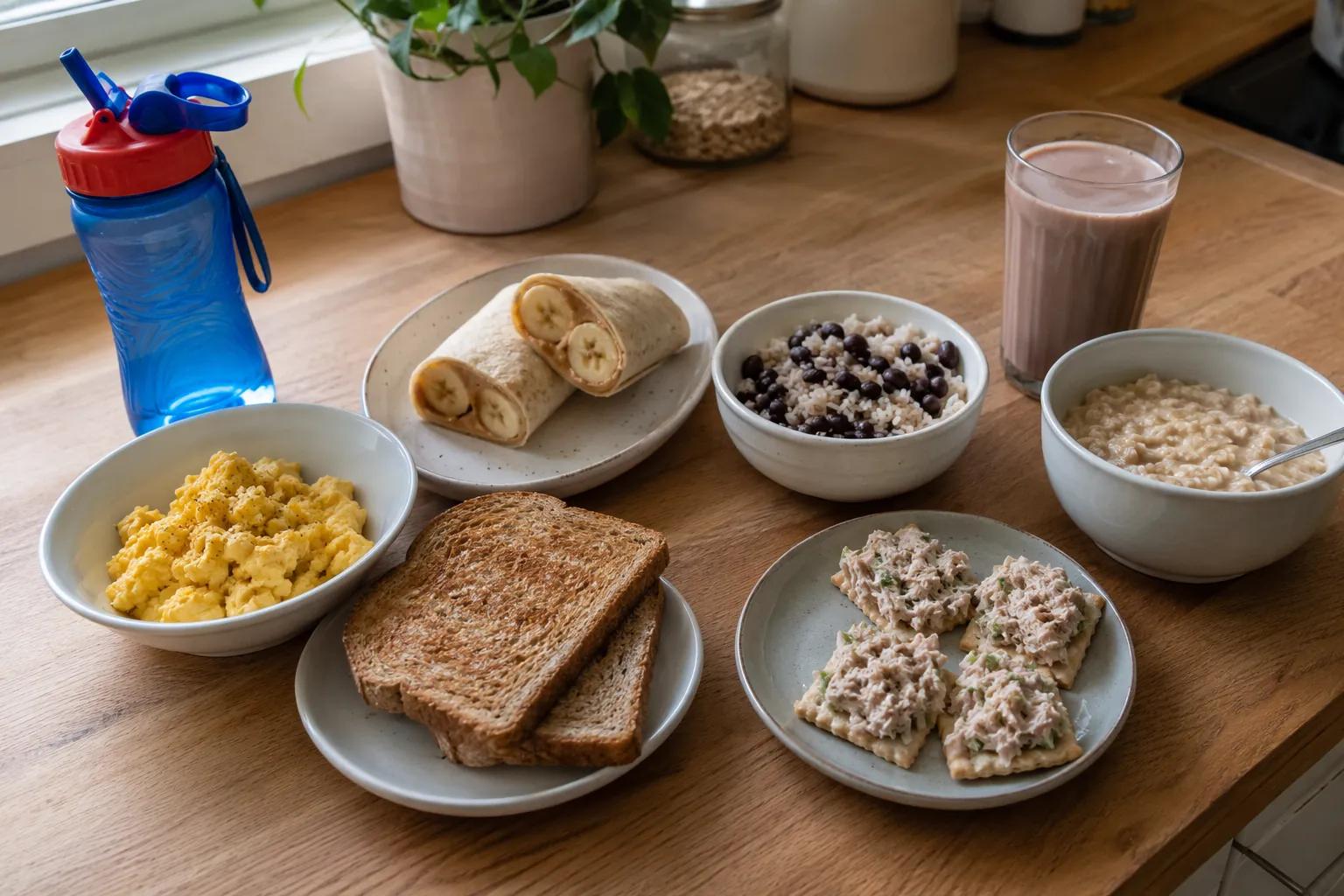
What a post-home-workout lunch needs
A good recovery lunch for an active kid does not need to look like a shake bottle. It needs protein for muscle repair, carbohydrate to refill some of the energy used during exercise, fluid, and ideally fruit or vegetables. If the workout was short and moderate, there is no need to panic over a perfect 30-minute window. Nicklaus Children’s notes that after a single moderate workout, recovery eating can stretch into the next full meal over the following few hours.[3]
Cost estimates here are deliberately rough. Grocery prices move by store, region, package size, and week. The point is not that one egg costs the same everywhere; it is that pantry foods can do the same recovery job as a $2 to $4 protein bar without turning lunch into a specialty purchase.
| Lunch | Approx. cost | Prep time | Protein | Carbohydrate source |
|---|---|---|---|---|
| 3-egg scramble on whole-wheat toast + banana | ~$0.75 | 10 minutes | ~20g | Toast + banana |
| Black beans + rice + frozen vegetables + cheese | ~$1.10 | 10-15 minutes | ~22g | Rice + beans |
| Tuna-yogurt salad on whole-grain crackers + apple | ~$1.50 | 10 minutes | ~24g | Crackers + apple |
| Peanut butter-banana wrap + milk | ~$0.90 | 5 minutes | ~18-20g | Tortilla + banana + milk |
| Chocolate milk overnight oats with peanut butter + chia | ~$0.80 | 5 minutes active prep | ~20g | Oats + chocolate milk |
Five lunches that beat a recovery bar on price
1. Three-egg scramble on whole-wheat toast with a banana
Scramble three eggs, put them on whole-wheat toast, and add a banana. That is the whole lunch. Eggs are one of the budget proteins highlighted by the American Academy of Pediatrics’ HealthyChildren.org budget-shopping guidance, and a typical $2 to $4 dozen puts this plate at roughly 75 cents.[4]
Three eggs bring about 18 grams of protein, and the toast nudges the meal to roughly the 20-gram recovery target. The toast and banana provide the carbohydrates. The banana also solves a second problem without effort: Cleveland Clinic, citing CDC data, notes that nearly two-thirds of adolescents do not eat whole fruit daily.[5] One banana after a workout will not fix national fruit intake, but it is a useful, cheap place to put fruit when a child is already ready to eat.
This is the lunch for the day when cooking has to be real but minimal. If three eggs are too much for a younger child, two eggs plus milk or yogurt on the side may fit better. If the child is bigger, hungrier, or coming off a harder circuit, add a second slice of toast or another piece of fruit.
2. Black beans, rice, frozen vegetables, and cheese
This bowl is for the fridge with leftover rice. Warm rice, canned black beans, and frozen mixed vegetables together, then add a little shredded cheese. Children’s Health lists beans among useful protein foods for young athletes, and canned beans provide about 15 grams of protein per cup with a typical can price around $0.79 to $1.29.[6]
The recovery logic is plain: beans and cheese supply protein, rice supplies carbohydrate, and frozen vegetables add volume and micronutrients without chopping. It is also forgiving. If the rice is already cooked, this is a microwave lunch. If there is no cheese, use a larger bean portion. If the child wants it less bowl-like, fold the same filling into a tortilla.
For many home workouts, this bowl is more lunch than “recovery protocol,” which is a good thing. It behaves like food, not a product.
3. Tuna-yogurt salad on whole-grain crackers with an apple
Drain a can of tuna, mix it with plain Greek yogurt instead of mayo, and spoon it onto whole-grain crackers. Add apple slices. The tuna does most of the protein work, the yogurt adds a little more, and the crackers and apple cover the carbohydrate side of the meal.
At roughly $1.50 per serving and about 24 grams of protein, this is the strongest protein lunch on the list without using powder. It is also the one most likely to depend on the child. Some kids will happily eat tuna after a workout; others will treat the smell as a household emergency. If tuna is a hard no, the same cracker-and-fruit structure can work with egg salad or leftover chicken, though the cost and protein will change.
The apple matters because this kind of lunch can otherwise become all protein and crunch. Fruit is not decoration here; it helps make the recovery meal complete and easier to eat.
4. Peanut butter-banana wrap with milk
Spread peanut butter on a whole-wheat tortilla, roll it around a banana, and pour a glass of milk. This is the fastest lunch here, and it is the one that looks most like something a child might have asked for anyway.
It needs one small caveat: depending on the tortilla, peanut butter amount, and milk serving, this combo may land around 18 grams of protein rather than a clean 20. A full cup of milk usually helps carry it closer to the target; for an older child after a harder workout, add a second small glass of milk, a spoonful of Greek yogurt on the side, or a little more peanut butter if that fits the household’s budget and appetite.
This is not the best choice for a child who needs a large, savory lunch. It is a good choice when lunch has to happen in five minutes and the workout was moderate. The banana and tortilla handle carbohydrates, milk brings fluid and protein, and peanut butter makes the meal stick longer than fruit alone.
5. Chocolate milk overnight oats with peanut butter and chia
This one works best if it is made before the workout, or the night before. Stir rolled oats, chocolate milk, peanut butter, and chia seeds in a jar or bowl. By lunch, it is cold, sweet, and ready. If the child wants it warm, microwave it in a bowl.
Chocolate milk deserves context because it is easy to oversell. TrueSport describes 16 ounces of chocolate milk as a recovery option with about a 4:1 carbohydrate-to-protein ratio, and the serving cost is usually around $0.40 to $0.60.[7] That makes it useful after aerobic-style work or a longer active session. TrueSport also notes that for higher-intensity workouts, a 3:1 ratio may be a better fit.[7]
In oats, chocolate milk becomes less like a magic recovery drink and more like a cheap ingredient. The oats add carbohydrates and fiber, peanut butter adds protein and fat, and chia helps the bowl thicken. The result can reach about 20 grams of protein without asking a child to drink a supplement.
When to adjust the formula
Home workouts vary too much for one lunch rule to fit every child. A 25-minute beginner bodyweight video, a sweaty 45-minute garage circuit, and a two-hour sports practice are not the same recovery situation. The lunch can stay simple, but the portion should move.
- For a younger or smaller child: use the same foods, but do not force the full adult-looking portion just to hit 20 grams.
- For an older child or harder workout: increase the carbohydrate first with more rice, toast, oats, fruit, or a tortilla.
- For activity under 60 minutes: start with water, not a sports drink, unless there is a separate medical or heat-related reason.
- For back-to-back practices or multiple sessions in a day: the 30-minute recovery window matters more than it does after one moderate home workout.
- For picky eaters: keep the protein-carbohydrate-fluid pattern and swap the food, rather than arguing over the exact lunch card.
The common thread is not a perfect sports-nutrition plate. It is a repeatable lunch: protein, carbohydrate, fluid, and some produce, scaled to the child and the workout. Most families can do that with eggs, beans, tuna, oats, peanut butter, milk, fruit, and water before they need a bar, powder, or recovery drink.
References
- Fueling and Hydrating Before, During and After Exercise, Nationwide Children’s Hospital, https://www.nationwidechildrens.org/specialties/sports-medicine/sports-medicine-articles/fueling-and-hydrating-before-during-and-after-exercise
- Healthy Eating for Kids Before and After Sports Practice & Games, Jump IN for Healthy Kids, https://blog.jumpinforhealthykids.org/healthy-eating-for-kids-before-and-after-sports-practice-games/
- Recovery Nutrition, Nicklaus Children’s Hospital, https://www.nicklauschildrens.org/patient-resources/blog/2020-blog-posts/recovery-nutrition
- Feeding Your Family Right on a Budget: How to Plan and Shop Smart, HealthyChildren.org, https://www.healthychildren.org/English/healthy-living/nutrition/Pages/feeding-your-family-right-on-a-budget-how-to-plan-and-shop-smart.aspx
- Healthy Children’s Lunch Ideas, Cleveland Clinic, https://health.clevelandclinic.org/healthy-childrens-lunch-ideas
- Fueling Your Athlete, Children’s Health, https://www.childrens.com/health-wellness/fueling-your-athlete
- Post-Workout Fueling, TrueSport, https://truesport.org/nutrition/post-workout-fueling/
What a small equipment investment adds
We don't have a build tagged to this exact tier yet. Browse all builds.
How often should you repeat this?
See our recovery and rest reference for citation-anchored rest-interval guidance.
Spot something off?
Tell us if a movement, tier assumption, or duration didn't match your experience.