
Prepare Your Home Workout for Extreme Heat
Learn how to safely exercise at home during a heat wave with three layers of preparation: managing your workout room's temperature, adjusting your routine based on heat-index thresholds, and using proven cooling and hydration strategies from sports science.
- Equipment tier required
- none
- Duration
- 20 min
- Difficulty
- beginner
- Target area
- full body
- Space footprint needed
- small
- Noise level
- low
The awkward part of extreme heat preparation for home workouts is that “indoors” is not one condition. Your living room may be tolerable while the bedroom corner where you train is ten minutes away from feeling like a laundry closet. A closed door, one west-facing window, a laptop streaming the class, a mat over carpet, and your own heat production can turn a small room into a separate heat zone before the thermostat in the hallway notices anything.
That is not just a comfort problem. HVAC professionals describe exercise rooms as spaces that heat faster because workouts add body heat, equipment can add heat, and poor return airflow or closed doors keep that load trapped in the room rather than moving it through the rest of the home.[1] For a renter without central AC, or anyone training in a spare bedroom with one fan and a door that stays shut for noise, this is the part most generic heat advice skips.
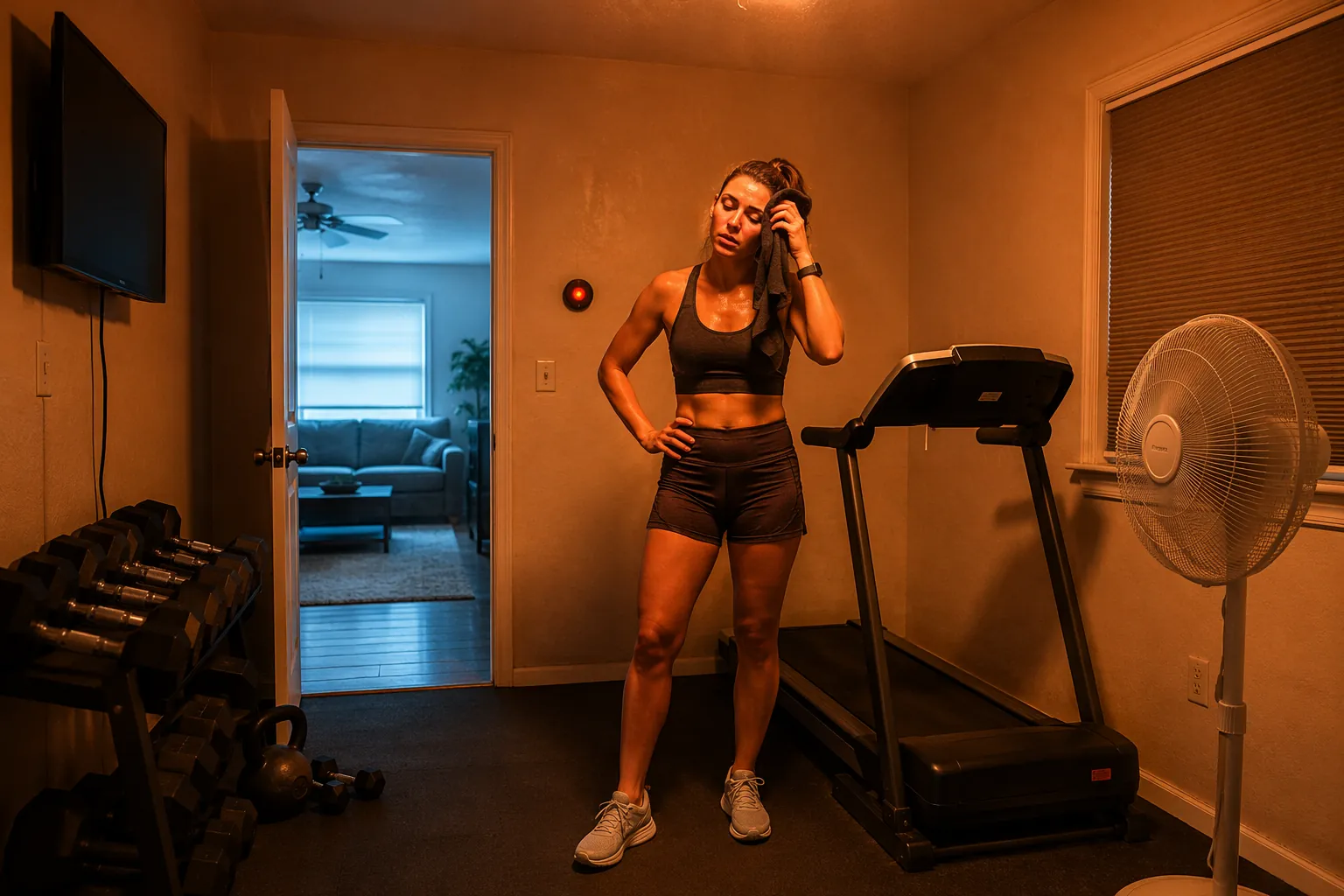
The first check, then, is not whether the weather app says it is hot outside. It is whether the exact room where you plan to train can stay within a reasonable range once you start moving. Put a thermometer in the workout area, not near the apartment entry, kitchen, or hallway thermostat. Let it sit where your body will actually be: near the mat, bike, bench, or step platform. If you use a fan, measure with the fan running and the door in the position you normally use.
Treat the workout room as its own heat zone
A home workout room needs a pre-check the same way a kitchen needs the oven checked before baking. The room can be hotter than the rest of the home, and it can keep getting hotter during the session. The smaller and more sealed the room, the less useful whole-home comfort feels as a safety signal.
- Measure the actual training spot before the workout, then again after five to ten minutes of easy movement.
- Open an airflow path if it cools the room: door open, interior door cracked, window positioned for cross-breeze, or fan placed to move cooler air in or warmer air out.
- Reduce heat sources you do not need: direct sun through blinds, unnecessary lights, gaming consoles, or extra screens.
- Move the workout to the coolest usable room, even if that means abandoning the “home gym” for a hallway, shaded living room, or tile-floor space.
- Keep the session solo-safe: phone nearby, water reachable, and enough floor space to sit or lie down quickly if symptoms start.
The fan deserves special attention because it can feel helpful while making a hot room more deceptive. The CDC says electric fans may provide comfort when indoor temperatures are below 90°F, but once temperatures are above 90°F, fans may increase body temperature instead of cooling you.[2] In a small workout room, that threshold matters. A fan pointed at your face during burpees may be moving hot air over skin that is already struggling to dump heat.
If the fan is pulling cooler air from another room or pushing hot air out a window, it may still be part of the room setup. If it is only stirring a sealed, 90°F-plus room, do not treat the breeze as permission to train hard. The difference is airflow that changes the room versus airflow that only makes the room feel less still.
Use thresholds before you choose the workout
Once the room is measured, the workout has to earn its place. A heat wave is not the day to open a random HIIT video and hope you will notice trouble early. The CDC’s exercise heat guidance uses heat index categories to frame risk, with caution beginning around 80°F to 90°F, extreme caution around 90°F to 103°F, and danger above 103°F.[3] Those values are usually discussed for outdoor activity, but they are still useful for home training because the stress on the body is the point: temperature, humidity, exertion, and cooling capacity are interacting.
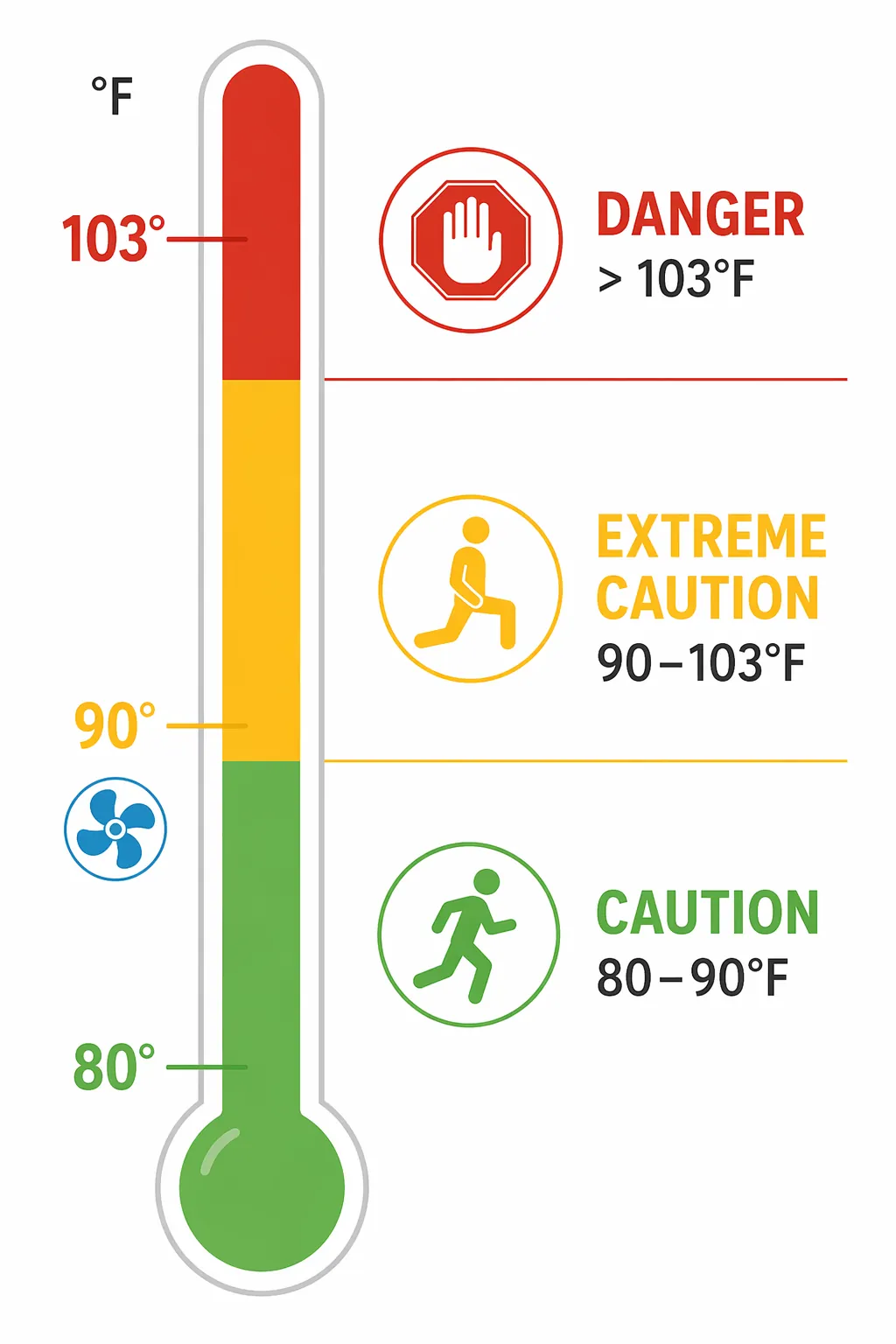
| Measured condition | Home-workout decision |
|---|---|
| Room below 80°F and cooling stays stable | Proceed with the planned workout if hydration and cooling supplies are ready. |
| 80°F to 90°F heat-index range or room temperature creeping upward | Shorten the session, reduce intensity, extend rest, and avoid all-out intervals.[3] |
| Above 90°F indoors | Do not rely on a fan for safety; switch to a cooler room, a very light session, or skip hard training.[2] |
| 90°F to 103°F heat-index range | Use extreme caution: choose low-impact, slower work and stop if the room keeps warming.[3] |
| Above 103°F heat-index range | Treat hard exercise as a no-go; cooling the room or skipping is the safer modification.[3] |
The practical swap is simple: remove the movements that create the most heat fastest. Jump squats, burpees, mountain climbers, sprint intervals, and dense circuits with short rests produce a lot of metabolic heat in a room that may already be failing to cool you. Walking lunges, step-ups at a controlled pace, slower tempo strength work, mobility, Pilates-style floor work, or an easy zone-style ride with long rests can keep the habit alive without pretending the room is normal.
Timing often beats toughness. Early morning usually gives the room its best chance because the walls, floor, and furniture have not spent the whole day storing heat. Late evening can work if the room has actually cooled, not just because the sun is down. In apartments, the room may lag behind outdoor temperature, especially after a hot afternoon. Measure again instead of guessing.
A quick decision flow before pressing play
- Check the actual room temperature and, if possible, humidity or local heat-index conditions.
- Ask whether the room can cool during exercise, not just whether it feels acceptable at rest.
- Downgrade first by intensity, then by duration, then by exercise type.
- If the room temperature crosses the fan warning threshold or moves into danger conditions, stop trying to rescue a hard workout.
- If you are training alone and feel uncertain, choose the version that would still be safe if no one checked on you for a while.
This is where “listen to your body” is too soft on its own. Heat illness can develop while a person is still trying to finish the set, the video, or the planned time. The CDC lists warning signs including heavy sweating, cold or clammy skin, fast or weak pulse, nausea or vomiting, muscle cramps, dizziness, headache, confusion, loss of consciousness, and very high body temperature.[2] Those signs are not a cue to lower the music and push through the last round. They are a cue to stop, cool, and get help when symptoms are severe or do not improve.
Prepare cooling and fluids before you sweat
Cooling supplies belong on the counter before the workout starts, not as a panicked scavenger hunt after you feel wrong. Mass General Brigham’s heat-exercise guidance, citing American Council on Exercise recommendations, gives a practical hydration schedule: drink 17 to 20 ounces several hours before exercise, 8 ounces 20 to 30 minutes before exercise, and 4 to 8 ounces every 15 to 20 minutes during exercise.[4] That does not mean forcing water past comfort, but it does give a better starting point than “drink when you remember.”
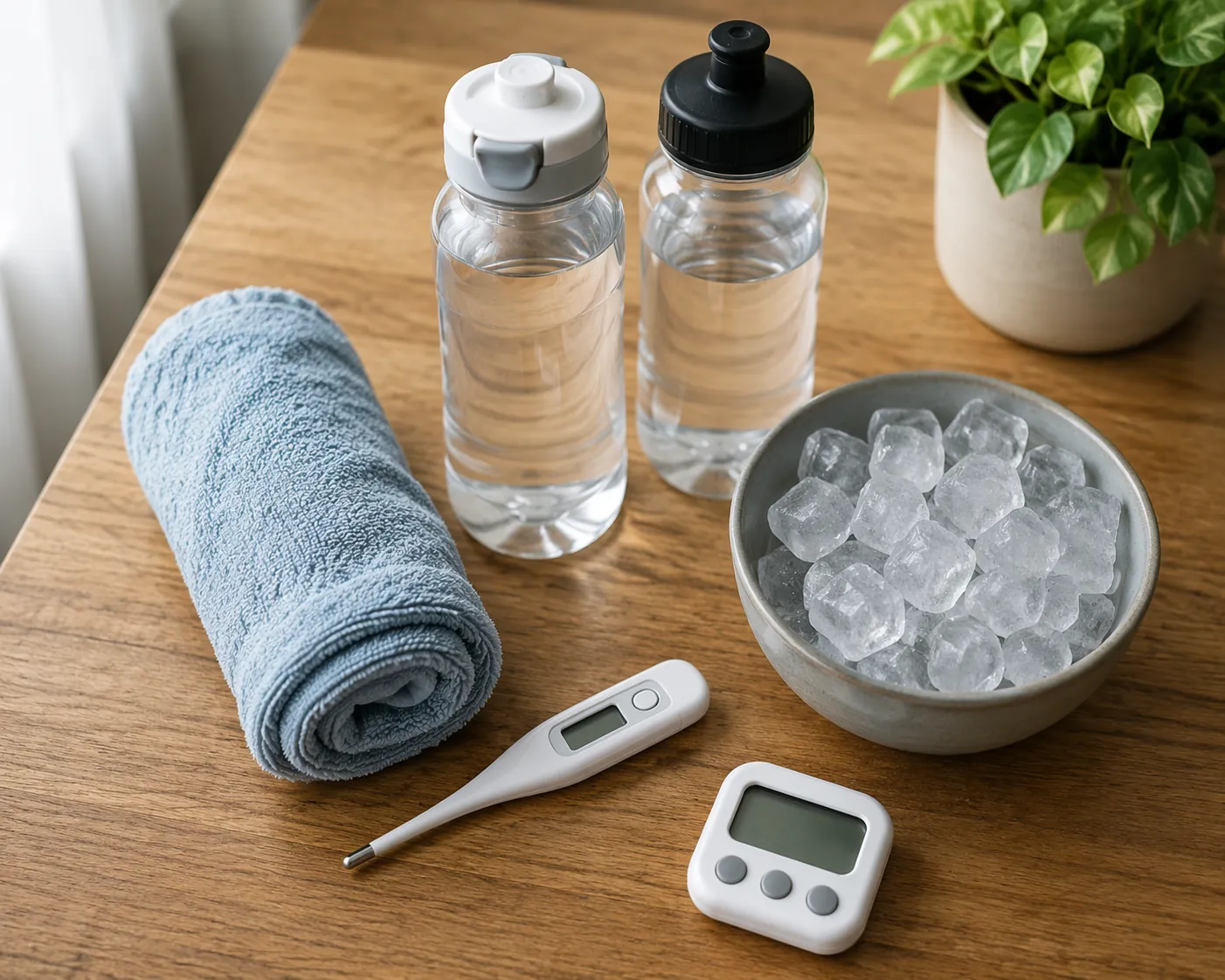
A home setup does not need to imitate a sports lab. It needs to make cooling easy enough that you actually use it. Put a cold damp towel in the refrigerator or a bowl of ice water. Set one bottle where you train and another where you recover. If the room is borderline, set a timer for drinking breaks rather than relying on thirst while following a class.
The Korey Stringer Institute describes pre-cooling and cooling strategies that include ice slurry ingestion, cold towels, and cold-water immersion approaches such as hand or forearm cooling.[5] For a home exerciser, the useful translation is modest: a cold drink before training, a towel for the neck or underarms during breaks, and a sink or bowl for hands and forearms if you need to bring heat down quickly. These are not decorations. They are ways to increase your cooling options when the room is not helping.
- Before: drink on schedule, chill a towel, fill bottles, and place the thermometer where you can see it.
- During: drink at planned intervals, use longer rest periods, and cool the neck, underarms, hands, or forearms if heat is building.
- After: keep cooling until breathing and skin temperature feel normal, and do not move straight from a hot workout room into a hot shower.
People at higher heat risk should set the bar lower. The CDC identifies higher-risk groups for heat-related illness, including older adults, young children, people with certain medical conditions, people taking some medications, and those without reliable cooling access.[2] If that describes you, or if you are returning to exercise after time off, the safer home workout during a heat wave may be a short mobility session in the coolest room, not a scaled version of the hardest class you normally do.
Acclimation helps, but it is not a home-gym permission slip
There is a real difference between being completely unaccustomed to heat and gradually adapting to it. BBC Future describes a one-week ramp for exercising safely in hot weather, while the American Heart Association says it can take 4 to 14 days to adapt to warm-weather activity.[6][7] That matters for the first heat wave of the season, after travel, after illness, or after weeks of training mostly in cool indoor conditions.
The sports-science literature is stronger for trained athletes than for a person doing a solo video workout in an apartment. A 2018 review on heat acclimation reported improvements of about 23% in time to exhaustion, about 7% in time-trial performance, and about 6% in VO2max after heat acclimation, but those figures come from performance-oriented research, not a guarantee that a home exerciser can safely push harder in a hot bedroom.[8]
For home workouts, acclimation is best treated as a reason to start smaller, not as a badge. Begin with shorter, easier sessions in the cooler part of the day. Keep perceived effort below normal. Stop while you still feel in control. If the room gets hotter each day, you are not adapting to a stable condition; you are adding environmental load.
The go/no-go standard
Some home workouts can continue during extreme heat. The version that survives is usually less dramatic: earlier, shorter, slower, better ventilated, and built around cooling breaks. A strength session with longer rests in the coolest room may make sense. A jump-heavy HIIT class in a sealed bedroom with a fan blowing 92°F air probably does not.
Use three checks. The room has to pass: measured temperature, airflow, and a cooling path that actually changes the space. The routine has to pass: intensity, duration, and exercise selection adjusted to the heat-index range rather than copied from a normal day. Your body-cooling plan has to pass: fluids ready, cold tools ready, and a clear stop point if symptoms begin.
If one layer fails, reduce the workout sharply. If two layers fail, make it a recovery day. If the room is too hot, the fan threshold is crossed, danger-level heat conditions apply, or you cannot prepare cooling and hydration before starting, skipping the hard session is not lost discipline. It is the preparation doing its job.
References
- “Why Exercise Rooms Get Hot Faster Than Other Rooms.” Meyer & Depew HVAC.
- “About Heat and Your Health.” CDC.
- “Heat and Athletes.” CDC.
- “Stay Safe Exercising in the Heat.” Mass General Brigham.
- “Heat Acclimatization.” Korey Stringer Institute, UConn.
- “How to exercise safely in hot weather.” BBC Future, June 2026.
- “How to Be Active Safely in Warm Weather.” American Heart Association.
- “Application of evidence-based recommendations for heat acclimation.” Pryor et al., 2018.
What a small equipment investment adds
We don't have a build tagged to this exact tier yet. Browse all builds.
How often should you repeat this?
See our recovery and rest reference for citation-anchored rest-interval guidance.
Spot something off?
Tell us if a movement, tier assumption, or duration didn't match your experience.