
Progressive Overload for Legs at Home: 7 Ways to Keep Building Muscle Without Adding Weight
Stuck doing endless bodyweight squats? This guide explains how to apply progressive overload to leg training at home using unilateral moves, tempo changes, pause reps, plyometrics, and other techniques that don't require a barbell or gym membership.
- Duration
- 30 min
What Progressive Overload Means and Why It Matters for Home Training
Progressive overload is the systematic process of increasing the demands placed on your muscles over time so they are forced to adapt, grow stronger, and increase in size. Without it, your body has no reason to change. You can perform a hundred bodyweight squats every day, but once your legs have adapted to that specific stimulus, you will stop seeing strength or muscle gains — you will simply be maintaining what you already have.
At a commercial gym, progressive overload is straightforward: add five pounds to the barbell each week. At home, especially when you do not own a squat rack or a set of heavy dumbbells, the path forward is less obvious. This leads many intermediate exercisers to stall. They know the basic exercises — squats, lunges, glute bridges — but they cannot figure out how to keep progressing without buying more equipment.
The good news is that adding weight is only one method of overload. Research has shown that resistance load alone does not solely determine hypertrophic gains. A 2012 study by Mitchell et al., referenced by Verywell Fit, demonstrated that bodyweight exercises can build strength and muscle when taken close to failure, even without heavy external loads. The key is finding other ways to increase the challenge — and for leg training at home, there are at least seven effective methods that require nothing more than your body, a few household items, and a structured plan.
The Leg Training Challenge at Home: Strong Muscles, Limited Resistance
Your legs are the strongest muscle group in your body. The quadriceps, hamstrings, and glutes are designed to move your entire body weight through space every time you walk, climb stairs, or stand up from a chair. This inherent strength is precisely what makes leg training at home so difficult to progress. A standard bodyweight squat might challenge a beginner for the first few weeks, but an intermediate exerciser can often perform 20, 30, or even 50 repetitions without reaching muscular failure.
Certified trainer Ava Fagin, speaking to SELF, notes that bodyweight exercises alone are generally not enough to build serious strength and muscle if overload cannot be applied. They are excellent for building strength endurance and refining form, but for continued hypertrophy and strength gains, you must find a way to increase the intensity. The challenge is compounded by the fact that legs recover relatively quickly and can be trained frequently, meaning you need a steady supply of new stimuli to keep progressing.
This article is written for the intermediate home exerciser who has already built a foundation with basic bodyweight moves. You know how to squat, lunge, and bridge. You have likely tried adding more reps or doing more sets, and you have hit a plateau. The solution is not to find heavier weights — it is to apply a systematic set of overload techniques that do not require a barbell.
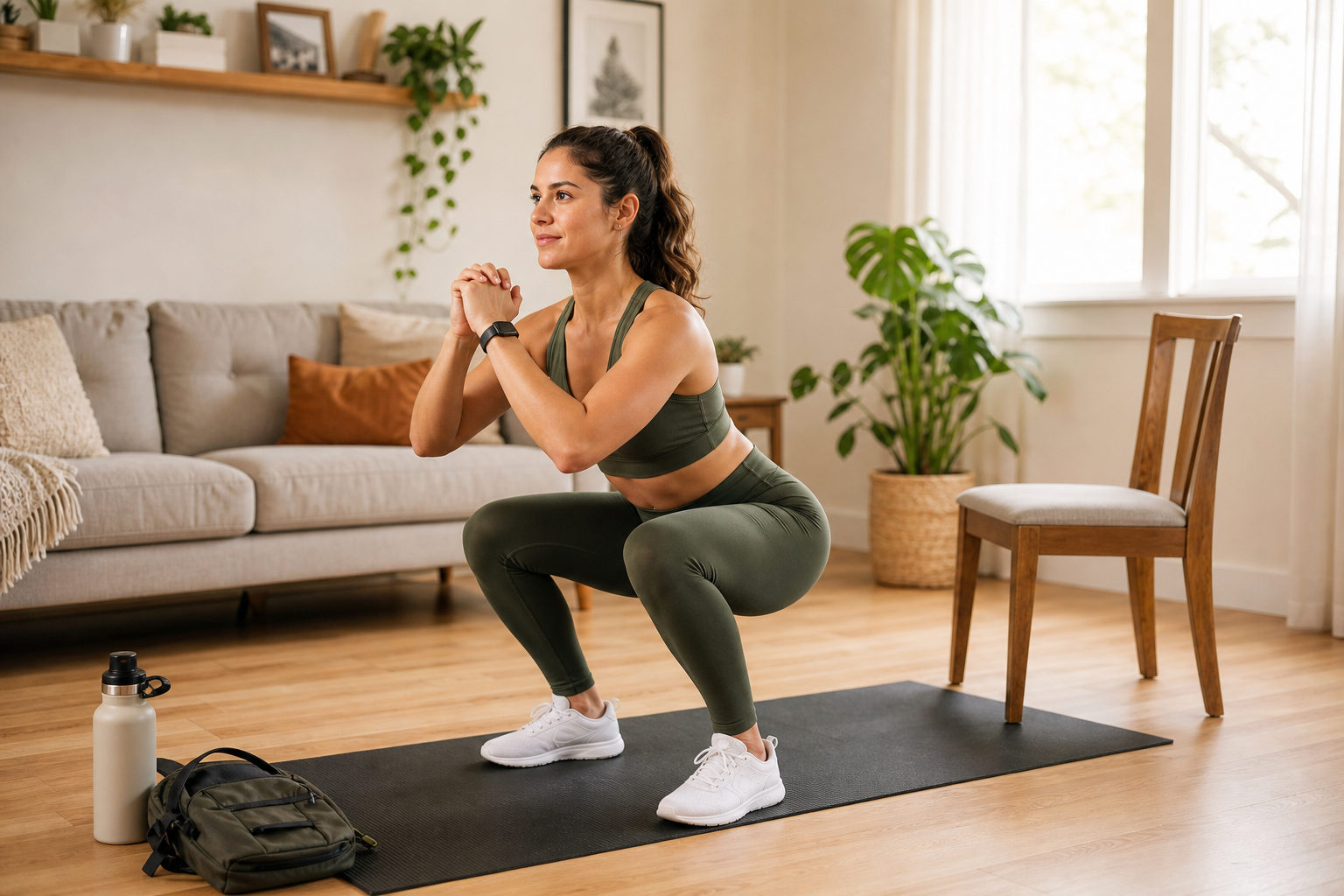
7 No-Weight Overload Methods for Stronger Legs
Each of the following methods provides a distinct way to increase the training stimulus without adding external weight. You do not need to use all seven in a single workout. Instead, think of them as tools you can select based on your current plateau, available equipment, and recovery capacity.
1. Unilateral Exercises (Single-Leg Work)
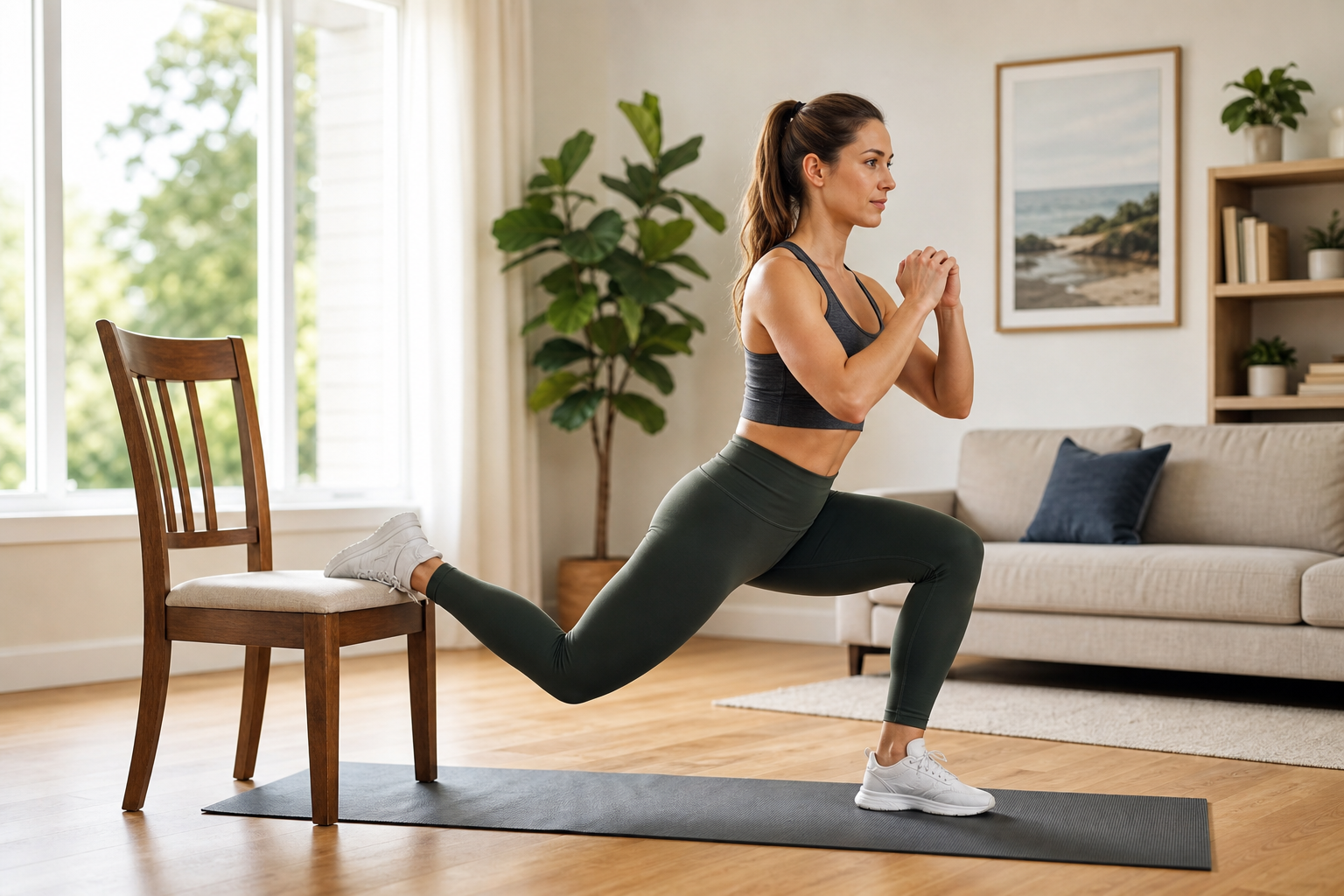
Unilateral exercises — movements performed one leg at a time — are arguably the most powerful no-weight overload technique available. When you perform a bilateral squat, both legs share the load. When you switch to a Bulgarian split squat or a single-leg deadlift, one leg must handle the entire load. According to trainer Ava Fagin, cited by SELF, this can increase the intensity by 50 to 100 percent per leg compared to the bilateral version.
Concrete examples: Replace bodyweight squats with Bulgarian split squats (rear foot elevated on a chair or couch). Replace bilateral glute bridges with single-leg glute bridges. Replace standard deadlifts with single-leg Romanian deadlifts. Each of these variations immediately increases the demand on the working leg without requiring a single pound of additional weight.
2. Tempo Changes (Eccentric Emphasis)
Manipulating the speed of a repetition — particularly slowing down the lowering (eccentric) phase — increases time under tension, which is a well-established driver of muscle hypertrophy. A standard squat might take one second to lower and one second to stand up. A tempo squat with a 3-0-3 cadence (three seconds down, no pause, three seconds up) more than triples the time your muscles spend under load for the same number of reps.
Concrete examples: Apply a 3-0-3 tempo to lunges, step-ups, and glute bridges. For an even greater challenge, use a 4-0-1 tempo (four seconds down, explosive up) on squat variations. The eccentric phase is where the most muscle damage and subsequent growth stimulus occurs, so slowing it down is a highly effective overload strategy.
3. Pause Reps
Adding a pause at the most challenging point of a movement — typically the bottom of a squat or lunge — eliminates momentum and forces your muscles to work harder to initiate the concentric (lifting) phase. This technique is recommended by Nerd Fitness as one of three primary ways to challenge your legs without weights.
Concrete examples: Perform a bodyweight squat, but hold the bottom position (thighs parallel to the floor or lower) for a full two-count before driving back up. Apply the same pause to walking lunges and glute bridges. Start with a one-second pause and work up to three or four seconds as you adapt.
4. Increased Range of Motion
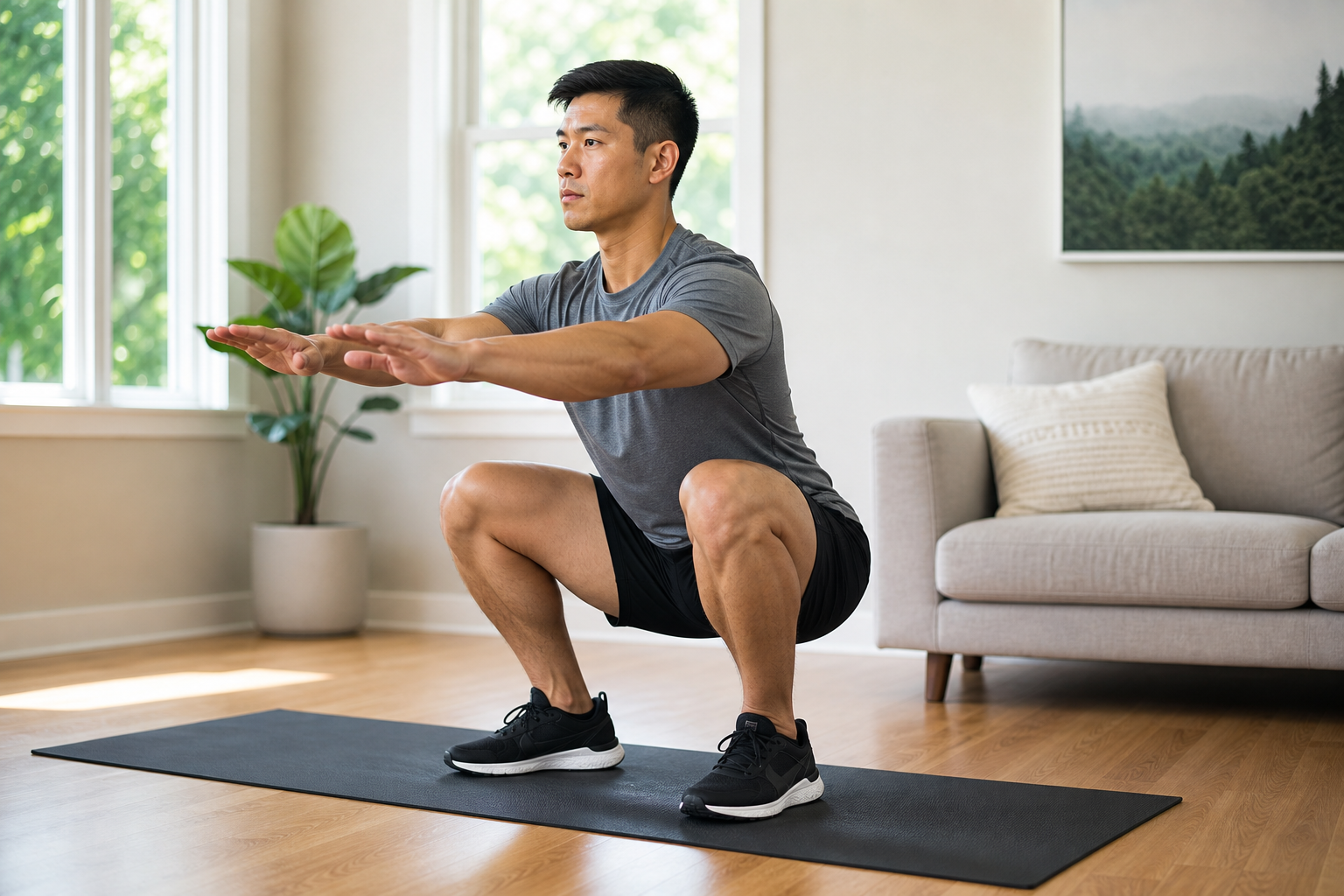
Performing an exercise through a fuller range of motion increases the mechanical work your muscles must perform on each rep. Research cited by InBody indicates that full range of motion in squats (descending until your thighs are at least parallel to the ground) is more effective for developing the adductors and glutes than half squats. You can increase range of motion beyond standard levels by using a deficit or heel elevation.
Concrete examples: Stand on a small, stable platform (a thick book or a low step) and perform squats, allowing your heels to descend below the platform surface for a deeper stretch. Alternatively, place your heels on a small wedge or rolled-up towel to allow a deeper squat while maintaining an upright torso. For lunges, increase the step length to achieve a deeper stretch in the glutes and hamstrings.
5. Plyometric Progressions
Adding a jump or explosive element to a bodyweight exercise recruits fast-twitch muscle fibers and increases the power output required from your legs. Nerd Fitness describes this as the "dynamic version" of overload — adding speed to movements like squat jumps or split jumps. Plyometric progressions are particularly effective for building explosive strength and can be scaled from low to high intensity.
Concrete examples: Progress from a bodyweight squat to a jump squat (explosive jump at the top of each rep). Progress from a stationary lunge to a split jump (switching legs in mid-air). Progress from a glute bridge to a single-leg glute bridge thrust. Start with low-intensity plyometrics (small jumps, soft landings) and advance to higher-intensity variations (tuck jumps, broad jumps) as your joints and connective tissues adapt.
6. Volume Accumulation (More Reps, More Sets, Density Sets)
Training volume — the total number of sets and reps you perform — is a primary driver of muscle hypertrophy. Research cited by Healthline suggests that volume matters more than frequency for muscle growth, making higher-volume sessions an effective path to continued gains. When you cannot increase the load, you can increase the total work performed.
Concrete examples: If you currently perform 3 sets of 12 reps per exercise, increase to 4 sets of 12 reps, or 3 sets of 15 reps. Use density sets: set a timer for 5 minutes and perform as many quality reps of a given exercise as possible within that window, resting only when needed. Track your total rep count and aim to beat it each session. This method works particularly well for bodyweight squats, lunges, and glute bridges.
7. Added Load via Household Items
You do not need a gym to add weight. Nerd Fitness points out that household items like milk jugs, laundry detergent bottles, buckets, luggage, and backpacks filled with books or canned goods can serve as makeshift free weights for deadlifts, squats, and lunges. A heavy backpack worn during squats, lunges, or step-ups is a particularly practical option because it distributes the load across your torso and leaves your hands free for balance.
Concrete examples: Fill a backpack with 10 to 20 pounds of books or water bottles and wear it during Bulgarian split squats, reverse lunges, and step-ups. Hold a gallon jug of water (approximately 8.3 pounds) in each hand during walking lunges. Use a filled laundry detergent bottle as a single dumbbell for single-leg Romanian deadlifts. These items provide enough additional resistance to extend your progression runway significantly.
| Overload Method | Key Mechanism | Example Exercise | Best For |
|---|---|---|---|
| Unilateral | 50–100% more load per leg | Bulgarian split squat | Strength plateaus |
| Tempo change | Increased time under tension | 3-0-3 squat | Hypertrophy focus |
| Pause reps | Eliminates momentum | Paused squat (2-sec hold) | Strength at bottom range |
| Increased ROM | More mechanical work per rep | Deficit squat | Muscle development |
| Plyometrics | Fast-twitch fiber recruitment | Jump squat | Power and explosiveness |
| Volume accumulation | Higher total workload | 5-min density set | Endurance and size |
| Household load | Added external resistance | Backpack squat | Strength progression |
How to Structure Progression Across Weeks
Having seven overload methods is useful only if you have a plan for applying them systematically. Without structure, you risk jumping between methods randomly and never giving any single approach enough time to produce adaptation. Three common progression frameworks — linear, double, and wave progression — can help you organize your training across weeks and months.
Linear Progression
Linear progression is the simplest framework: add one rep per session (or per week) to a given exercise until you reach a target ceiling, then switch to a harder variation. For example, if you are performing Bulgarian split squats, you might aim for 3 sets of 8 reps in week one, 3 sets of 9 in week two, 3 sets of 10 in week three, and so on until you reach 3 sets of 15. Once you hit 15 reps with good form, you advance to a harder variation — such as adding a pause at the bottom or wearing a loaded backpack.
This framework works well for beginners and intermediates who are still making rapid progress. It is straightforward to track and provides clear weekly targets.
Double Progression
Double progression is a more flexible approach that is well-suited to home training where small increments of weight are not available. You define a rep range — for example, 8 to 12 reps per set. You stay with the same exercise variation until you can complete all sets at the top of the rep range (12 reps) with good form. Only then do you advance to a harder variation, which will likely drop you back to the bottom of the rep range (8 reps), and the cycle repeats.
For example: You perform Bulgarian split squats with a goal of 3 sets of 8–12 reps. In week one, you manage 8, 8, and 9 reps. In week four, you hit 12, 12, and 11. In week six, you hit 12, 12, and 12. Now you advance to a paused Bulgarian split squat, and your reps drop back to 8 per set. This framework provides clear progression criteria and prevents you from advancing too quickly.
Wave Progression
Wave progression involves cycling between higher-volume and lower-volume weeks to manage fatigue and stimulate different adaptations. A simple wave might look like: week one (moderate volume), week two (high volume), week three (very high volume), week four (deload or low volume). This approach is particularly useful when using plyometric or high-tempo methods that generate more systemic fatigue.
For example, during a high-volume week, you might perform 4 sets of 15 reps of each exercise. During a deload week, you drop to 2 sets of 10 reps at a lower intensity. The wave pattern allows you to accumulate significant volume over several weeks while building in recovery periods that prevent overtraining.
| Framework | How It Works | Best Use Case | Example |
|---|---|---|---|
| Linear | Add 1 rep per session until ceiling, then advance | Rapid early progress | Week 1: 3x8 → Week 4: 3x12 → Advance |
| Double | Stay in rep range (e.g., 8–12); advance only at top | Long-term, steady progression | 3x8–12; advance when all sets hit 12 |
| Wave | Cycle volume: moderate → high → very high → deload | Managing fatigue with high-intensity methods | Week 1: 3x12 → Week 3: 4x15 → Week 4: 2x10 |
Sample 4-Week Leg Progression Program
The following 4-week program applies the overload methods from section 3 within a structured weekly schedule. It provides two tracks: one for bodyweight-only training and one for those with dumbbells or resistance bands. Perform each workout twice per week, with at least 48 hours between sessions. Each session should take approximately 30 minutes including warm-up and cool-down.
Track A: Bodyweight Only
| Week | Overload Focus | Exercises | Sets x Reps | Rest |
|---|---|---|---|---|
| 1 | Unilateral + Tempo | Bulgarian split squat, Single-leg glute bridge, Reverse lunge (3-0-3 tempo) | 3 x 10–12 per leg | 60 sec |
| 2 | Pause + Increased ROM | Paused squat (2-sec hold), Deficit squat (on book), Walking lunge (pause at bottom) | 3 x 8–10 | 75 sec |
| 3 | Plyometric + Volume | Jump squat, Split jump, Bodyweight squat density set (5 min) | 3 x 6–8 (plyos), 1 density set | 90 sec (plyos) |
| 4 | Household Load + Deload | Backpack Bulgarian split squat, Backpack reverse lunge, Single-leg deadlift (holding jug) | 2 x 10–12 per leg | 60 sec |
Track B: Dumbbell or Resistance Band
| Week | Overload Focus | Exercises | Sets x Reps | Rest |
|---|---|---|---|---|
| 1 | Unilateral + Tempo | Dumbbell Bulgarian split squat, Single-leg RDL (dumbbell), Banded lateral walk | 3 x 10–12 per leg | 60 sec |
| 2 | Pause + Increased ROM | Dumbbell goblet squat (pause at bottom), Dumbbell deficit lunge, Banded glute bridge | 3 x 8–10 | 75 sec |
| 3 | Plyometric + Volume | Dumbbell jump squat (light weight), Banded jump lunge, Dumbbell squat density set (5 min) | 3 x 6–8 (plyos), 1 density set | 90 sec (plyos) |
| 4 | Household Load + Deload | Dumbbell reverse lunge, Banded Bulgarian split squat, Single-leg RDL (dumbbell) | 2 x 10–12 per leg | 60 sec |
Before each session, perform a 5-minute warm-up: leg swings (forward and side), bodyweight squats (10 reps), walking lunges (10 reps per leg), and glute bridges (10 reps). After each session, perform a 5-minute cool-down: standing quad stretch, seated hamstring stretch, and glute stretch (30 seconds each side).
Tracking Progress and Knowing When to Advance
Progressive overload requires measurement. Without tracking, you cannot know whether you are actually progressing or simply maintaining. The most useful metrics for home leg training are: reps completed per set, total volume (sets x reps), perceived exertion (how hard each set felt on a 1–10 scale), and recovery quality (how your legs feel 24 and 48 hours after a session).
Use a simple notebook, a notes app, or a strength-logging app to record each session. Note the exercise, the variation used, the number of sets and reps, and any overload method applied (e.g., "Bulgarian split squat, 3x11, 2-sec pause at bottom"). Over time, this log will reveal patterns: which methods produce the fastest progress, which exercises cause disproportionate soreness, and when you are ready to advance.
- Advance when you can complete all prescribed sets and reps with good form and without reaching failure before the final rep.
- Advance when your perceived exertion drops consistently below 7 out of 10 for a given exercise variation.
- Advance when you have been using the same overload method for 3–4 weeks and progress has stalled (no increase in reps or volume for two consecutive sessions).
- Regress or deload when you experience persistent joint pain, excessive fatigue, or a decrease in performance (fewer reps than the previous session despite adequate recovery).
Plateaus are normal and are not a sign of failure. They are a signal that your current stimulus is no longer sufficient and that it is time to apply a different overload method or progression framework. If you have been using unilateral exercises for four weeks and progress has stalled, switch to tempo changes or pause reps for the next block. The variety itself can be a powerful stimulus.
Recovery Considerations for Higher-Volume Leg Training at Home
Higher-volume leg training — especially when incorporating plyometrics, tempo work, and unilateral exercises — places significant demands on your muscles, joints, and central nervous system. Recovery is not an afterthought; it is a critical component of the progressive overload cycle. Without adequate recovery, you cannot adapt to the training stimulus, and progress will stall or reverse.
Aim for at least 48 hours between leg training sessions, as recommended by SELF and Verywell Fit. This means training legs on Monday and Thursday, or Tuesday and Friday. If you are using high-intensity plyometric methods, consider 72 hours between sessions to allow your connective tissues to recover fully. On rest days, light activity such as walking, stretching, or foam rolling can promote blood flow and reduce soreness without interfering with recovery.
Sleep is the most underrated recovery tool. Aim for 7–9 hours per night, as sleep is when the majority of muscle repair and growth hormone release occurs. Nutrition also plays a role: ensure you are consuming enough protein (approximately 1.6–2.2 grams per kilogram of body weight per day) and total calories to support the increased training volume.
Finally, listen to your body. The seven overload methods in this article are tools, not commandments. If a particular method causes excessive soreness or joint discomfort, replace it with a different method from the list. The goal is to keep progressing, not to force a specific technique. A well-designed home leg program should challenge you without breaking you down.
What a small equipment investment adds
We don't have a build tagged to this exact tier yet. Browse all builds.
How often should you repeat this?
See our recovery and rest reference for citation-anchored rest-interval guidance.
Spot something off?
Tell us if a movement, tier assumption, or duration didn't match your experience.