
Quiet Apartment Workout for Bad Air Quality Days
When wildfire smoke sends the AQI into the red, move your workout indoors — but only into a deliberately cleaned room with filtration running. This guide gives you the AQI thresholds that should end outdoor training, a 10-minute air-prep checklist for your workout corner, and a 20–25 minute no-jump routine that keeps the session neighbor-safe.
- Equipment tier required
- none
- Duration
- 25 min
- Difficulty
- beginner
- Target area
- full body
- Noise level
- quiet, no jumping
The smoke-day decision starts before the mat comes out. If AirNow is showing red, the outdoor run, walk, hill repeat, or balcony HIIT plan is done for the day. If you are in a sensitive group, that cutoff arrives earlier, around the orange range. The replacement is not “just work out indoors.” The replacement is: check the AQI, prepare the cleanest room you have, run filtration, keep the session moderate, and choose movements that will not turn your floor into a drum.
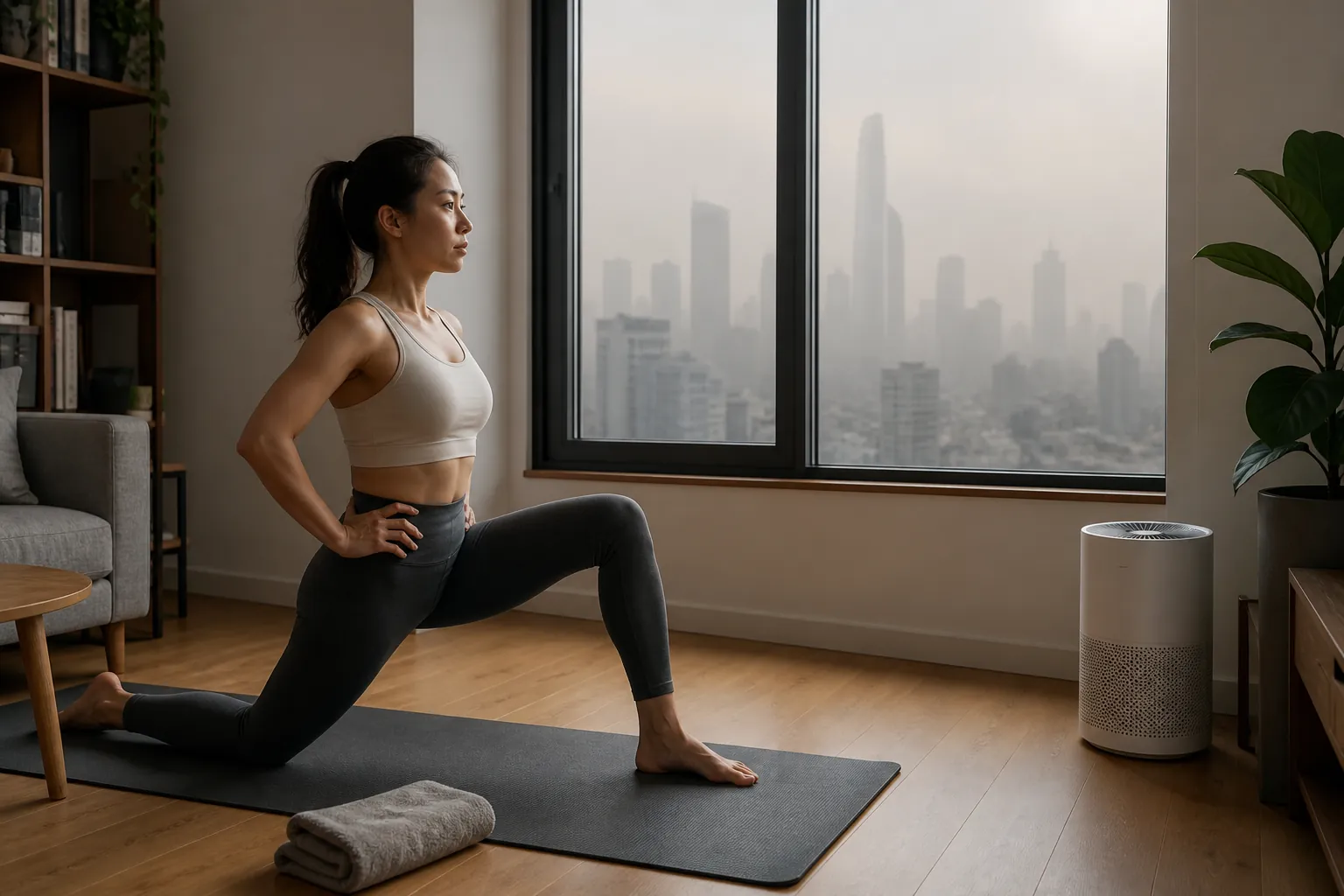
That order matters. AQI tells you when the outdoor plan is over. Room prep decides whether your apartment is actually a better place to breathe. The workout itself has to respect both smoke and neighbors: no jumping, no hard landings, no hour-long “indoor cardio challenge” that makes you breathe like you are still outside.
Use the AQI number as the stop sign
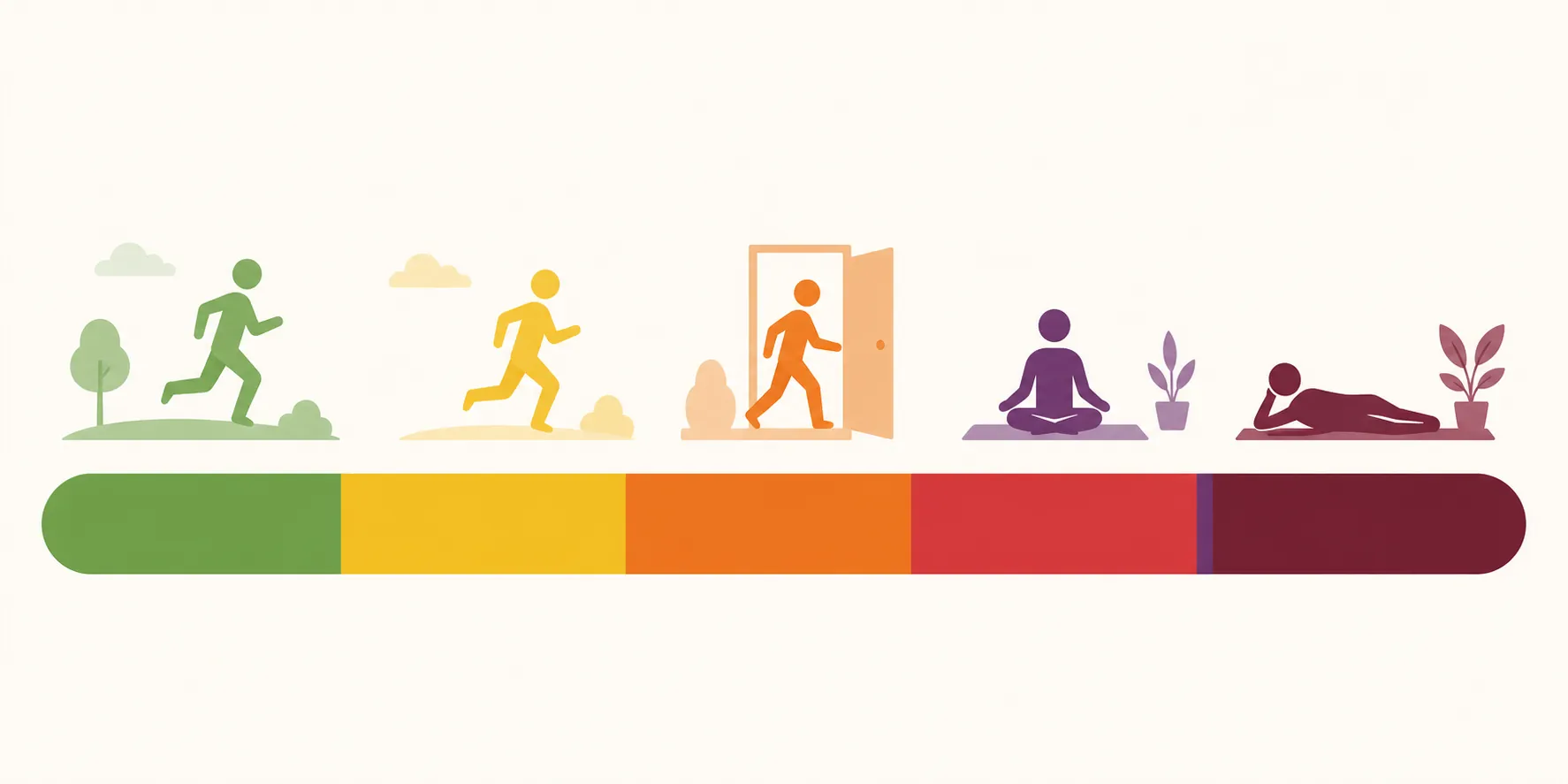
For a quiet indoor apartment workout when wildfire smoke air quality is bad, the first useful rule is blunt: red-tier AQI changes the day. AirNow defines the AQI color bands, and exercise guidance from the American Lung Association and TrainingPeaks’ Dr. Jeff Sankoff points to the same practical split: healthy adults have more room below red, while sensitive groups should be more conservative once the AQI reaches the unhealthy-for-sensitive-groups range.[1][2][3]
| AirNow AQI color | Outdoor workout decision | Indoor replacement |
|---|---|---|
| Green, 0–50 | Generally fine for outdoor activity for most people.[1] | Use your normal plan unless local smoke, symptoms, or medical guidance says otherwise. |
| Yellow, 51–100 | Usually acceptable for many adults, but sensitive people should pay closer attention.[1][2] | Consider a shorter or easier session if you smell smoke or feel irritation. |
| Orange, 101–150 | Sensitive groups should move training indoors; healthy adults should consider shortening or reducing intensity.[1][2][3] | Use the prepared-room routine below, especially if you have asthma, COPD, heart disease, are pregnant, are older, or are training a child. |
| Red, 151–200 | Outdoor training is over for everyone. Michigan DHHS guidance also treats red-tier conditions as a time to avoid prolonged or heavy outdoor exertion, with vigorous outdoor activity sharply limited.[1][4] | Prepare the cleanest available room and do a short, moderate, no-jump session only if you feel well. |
| Purple or maroon, 201+ | No outdoor exercise. | Mobility, light strength, or rest may be the better choice if the room cannot be cleaned well. |
There is one awkward but important correction: EPA clean-room guidance is not a license to do hard workouts in that room. EPA specifically says not to exercise in a clean room because exercise increases breathing rate and the amount of particles you may inhale.[5] In an apartment, though, the cleanest room may also be the only realistic place to move. So the compromise is narrower: use the cleanest available room, run filtration, keep the workout moderate and short, and stop if symptoms show up.
This is situational fitness guidance, not medical advice. If you have asthma, COPD, heart disease, are pregnant, are older, are immunocompromised, or are planning activity for a child, use the lower threshold and follow clinician guidance.
The 10-minute room prep before you move
The apartment version of a smoke-day workout starts like a pre-flight check. You are trying to keep outdoor particles from coming in, avoid adding new particles indoors, and give your filter a short head start before your breathing rate rises.
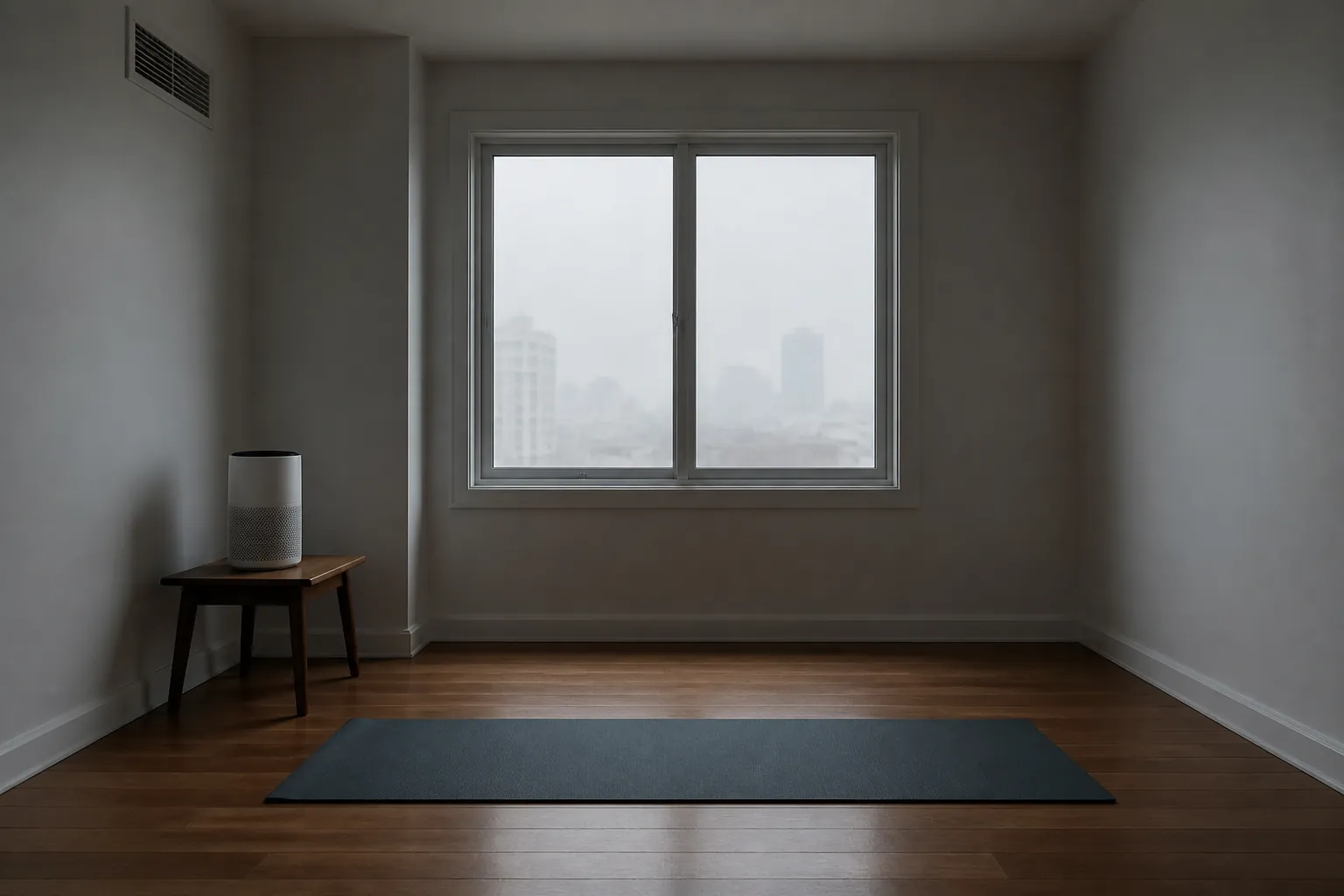
- Close and latch windows and exterior doors. If one window leaks more than the others, move the mat away from it instead of pretending the draft is not there.
- If you have air conditioning, set it to recirculate rather than pulling in outdoor air. EPA wildfire indoor-air guidance emphasizes reducing outdoor-air entry during smoke events.[6]
- Run your portable HEPA air cleaner in the workout room, ideally on a higher setting before the session and the highest tolerable setting during it.
- If you use a DIY box-fan air cleaner with a MERV-13 filter, place it where it will not blow dust off a shelf or directly into your face. EPA has reviewed DIY air-cleaner research for wildfire-smoke reduction, but build quality, filter fit, and safe fan use still matter.[7]
- Do not vacuum, sweep dry dust, fry or broil food, burn candles, burn incense, or start any other particle-making activity right before training. OSU Extension’s wildfire-smoke indoor-air guidance calls out these kinds of indoor sources because they can worsen particle levels indoors.[8]
- Pick the cleanest corner, not the most photogenic one. A mat in the bedroom with a purifier beats a living-room circuit beside a leaky sliding door.
- Give the room about 10 minutes with filtration running before the warm-up. This is not magic purification; it is a practical head start.
Public guidance gives useful direction, not a guaranteed indoor AQI number. Colorado State University notes that, with windows closed, air conditioning set to recirculate, and an air cleaner running, indoor AQI can be roughly half the outdoor value; that is a directional estimate, not a promise for every rental, window frame, filter, or floor plan.[9] OSU Extension cites literature showing portable high-efficiency air cleaners can reduce indoor particle concentrations by up to about 45% during smoke events, which is encouraging but still not the same as measuring your exact room.[8]
If you open the window “just a crack” because the room feels stale, you have changed the deal. On a red or worse day, stale-but-filtered air is usually the better workout environment than smoky air with a breeze. If the apartment is also dangerously hot and you have no way to cool it, do not force a workout; use the same conservative logic you would use for a heat advisory.
For heat-specific swaps, use the site’s no-equipment heat-wave routine or the broader home workout alternatives for a heat advisory. Smoke days and heat days overlap often enough that the room has to pass both tests.
Why the session stays moderate and short
The cap is not there to make the workout feel watered down. It is there because dose matters. GU Energy Labs, citing European Lung Foundation figures, describes breathing rate rising from about 15 breaths per minute at rest to roughly 40–60 breaths per minute during exercise.[10] A long, hard indoor session in a not-quite-clean apartment can turn into a lot of air moving through irritated lungs.
That is why this routine aims for steady effort rather than a breathless finish. You should be warm, focused, and mildly challenged. You should not be gasping, coughing through reps, or chasing the same heart-rate number you would chase on a clear-air run.
Stop the session if you develop chest tightness, wheezing, unusual shortness of breath, dizziness, a headache that escalates, burning eyes that do not settle, or coughing that changes the workout. On a bad smoke day, finishing the planned circuit is not the goal. Keeping the routine alive without making the air problem worse is the goal.
The 20–25 minute no-jump apartment routine
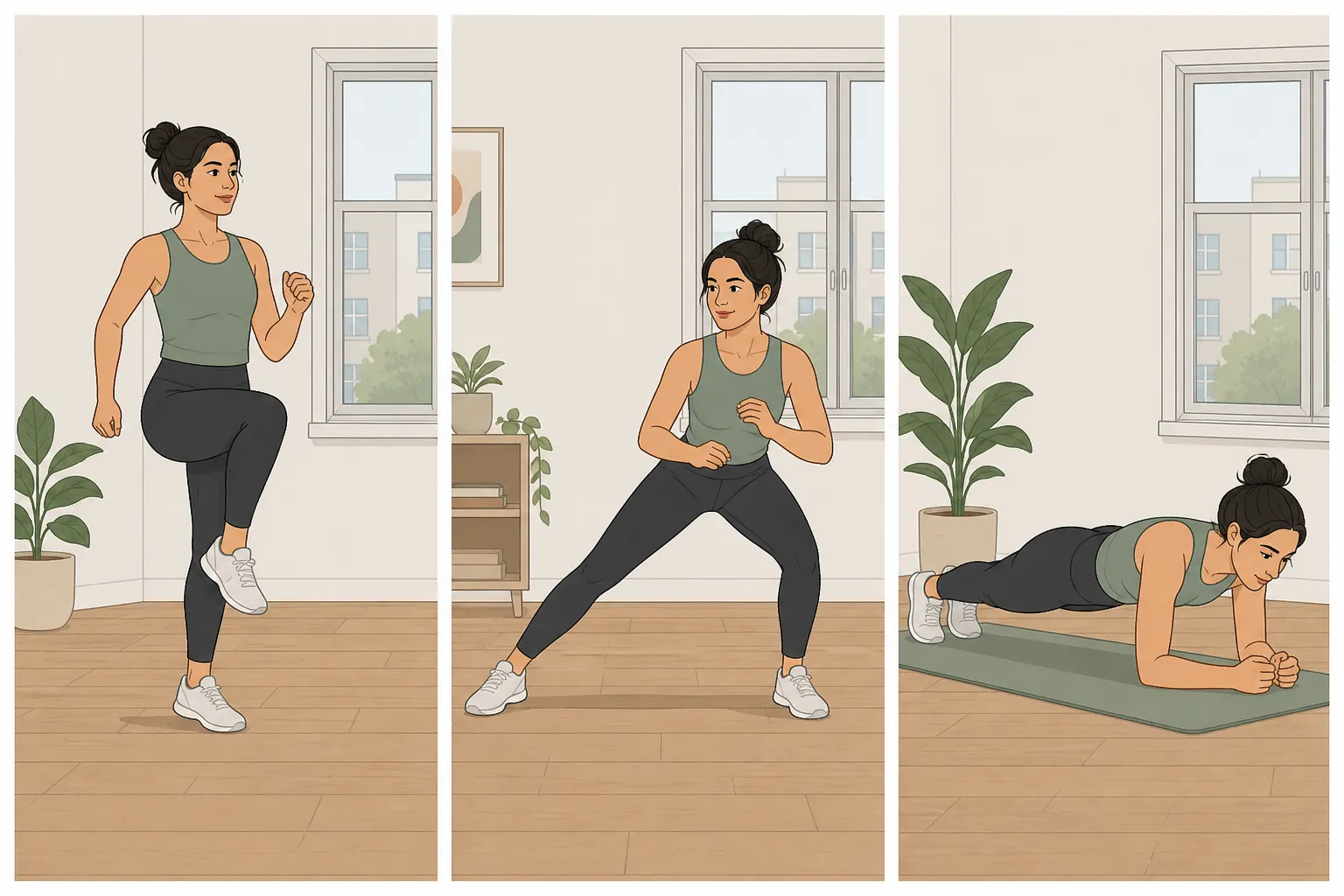
This routine uses quiet cardio substitutions that appear across low-impact apartment workout guidance: march jacks instead of jumping jacks, step-back burpees instead of jump burpees, slow mountain climbers instead of sprint climbers, lateral steps instead of skaters, and controlled planks or lunges instead of plyometrics.[11][12][13][14] Those sources help with movement selection; the smoke-day limits come from the air-quality guidance above.
| Time | Move | How to keep it quiet | Effort |
|---|---|---|---|
| 0:00–1:00 | Easy march in place | Roll through the feet. Keep steps light enough that you could do them while someone sleeps in the next room. | Very easy |
| 1:00–2:00 | Step-touch with arm swings | Step side to side without pushing off the floor. Arms move, feet stay soft. | Easy |
| 2:00–3:00 | Hip hinge to reach | Hinge back, reach forward, stand tall. No bouncing at the top. | Easy |
| 3:00–4:00 | Slow bodyweight squat | Sit back under control. Pause briefly before standing so the floor never gets a hard stomp. | Easy to moderate |
| 4:00–19:00 | Main circuit: 5 moves, 40 seconds each, 20 seconds to change, 3 rounds | Use the move notes below. Keep one foot or both hands grounded at all times. | Moderate |
| 19:00–23:00 | Quiet strength finisher: 4 moves, 45 seconds each, 15 seconds to change | Stay on the mat. No transitions that involve hopping up. | Moderate |
| 23:00–25:00 | Cool down or stop at 23 minutes | Walk slowly, breathe normally, stretch calves, hips, and chest. | Easy |
Main circuit: 3 rounds
- March jacks — Step one foot out, then the other, while the arms move like a jumping jack. Keep the feet close to the floor. If your breathing climbs too fast, reduce the arm range first.
- Low lateral steps — Take two quiet steps right, two quiet steps left. Add a shallow hinge or small knee bend if you want more leg work. Do not turn it into a side-to-side leap.
- Controlled squat to reach — Squat to a comfortable depth, stand, and reach overhead. Skip the calf raise if it makes you slap the floor on the way down.
- Stepping burpee — Hands to the floor or a couch edge, step one foot back, step the other back, hold a plank for one beat, then step in and stand. No push-up, no jump, no dramatic finish.
- Slow mountain climber — From a high plank on the floor or with hands elevated on a sturdy couch, bring one knee forward at a time. Move slowly enough that the toes land quietly.
Rest as needed between rounds. If the AQI is red outside and your room is merely “better,” not genuinely clean-feeling, take the full 20-second transitions and skip any urge to make the circuit harder. The workout is already doing its job if you move for 15 controlled minutes without pounding the floor or chasing breathlessness.
Quiet strength finisher: 4 minutes
- Glute bridge, 45 seconds — Lie on your back, feet planted, lift and lower the hips under control. Keep the ribs down and do not slam the hips into the mat.
- Forearm plank, 45 seconds — Knees down is fine. The point is steady tension, not shaking until you hold your breath.
- Dead bug, 45 seconds — Move opposite arm and leg slowly. This is a good smoke-day core move because it stays quiet and does not demand fast breathing.
- Split squat hold or slow reverse lunge, 45 seconds — Choose the version you can do without thudding. If lunges bother your knees or your floor, hold a wall sit instead.
If you finish at 23 minutes and feel like you could do more, that is not a failure. On smoke days, leaving some effort unused is part of the plan. Save the longer conditioning work for clean air.
Small-space adjustments that matter more than gear
The $0 version is enough: bodyweight movements, a towel or existing mat, closed windows, recirculated air if available, and whatever filtration you already own. If your floor is thin, place the mat away from joists that seem to carry sound and keep the work centered over the most stable part of the room. Bare feet are not automatically quieter; some people slap the floor less in soft indoor shoes, while others are quieter barefoot on a mat.
If you already know your feet are the noisy part, the site’s small-space shoe testing may help later: which Hoka is best for walking and home fitness and which supercritical foam shoes are worth it for home cardio are better upgrade questions than buying random “apartment workout” shoes during a smoke alert.
| Budget tier | Useful smoke-day upgrade | What it solves |
|---|---|---|
| $0 | Bodyweight routine, towel or existing mat, closed windows, recirculated air, existing purifier if you have one | Keeps the habit alive without buying your way out of a temporary air problem |
| $0–100 | A denser exercise mat, loop band, or sliders | Reduces floor contact noise and adds strength options without more breathing demand |
| $100–300 | Better mat coverage, adjustable dumbbells at modest loads, or a more comfortable purifier placement setup | Improves comfort and consistency for repeated smoke days |
| $300–800 | A quiet machine path only if your room air and noise situation can support it | May help long-term cardio, but it is not the first smoke-day fix |
For non-smoke weather days, this routine sits next to the site’s quiet storm-day apartment workout. The movement logic is similar; the air-quality logic is not. A thunderstorm mainly changes where you train. Wildfire smoke changes where, how hard, and how long.
When the workout becomes mobility or rest
There are days when the practical answer is smaller than a workout. If the outdoor AQI is red or worse, outdoor training ends. If you cannot close the room, cannot run filtration, smell smoke strongly indoors, or feel symptoms before you start, switch to gentle mobility or rest. If the room is prepared and you feel normal, the 20–25 minute quiet session is the compromise: enough movement to protect the habit, not so much effort that you treat smoky air like a toughness test.
References
- Air Quality Index (AQI) Basics, AirNow.gov
- Four Things to Know about Air Quality and Exercising Outdoors, American Lung Association
- High AQI: Is it Safe to Exercise Outside?, TrainingPeaks
- Your Health and Wildfire Smoke, Michigan DHHS
- Create a Clean Room to Protect Indoor Air Quality During a Wildfire, US EPA
- Wildfires and Indoor Air Quality (IAQ), US EPA
- Research on DIY Air Cleaners to Reduce Wildfire Smoke Indoors, US EPA
- Protecting Indoor Air from Wildfire Smoke (EM 9379), OSU Extension
- Is it safe to exercise outside when there is wildfire smoke in the air?, CSU College of Health and Human Sciences
- The AQI Dilemma: Is it Safe to Exercise?, GU Energy Labs
- Quiet Cardio Workout, Fitness Blender
- Shh! Quiet exercises for an apartment-friendly workout, Centr
- 7 Quiet Workout Tips, SELF
- 17 Quiet, At-Home Cardio Exercises That Trainers Recommend, POPSUGAR
What a small equipment investment adds
We don't have a build tagged to this exact tier yet. Browse all builds.
How often should you repeat this?
See our recovery and rest reference for citation-anchored rest-interval guidance.
Spot something off?
Tell us if a movement, tier assumption, or duration didn't match your experience.