
3 Quiet Indoor Cycling Workouts for Small Apartments
Three structured, timed indoor cycling workouts designed for small apartments. Seated-only cadence intervals minimize floor vibration and neighbor disturbance while delivering effective cardio.
- Equipment tier required
- $100-300
- Duration
- 30 min
- Difficulty
- beginner
- Target area
- legs
- Space footprint needed
- 4 ft x 8 ft
- Noise level
- —
The best indoor cycling workout for a small apartment is not the one that feels most like a studio class. It is the one you can ride without waiting for the downstairs neighbor to knock. Start with one operating rule: stay seated, keep the pedal stroke smooth, ride most work between 80 and 95 RPM, and change cadence before you crank resistance. The main thing being removed is the out-of-saddle climb, because that is where a quiet bike can still become a floor problem.
A magnetic-resistance belt-drive bike may be quiet in the air. Norsk Store estimates moderate-use magnetic bikes at about 25 to 35 dB, which it describes as quieter than a refrigerator, but that is an industry estimate, not a promise for every apartment floor, mat, bike, and rider combination.[1] The more useful boundary is this: airborne sound is only half the issue. Floor vibration is what turns a good workout into someone else’s ceiling noise.
Before You Ride: Set the Quiet Boundary
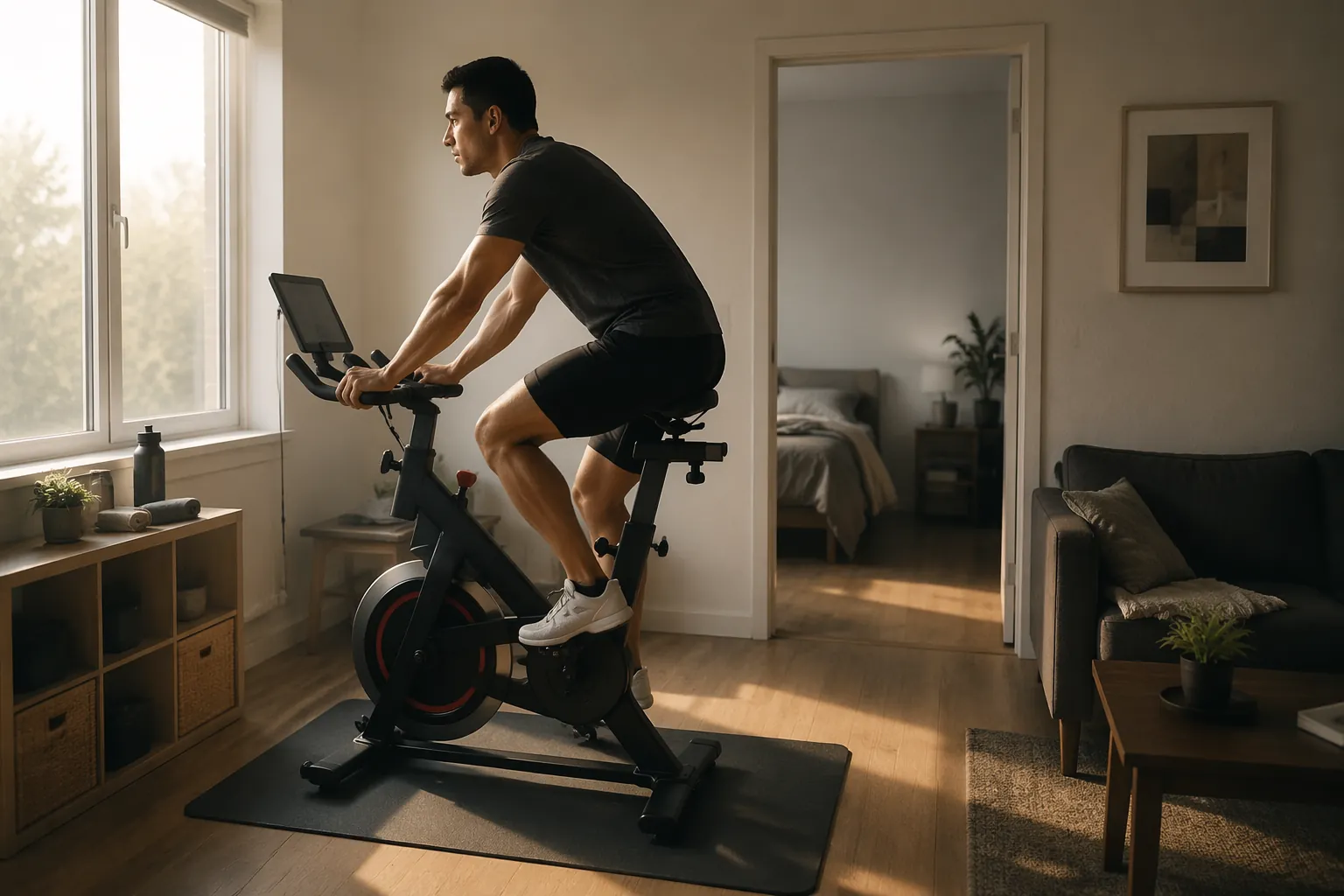
These workouts assume a compact magnetic-resistance exercise bike on a high-density mat, with enough room to mount, dismount, and pedal without clipping furniture. If you are using a felt-pad or friction-resistance bike, the noise profile can change because friction systems create more contact noise than magnetic resistance systems.[2]
- Use a clear zone of about 4 by 8 ft so the bike is not touching a wall, shelf, bed frame, or radiator.
- Put the bike on a dense rubber equipment mat. Norsk Store claims its 0.47-inch rubber tile absorbs about 80% of impact vibration before it reaches the subfloor; treat that as a product-specific vendor claim, not a universal lab number.[1]
- Keep the bike footprint under roughly 6.5 sq ft if the apartment is tight. BarBend’s 2025 listing of the Yosuda YB001R, for example, gave it a 6.11 sq ft footprint and a $279 price point, which is useful here only as a compact-bike reference, not current shopping advice.[3]
- Check every contact point before early-morning rides: levelers planted, mat flat, pedals tight, bottle removed from rattly cages, and no loose phone mount buzzing against the handlebar.
If your unit has a concrete slab or you are on the top floor, you usually have more margin. If you are on a wood-subfloor middle floor, assume less margin. NordicTrack’s discussion of compact bikes notes that building construction changes how vibration travels, and it also flags standing riding as a bigger vibration source than seated riding.[4]
The Three Quiet Workouts
| Workout | Best Use | Quiet Rule | Main Intensity Tool |
|---|---|---|---|
| 20-minute Early-Morning Silent Ride | Before work, thin walls, cautious buildings | No standing, no surges, no heavy grinding | Steady 80–90 RPM |
| 30-minute Lunch-Hour Interval Burner | Best cardio-to-noise ratio | Cadence intervals, seated recoveries | 80–95 RPM changes |
| 40-minute After-Work Endurance Builder | More forgiving hours and better floor conditions | Progressive seated effort, controlled resistance | Longer tempo blocks |
The routines borrow ordinary indoor-cycling workout architecture—warm-up, main set, recovery, cool-down—from beginner and interval templates, then strip out the apartment-hostile parts: standing climbs, max-resistance stomping, and sudden sprint jumps.[5][6][7]
20-Minute Early-Morning Silent Ride
Use this when the building is still quiet, the floor feels suspicious, or you want a session you can finish before the day starts negotiating with you. It is seated from the first pedal stroke to the last.
- Minutes 0–3: Easy warm-up at 75–80 RPM. Resistance should feel like a flat road with a little chain tension, not a climb.
- Minutes 3–7: Settle into 80–85 RPM. Stay tall in the saddle, light hands on the bars, hips quiet.
- Minutes 7–11: Ride 85–90 RPM at moderate resistance. Breathing should deepen, but the bike should not rock.
- Minutes 11–15: Drop back to 80–85 RPM. Keep the same smooth pressure through the whole pedal circle.
- Minutes 15–18: Return to 85–90 RPM. If vibration increases, lower resistance before lowering cadence.
- Minutes 18–20: Cool down at 70–75 RPM, then stop pedaling gradually rather than snapping the pedals to a halt.
This is the least dramatic ride in the library, which is the point. The effort comes from holding a clean rhythm long enough to raise breathing and temperature, not from proving the bike can handle a climb. Verywell Fit’s beginner stationary-bike workout uses a similar warm-up, work, and cool-down shape; the apartment version keeps the work seated and removes resistance jumps that invite rocking.[5]
30-Minute Lunch-Hour Interval Burner
This is the strongest default choice: enough structure to feel like training, short enough to fit between meetings, and controlled enough that the bike should not thump under you if the setup is right. The work-to-rest pattern follows common indoor interval principles, but the intensity lever is cadence first, resistance second.[6][7]
- Minutes 0–5: Warm up from 75 to 85 RPM. Add only enough resistance that the pedals do not feel loose.
- Minutes 5–6: Work interval at 90–95 RPM, seated. Keep shoulders still and pressure even through both pedals.
- Minutes 6–7: Recovery at 80–85 RPM. Do not dump all resistance; just make the pedal stroke easy to control.
- Minutes 7–18: Repeat the 1-minute work, 1-minute recovery pattern six more times.
- Minutes 18–21: Steady seated ride at 85–88 RPM. This is not a rest; it is a controlled bridge.
- Minutes 21–22: Work interval at 92–95 RPM. If the bike starts to sway, reduce resistance and keep cadence smooth.
- Minutes 22–23: Recovery at 80–85 RPM.
- Minutes 23–26: Repeat the work and recovery pattern two more times.
- Minutes 26–30: Cool down from 80 RPM toward 70 RPM. Stay seated until the pedals stop.
The mistake this workout avoids is the heavy seated grind that looks quiet until the bike starts pulsing into the floor. Zycle’s noise-reduction guidance emphasizes even cadence, correct setup, and avoiding erratic pedaling; it specifically points to the 80–95 RPM range as a smoother target than uneven high-force riding.[8] For a renter, that matters more than whether the workout feels heroic in the first five minutes.
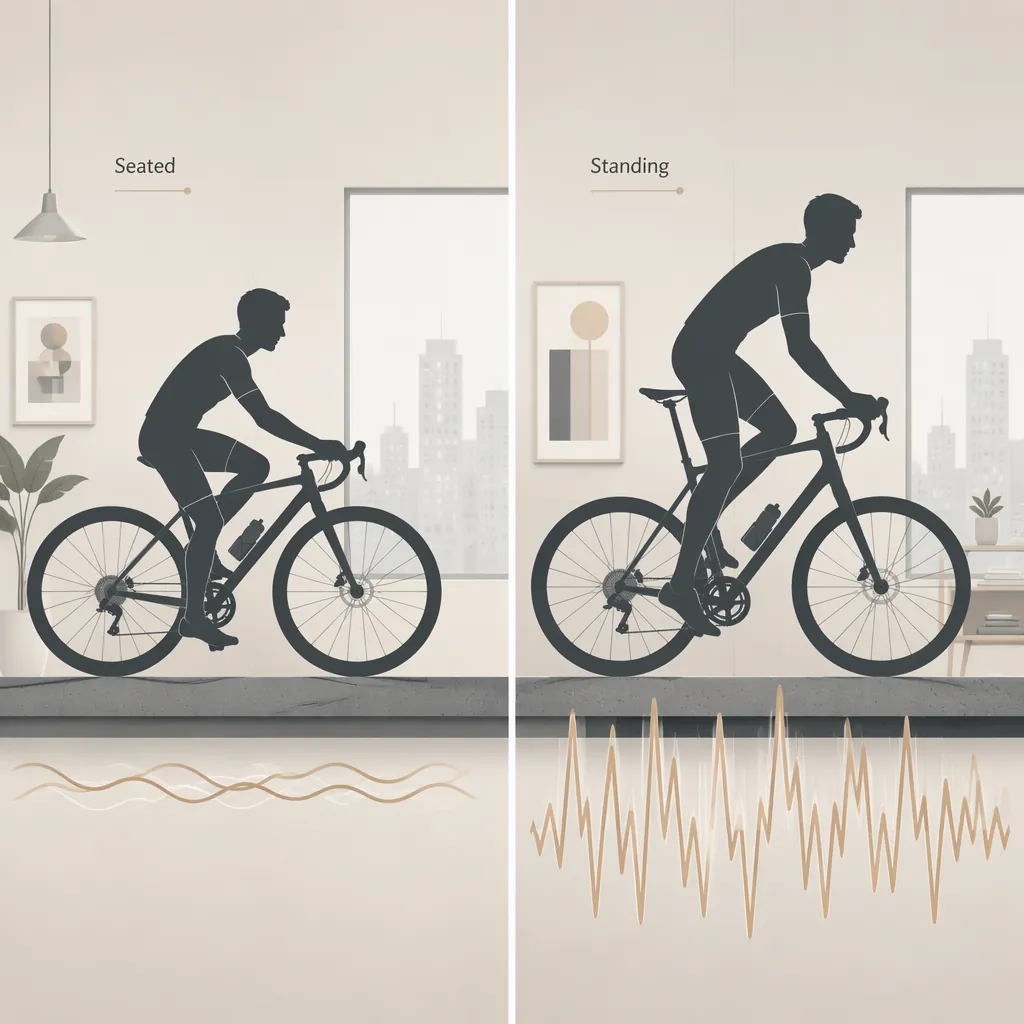
If you want this harder, do not stand. Add a small amount of resistance during the work minutes while keeping the same 90–95 RPM ceiling. If cadence drops below 85 RPM during a work interval, the resistance is probably too high for this apartment version. Save the climb fantasy for a time and place where the floor is not part of the workout.
40-Minute After-Work Endurance Builder
Use this when timing is more forgiving: early evening, normal building noise, no one sleeping below you, and a floor that has already passed shorter rides without complaint. It is still seated-only, but it lets resistance rise gradually enough to feel like a climb without the stomp.
- Minutes 0–6: Warm up at 75–82 RPM. Start lighter than you think you need.
- Minutes 6–10: Ride at 82–85 RPM with moderate resistance. Check that the bike stays still under your hips.
- Minutes 10–15: Increase resistance one small step and hold 84–88 RPM. Breathing should be steady, not ragged.
- Minutes 15–20: Keep the resistance and lift cadence to 88–92 RPM. The effort rises without a new force spike into the pedals.
- Minutes 20–25: Add one small resistance step only if cadence can stay above 85 RPM. If not, keep resistance where it is.
- Minutes 25–30: Return to 88–92 RPM at the previous resistance. Think smooth pressure, not attack.
- Minutes 30–34: Ease to 82–85 RPM. Let your breathing come down while continuing to pedal cleanly.
- Minutes 34–37: Final steady block at 85–88 RPM, moderate resistance, seated and still.
- Minutes 37–40: Cool down from 80 RPM toward 70 RPM. Step off quietly, then stretch away from shared walls if your floor creaks.
This is the closest these routines get to a climb, and it works only because the climb is simulated rather than acted out. NordicTrack’s vibration discussion says standing riding can create 2 to 3 times more vibration than seated riding at equivalent power output.[4] That does not mean every seated ride is silent. It means seated progressive work gives you a better chance of keeping effort in your legs instead of sending it into the joists.
Why These Rides Stay Quieter Than Studio-Style Sessions
Most apartment cycling problems start when a workout imports studio habits into a shared building. Standing surges shift body weight over the pedals. Heavy resistance encourages a downward stomp. Abrupt accelerations make the bike frame rock before the rider notices it. None of those have to be loud in the room to be annoying below the room.
Seated cadence work changes the force pattern. Instead of asking the floor to absorb repeated bodyweight-driven pulses, the workout asks your cardiovascular system to tolerate sustained rhythm. The difference is small in appearance and large in consequence: less bike sway, fewer impact peaks, and fewer moments where a mat has to rescue bad technique.
The mat still matters. So does the bike type. So does floor construction. But the rider’s choices are the part available tonight. You can choose 90 RPM instead of a resistance spike. You can stay seated instead of standing for a chorus. You can stop a set when the frame starts rocking instead of finishing the interval out of stubbornness.
Which Workout to Use Tonight
Pick the 20-minute Early-Morning Silent Ride if the hour is awkward, the building is quiet, or you are still testing how your floor behaves. Pick the 30-minute Lunch-Hour Interval Burner when you want the best cardio-to-noise ratio. Pick the 40-minute After-Work Endurance Builder when you have a better time window, a stable setup, and enough floor confidence to ride longer without turning it into a stomp session.
If the bike or mat is the weak point, solve that before making the workouts harder. FitAtHome’s compact home exercise equipment guide covers apartment equipment constraints, and the small-space cardio equipment guide is the better place to compare bikes against other cardio machines. For this bike, in this apartment, the safer training choice is already clear: seated, smooth, cadence-driven work before resistance theater.
References
- Quiet Apartment Workout Equipment, Norsk Store.
- Can I get a quiet exercise bike?, Energym.
- Best Exercise Bikes for Small Spaces (2026), BarBend.
- Best Compact Exercise Bike for Small Spaces, NordicTrack.
- Stationary Bike Workout for Beginners, Verywell Fit.
- 3 Indoor Cycling Workouts Under One Hour, TrainingPeaks.
- 5 Indoor Cycling Workouts, XTERRA Fitness.
- How to Reduce Noise and Vibrations, Zycle.
What a small equipment investment adds
We don't have a build tagged to this exact tier yet. Browse all builds.
How often should you repeat this?
See our recovery and rest reference for citation-anchored rest-interval guidance.
Spot something off?
Tell us if a movement, tier assumption, or duration didn't match your experience.