
Quiet Pickleball Home Workout Drills for Small Spaces
A 3-week progressive routine for apartment pickleball players that uses foam balls and silent shadow drills to build real skills in small spaces without disturbing neighbors or damaging floors.
- Equipment tier required
- $0-100
- Duration
- 15 min
- Difficulty
- beginner
- Target area
- full body
- Space footprint needed
- 6x6 feet
- Noise level
- low
The apartment version of pickleball practice has one job before it has any athletic ambition: it has to avoid becoming a building-wide sound event. Good pickleball home workout drills for small spaces start by changing the conditions, not by pretending a living room is a court. Use a foam ball instead of a hard plastic ball, keep the first week contact-free, and treat floor protection and timing as part of the workout rather than afterthoughts.
That equipment choice matters. Hudef Sport reported that its Pro Silent Indoor Pickleball Ball produces about 60 dB of sound, compared with roughly 80–85 dB for a standard hard plastic pickleball in its 2025 testing.[1] That is a manufacturer-reported figure, not an independent apartment-acoustics benchmark, so it should be read as directional. Still, the difference is large enough to change the planning question from “Should I ever hit a ball indoors?” to “Where, when, and how softly can I test controlled contact?”
There is a reason to be conservative. The Wall Street Journal has reported home readings around outdoor pickleball courts at about 65 dB, which helps explain why even recreational sound can irritate people who did not choose to hear it.[2] An apartment adds shared walls, ceilings, floors, and late-evening impatience. The answer is not to give up practicing. It is to make the first sounds small, predictable, and optional.
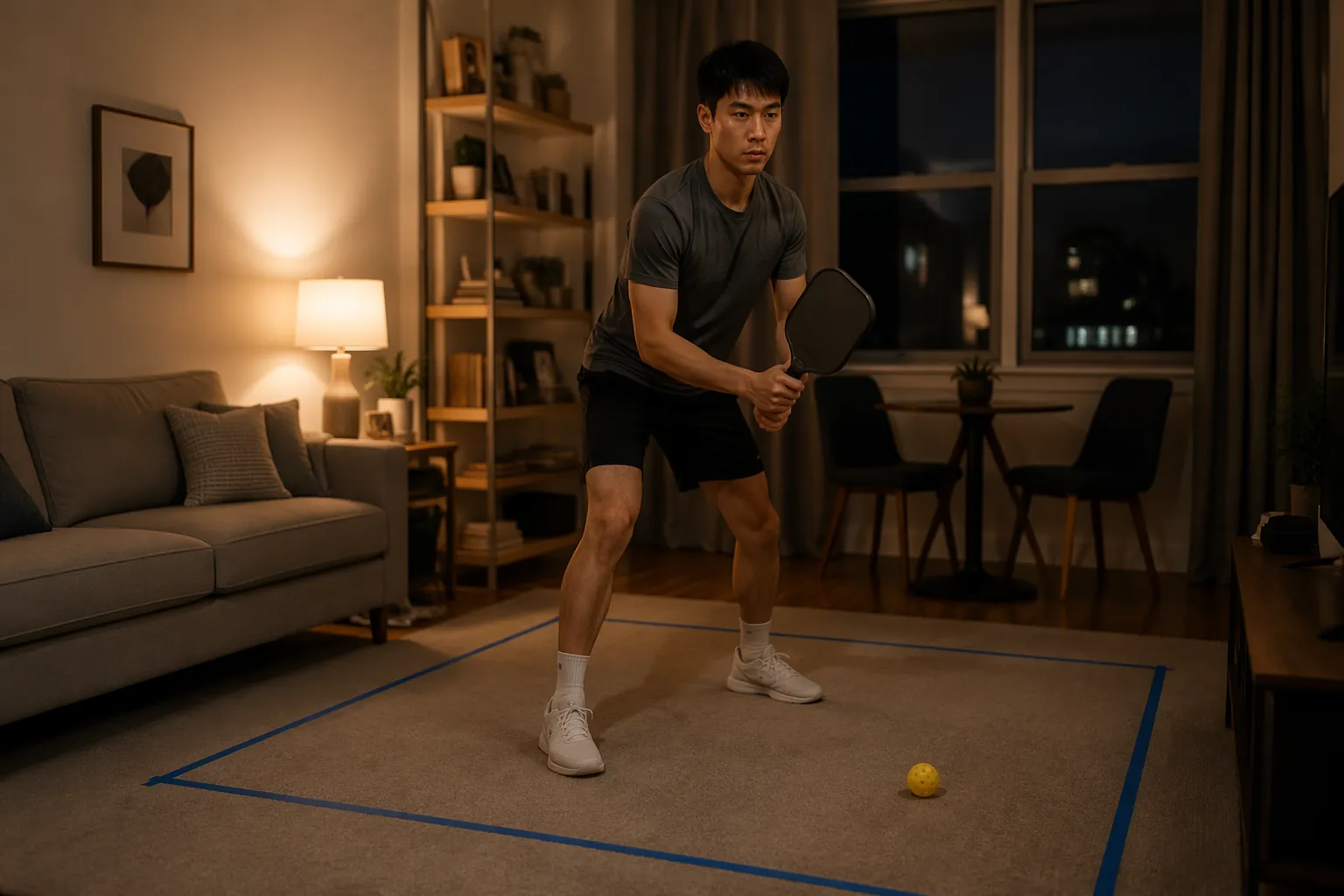
Set Up the Room Before You Practice
Most bad indoor practice sessions fail before the first rep. The ball is too loud, the floor is too slick, the paddle clips a lampshade, or the “quick drill” happens at the exact hour when the downstairs neighbor is trying to sleep. A quiet routine needs a boring setup.
- Use one foam pickleball for any contact work. Save standard hard plastic balls for the court.
- Practice on a rug or carpet if possible. If the only clear area is hard flooring, add a rug, mat, or folded towel under the contact zone.
- Mark a compact kitchen line and center line with painter’s tape, preferably on the rug rather than directly on delicate flooring.
- Give yourself a paddle-safe bubble: arm extended forward, to both sides, and overhead without touching a wall, plant, light, television, or doorframe.
- Choose neighbor-conscious hours. Late-night paddle taps are still taps.
- Start with 10–20 minutes. Longer sessions increase fatigue, missed contacts, and accidental thuds.
The footprint can be smaller than most people assume. A useful starting area is roughly a clear 6-by-6-foot space, enough for split steps, lateral resets, shadow dinks, and short target work. USAPickleball’s wall-dink setup uses a player position about 7 feet from the wall, while The Dink describes figure-8 cone movement with cones set 8 feet apart.[3][4] Those are not apartment mandates, but they show that productive solo work does not require anything close to a full court.
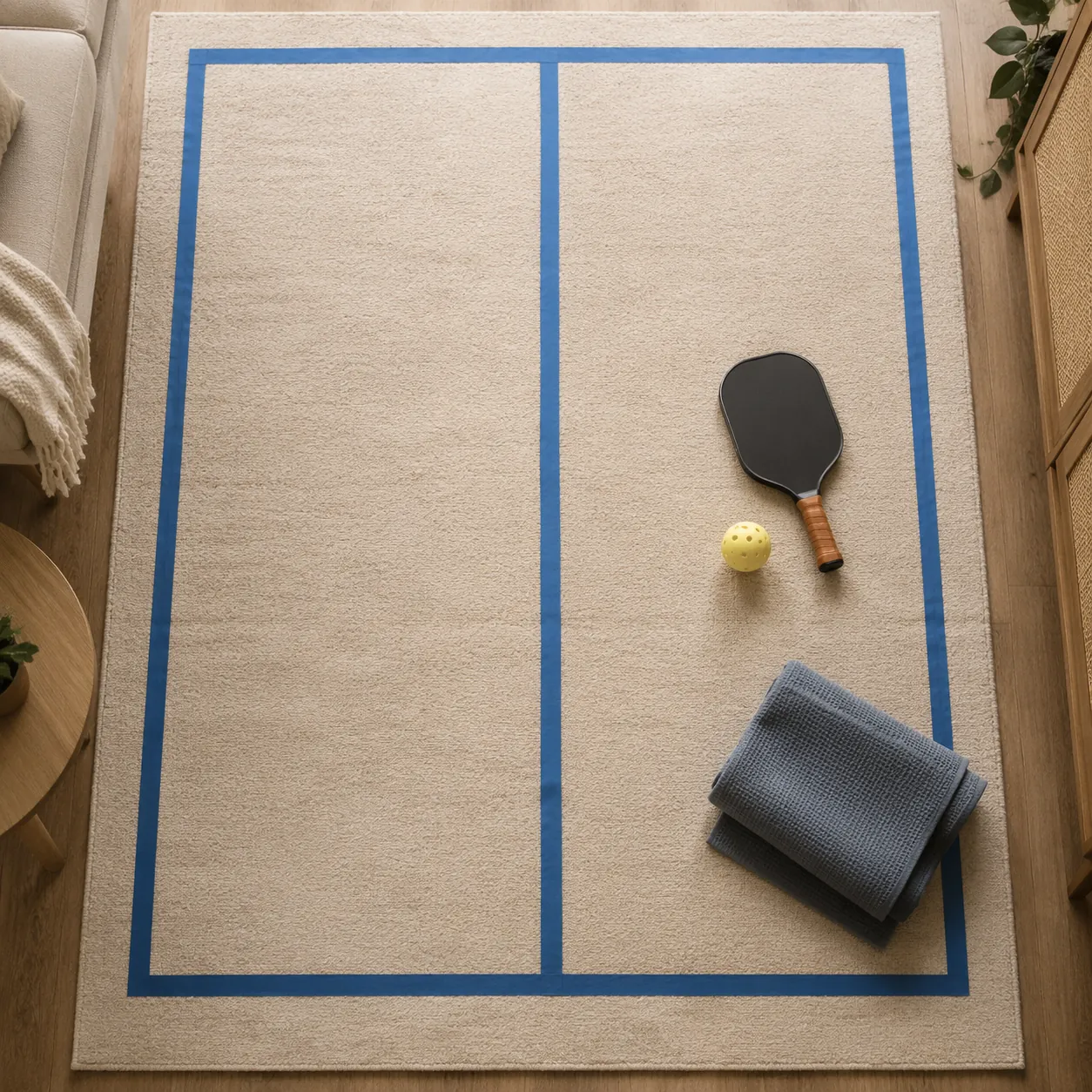
The 3-Week Quiet Progression
This routine progresses in the order an apartment can tolerate: silent mechanics first, soft contact second, combined movement third. It is meant for recreational players who already understand basic pickleball strokes and want cleaner habits before weekend games.
| Week | Main Goal | Noise Level | Primary Work |
|---|---|---|---|
| Week 1 | Build repeatable footwork and paddle paths | Silent except for footsteps | Shadow swings, split steps, kitchen-line movement, balance holds |
| Week 2 | Add controlled foam-ball contact | Low, occasional contact | Drop catches, soft taps, target dinks, short paddle-control drills |
| Week 3 | Connect movement, targets, and shot patterns | Moderate but controlled | Wall dinks, third-shot drop shadowing, figure-8 movement, target sequences |
The first week is not filler. Paddletek’s shadow-swing guidance and TopspinPro’s at-home training materials both treat ball-free repetition as a way to build muscle memory without the pressure of live contact.[5][6] For an apartment player, that benefit comes with a second advantage: the building hears almost nothing while you clean up the movements that usually make ball contact messy.
Week 1: Silent Mechanics That Actually Transfer
Do Week 1 for four or five sessions. Each session can run 12–18 minutes. Wear court shoes only if they are clean and not squeaky on your surface; socks on a rug may be quieter, but only if you are not sliding. The goal is stable, repeatable movement, not cardio.
1. Ready Position and Split-Step Reset
Stand behind your taped kitchen line with feet slightly wider than hip width, knees soft, paddle up in front of your chest. Make a quiet split step: both feet leave the floor only enough to reset your balance, then land softly. If the floor hears you, the drill is too big.
- Do 3 sets of 20 split-step resets.
- After every fifth reset, freeze and check whether your weight is forward on the balls of your feet.
- Keep the paddle face quiet. It should not swing behind your body or dip toward your knees.
This is the apartment substitute for all the wasted court seconds when a player is standing upright, admiring the previous shot, and then lunging late. The home version is smaller, but the habit is the same: reset before the next ball would arrive.
2. Kitchen-Line Shuffle
Use painter’s tape to mark a line about the width of your available space. Start in the center, shuffle two small steps right, return to center, shuffle two small steps left, return to center. Keep your toes mostly forward and your paddle in the ready window.
- Work for 30 seconds, rest for 20 seconds.
- Repeat 5 rounds.
- Do not cross your feet unless you are deliberately practicing a recovery step.
- Stop before the wall, couch, or coffee table forces your stride to change.
A smaller shuffle is not a lesser drill. At the kitchen, many useful adjustments are only a foot or two. The habit you want is moving the body behind the paddle instead of reaching across your frame and hoping your hand saves the shot.
3. Shadow Dink Path
Stand just behind the taped kitchen line. Without a ball, rehearse a forehand dink: paddle starts in front, face slightly open, movement comes from the shoulder and a soft lift through the ball path. Finish low and controlled. Then rehearse the backhand side.
- Do 25 forehand shadow dinks.
- Do 25 backhand shadow dinks.
- Do 20 alternating forehand-backhand reps with a split-step reset between each.
- Keep the imaginary contact point in front of your lead knee, not beside your hip.
The check is simple: if your paddle path would slap a real ball forward, slow it down. Apartment practice rewards the same shape that helps on court—a quiet paddle face, a short lift, and a finish you can recover from.
4. Third-Shot Drop Shadow
Move a step behind your kitchen-line mark. Imagine receiving a return that gives you time to move forward. Take one small loading step, swing low to high with a relaxed paddle face, and finish as if the ball is arcing into the kitchen. Then step in and reset at the line.
- Do 3 sets of 12 forehand-side shadows.
- Do 3 sets of 12 backhand-side shadows.
- Between reps, return to ready position instead of admiring the swing.
No one needs to hear a ball for you to practice the hardest part of the third-shot drop: arriving balanced enough to choose touch over panic.
5. Single-Leg Balance With Paddle Control
Stand on one foot with the paddle held in ready position. Without twisting your torso, move the paddle slowly from forehand block position to backhand block position. Switch legs.
- Hold 20 seconds per leg.
- Repeat 3 rounds.
- If balance fails, tap the other toe down rather than hopping.
The point is not circus balance. It is noticing whether your paddle stays calm when your lower body is doing work.
Week 2: Add Foam-Ball Contact Without Losing the Room
Week 2 is where apartment practice becomes tempting and risky. The foam ball makes contact more reasonable, but it does not make your wall, floor, or neighbor irrelevant. Keep the same 12–18 minute session length and add contact only after two minutes of Week 1 movement.
Before the first drill, do a sound check at the actual practice hour. Drop the foam ball from waist height onto the rug. Tap it lightly with the paddle. If either sound feels sharp in your room, reduce the drop height, add a towel under the contact area, or return to shadow work that day. A quiet routine is allowed to say no.
1. Drop-Catch Contact
Hold the foam ball at chest height, drop it, and cushion it upward with the paddle so it rises only a few inches. Catch it with your non-paddle hand. This is not a bounce drill. It is a touch drill.
- Do 30 forehand catches.
- Do 30 backhand catches.
- Keep the paddle face open enough to lift the ball, not launch it.
- If the ball reaches knee height after contact, you hit too firmly.
This is the safest first contact because the ball does not need to hit the floor or wall. It also teaches the hand something useful: how little force a controlled dink or reset actually needs.
2. Paddle-Up Juggles
Tap the foam ball straight up from the paddle face and keep it below eye level. Use a soft grip. If the paddle starts chasing the ball around the room, stop and reset instead of saving the rep near furniture.
- Do 5 rounds of 20 seconds.
- Rest 20 seconds between rounds.
- Alternate one round forehand face, one round backhand face.
- Cap the ball height. Low control matters more than streak length.
A foam ball can still drift into a wall. Place your body so a miss falls onto the rug, not toward a baseboard, radiator, glass cabinet, or sleeping dog.
3. Tape-Target Dinks
Put two small painter’s tape boxes on the rug in front of you. From a stationary ready position, drop the foam ball and dink it softly toward one target. Catch or stop the ball after it lands. Do not let this become a rolling chase drill.
- Aim for 10 soft forehand dinks to the right target.
- Aim for 10 soft backhand dinks to the left target.
- Then alternate targets for 20 total reps.
- Count only balls that land quietly and leave you balanced.
The scoring rule matters. A loud make is not a make. A target hit that pulls you into a lunge you could not recover from is not a make either.
4. Soft Reset From the Feet
Start with the ball in your non-paddle hand. Take one quiet shuffle step right, drop the ball, cushion it upward with the paddle, catch it, and return to center. Repeat to the left. The contact should feel like receiving speed and taking it off, even though the setup is gentle.
- Do 3 rounds of 8 reps to each side.
- Move first, then contact. Do not reach before your feet arrive.
- Keep the paddle in front of your body after the catch.
This is the Week 2 bridge: ball contact is now attached to footwork, but the ball still does not need to ricochet off anything.
Week 3: Controlled Sequences in a Small Space
Week 3 is not permission to hammer balls into drywall. It is the point where you can combine contact, movement, and targets because the quieter habits are already in place. Keep foam-ball contact on soft surfaces when possible, and use a wall only if it is not shared with a neighbor’s bedroom, office, or living room.
Wall Dinks, If Your Wall Makes Sense
USAPickleball’s wall-dink guidance places the player about 7 feet from the wall.[3] In an apartment, that distance is useful only if the wall is appropriate. An interior wall shared with a hallway may be better than a party wall shared with another unit. A concrete garage wall would be better still, but many renters do not have that luxury.
- Mark a small target on the wall with painter’s tape only if the paint can tolerate it.
- Stand close enough to dink softly, not drive.
- Work in 30-second rounds, then pause and listen.
- End the drill if the ball starts striking low baseboards, vents, or trim.
A good wall-dink session should sound more like light taps than a rally. If the wall sends the ball back too fast, step closer and soften the paddle rather than hitting harder from farther away.
Third-Shot Drop Pattern Without a Full Court
Use the same shadow third-shot movement from Week 1, then add one foam-ball contact. Start behind your taped line, drop the ball, lift it softly toward a rug target, and step forward into ready position. The target can be a tape box or a folded towel.
- Do 12 forehand-side drops.
- Do 12 backhand-side drops.
- After each contact, take two controlled steps forward and split-step at the kitchen line.
- Judge the rep by arc, quiet landing, and balanced recovery.
This drill will not recreate the pressure of a returner waiting at the kitchen. It can still improve the sequence that often breaks down first: move, lift, recover, prepare for the next ball.
Figure-8 Footwork With a Paddle
The Dink describes figure-8 movement using cones set 8 feet apart.[4] If your room cannot handle that spacing, shorten it. Use two tape marks or soft objects instead of cones, move around them in a figure-8 path, and keep the paddle up the entire time.
- Work for 20 seconds at walking speed.
- Rest for 20 seconds.
- Repeat 6 rounds.
- Add a shadow dink at each end of the pattern once the feet stay quiet.
Do not chase unsupported promises about guaranteed lateral-speed gains. Use this drill for a narrower, more reliable purpose: learning to turn, recover, and keep the paddle available in a cramped space.
Target Sequence: Dink, Reset, Drop
Set one target near your taped kitchen line and one target a few feet deeper into the rug. Start with a soft drop-catch dink to the near target. Then take one shuffle step, do a cushion reset, and finish with a controlled drop toward the deeper target.
- Run 5 slow sequences on the forehand side.
- Run 5 slow sequences on the backhand side.
- Run 5 mixed sequences where you choose the side before each rep.
- Stop the sequence immediately after a loud miss and restart from ready position.
The mixed sequence is the closest this routine gets to a real point pattern. It asks for touch, foot placement, paddle control, and recovery without turning the room into a rebound cage.
A Simple Weekly Schedule
Three to five short sessions per week is enough for this style of home practice. The apartment advantage is repeatability, not volume. A clean 15 minutes before dinner is better than a 45-minute session that gets sloppy, loud, and tense.
| Day | Week 1 | Week 2 | Week 3 |
|---|---|---|---|
| Session 1 | Ready position, split steps, kitchen shuffle | Week 1 warmup, drop-catch contact, paddle-up juggles | Warmup, wall dinks or target dinks, figure-8 footwork |
| Session 2 | Shadow dink path, balance holds | Week 1 warmup, tape-target dinks, soft resets | Third-shot drop pattern, target sequence |
| Session 3 | Full silent circuit | Soft-contact circuit | Controlled sequence circuit |
| Optional Session 4 | Repeat weakest silent drill | Repeat quietest contact drill | Repeat the sequence that stayed quietest |
If your building is especially noise-sensitive, stretch Week 1 across two weeks. There is no penalty for arriving at contact work with better balance and quieter feet.
How to Keep It Neighbor-Safe
Gatorstrike’s apartment practice guidance includes timing-window recommendations, which is the kind of unglamorous detail that decides whether a routine survives past the first week.[7] Pick a regular practice window when ordinary household noise is already acceptable. Midday, early evening, or weekend afternoon is usually easier to defend than early morning or late night.
If you have a downstairs or wall-sharing neighbor you already talk to, a short heads-up can remove mystery without making it dramatic: “I’m testing a quiet foam-ball pickleball routine for about 15 minutes in the early evening this week. If you hear anything annoying, please let me know and I’ll adjust.” That message is not a legal shield or a license to keep tapping. It is a way to make the sound identifiable and negotiable.
- Avoid shared bedroom walls for wall drills.
- Avoid bare floors for ball contact.
- Avoid max-effort movement indoors; speed makes mistakes louder.
- Remove painter’s tape after practice if your rug or floor finish is delicate.
- Keep hard balls out of the apartment routine entirely.
Also check your lease, building rules, and common-sense household limits. A foam ball lowers the impact problem; it does not override quiet hours or a roommate’s meeting on the other side of the wall.
What This Routine Can and Cannot Replace
A small-space routine cannot replace court play. It will not teach you how your dink holds up against a patient opponent, how your third-shot drop behaves in wind, or how your decisions change when someone speeds up at your chest. Those tests still belong on a court.
What it can do is remove some of the easy leaks before you arrive. You can show up with quieter feet, a paddle that stays in front, a softer first touch, and a clearer sense of how little swing many control shots need. That is a useful home outcome, especially for a renter who wants to improve without scuffing the floor, denting the trim, or sending apology texts after every practice session.
References
- Pro Silent Indoor Pickleball Ball, Hudef Sport, 2025.
- Wall Street Journal reporting on pickleball noise readings near outdoor courts, The Wall Street Journal.
- Wall Dinks, USA Pickleball.
- Figure 8 Cone Drill, The Dink.
- Shadow Swing Protocol, Paddletek.
- At-Home Pickleball Training Guide, TopspinPro.
- Apartment Pickleball Practice Guide, Gatorstrike.
What a small equipment investment adds
Cable Machine Alternatives That Save Space and Money
Compare the best cable machine alternatives for home gyms – from resistance bands and pulley systems to suspension trainers and compact digital units – and find the right option for your space and budget.
Small Treadmill Buying Guide: 7 Critical Specs to Check Before You Buy
A cross-category spec primer for apartment and small-space dwellers comparing walking pads, ultra-compact folding treadmills, and full-size folding treadmills. Learn the concrete thresholds for motor HP, deck length, noise, warranty, and subscription lock-in so you can compare apples to apples.
How to Practice Basketball at Home Without Noise Complaints
Learn how to run a full basketball workout in a small apartment without noise complaints. This guide covers no-dribble handling drills, wall form shooting, and silent ball options that let you train without disturbing neighbors.
How often should you repeat this?
See our recovery and rest reference for citation-anchored rest-interval guidance.
Spot something off?
Tell us if a movement, tier assumption, or duration didn't match your experience.