
Quiet Tennis Drills at Home for Renters
Renting doesn't mean tennis practice is off the table. Apartment-safe drills — foam-ball control, shadow swings, toss work, and visualization — plus gear and setup swaps like soft balls, removable tape, and daytime timing, keep your touch and timing ready for the court.
- Equipment tier required
- $0-100
- Duration
- 22 min
- Difficulty
- beginner
- Target area
- full body
- Space footprint needed
- one racket-length clearance on all sides
- Noise level
- low
Most advice for tennis training drills at home gets awkward the second you rent. “Find a wall and hit” sounds simple until the wall is shared, the floor is hard, the ball is regulation felt, and the room contains a lamp, a TV, a lease, and someone downstairs who did not agree to hear your forehand practice.
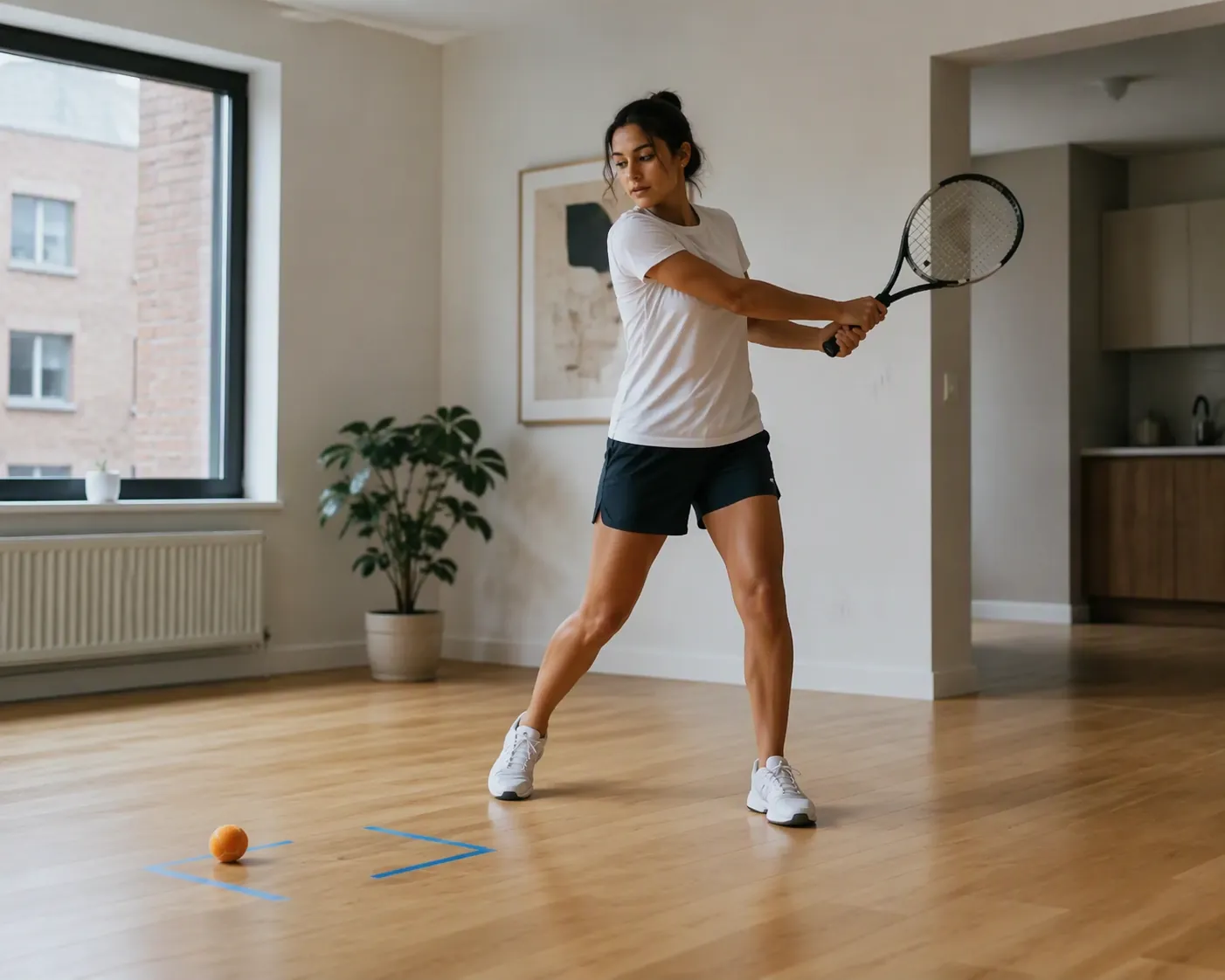
The good news is that apartment practice does not have to mean fake practice. It just has to stop pretending your living room is a court. The safest useful work is quieter and smaller: foam-ball control, toss repetition, shadow swings, slow-motion serve mechanics, light footwork, and visualization. Those drills keep touch, timing, racket-face awareness, and service rhythm alive without turning a wall into a rebound surface.
Start by changing the ball, not buying more gear
A standard tennis ball is a bad default indoors. PlayYourCourt’s at-home practice guide says regular balls are “not great indoors” and recommends foam, dead, or low-compression balls because they are quieter and greatly reduce the risk of property damage compared with live balls hit inside.[1] That one swap changes the whole risk profile: less rebound, less speed, less wall panic, less chance that a missed touch drill becomes a scuff mark you stare at until move-out.
Foam balls are the easiest renter choice for hand drills and racket-face work. Dead balls can work when you want the shape and feel of a tennis ball without lively bounce. Low-compression balls sit between those worlds: more tennis-like than foam, still less aggressive than a fresh regulation ball. None of them makes swinging indoors magically risk-free, but they lower the stakes before the drill starts.
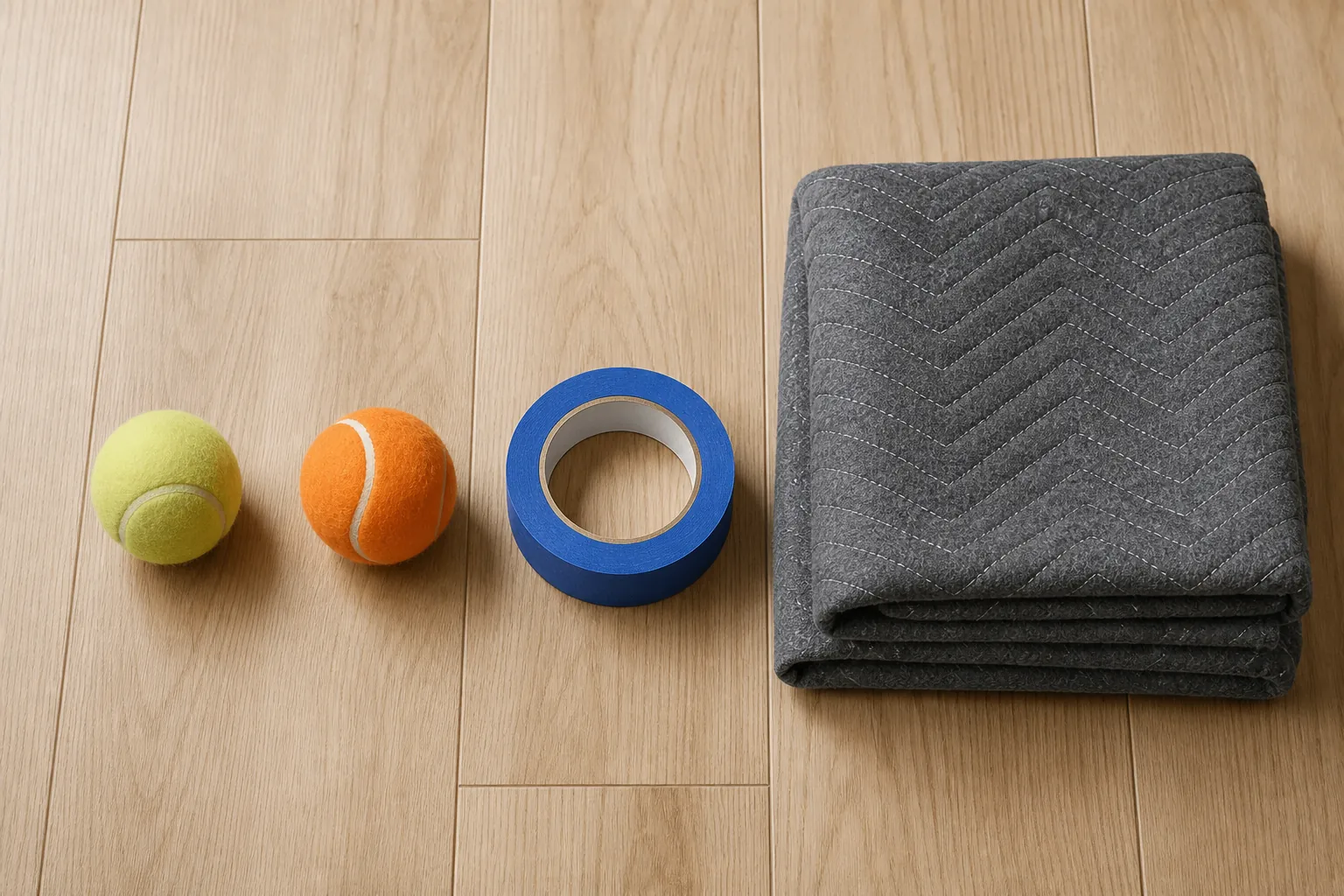
Removable painter’s tape is useful for the same reason: it creates a target without installing anything. PlayYourCourt recommends it for marking mini-courts, service boxes, and wall target zones at home.[1] The word that matters is removable. Test a tiny hidden area first, especially on painted trim, older floors, or landlord-special wall paint. If tape pulls finish, leaves residue, or makes you nervous, skip the floor map and use visual landmarks instead.
| Apartment setup choice | Why it matters |
|---|---|
| Foam, dead, or low-compression ball | Lowers bounce, noise, and damage risk compared with a live regulation ball |
| Removable painter’s tape only | Marks targets without permanent mounting or adhesive damage when the surface tolerates it |
| Cleared floor zone | Keeps racket paths away from lamps, TVs, plants, chair legs, and glass |
| Daytime or early-evening practice | Reduces the chance that even light noise becomes a neighbor problem |
| Low, light footwork | Trains readiness without stomping through the ceiling below |
Clear the room before you swing. PlayYourCourt specifically calls out moving practice away from breakables like lamps and TVs.[1] That is not fussy advice; it is the difference between a useful ten-minute drill and an expensive apology. If you cannot make a racket-length bubble in front, behind, and to both sides, do toss work, visualization, or no-racket footwork instead.
The quiet drill menu that still trains tennis
Apartment-safe practice works best when each drill has a job. It does not need to look intense. It needs to repeat the piece of tennis you are trying to preserve: touch, toss, swing path, balance, timing, or concentration.
Foam-ball bounce control
Stand in your cleared zone with a foam or very dead ball. Bounce it gently on the strings at waist height. Then lower the bounce. Then alternate forehand face and backhand face. If the ball starts drifting, the correction is smaller hands, quieter wrists, and a cleaner racket angle, not chasing it across the room.
This trains touch and racket-face awareness. You feel whether the strings are open, closed, or wobbling. On court, that same awareness shows up in volleys, drop shots, half-volleys, and emergency blocks—shots where smashing the ball harder is usually the least helpful idea.
Frame-bounce challenges
Once string bounces are easy, use the racket frame for a few controlled taps. Keep the ball low and use a foam ball so a miss does not launch into furniture. The frame gives less forgiveness than the strings, which makes tiny angle changes obvious.
This is not a party trick if you keep it slow. It makes your hand notice contact quality. If the frame challenge turns loud, fast, or mobile, it has stopped being an apartment drill.
Toss work for the serve
The serve toss is one of the best things to practice at home because it needs repetition more than space. US Sports Camps describes an at-home ball-toss drill focused on building a consistent toss position.[2] In an apartment, use a foam ball or a soft practice ball, stand where the ceiling gives you room, and toss without swinging at first.
Pick a visual window above your hitting shoulder. Release the ball smoothly. Let it rise, track whether it would land in a usable contact zone, then catch it or let it drop softly. The point is not height for height’s sake; the point is repeatability. A serve motion becomes much less mysterious when the toss stops wandering.
Mirror shadow swings
Shadow swings are the rare home drill that can be silent and useful at the same time. US Sports Camps recommends using a mirror for shadow swings, including full-speed swings followed by slow-motion analysis.[3] For a renter, the slow-motion part deserves more time than the full-speed part.
Stand far enough from the mirror that a slipped grip would not matter. Move through the unit turn, racket drop, contact position, and finish without a ball. Watch for the obvious leaks: shoulders opening too early, contact too close to the body, a collapsing wrist, or a finish that pulls you off balance. Then do the same motion at a pace slow enough that you can actually see it.
A mirror will not tell you whether the ball cleared the net. It will tell you whether your body is rehearsing the swing you think it is rehearsing.
Slow-motion serve shadowing
PlayYourCourt includes slow-motion serve shadowing in its at-home practice recommendations.[1] This is where a living room can actually beat a crowded court: there is no pressure to hit the next ball, no one waiting behind you, and no reason to rush through the positions.
Without a ball, rehearse the toss arm rising, the hitting arm loading, the trophy position, the upward swing path, and the finish. Keep the racket speed low enough that you can stop at any point. If your ceiling is low, choke up on the racket, use a shortened motion, or do the drill without the racket. Ceiling contact is not training; it is damage with a tennis theme.
Low, light footwork between tape markers
Footwork indoors should be quiet enough that you can hear your own breathing. PlayYourCourt recommends low, light footwork to avoid noise complaints during home practice.[1] That means split-step timing, small recovery steps, and controlled shuffles—not jumping, pounding, or pretending the hallway is a baseline.
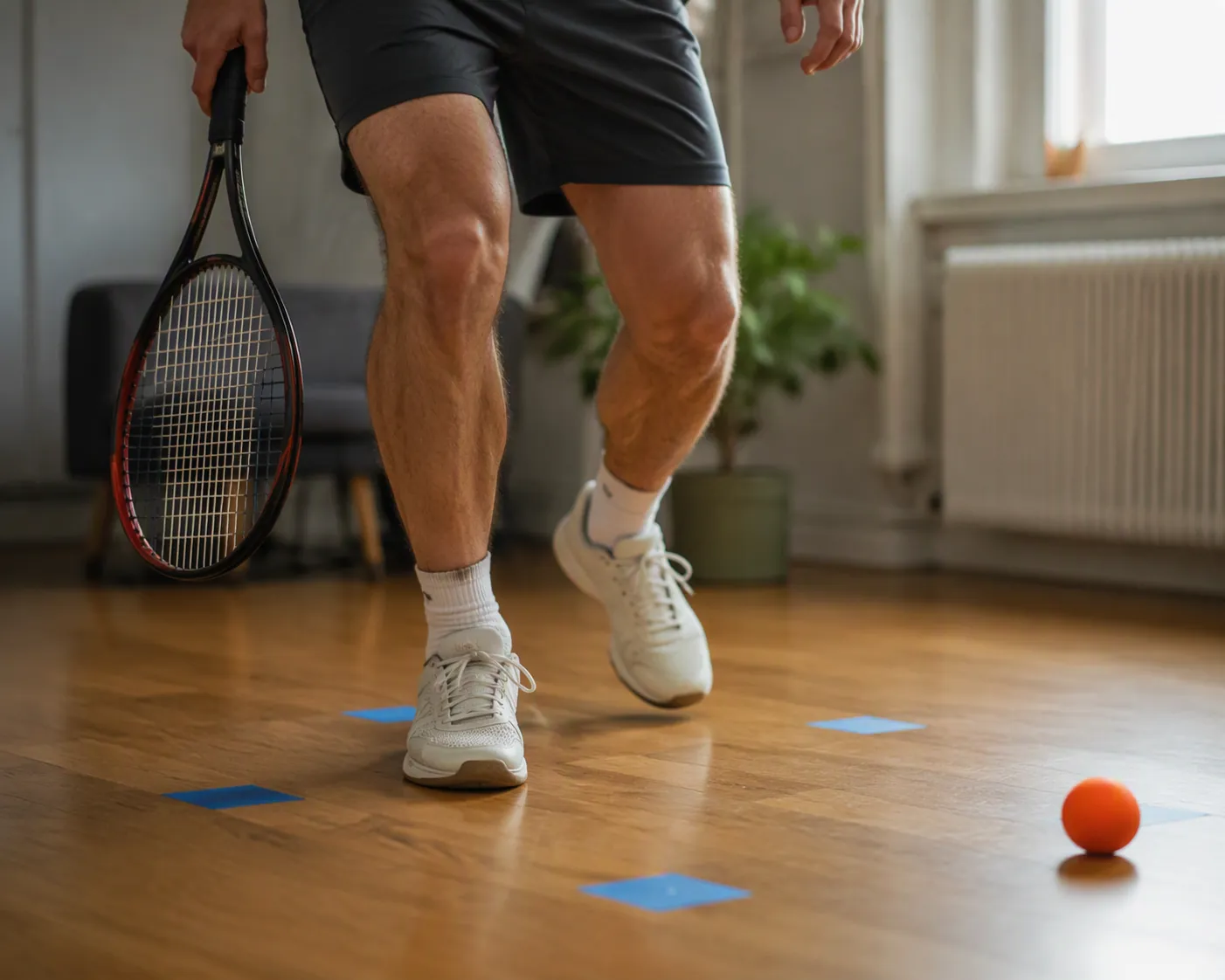
Place two or three tape markers if your floor tolerates tape. Move from ready position to marker, pause in balance, shadow the stroke, and recover. The pause matters. It keeps the drill from becoming indoor cardio and turns it back into tennis: arrive, set, swing, recover.
A renter-safe session can be short
A useful home session does not need a dramatic rep count. If you want structure, use blocks instead of chasing fatigue.
- Two minutes: clear the zone, choose the soft ball, check the floor, and set tape markers only if the surface is safe.
- Five minutes: foam-ball bounce control, alternating string face and height.
- Five minutes: serve toss work, judging whether the ball returns to a repeatable contact window.
- Five minutes: mirror shadow swings, slow enough to see the unit turn, contact spacing, and finish.
- Three minutes: low footwork between markers, staying quiet and balanced.
- Two minutes: visualization of a serve pattern, return pattern, or point routine.
That is enough for a weekday apartment session. If you want more, repeat the cleaner block, not the noisiest one. The future version of you dealing with a neighbor text does not care that the last ten minutes looked athletic.
Wall work is the exception, not the default
Some renters do have a safe wall: maybe a basement common area, a private garage, or a non-shared exterior surface where hitting is allowed. Most do not. If you are guessing whether a wall is legal, quiet, or dent-resistant, the answer is no for practice purposes.
If wall work is genuinely allowed, keep it soft and controlled. Use foam or low-compression balls. Mark a small target with removable painter’s tape only if the surface tolerates it. Practice during daytime or early evening, which PlayYourCourt recommends for reducing conflict around home tennis noise.[1] Hit at touch-drill speed, not rally speed.
The garage examples are useful mainly because they explain why impact travels. All Court Sports Guide notes that metal garage doors can dent and vibrate loudly, and says hanging a tarp or moving blanket can absorb energy and reduce noise.[4] That physics does not stop at garage doors. Hard surfaces can turn a tennis ball into a building-wide announcement, especially when the surface vibrates.
A moving blanket may help where you are already allowed to hit, but it is not a permission slip. If the setup needs hard impact, permanent mounting, or a surface you would be embarrassed to explain to a landlord, skip it.
Where bigger equipment fits
Rebounder nets, portable targets, and ball machines can be useful for players with garages, driveways, or outdoor space. They do not solve the core apartment problem by themselves. A rebounder still rebounds. A machine still launches balls. A net still needs room around it. If the building constraint is noise, impact, and limited clearance, the first upgrade is still the boring one: softer ball, clearer space, quieter timing.
Visualization is not court time, but it is not nothing
Visualization belongs near the end of an apartment routine because it is silent, safe, and surprisingly practical when the body has already rehearsed the motion. Picture a specific serve target, a return position, or the first two shots of a point. Include the pre-serve breath, the toss rhythm, the contact feel, and the recovery step. The scene should be simple enough to repeat, not a highlight reel.
A PMC-indexed article titled “The Effects of Imagery Practice on Athletes’ Performance” reports that imagery practice can affect areas including agility, muscle strength, and tennis performance, but the citation should be re-verified before treating it as a broad claim.[5] The modest takeaway is enough for this routine: a visualization block can support performance rehearsal, especially when paired with real toss work and shadow swings.
What transfers when you get back on court
Quiet tennis training drills at home will not replace live hitting. They will not teach you how a heavy topspin ball jumps, how wind changes a toss, or how your timing holds up under pressure. That boundary matters.
What they can preserve is the part that gets rusty when you do nothing: the feel of the racket face, the habit of watching the toss, the sequence of a serve motion, the spacing of a shadow forehand, the readiness of a split step, and the concentration of choosing a target before the shot. Those are real tennis skills, just practiced at apartment volume.
The line is simple. If a drill needs hard impact, late-night noise, permanent mounting, risky tape, full-speed swinging near furniture, or equipment better suited to a garage, it does not belong in a renter-safe routine.
References
- How to Practice Tennis at Home | Effective Practice Drills, PlayYourCourt
- Tennis Tip: At Home Ball Toss, US Sports Camps
- Tennis Tip: At Home Shadow Swing, US Sports Camps
- Solo Tennis Practice Garage: Your Guide to Training at Home, All Court Sports Guide
- The Effects of Imagery Practice on Athletes’ Performance, PMC/NCBI
What a small equipment investment adds
Cable Machine Alternatives That Save Space and Money
Compare the best cable machine alternatives for home gyms – from resistance bands and pulley systems to suspension trainers and compact digital units – and find the right option for your space and budget.
Small Treadmill Buying Guide: 7 Critical Specs to Check Before You Buy
A cross-category spec primer for apartment and small-space dwellers comparing walking pads, ultra-compact folding treadmills, and full-size folding treadmills. Learn the concrete thresholds for motor HP, deck length, noise, warranty, and subscription lock-in so you can compare apples to apples.
How to Practice Basketball at Home Without Noise Complaints
Learn how to run a full basketball workout in a small apartment without noise complaints. This guide covers no-dribble handling drills, wall form shooting, and silent ball options that let you train without disturbing neighbors.
How often should you repeat this?
See our recovery and rest reference for citation-anchored rest-interval guidance.
Spot something off?
Tell us if a movement, tier assumption, or duration didn't match your experience.