
How Boxing at Home Changes Your Body in 12 Weeks
A week-by-week guide to what actually happens when you start boxing at home, from early mental health improvements to measurable body changes by week eight and the full 12-week transformation.
- Equipment tier required
- none
- Duration
- 20 min
- Difficulty
- beginner
- Target area
- full body
- Space footprint needed
- 6x6 ft
- Noise level
- quiet
If you start boxing at home today, the first change probably will not be a dramatic waist drop or a sharper face. It will be the discovery that a three-minute round is long, your calves are involved, your upper back has opinions, and your breathing may fall apart before your ambition does. That is not a bad sign. It is the first honest data point.
That matters because beginners often quit inside the exact stretch when boxing is beginning to work but still looks unimpressive in the mirror. FightCamp cites the familiar fitness drop-off problem: more than 80% of New Year’s resolutions fail by March, which is less a moral failure than a mismatch between expectations and the timing of results [1]. A staged 12-week timeline is useful because it tells you what to notice before visible change arrives.
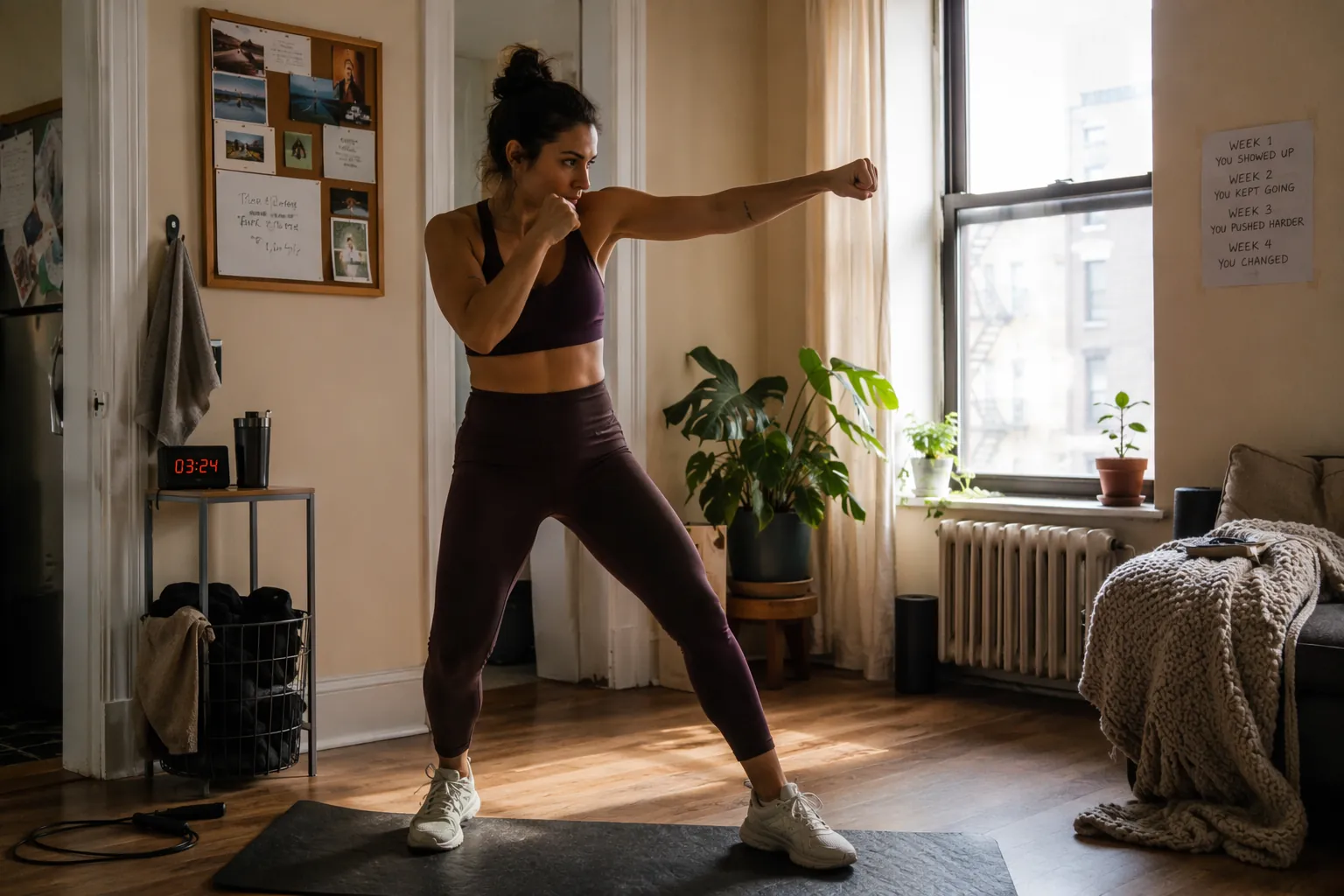
The timeline below assumes a beginner training consistently at home three times per week, starting with realistic sessions rather than fighter fantasy. Shadow Boxing App recommends three sessions per week and a 20-minute structure as a workable home starting point [2]. You need enough clear floor to step, turn, and punch without clipping a wall or lamp; for many apartment setups, that means clearing roughly a 6-by-6-foot square and accepting that your first gym is more practical than cinematic.
Basic gear can stay basic: wraps, gloves if you hit a bag, a timer, and possibly a jump rope if your floor and neighbors allow it. If you are only shadowboxing, the timer matters more than the shopping cart. Nutrition also has to be named early: boxing can raise energy expenditure and improve conditioning, but body-composition change moves much faster when food intake supports the goal.
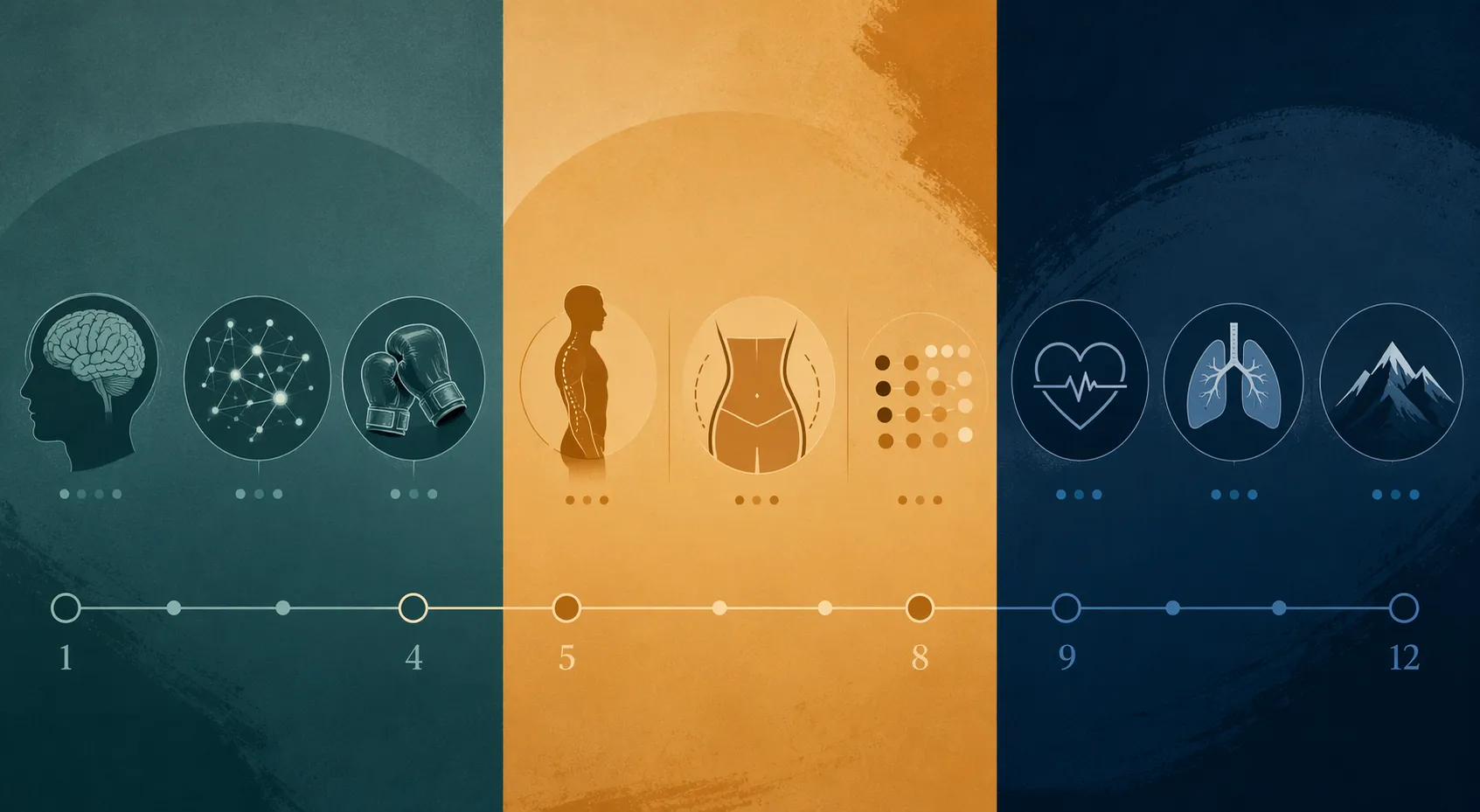
| Weeks | What usually shows up first | What not to overread |
|---|---|---|
| 1–2 | Breathlessness, calf and quad soreness, upper-back fatigue, awkward rhythm | This is not proof you are bad at boxing; it is the cost of learning a new motor pattern. |
| 3–4 | Cleaner combinations, less panic between rounds, early mood and confidence changes | Mental improvement can arrive before the mirror changes. |
| 5–6 | Posture changes, tighter waistline for some, better work capacity | Visible change is still sensitive to nutrition and total weekly activity. |
| 7–8 | Measurable differences may begin to separate: waist, body-fat trend, VO2 max, resting heart-rate trend | A scale-only judgment can miss useful progress. |
| 9–12 | Technique consolidation, harder rounds, more durable conditioning, clearer before-and-after comparison | Twelve weeks does not create elite skill or competition conditioning. |
Weeks 1–2: the body finds out boxing is not just arms
The first two weeks are usually the least glamorous and the easiest to misinterpret. A beginner expects tired shoulders. The surprise is how much the lower body works during a home boxing session: calves from bouncing and resetting, quads from sitting into stance, hips from turning punches, and upper back from holding guard and retracting punches instead of letting them flop.
You may gas out in the first round even if you can walk, jog, or lift casually. Boxing asks for repeated bursts of tension and relaxation. Beginners often stay tense the whole time: fists clenched, jaw tight, shoulders shrugged, breath held during combinations. That tension is expensive. The workout feels harder than the punches look because the nervous system has not learned what it can ignore yet.
At this stage, the right prediction is not weight loss. It is better round tolerance. If round one used to empty you, by the end of week two you may notice that you recover faster during rest periods or can finish the final 30 seconds without abandoning stance. That is a real adaptation, even if the mirror remains unmoved.
- Track whether you can finish the planned rounds without extending rest.
- Notice whether your shoulders stay lower when you jab.
- Watch whether your feet return to stance after a punch instead of crossing or freezing.
- Treat soreness in calves, quads, and upper back as expected, while sharp joint pain is a stop signal.
The useful beginner session here is simple: warm up, shadowbox in short rounds, rest honestly, and finish before your form turns into flailing. Trying to prove toughness in week one usually just teaches sloppy movement under fatigue.
Weeks 3–4: combinations begin to land, and mood may move before the mirror does
Around weeks three and four, beginners often get their first skill reward. The jab-cross stops feeling like two separate chores. A basic one-two-hook begins to have a rhythm. You can punch, reset, breathe, and move again without needing to mentally negotiate every limb.
This is where home boxing becomes unusually motivating. You do not need visible abs to feel the difference between a panicked combination and a clean one. The body starts removing small delays: the rear heel turns sooner, the guard returns faster, the exhale lines up with the punch, and the feet stop acting like they received separate instructions.
There is research support for taking these early internal changes seriously. A German randomized controlled trial cited by Honour & Glory reported reduced anxiety and depressive symptoms after three weeks of 45-minute boxing sessions [3]. That does not mean every beginner will feel calmer after the same number of workouts, but it does support a pattern many home trainees recognize: mood and confidence can improve before body composition visibly changes.
A broader mental-health signal points in the same direction, though it should be read carefully. Boxing Insider re-cited the large 2018 Lancet Psychiatry analysis in February 2026, noting that boxing was associated with a 20.1% lower mental health burden in a 1.2 million-participant dataset [4]. Associated is the important word. This kind of finding does not prove that boxing alone caused better mental health for every participant, but it makes the early mood effect worth tracking rather than dismissing as placebo or novelty.
For a beginner training at home, weeks three and four are a good time to make the workout slightly more structured. Keep the same weekly frequency, but give each round a job. One round can be jab-only footwork. One can be jab-cross with a defensive exit. One can be light continuous movement where the goal is breathing, not power. The point is not to imitate a professional camp; it is to make progress visible inside the session.
Weeks 5–6: visible changes start to become plausible
By weeks five and six, the first visible changes may appear, but they are usually quieter than marketing photos suggest. Posture often changes before size does. Holding guard, rotating through punches, and retracting the hands repeatedly can make the upper back feel more awake. When the traps, rhomboids, and rear shoulders stop acting like emergency support staff, a beginner may stand a little taller.
Some people also notice the face and waist looking slightly leaner in this phase, especially if boxing replaced sedentary evenings or came with better eating. The training itself can contribute meaningful energy expenditure. Combat-sport energy-expenditure research cited by Honour & Glory places 90-minute sessions in the 600–800 calorie range, though that number depends heavily on body weight, intensity, rest periods, and what the session actually includes [3]. A 20- or 30-minute home session should not be inflated to match a hard 90-minute combat-sport workout.
The more useful idea is accumulation. Three sessions a week, repeated for six weeks, changes the week. It adds vigorous movement, skill practice, sweat, and a reason to make dinner choices that do not erase the deficit. Without that dietary piece, boxing can still improve conditioning and coordination, but visible fat loss becomes less predictable.
This is also the window where beginners should stop judging progress only by exhaustion. A workout that feels slightly less brutal may mean you are getting fitter, not that it stopped working. If you can finish combinations with cleaner posture, recover more quickly, and add a round without form collapsing, the system is adapting.
What to track in the middle weeks
- Waist measurement once per week, under the same conditions.
- Resting heart-rate trend, if you already use a wearable.
- Number of rounds completed at the planned work-rest ratio.
- Video of one basic combination every two weeks, filmed from the same angle.
- Energy and mood after training, especially on days you did not feel motivated before starting.
Weeks 7–8: measurable change has a better chance of showing up
Weeks seven and eight are where the timeline becomes less about isolated good workouts and more about trend lines. You have enough sessions behind you for small changes to stack: more total rounds completed, less wasted tension, better foot placement, and a more reliable warm-up-to-work rhythm.
A useful body-composition anchor is a BMC Sports Science, Medicine and Rehabilitation pilot study cited by Honour & Glory. Over 12 weeks, boxing outperformed moderate-intensity brisk walking on VO2 max and body-composition measures including body fat percentage and waist circumference [3]. The study does not prove that every home trainee will see a dramatic change by week eight, and it compares specific interventions rather than every possible home routine. It does, however, support the idea that boxing can produce measurable fitness and body-composition movement across a 12-week block.
That is why week eight is a better checkpoint than week two for physical results. Earlier discomfort is mostly the body learning the demand. By the later middle of the program, you can ask better questions: is the waist measurement trending down, is the same workout producing a lower perceived effort, are you recovering faster, and do photos taken under similar lighting show posture or shape changes?
This is also when two beginners doing the same boxing sessions may begin to separate visibly. One adjusts food, sleeps enough, and keeps the three-day rhythm. Another boxes hard, snacks harder, and misses every third session. Both may improve skill. Their body-composition results will not look the same.
Weeks 9–12: the transformation is mostly consolidation
The final month is where boxing at home starts to feel less like an experiment and more like a routine you can inhabit. You are not just surviving rounds. You can assign intent: one round for speed, one for footwork, one for defense, one for a longer combination, one for steady conditioning.
Technique is still beginner technique, and that distinction matters. Twelve weeks can make punches cleaner, stance more stable, conditioning better, and movement less clumsy. It will not turn apartment shadowboxing into elite boxing skill. Without coaching, partner work, bag feedback, or sparring, you are building fitness and basic mechanics, not fight readiness.
A Muscle & Fitness 12-week case study gives one vivid endpoint: Eric Velazquez trained three times per week at Wild Card under Freddie Roach and went from 178 to 161 pounds, with body fat moving from 17% to 10% [5]. That is useful as a documented example of what can happen in a tightly structured, coached, consistent block. It is not a promise to every home beginner with a timer and a cleared living room.
For most home trainees, the better 12-week finish line is a cluster of changes: you can complete more work, combinations look less frantic, your mood has a reliable training outlet, your waist or body-fat trend may have moved, and you have enough conditioning to choose a next phase. That might mean adding bag work, following a more advanced routine, or moving into something like How to Train Like Terence Crawford at Home once the starter phase no longer feels chaotic.
A realistic 12-week reset
If you train three times per week at home, the most predictable order is mood first, coordination next, visible physical changes around the middle, and more measurable body-composition movement later. The first two weeks may feel embarrassingly hard. Weeks three and four often bring the first satisfying skill clicks. Weeks five through eight are where posture, waist, conditioning, and body-composition trends become more worth measuring. Weeks nine through twelve consolidate the work.
Boxing at home can do a lot in 12 weeks, but it has boundaries. It will not create competition conditioning without a much larger training structure. It will not guarantee major fat loss without nutrition doing its part. It will not make you technically polished just because you sweat through combinations. What it can do, reliably enough to build motivation around, is give a beginner fast internal wins while the slower physical changes catch up.
References
- How to Find Your Motivation to Work Out, FightCamp.
- How to Structure a Shadow Boxing Home Workout, Shadow Boxing App.
- Honour & Glory blog, Honour & Glory.
- The Science of Boxing Training: What 1.2 Million Americans Revealed, Boxing Insider, February 2026.
- The Ultimate Boxing Workout Plan to Get Lean and Fit, Muscle & Fitness.
What a small equipment investment adds
We don't have a build tagged to this exact tier yet. Browse all builds.
How often should you repeat this?
See our recovery and rest reference for citation-anchored rest-interval guidance.
Spot something off?
Tell us if a movement, tier assumption, or duration didn't match your experience.