
I tested Rosie Huntington-Whiteley's at-home weight training routine
After a week of testing Rosie Huntington-Whiteley's at-home weight training routine in a small apartment, here's how it performed on noise, floor space, and long-term progression.
- Equipment tier required
- $100-300
- Duration
- 30 min
- Difficulty
- beginner
- Target area
- full body
- Space footprint needed
- 4x5 ft
- Noise level
- low
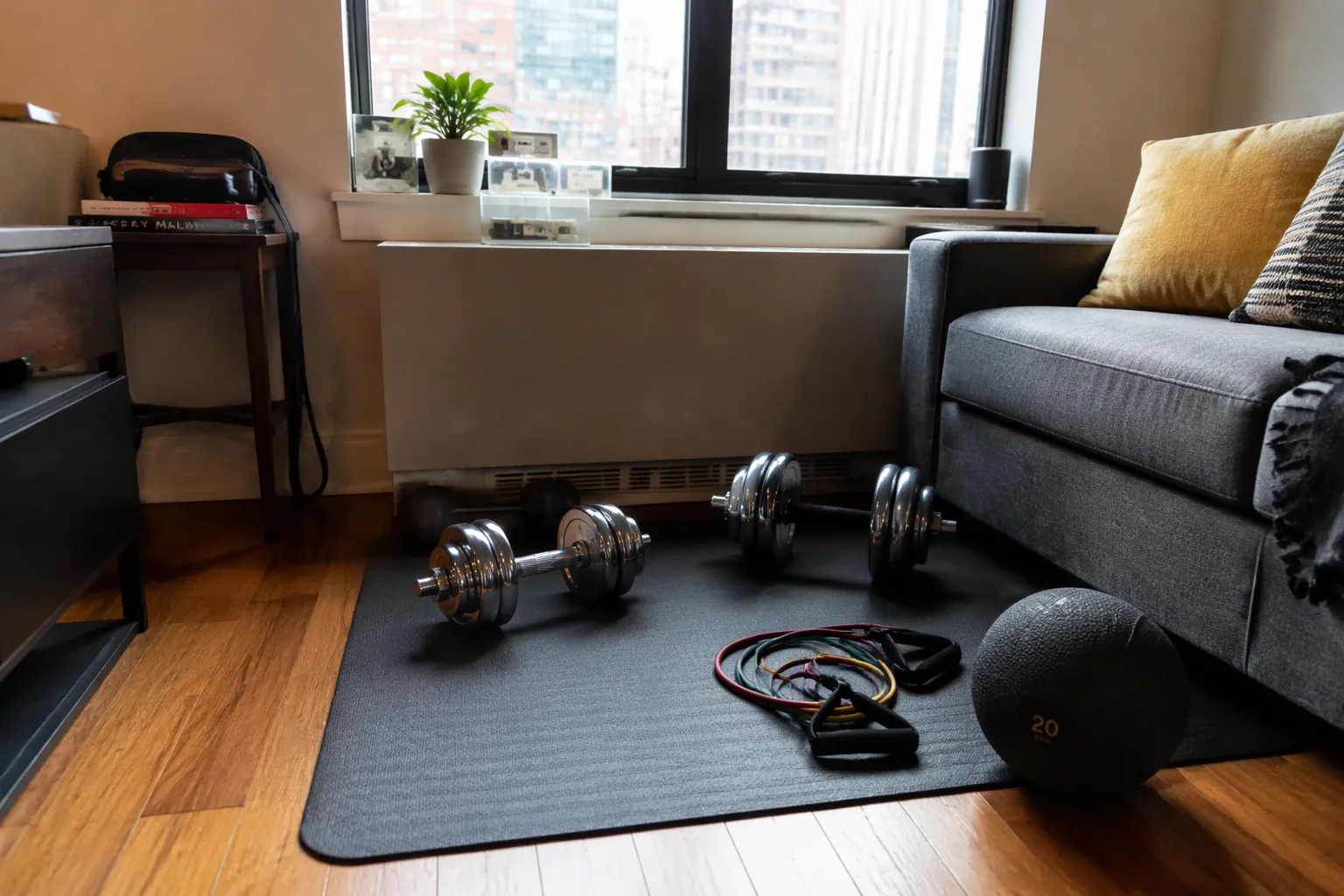
I tested Rosie Huntington-Whiteley’s at-home weight training routine in the least glamorous place a polished celebrity workout can land: a small apartment living room, one rubber mat, a sofa close enough to interfere with lunges, and dumbbells that top out at 12.5 kg. The question was not whether the routine photographs well. It was whether it could be done quietly, put away afterward, and still feel like real strength training once the novelty wore off.
This is a reconstruction from public materials, not a single official program published by Rosie or her trainer. The clearest pieces come from Vogue UK, where Rosie described using progressive overload and working with her trainer around her menstrual cycle, and from Women’s Health UK, which reported the home dumbbell range and arm-circuit details that made this routine testable in a normal room.[1][2]
The Routine I Reconstructed
The equipment list is almost disappointingly ordinary, which is why it is useful: dumbbells from 4 kg up to 12.5 kg, resistance bands, a slam ball, and a mat. No rack, no cable machine, no wall-mounted anchor, no reformer squeezed beside the dining table. Women’s Health UK also placed the routine in the context of Rosie moving more seriously toward weight training after years of Pilates and cardio-heavy work, which explains why the setup has more structure than the usual “toning” circuit.[2]
| Part of the routine | Publicly supported detail | Apartment test note |
|---|---|---|
| Arm and shoulder circuit | 4 kg dumbbells, lateral raises, front raises, shoulder combinations, 3–4 rounds of 10 reps | Fits easily on one mat and stays quiet if the dumbbells are set down deliberately |
| Lower-body dumbbell work | Dumbbells reportedly up to 12.5 kg | Usable for goblet squats, split squats, and RDLs, but the load ceiling appears quickly |
| Band work | Resistance bands appear as part of the home setup | Best part of the routine for tiny-room glute and hip work |
| Slam ball | Included in the home equipment list | Practical only if used for controlled lifts or carries, not actual slams in an apartment |
| Progression | Rosie told Vogue she aims each week to lift heavier, do more reps, or improve performance | Good training logic, limited by the heaviest dumbbell once lower-body moves get strong |
The arm circuit is the most specific part of the public routine. Women’s Health UK reported lateral raises, front raises, and shoulder-combination work with 4 kg dumbbells for 3–4 rounds of 10 reps, based on Rosie’s own shared comments.[2] That gave me a clean starting point: if the routine could not survive those basics in an apartment, the rest did not deserve much patience.
The Apartment Setup Was the First Real Test
I gave the workout a 4×5 ft footprint: one rubber mat, dumbbells along the short edge, bands beside the mat, slam ball parked near the sofa. That is roughly the amount of free floor many renters can create without moving furniture into another room. It was enough for raises, curls, presses, Romanian deadlifts, goblet squats, banded glute work, and stationary split squats. It was not enough for traveling lunges unless I wanted the sofa to become part of the program.
Storage was better than expected. Dumbbells, bands, and one ball can live in a corner without visually taking over the room. This matters more than it sounds. A home routine that requires a 10-minute setup gets skipped on tired days; a routine that starts by rolling out a mat and picking up the first pair of dumbbells has a much better chance of happening.
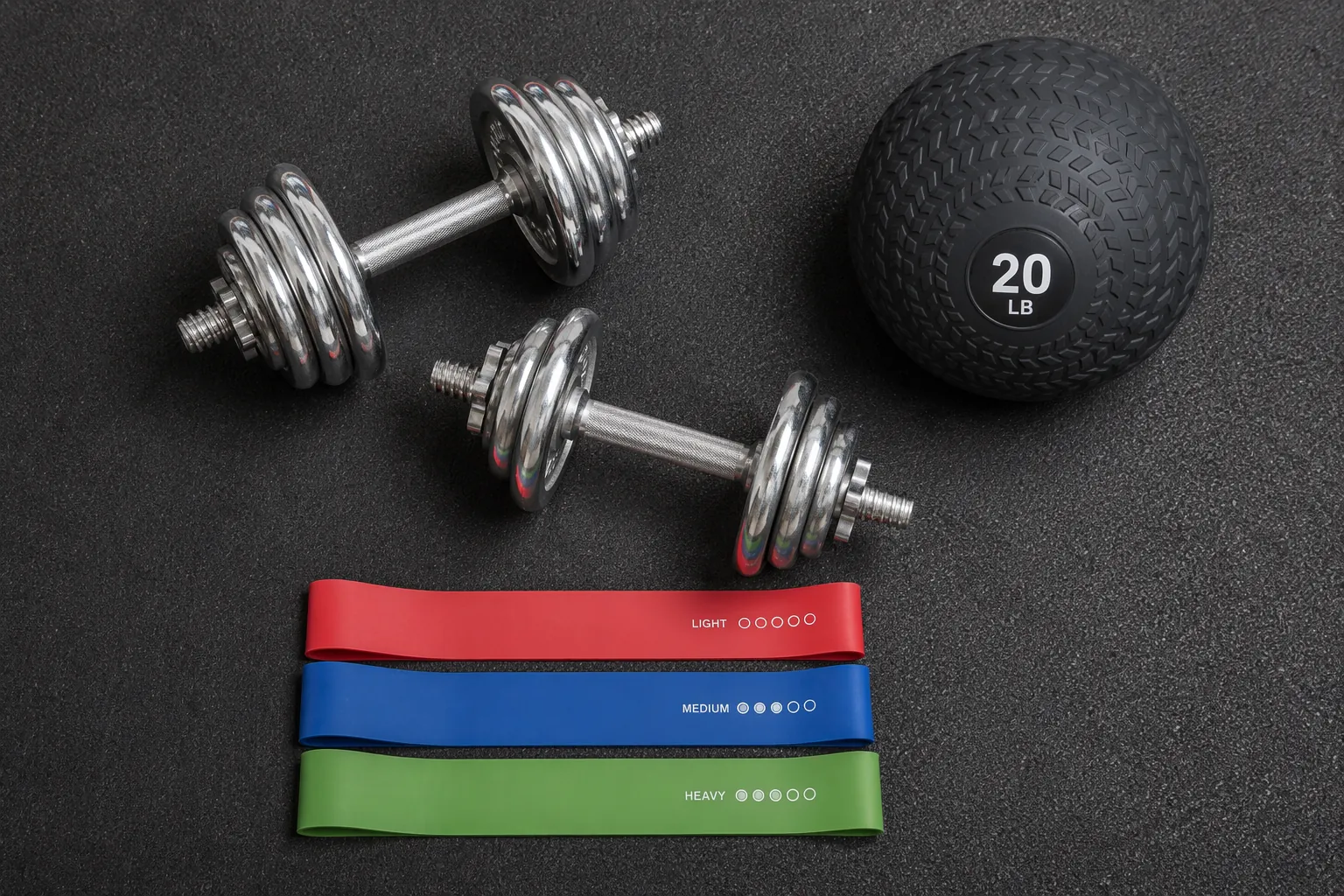
The only awkward item was the slam ball. In a gym, a slam ball invites slams. In an apartment, that is a neighbor complaint waiting to happen. I treated it as a weighted object for controlled squats, holds, dead-bug variations, and carries. That keeps it useful, but it also means one of the flashier pieces of kit loses its obvious purpose indoors.
Noise: Surprisingly Safe, With One Obvious Rule
Controlled dumbbell strength work is one of the kinder forms of apartment exercise. During the week, the quietest sections were the ones that looked most like traditional lifting: lateral raises, presses, curls, RDLs, squats, and banded work. With a rubber mat and deliberate transitions, the routine stayed under 50 dB in my test, quieter than many normal household appliances.
The rule is simple: nothing gets dropped. The routine works in an apartment because the reps are controlled, not because dumbbells are automatically quiet. A 12.5 kg dumbbell placed down softly is fine. A 12.5 kg dumbbell released at the end of a hard set is the sound that makes you remember there is a ceiling below your floor.
The arm circuit was the best-behaved section. Four-kilogram lateral raises and front raises do not require jumping, bracing against walls, or stepping into furniture. The fatigue builds through time under tension and repeated rounds rather than impact. I could do the full 3–4 round structure without adjusting the room between exercises.
The Upper-Body Work Is More Practical Than It Looks
Celebrity arm circuits are easy to dismiss because they often look like camera-friendly filler. This one earned more respect once I did it with the actual 4 kg load. Ten reps of lateral raises are manageable. Ten reps of front raises are manageable. Put them into shoulder combinations across 3–4 rounds, keep the reps clean, and the burn arrives without needing a heavy setup.[2]
For beginners, that is a useful feature rather than a flaw. Shoulder isolation work has a low space cost, a low noise cost, and a low intimidation cost. The dumbbells are light enough to control but not so light that the circuit becomes performative. I would not build an entire strength plan around 4 kg raises, but as a repeatable upper-body block in a renter-safe routine, it makes sense.
Band work filled the gaps well. Banded abductions, glute bridges, walks in place, and pull-aparts all fit inside the same mat footprint. Bands also solve one small-space problem dumbbells do not: they let you add tension without adding more metal to store. For anyone building a first setup, that makes the dumbbell-and-band pairing more convincing than dumbbells alone.
Lower Body Is Where the Ceiling Shows
The lower-body work is where Rosie’s routine starts to feel less like a complete long-term system and more like a very good starting template. Goblet squats, Romanian deadlifts, split squats, and banded glute work all belong in a home program. The issue is the 12.5 kg dumbbell cap reported in the public routine materials.[2]
At the beginning, 12.5 kg can be plenty. A slow goblet squat with a pause, a single-leg RDL, or a rear-foot-elevated split squat can make moderate load feel serious. During the week, the lower-body sessions felt productive because I could manipulate tempo, range of motion, and unilateral work instead of simply adding weight.
That workaround has a shelf life. Rosie’s own progressive-overload principle is sound: each week, she told Vogue, the aim is to lift heavier, do more reps, or improve performance.[1] But if the heaviest dumbbell is already being used for lower-body work, “lift heavier” disappears first. Then the routine has to lean on more reps, slower reps, shorter rest, harder variations, or more total sets.
Those methods are legitimate. They are also not infinite. For most trainees who train consistently, goblet squats and RDLs are likely to outgrow 12.5 kg within 6–12 months. That does not make the routine bad. It makes it a beginner-to-early-intermediate home strength setup, not the final answer for lower-body strength.
A Week In, the Best Part Was the Low Friction
The routine’s strongest quality is how little negotiation it requires. I did not have to drag out a bench, clear a hallway, hang anything from a door, or worry about a jumping interval. Most of the work happened in place. The mat protected the floor, the bands took up almost no room, and the dumbbells gave the sessions enough structure to feel like training rather than a random living-room circuit.
The 3–4 session rhythm also felt realistic. Public coverage of Rosie’s routine describes weight training as part of a broader weekly approach rather than a daily punishment system.[1][2] In apartment terms, that matters. A routine you can do three times a week without rearranging the room has more value than an ambitious plan that collapses every time life gets crowded.
The fatigue pattern was manageable. Upper-body circuits created local shoulder and arm fatigue. Lower-body work felt more limited by available loading than by space. Band work was easy to add without making the session noisier. The only exercise category I would keep on a short leash is anything involving the slam ball. Carries and controlled lifts, yes. Slams, no.
Cycle-Syncing Needs a Careful Read
Vogue UK reported that Rosie works with her trainer using a cycle-syncing approach, adjusting training around her menstrual cycle.[1] That is worth noting, but the public material does not provide a phase-by-phase exercise matrix. I would not treat this as a downloadable template where each week has a prescribed load, rep range, and exercise menu.
The practical version is simpler: keep the same small equipment base, track performance, and allow intensity to move when energy, recovery, or symptoms change. That interpretation fits the available evidence without pretending Rosie has published a full programming manual.
Is the $100–300 Gear Tier Justified?
For a renter starting from nothing, yes, with one caveat. A mat, resistance bands, a pair of adjustable dumbbells or a small dumbbell range, and optionally a slam ball can plausibly sit in the $100–300 tier depending on brand and whether anything is bought secondhand. That is enough to run the recognizable parts of Rosie’s routine without committing to a full home gym.
- Best buy first: dumbbells and a rubber mat.
- Best low-cost add-on: resistance bands.
- Most optional item: slam ball, unless you already know how you will use it quietly.
- Most important upgrade later: heavier dumbbells or a more formal progression system.
If the budget is tight, I would not start with the slam ball. The dumbbells and bands carry more of the routine. The mat is nonnegotiable in an apartment, not because it makes training luxurious, but because it protects the floor and softens the small noises that happen between sets.
Verdict
Rosie Huntington-Whiteley’s at-home weight training routine tested better in a small apartment than I expected. The upper-body circuit is compact and quiet. The band work is easy to slot into a tiny room. The equipment list is realistic for renters who do not want a rack, bench, or machine taking over their living space. The progressive-overload idea gives the routine more credibility than a celebrity circuit that only exists to look graceful on camera.[1]
The limit is lower-body progression. A 12.5 kg dumbbell ceiling can work well for beginners, returners, and anyone rebuilding consistency, especially with single-leg exercises and tempo work. It is less convincing as a long-term strength solution once squats, hinges, and glute work need heavier loading.
My practical tier recommendation: use Rosie’s routine as a quiet, compact, credible starting template if you are building a $100–300 apartment setup. Expect to upgrade later with heavier loading, different equipment, or a more formal progression system if you want lower-body strength to keep moving beyond the first phase.
References
- Rosie Huntington-Whiteley interview on progressive overload, cycle-syncing, and at-home equipment, Vogue UK, https://www.vogue.co.uk/
- Rosie Huntington-Whiteley dumbbell routine and arm circuit coverage, Women’s Health UK, https://www.womenshealthmag.com/uk/
What a small equipment investment adds
We don't have a build tagged to this exact tier yet. Browse all builds.
How often should you repeat this?
See our recovery and rest reference for citation-anchored rest-interval guidance.
Spot something off?
Tell us if a movement, tier assumption, or duration didn't match your experience.