
Safe Home Workouts After Hysterectomy, Week by Week
A week-by-week plan for safe home exercise after hysterectomy, from early breathing and walking to gradual strength work after clearance. It covers how the timeline differs by surgical route and the warning signs that mean you should ease off.
- Equipment tier required
- none
- Duration
- 5-30 min
- Difficulty
- beginner
- Target area
- full body
- Noise level
- low
Safe home workouts after hysterectomy recovery start with a route check. Laparoscopic, vaginal, and abdominal hysterectomy recoveries do not move at the same speed, even though the earliest safe movements look surprisingly similar: breathing, circulation work, careful bed mobility, and short walks. The useful question is not whether a movement sounds “gentle.” It is whether that movement fits your surgical route, your week of recovery, your surgeon’s instructions, and your symptoms today.
The Royal College of Obstetricians and Gynaecologists encourages a regular, gradual build-up after laparoscopic hysterectomy and states that there is “no evidence that normal physical activity levels are in any way harmful,” while still placing that activity inside a recovery plan rather than a free-for-all [1]. The NHS gives the broader route split clearly: full recovery after abdominal hysterectomy is often about 6–8 weeks, and recovery is generally shorter after vaginal or laparoscopic surgery [2].
| Surgical route | What usually changes | What does not change |
|---|---|---|
| Laparoscopic hysterectomy | Often a faster early recovery. RCOG says many women can walk 30–60 minutes after 2–3 weeks and most return to previous activity within 4–6 weeks, if recovery is uncomplicated [1]. | You still need symptom-based stop rules, gradual walking, no rushing heavy lifting, and surgeon clearance before strength work. |
| Vaginal hysterectomy | Usually shorter recovery than abdominal surgery, though the exact pace depends on the operation, repairs done at the same time, bleeding, pain, and your clinician’s instructions [2]. | The early home plan is still breathing, circulation work, careful movement, short walks, and pelvic floor only once catheter removal and urination make it appropriate. |
| Abdominal hysterectomy | Generally the slowest route because the abdominal wall incision changes how loading, twisting, getting out of bed, and lifting feel. NHS describes full recovery as about 6–8 weeks [2]. | The six-week point is still a milestone, not a finish line. Walking can build gradually, but strength loading needs more caution and clearance. |
This is general education, not a substitute for your surgeon’s or pelvic-health physiotherapist’s plan. If your discharge papers are more conservative than anything here, follow them. If you had complications, significant blood loss, prolapse repair, endometriosis excision, cancer treatment, or other procedures at the same time, your timeline may be different.
Days 0–2: circulation, breathing, and getting upright
The first “workout” is not a workout in the usual sense. It is a set of small actions that reduce stiffness, support circulation, help your lungs clear, and let you get out of bed without bracing hard through your abdomen.

Bedfordshire Hospitals NHS Trust lists ankle pumps, deep breathing, huffing, and careful bed mobility among exercises that can be carried out after hysterectomy [3]. These are the kinds of movements that belong in the first day because they do not ask the healing tissues to prove anything.
- Ankle pumps: point and flex your feet while lying or sitting. Think of this as circulation work, not leg training.
- Deep breathing: breathe into the lower ribs and belly without forcing a hard abdominal expansion.
- Huffing: use a gentle open-mouth “huff” if you need to clear your chest, rather than a hard cough that makes you bear down.
- Getting out of bed: roll to your side first, use your arms, and come up through your side rather than sitting straight up like a crunch.
- First walks: once you are home and cleared to be up, walk short, easy distances around the room or hallway.
At this stage, “more” is not automatically better. A few minutes repeated across the day is usually more useful than one determined effort that leaves you sore, dizzy, or bleeding more.
Pelvic floor work waits for one practical checkpoint
Pelvic floor exercises are often safe early, even with stitches, but the timing matters. RCOG and Bedfordshire both place pelvic floor work around day 1–2, once your catheter has been removed and you can pass urine [1][3]. That detail matters because the point is not to push ahead while your bladder is still being managed for you.
A typical early prescription from these sources is 10 longer squeezes, building up to 10 seconds each, plus 10 short squeezes, at least 3 times a day [1][3]. Keep the effort clean: lift and release, keep breathing, and avoid clenching your buttocks or holding your breath. If you cannot feel a release, reduce the effort or stop and ask for help; an over-gripped pelvic floor is not better than an inactive one.
Weeks 1–2: short flat walks, light daily tasks, no heroics
Walking is the main training tool in the first two weeks. It is adjustable, it gives you immediate feedback, and it does not require you to guess whether a “gentle core” move is secretly too much. A practical physiotherapy progression from Michelle Kenway’s Pelvic Exercises guidance starts with short, flat walks of about 5 minutes in weeks 1–2, building toward about 10 minutes by the end of week 2 if symptoms stay quiet [4].
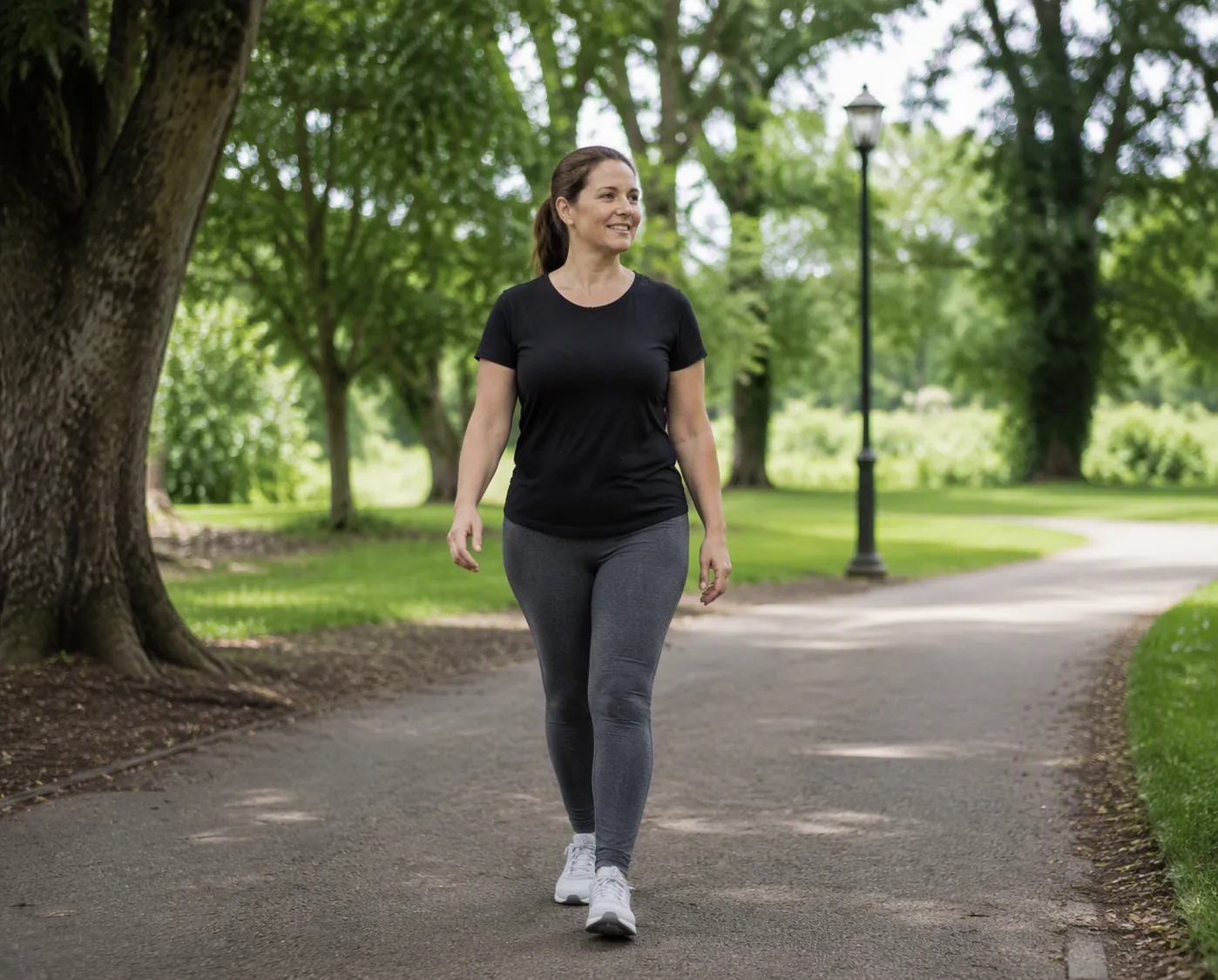
Flat matters. This is not the week to chase hills, treadmill incline, weighted vests, fast intervals, or a step-count number from your pre-surgery life. If a five-minute walk feels fine while you are doing it but produces pelvic heaviness, increased abdominal pain, or more bleeding later that day, the walk was too much for today.
Housework counts as loading. RCOG advises keeping to light loads in the first 1–2 weeks, using an example such as a 1-liter bottle of water, and avoiding heavy objects, full shopping bags, lifting children, vacuuming, and strenuous housework until later [1]. That advice is more useful than a vague instruction to “take it easy,” because many women will rest from exercise and then accidentally do a workout by stripping beds, carrying laundry, or pushing a vacuum.
| If you want to do something | Choose this | Skip this for now |
|---|---|---|
| You feel stiff after sitting | Stand up, breathe, walk around the room, do ankle pumps | Long stretching sessions, deep twisting, floor-based flows that are hard to get out of |
| You want a walk | Short, flat, easy walk; stop before fatigue changes your posture | Hills, speed walking, treadmill incline, long errands |
| You want to help at home | Light tasks at waist height in short bouts | Vacuuming, heavy laundry baskets, full grocery bags, lifting children |
| You miss core work | Breathing, posture resets, gentle pelvic floor after catheter removal and urination | Crunches, planks, Pilates hundreds, leg lowers, loaded carries |
Weeks 3–4: increase walking before you add exercise variety
By weeks 3–4, the temptation is often to shop for a beginner routine. A safer move is to make walking more consistent first. The Pelvic Exercises walking progression adds about 5 minutes per week, aiming toward roughly 20 minutes by week 4 when recovery is uncomplicated [4]. RCOG also notes that many women can walk 30–60 minutes after 2–3 weeks after laparoscopic hysterectomy, but that is not a demand; it is a possible range for many, not a minimum standard [1].
For laparoscopic or vaginal recovery, these weeks may feel like a clear upswing. For abdominal recovery, the incision may still make rolling, standing tall, and walking farther feel more effortful. The route difference should change your pacing, not your stop rules.
- Increase only one variable at a time: duration, frequency, or terrain.
- Keep walks easy enough that you can speak in full sentences.
- Use the next 24 hours as part of the test. A walk is not “cleared” just because it felt fine in the moment.
- If symptoms increase, return to the last distance that felt boringly safe.
Some restrictions also begin to loosen around this period, depending on your route and your clinician’s plan. RCOG’s patient guidance keeps heavy objects, full shopping bags, children, vacuuming, and strenuous housework out until about 3–4 weeks [1]. That does not mean week 4 is the day to catch up on every chore you skipped. It means some tasks may re-enter in small pieces if your symptoms and instructions allow it.
Weeks 5–6: the check-in is coming, but you are not done healing
By weeks 5–6, a continuous 30-minute walk may be realistic for some women, especially after laparoscopic or vaginal surgery. Kenway’s walking progression builds toward about 30 minutes by week 6, and RCOG places many women’s return to previous activity after laparoscopic hysterectomy within about 4–6 weeks [4][1]. That combination can make week 6 feel like the finish line. It is better treated as a review point.
If bleeding has stopped, some low-impact options such as swimming or a stationary bike may be allowed around this stage, but only if your surgeon clears them and the activity does not provoke symptoms. Contact sports and power sports should wait at least 6 weeks in RCOG’s guidance [1]. For home exercise, this is still not the moment to stack squats, planks, mountain climbers, and heavy dumbbells into a “low impact” circuit just because nothing involves jumping.
Lifting rules are where tidy advice gets especially slippery. RCOG uses light-load examples early, while Dana-Farber’s hysterectomy recovery guidance tells patients not to lift anything over 20 pounds for 6 weeks [1][5]. Those are institution-specific instructions, not proof that one number is universally safe for every route, body, incision, and repair. Your discharge instructions win.
Weeks 6–8: start graded strength only after clearance
If your surgeon clears exercise at the six-week visit, interpret that as permission to begin graded rebuilding, not permission to resume your old training week. The body can feel outwardly normal before the deeper tissues are ready for high pressure, heavy bracing, or fatigue-driven form.
The healing data are a useful brake on impatience. A review on activity restrictions after gynecologic surgery notes that abdominal fascia has regained only 51–80% of original tensile strength at 6 weeks, 70–80% at 17 weeks, and 73–93% by 20 weeks, and that it never fully returns to original tensile strength [6]. That does not mean you must lie low for 20 weeks. It means progressive loading should behave like progressive loading, not like a switch has flipped.
A reasonable post-clearance home strength session is short and deliberately underwhelming at first. Think sit-to-stand from a chair, wall push-ups, gentle hip hinges without weight, heel raises, supported step-ups, and light band rows if they do not cause bearing down, pelvic heaviness, incision discomfort, or delayed pain. Keep breathing through the effort. Stop before you need to brace hard.
| Training piece | Good first version after clearance | Progress later, if symptoms stay quiet |
|---|---|---|
| Lower-body strength | Sit-to-stand from a chair; small-range supported squat | Deeper range, more reps, then external load |
| Upper-body push | Wall push-up | Counter push-up, then lower surfaces gradually |
| Hip hinge | Hands-supported hinge with no weight | Light object held close to the body, then gradual load |
| Core reconnection | Breathing, posture, pelvic floor coordination | Dead-bug-style arm or heel slides only if cleared and pressure-free |
| Conditioning | Walking or easy stationary cycling if cleared | Longer duration before higher intensity |
If you use an app after clearance, choose one that lets you downshift, repeat beginner sessions, and avoid core pressure rather than one that keeps nudging you toward streaks. The pelvic-floor and core-reconnection lens in prenatal and postpartum fitness apps can be useful because the programming often respects breath, pressure, and gradual rebuilding. For women returning to broader training in perimenopause or menopause, workout apps for women over 40 may fit later, once the recovery layer is no longer the main limiter.
The stop rules matter more than the exercise label
A movement can be called gentle and still be wrong today. A walk can be safe on Monday and too much on Wednesday if you slept badly, stood too long, or added errands. Use symptoms as data, not as a character judgment.
- Stop or scale back if you notice increased abdominal, pelvic, or lower-back pain during or after activity.
- Stop or scale back if bleeding or discharge gets heavier after movement.
- Stop if an incision begins oozing or feels newly irritated after activity.
- Treat pelvic heaviness, dragging, or pressure as a sign to reduce load and ask for clinical guidance if it persists.
Call your doctor urgently for fever of 100.4°F or higher, bleeding that soaks a pad within an hour, foul-smelling discharge, leg swelling, redness, or warmth, or chest pain. These are not workout-adjustment issues; they need medical advice.
Why the guidance is cautious, and why it still has limits
Post-hysterectomy exercise guidance is more consensus-based than many people realize. Nygaard and colleagues note that no randomized trial or prospective cohort study directly tests whether post-operative activity affects surgical success after gynecologic surgery [6]. That is one reason lifting limits and timelines vary between institutions.
For a U.S. reader, the practical details can feel scattered. The richest step-by-step recovery protocols in this material come from UK and Australian patient and physiotherapy sources, while U.S. institutions tend to give broader restrictions such as a lifting cap or a six-week review. That does not make the step-by-step guidance useless. It means it should be read as a conservative recovery map, then filtered through your surgical route and your own clinician’s instructions.
After week 8: build back toward normal adult activity
After the first 8 weeks, many women are moving out of recovery-only exercise and toward normal adult training again. The eventual public-health baseline is not exotic: the CDC recommends 150 minutes of moderate-intensity physical activity weekly plus 2 days of muscle-strengthening activity for adults, and ACSM reflects the same broad target [7][8]. The post-hysterectomy path back to that baseline should still be layered: walking consistency first, then low-impact conditioning, then light strength, then heavier and more complex training.
If you were active before surgery, the hard part may be accepting that “cleared” and “conditioned” are different states. Your first few strength sessions may feel embarrassingly easy. Good. Easy is how you find the line without crossing it. Add reps before load, load before speed, and simple patterns before complex circuits.
Later, when you are no longer managing surgical symptoms, broader training tools such as exercise apps that sync with your cycle or hormonal tracking may help organize workouts again. In the recovery window, though, the hierarchy stays plain: your surgeon’s instructions first, your body’s warning signs second, the calendar third, and the workout plan last.
References
- Laparoscopic hysterectomy – recovering well, Royal College of Obstetricians and Gynaecologists
- Hysterectomy – Recovery, NHS
- Exercises that can be carried out after a Hysterectomy, Bedfordshire Hospitals NHS Trust
- Walking After a Hysterectomy Weeks 1–6, Pelvic Exercises / Michelle Kenway
- Recovering From Your Hysterectomy, Dana-Farber Cancer Institute
- Activity Restrictions after Gynecologic Surgery, International Urogynecology Journal
- Adult Activity: An Overview, Centers for Disease Control and Prevention
- Physical Activity Guidelines, American College of Sports Medicine
What a small equipment investment adds
We don't have a build tagged to this exact tier yet. Browse all builds.
How often should you repeat this?
See our recovery and rest reference for citation-anchored rest-interval guidance.
Spot something off?
Tell us if a movement, tier assumption, or duration didn't match your experience.