
Your Apartment-Friendly SF Marathon Training Plan
Training for the hilly SF Marathon from a small apartment requires a smart weekly split and quiet strength moves. This guide shows you how to build race-ready glutes, quads, and core using just a yoga mat, bands, and dumbbells — without bothering your neighbors or needing a treadmill.
- Equipment tier required
- $0-100
- Duration
- 30 min
- Difficulty
- intermediate
- Target area
- lower body
- Space footprint needed
- 6 ft x 6 ft
- Noise level
- low
Start with the course your legs are actually training for
The 2026 San Francisco Marathon weekend has just passed, which makes this the useful window for 2027 planning rather than last-minute scrambling. If you are training for the SF Marathon from an apartment, the answer is not to pretend your living room is a hill. The running still happens outdoors. The apartment becomes the quiet strength, cross-training, and recovery base that makes those outdoor miles hold up.
The full course asks for roughly 1,303 feet of total elevation gain, with major climbs around miles 7, 12, and 16, plus descents around miles 10, 14, and 21. That is more gain than Boston’s 815 feet and less than Big Sur’s 2,182 feet, which is a helpful calibration: San Francisco is not the steepest famous marathon, but it is not a flat-city race with a bridge photo attached either. The same SF Marathon pacing guide estimates the course elevation adds about 3:47 compared with a flat marathon, using John Kellogg’s formula and Noakes’ Lore of Running rules; that number is best treated as pacing context, not a receipt for exactly how much time the hills will take from you. [1]
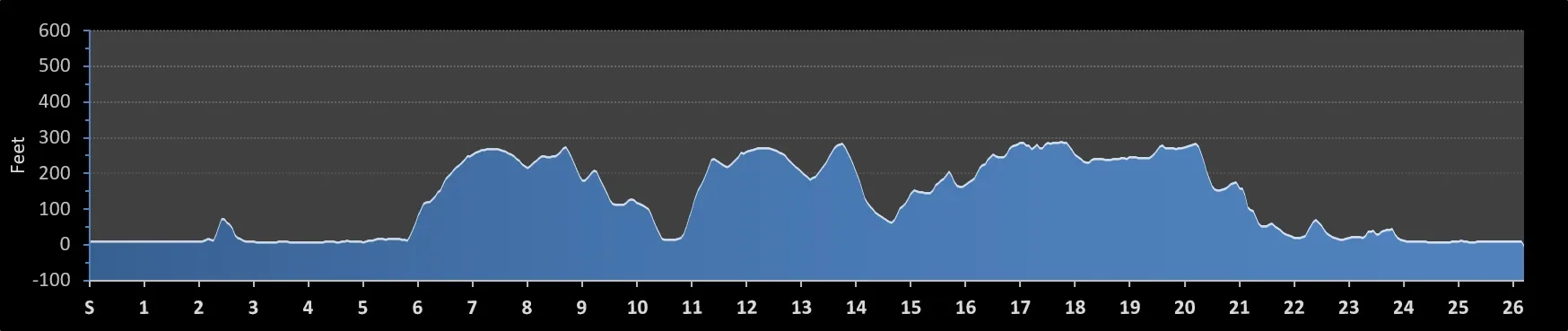
The 2027 race is the next real target, and registration for the 2027 full marathon is already open on the official race site. It is also the 50th anniversary edition, which is nice for the medal drawer, but the training problem is more ordinary: your glutes need to keep you stable on climbs, your quads need to tolerate long downhill braking, and your core needs to stop your form from folding late. [2]
The weekly split: outdoor miles, apartment strength, one low-impact support day
A small-apartment plan works best when the apartment has a narrow job description. It is not where you fake long runs. It is where you build the chassis for them. For most runners building toward San Francisco, that means 3–4 outdoor runs, 2 indoor strength sessions, and 1 low-impact cardio or mobility-focused cross-training session.
| Weekly slot | Where it happens | Main job | Apartment-friendly note |
|---|---|---|---|
| Easy run | Outdoors | Build aerobic consistency without adding intensity | Keep it truly easy so the strength work does not become extra punishment |
| Strength A | Apartment | Glute activation and core stability | Bands, mat, and controlled bodyweight work; no jumping |
| Quality run or hill-focused run | Outdoors | Practice climbing effort, controlled breathing, and pacing changes | Use real terrain when available; do not replace this with noisy indoor cardio |
| Strength B | Apartment | Eccentric quad strength, single-leg control, and downhill durability | Slow lowering matters more than heavier loading |
| Easy run or rest | Outdoors or off | Absorb training and keep the weekly rhythm sustainable | If the legs feel flat, make this the first place you reduce |
| Low-impact cardio or mobility | Apartment, outdoors, pool, or bike if already available | Support fitness without more pounding | Yoga, cycling, and swimming are all listed by the SF Marathon as cross-training complements to running |
| Long run | Outdoors | Build marathon-specific endurance and fueling practice | This is not an apartment session; protect it by keeping home workouts quiet and recoverable |
That split leaves room for the part people usually try to cram into a tiny living room: hill preparation. The climbs around miles 7, 12, and 16 still need outdoor running practice. The apartment work supports those runs by improving the muscles that hold your pelvis level, keep your knees tracking, and help you descend without turning every downhill into a quad demolition.
The SF Marathon’s own training tips call out glute activation exercises such as lateral band walks, monster walks, and single-leg glute bridges, along with core work, as useful preparation. Those recommendations are conveniently apartment-sized. None of them requires a treadmill, a gym floor, or a neighbor willing to listen to box jumps before work. [3]
Strength A: make the glutes wake up before the hills do
The first indoor strength session should be boring in the best way: glutes, hips, and trunk. On the San Francisco course, weak or sleepy glutes do not announce themselves politely. They show up as knees drifting inward on climbs, hips dropping late in the run, and lower legs doing work they were not meant to carry for 26.2 miles.
| Move | Why it belongs | How to keep it apartment-friendly |
|---|---|---|
| Lateral band walks | Train side-to-side hip control for climbing and tired-mile stability | Use a mini band and step softly; keep tension on the band instead of rushing |
| Monster walks | Add diagonal hip work that feels closer to running mechanics than a static hold | Stay low and controlled; the feet should not slap the floor |
| Single-leg glute bridges | Build hip extension without needing a bench or machine | Lie on a mat and lower slowly so the floor never gets a thud |
| Dead bugs or heel taps | Teach the trunk to resist arching while the legs move | Use the mat; stop the set when the low back starts taking over |
| Side plank variations | Challenge lateral core and hip stability together | Choose a bent-knee version if space is tight or fatigue makes form sloppy |
This session should feel controlled, not ceremonial. If the band work is so fast that your feet scrape and slap, it is no longer the quiet option or the useful one. Slow enough to feel the hip working is slow enough for an apartment.
Strength B: prepare for the descents without jumping on your floor
The downhill sections around miles 10, 14, and 21 are the reason the second strength day should not be another generic runner core circuit. Downhill running asks the quads to brake repeatedly. In an apartment, the cleanest way to train that quality is eccentric work: slow lowering, steady knees, no crashing into the bottom of the movement.
| Move | Course problem it addresses | Quiet execution |
|---|---|---|
| Split squat with slow lowering | Single-leg strength for climbs and downhill braking | Lower under control, pause briefly, then stand without bouncing |
| Step-down from a low, stable surface | Quad control for descents | Use a low step or sturdy surface; tap the heel lightly rather than dropping |
| Slow step-up | Climbing strength without a jump | Drive through the full foot and step down as carefully as you stepped up |
| Romanian deadlift with dumbbells | Posterior-chain support for running posture | Hinge slowly and set weights down on a mat, not directly on the floor |
| Wall sit or squat hold | Quad endurance without movement noise | Keep it short enough that form stays clean and breathing stays steady |
This is where “quiet” can get misunderstood. Quiet does not mean easy. A slow split squat with a clean lower is often more honest than a rushed jump squat, and it is far less likely to shake the ceiling below you. The point is not to dodge hard work; it is to remove impact noise that does not help the marathon anyway.
Your low-impact day should reduce pounding, not create a second workout problem
The SF Marathon has published swimming, cycling, and yoga as cross-training methods that can complement running performance. For an apartment runner, the useful takeaway is not that you must now buy a bike trainer or find a pool lane. It is that the support day should give your heart, hips, and soft tissue some work without adding another round of pounding. [4]
- If you already bike or swim, keep that day easy enough that it supports the next run instead of competing with it.
- If you are staying inside, use a mobility-focused session: hips, calves, hamstrings, thoracic rotation, and relaxed core control.
- If you are mentally fried from indoor time, make it a brisk outdoor walk and keep the apartment for stretching afterward.
This is also the day to be honest about fatigue. If the long run is starting to feel stale, the low-impact day should get smaller before the long run gets compromised.
Quiet substitutions that still train runners
The worst apartment training advice takes a normal gym circuit, removes the jumps, and leaves the runner with a watered-down version of the same workout. Better substitutions keep the training purpose and change the delivery. Runner’s World and SELF both point to quiet home-workout swaps such as walkout planks instead of burpees, slow step-ups instead of box jumps, and slow mountain climbers instead of noisy high-impact cardio. [5][6]
| Noisy or space-hungry move | Apartment swap | What you keep |
|---|---|---|
| Burpees | Walkout plank | Core stiffness, shoulder loading, and full-body control without the jump-back thud |
| Box jumps | Slow step-ups | Single-leg climbing strength without landing noise |
| Jump squats | Tempo squats or split squats | Quad and glute work without floor impact |
| Fast mountain climbers | Slow mountain climbers | Trunk control and hip flexor work without foot-slapping |
| Skater jumps | Lateral band walks | Lateral hip strength without side-to-side crashing |
| High knees | Marching high knees with a pause | Hip drive and posture practice without pounding |
A chair can be useful, but it is not automatically a plyo box because an article says so. If it slides, wobbles, has wheels, or makes you tense before the first rep, it is not the right surface. A low step, a firm ottoman against a wall, or simply a slower split squat is a better choice than turning furniture into a liability.
The 6 ft × 6 ft setup
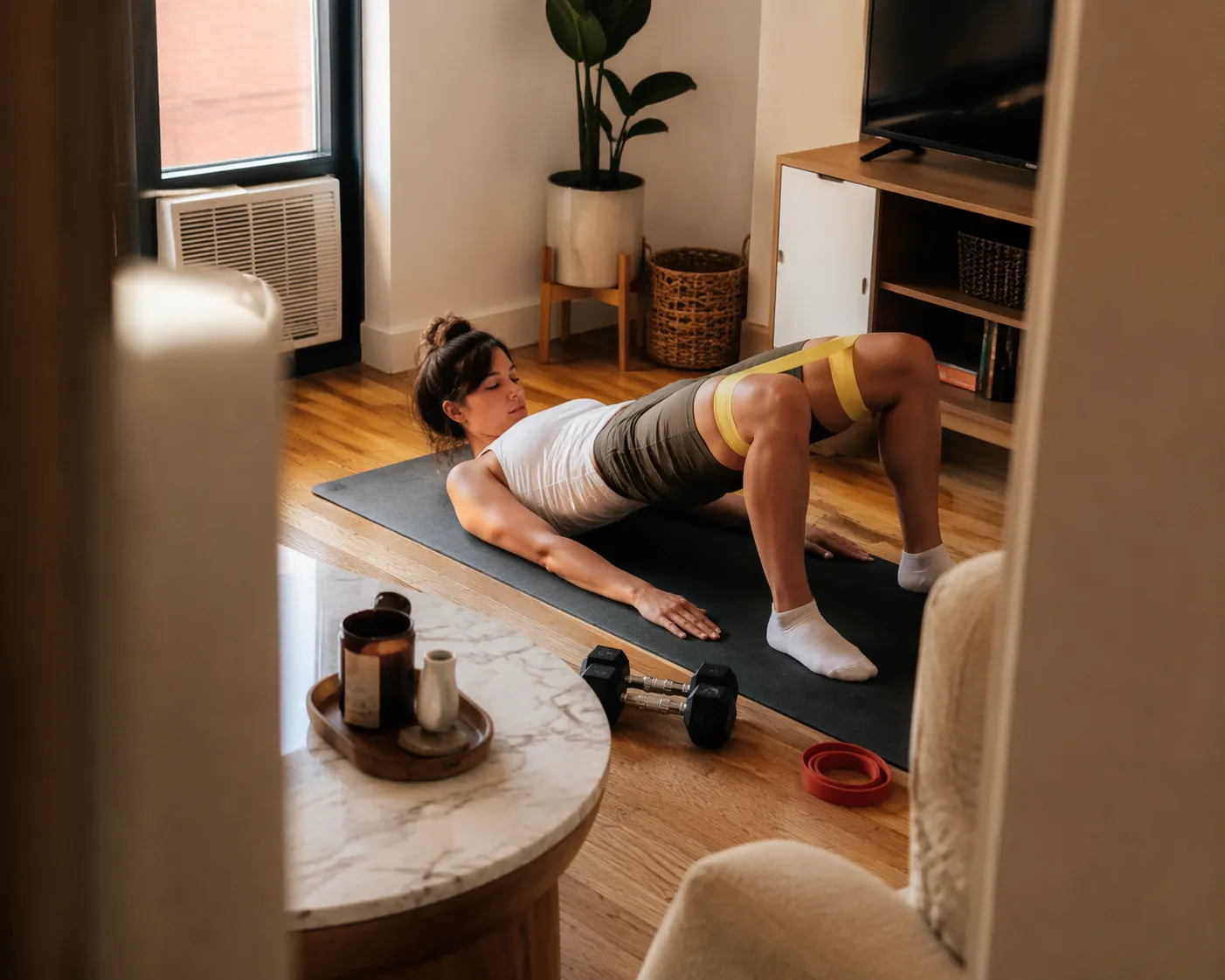
A complete apartment strength setup for this plan can be simple: one yoga mat, resistance bands, and one pair of dumbbells. Brooks’ runner-focused home workout guidance, SELF and Runner’s World’s quiet workout recommendations, and apartment workout guidance from Trahere all support the idea that small-space training can be legitimate when the movements are chosen for the space instead of forced into it. [5][6][7][8]
| Item | Why it earns its space | Apartment rule |
|---|---|---|
| Yoga mat | Protects the floor, softens contact, and defines the workout area | Put dumbbells down on the mat every time |
| Mini band or long resistance band | Adds glute and hip resistance without heavy equipment | Choose tension you can control without snapping or sliding |
| One pair of dumbbells | Loads split squats, hinges, carries, and step-ups | Adjustable is convenient, but quiet handling matters more than brand |
| Stable chair or low step | Supports step-ups or assisted balance work | Use it only if it does not move, creak, or make the movement feel risky |
| Towel | Wipes sweat and can pad knees or hands | Do not use it as a slider on floors where it may shoot out from under you |
The practical floor test is simple: can you lie down, reach overhead, step sideways, hinge with dumbbells, and do a split squat without kicking the coffee table? If yes, the space is enough. If not, move the table before the session starts. Rearranging furniture mid-circuit is how dumbbells get dropped, shins get clipped, and workouts become louder than they needed to be.
How the apartment sessions change as race day gets closer
Early in the build, the two strength sessions can both carry meaningful work. Strength A keeps the hips and trunk honest. Strength B gradually asks the quads to tolerate more controlled lowering. As the outdoor long runs get longer and hillier, the apartment work should become more selective. The goal is to arrive at key runs supported, not pre-fatigued by heroic living-room circuits.
Late in the cycle, taper the home work before it becomes hidden soreness. NYRR Senior Advisor of Training Roberto Mandje recommends phasing out heavy strength training 2–3 weeks before race day and reducing cross-training volume 10–14 days out. For this plan, that means the dumbbells get lighter or disappear, eccentric quad work becomes gentler, and the low-impact day shifts toward mobility and circulation rather than fitness-building. [9]
| Training phase | Strength A | Strength B | Cross-training or mobility |
|---|---|---|---|
| Base and early build | Full glute and core session | Controlled single-leg and eccentric quad work | Easy aerobic support or mobility |
| Peak outdoor running | Keep activation and core; cut anything that lingers as soreness | Use fewer heavy or deep eccentric movements if downhill runs are already demanding | Keep it low-impact and recoverable |
| Final 2–3 weeks | Activation only, no heavy strength emphasis | Phase out heavy lower-body work | Reduce volume 10–14 days out and favor mobility |
| Race week | Brief band work only if it makes you feel better | Skip fatigue-producing strength | Gentle movement, sleep, and floor-safe stretching |
This is where the apartment constraint becomes an advantage. You are not tempted by a crowded weight room or a treadmill workout that turns into a test. You can do the small things, stop while they are still small, and save the legs for the course.
What this plan does not need to imitate
It does not need indoor hill repeats. It does not need a treadmill incline session wedged between the couch and the wall. It does not need a chair treated like gym equipment at 7 a.m. The outdoor runs carry the marathon-specific running load. The apartment sessions prepare the muscles and movement patterns that make those runs more durable.
For the SF Marathon, that means the living room work has to be specific enough to matter: lateral band walks and single-leg glute bridges for hip control, slow step-ups and split squats for climbing and descending strength, eccentric quad work for the downhill miles, and core stability that survives fatigue. A renter with a mat, bands, dumbbells, and a respectful relationship with the floor can build a serious support system for a hilly marathon without turning home into a noisy gym.
References
- Your Updated San Francisco Marathon Elevation & Pacing Guide — The San Francisco Marathon, April 15, 2025.
- The San Francisco Marathon - Full Marathon Page — The San Francisco Marathon.
- Training Tips - The San Francisco Marathon — The San Francisco Marathon.
- Unconventional Cross-Training Methods to Boost Your Running Performance — The San Francisco Marathon, July 4, 2025.
- At-Home Cardio Workouts: Make the Most of Your Living Room — Runner’s World.
- 7 Quiet Workout Tips So You Can Exercise at Home Without Infuriating Your Neighbors — SELF.
- At home workouts for runners — Brooks Running.
- Home Workout Solutions for Apartment Dwellers — Trahere.
- Cross Training and Strength Training: Finding Your Fitness Balance — NYRR.
What a small equipment investment adds
Cable Machine Alternatives That Save Space and Money
Compare the best cable machine alternatives for home gyms – from resistance bands and pulley systems to suspension trainers and compact digital units – and find the right option for your space and budget.
Small Treadmill Buying Guide: 7 Critical Specs to Check Before You Buy
A cross-category spec primer for apartment and small-space dwellers comparing walking pads, ultra-compact folding treadmills, and full-size folding treadmills. Learn the concrete thresholds for motor HP, deck length, noise, warranty, and subscription lock-in so you can compare apples to apples.
How to Practice Basketball at Home Without Noise Complaints
Learn how to run a full basketball workout in a small apartment without noise complaints. This guide covers no-dribble handling drills, wall form shooting, and silent ball options that let you train without disturbing neighbors.
How often should you repeat this?
See our recovery and rest reference for citation-anchored rest-interval guidance.
Spot something off?
Tell us if a movement, tier assumption, or duration didn't match your experience.