
Turn Sports Day Into a Field Day Home Workout
Classic field-day events — sprint, long jump, tug-of-war, sack race, egg-and-spoon, relay — become a full-body home workout that fits a small living room. Every event card carries the space it needs, a noise rating, a quiet no-jump alternative, and the equipment tier it assumes, so you can pick a version that works with your room, your neighbors, and your budget.
- Equipment tier required
- none
- Duration
- 25 min
- Difficulty
- beginner
- Target area
- full body
- Space footprint needed
- 6x6 ft clear floor space
- Noise level
- 1–2 with quiet versions; 3–4 for jumping versions
Search for sports day home workout ideas in the U.S. and the language gets wobbly fast. “Sports day” usually translates to “field day,” then most ideas veer toward kids, summer camps, team bootcamps, or somebody’s generous lawn. Useful energy, wrong room.
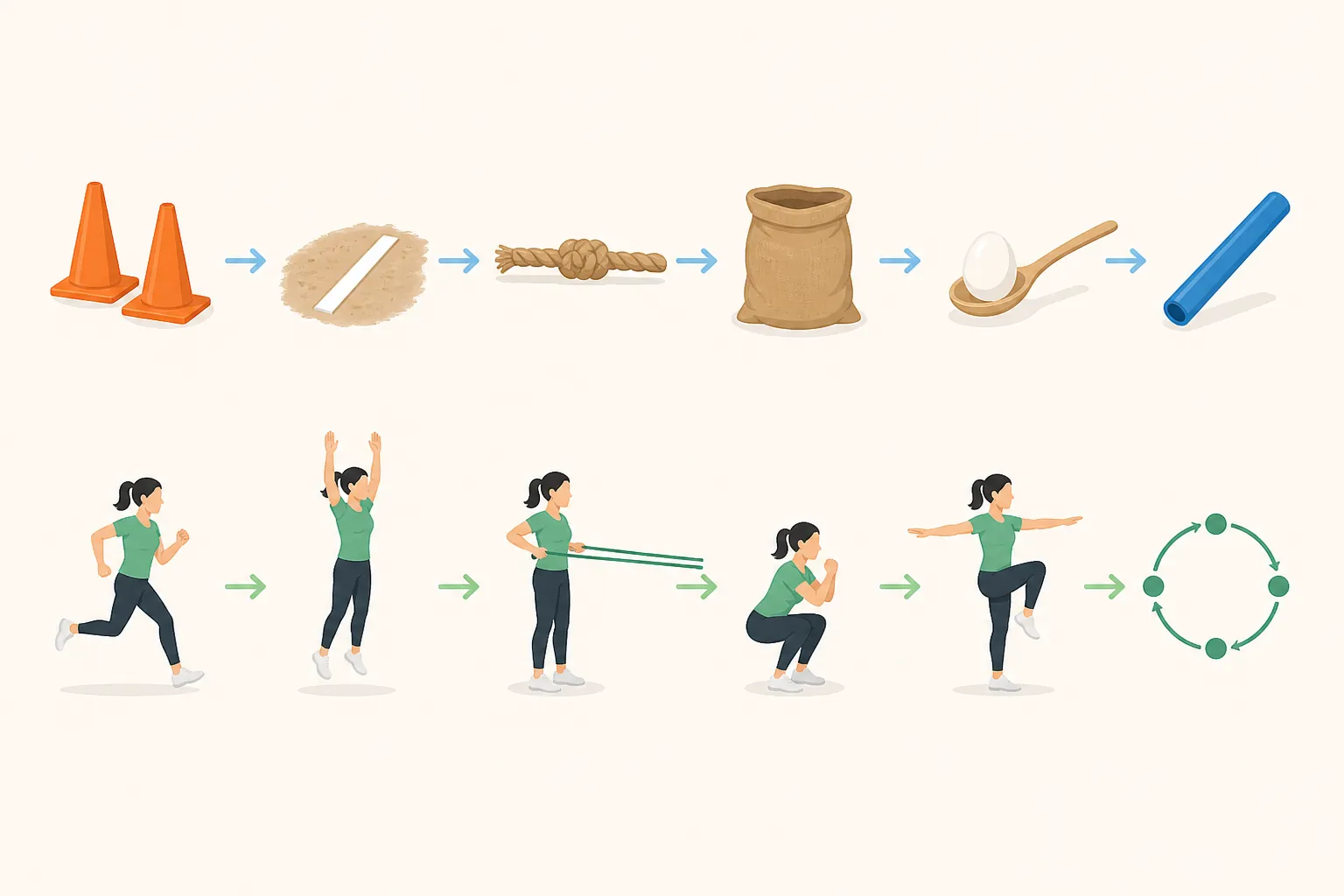
A living-room version works better when you stop trying to recreate the school field and start translating the events. A sprint becomes interval cardio. A long jump becomes a plyometric or a quiet power drill. Tug-of-war becomes an isometric pull. A sack race becomes squat-based leg work. Egg-and-spoon becomes balance under distraction. A relay becomes the circuit that holds the whole thing together.
That does not mean “field day” has its own special training science. It is a wrapper. The useful evidence comes from the ordinary ingredients inside it: intervals, agility, plyometrics, circuit structure, balance, and weekly activity volume. Health.gov’s adult guideline, repeated in Healthline’s at-home workout guide, is still the boring-but-helpful reality check: adults are advised to aim for 150 minutes of moderate-intensity aerobic activity or 75 minutes of vigorous-intensity activity per week, plus muscle-strengthening work on at least 2 days.[1]
The Conversion Rules
Before the event cards, set the room rules. The workout should answer four questions before you do the first rep: where does your body go, how loud is it, what equipment does it assume, and what happens if jumping is off the table?
| Field-day event | Home-workout translation | Main training quality |
|---|---|---|
| Sprint | Short interval burst in place or along a tape line | Cardio intensity, coordination |
| Long jump | Broad jump, cushion jump, or quiet hinge-to-reach | Lower-body power |
| Tug-of-war | Towel, band, or anchor pull | Isometric pulling strength |
| Sack race | Squat hop, squat march, or pillow squeeze squat | Leg endurance and power |
| Egg-and-spoon | Loaded balance carry or single-leg control task | Balance, control, deceleration |
| Relay | Circuit order and timed handoff between stations | Work capacity and pacing |
A simple noise scale keeps the apartment version honest: 1 means nearly silent, 2 means foot shuffling or fabric movement, 3 means light landing noise, and 4 means repeated jumping that may not be downstairs-neighbor friendly. If your floor is thin, live mostly in the 1–2 range.
For equipment, use tiers instead of shopping lists: $0 means towel, cushion, tape line, chair, wall, or laundry bag; band means a resistance band or loop; small-gear means a jump rope, sliders, light dumbbell, kettlebell, cone, or mat. If you are still deciding what your room can support, treat the site’s beginner home fitness decision guide as the boring useful pre-game.
Event Cards for a Living-Room Field Day
Sprint: The Hallway Dash Without the Hallway
The sprint card is where the theme earns its place. Track-inspired home workouts often pair sprint intervals with bodyweight strength blocks, and athlete-focused at-home programming also uses sprint-interval formats when space or equipment is limited.[2][3] In a small room, the point is not distance. It is a short, deliberate burst that raises effort fast.
| Card part | How to run it |
|---|---|
| Setup | Mark a 6- to 10-foot lane with a towel, tape line, yoga mat edge, or hallway seam. Keep the path clear enough that you never have to dodge a coffee table at speed. |
| Standard version | Do fast feet down the line and back, or run in place with high knees for 15–30 seconds. Rest until you can repeat the burst with control. |
| Quiet version | Use power marching, low fast feet, or step-jacks. Keep one foot connected to the floor and let the arms drive the heart rate. |
| Noise rating | Standard: 3. Quiet: 1–2. |
| Equipment tier | $0. Optional small-gear: cones or tape. |
| Training quality | Interval cardio, foot speed, arm-leg coordination. |
If you like running but do not have room to run, this is the miniature version of the same impulse: accelerate, recover, repeat. For more traditional interval context, FitAtHome’s running routine breakdown is a better place to think about outdoor or treadmill dosage. Here, the sprint is a station, not a whole training identity.
Long Jump: Power Without Pretending Your Floor Is a Track
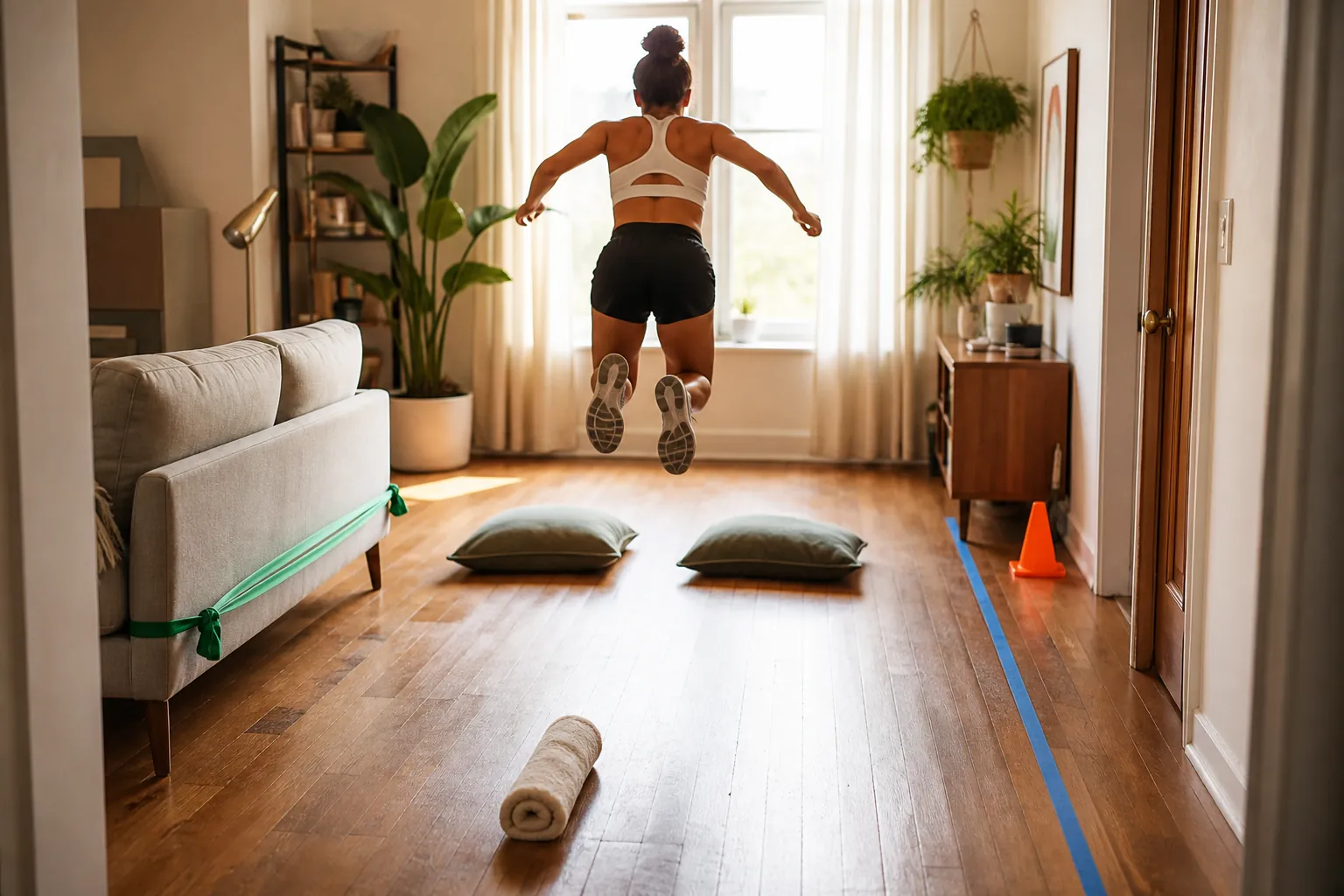
Healthline’s at-home exercise guide includes the broad jump as an advanced plyometric move, which is the cleanest translation of the long jump: load the hips, swing the arms, jump forward, land softly.[1] That standard version is also the one most likely to be rude in an upstairs apartment.
| Card part | How to run it |
|---|---|
| Setup | Place two cushions or folded towels on the floor as start and landing markers. Leave more room for the landing than for the takeoff. |
| Standard version | Do 3–6 controlled broad jumps. Reset fully after each landing instead of bouncing into the next rep. |
| Small-room version | Jump from a squat to a soft two-foot landing in place, or do a tiny forward hop over a towel line. |
| Quiet no-jump version | Do a squat-to-calf-raise with an aggressive arm swing, or a hinge-to-reach: hips back, arms behind you, then stand tall and reach forward like you are sending the jump without leaving the floor. |
| Noise rating | Standard: 4. Small-room hop: 3. Quiet: 1. |
| Equipment tier | $0. Optional mat or cushion markers. |
| Training quality | Lower-body power, landing control, hip extension. |
The quiet version is not a consolation prize. It keeps the same pattern — load, drive, finish tall — while removing the landing impact. That matters if your “field” is laminate flooring above someone trying to watch TV.
Tug-of-War: Pull Like There Is a Team on the Other End
Bootcamp Ideas uses field-day events as a workout structure, including rope- and band-style partner ideas.[4] Solo at home, tug-of-war becomes cleaner if you stop needing another person. The “opponent” can be a towel you pull against yourself, a band, or a carefully chosen anchor.
| Card part | How to run it |
|---|---|
| Setup | For $0, loop a towel around your hands and pull it apart. For band work, anchor the band only to something stable and safe, then step back until there is light tension. |
| Standard version | Hold a split stance, bend the knees slightly, brace the ribs down, and row the towel or band toward the body. Hold the hardest position for 10–30 seconds. |
| Quiet version | Same movement. This station should be nearly silent unless the anchor or floor setup is bad. |
| No-anchor version | Sit tall, loop a towel around the midfoot, and pull gently while the leg pushes back. Keep the knee slightly bent and avoid yanking. |
| Noise rating | 1. |
| Equipment tier | $0 towel. Band tier for stronger pulling options. |
| Training quality | Isometric pulling strength, grip, trunk bracing, upper-back endurance. |
This is the station where a cheap band actually changes the workout. A towel gives you tension and intent; a band gives you progressive resistance and more angles. If you are building a small setup around bands, the resistance-band beginner workout has more ways to make that tier useful.
Sack Race: The Laundry-Bag Version Is Optional
A real sack race is chaos with handles. At home, keep the joke but protect the ankles. Bootcamp field-day templates include potato-sack-style racing as an event, but the solo indoor version should become squat-based power or endurance rather than blind hopping across the room.[4]
| Card part | How to run it |
|---|---|
| Setup | Stand on a towel line or between two cushions. If you use a laundry bag as a prop, hold it at the hips rather than trapping both feet inside it. |
| Standard version | Do squat hops in place for 10–20 seconds, landing softly and resetting the feet each time. |
| Quiet version | Do squat marches: squat, stand, lift one knee, squat again, lift the other knee. Keep the rhythm playful without leaving the floor. |
| Extra silly version | Hold a pillow between the knees and do controlled mini-squats. It looks ridiculous and immediately exposes sloppy knee tracking. |
| Noise rating | Standard: 3–4. Quiet: 1–2. |
| Equipment tier | $0. Optional pillow or laundry bag. |
| Training quality | Quads, glutes, hip control, leg endurance. |
Egg-and-Spoon: Balance Work That Refuses to Look Serious
Family sports-day guides often use balance races and silly object-carry events because they are easy to scale and easy to understand.[5][6] For an adult home workout, the point is not the egg. It is the way a small balancing task makes you slow down, steer, and control your center of mass.
| Card part | How to run it |
|---|---|
| Setup | Use a spoon and a small soft object: a rolled sock, ping-pong ball, cotton ball, or toy. Skip the actual egg unless you enjoy cleaning. |
| Standard version | Walk heel-to-toe along a tape line while carrying the object on the spoon. Turn around slowly and return. |
| Strength version | Do reverse lunges or split-squat taps while holding the spoon in one hand. Change hands halfway. |
| Quiet version | Single-leg balance hold with the spoon extended in front of you. Add slow head turns if it is too easy. |
| Noise rating | 1. |
| Equipment tier | $0. |
| Training quality | Balance, ankle strategy, visual focus, deceleration, patience. |
Agility work is not only about ladders and cones. Healthline summarizes research indicating that agility training can improve strength, explosive power, balance, and mobility in less total time than traditional training, though that is general agility research rather than proof that spoon races have magic powers.[7]
Three-Legged Race: Use the Band, Lose the Partner
The three-legged race is usually a partner coordination mess. Bootcamp Ideas uses a band or rope setup for a field-day version, but a solo room version works better as lateral band walking or tied-feet-free coordination.[4]
| Card part | How to run it |
|---|---|
| Setup | Put a loop band above the knees or around the ankles. If you have no band, stand with feet close and use a towel line as your boundary. |
| Standard version | Do lateral band walks: step right, bring the other foot in without snapping the band, then reverse. |
| Quiet $0 version | Do side steps over a towel line, keeping the knees soft and the hips level. |
| Coordination version | Step side, tap behind, step side, tap in front. Move slowly enough that the pattern stays clean. |
| Noise rating | 1–2. |
| Equipment tier | $0 or band. |
| Training quality | Hip stability, lateral movement, coordination. |
Relay: The Circuit Wearing a Baton Costume
The relay is not another exercise so much as the operating system. Circuit workouts commonly rotate through multiple movements with short rest, and Anytime Fitness gives one no-equipment example built around 8 exercises with 20 seconds of rest between moves.[8] That is a template, not a law. Your relay can be shorter, quieter, or more strength-biased.
| Card part | How to run it |
|---|---|
| Setup | Choose 4–6 event cards and arrange them in a loop. Use a rolled towel, water bottle, or sock as the baton. |
| Standard version | Work 30–45 seconds per station, then take 15–30 seconds to “handoff” to the next station. |
| Quiet version | Choose only stations rated 1–2 and make the handoff a slow walk, not a dash. |
| Solo scoring | Count clean rounds, not frantic reps. If landings get loud or balance disappears, the round stops being clean. |
| Noise rating | Depends on station selection. |
| Equipment tier | Any tier. |
| Training quality | Cardio pacing, muscular endurance, transitions, decision-making under fatigue. |
How to Run the Field Day as a Workout
You can run this as a 15-minute novelty session or a longer full-body workout. The trick is not to make every event maximal. If sprint, long jump, and sack race are all loud and explosive, the workout becomes a downstairs complaint form with a warm-up.
Warm Up Like a Mini Field Day, Not a Punishment Lap
Bootcamp field-day programming includes playful warm-up ideas such as Duck Duck Goose before the main event work.[4] Solo, you only need the useful part: gradually raise temperature, move sideways, practice stopping, and rehearse the room’s boundaries.
- 1 minute easy marching around the room, touching each “station” marker.
- 30 seconds arm circles and cross-body reaches.
- 30 seconds side steps over a towel line.
- 5 slow squats, then 5 squat-to-calf-raises.
- 2 practice landings or quiet hinge-to-reaches before any jump card.
Choose a Relay Format
| Format | Best for | How to run it |
|---|---|---|
| Apartment quiet relay | Thin floors, late evenings, no-jump days | Sprint quiet version, tug-of-war, egg-and-spoon, three-legged side steps, squat march. Work 30 seconds, transition 20 seconds, repeat 2–4 rounds. |
| Power field day | Ground-floor room, garage, or forgiving surface | Sprint, long jump, tug-of-war, sack race, relay finisher. Use lower reps on jump stations and longer rest. |
| Band-tier relay | A small setup with one resistance band | Band tug-of-war row, lateral band walk, sprint line drill, squat march, balance carry. Keep the band station strict rather than fast. |
| Beginner short course | First try or low-energy day | Pick any 4 cards. Do one practice round, then 2 working rounds. Stop before form turns into furniture negotiation. |
For a cardio-biased day, put the sprint card first and repeat it between quieter stations. For a strength-biased day, put tug-of-war after the leg work so your heart rate comes down while your upper back still has a job.
Use a Small-Space Power Lane
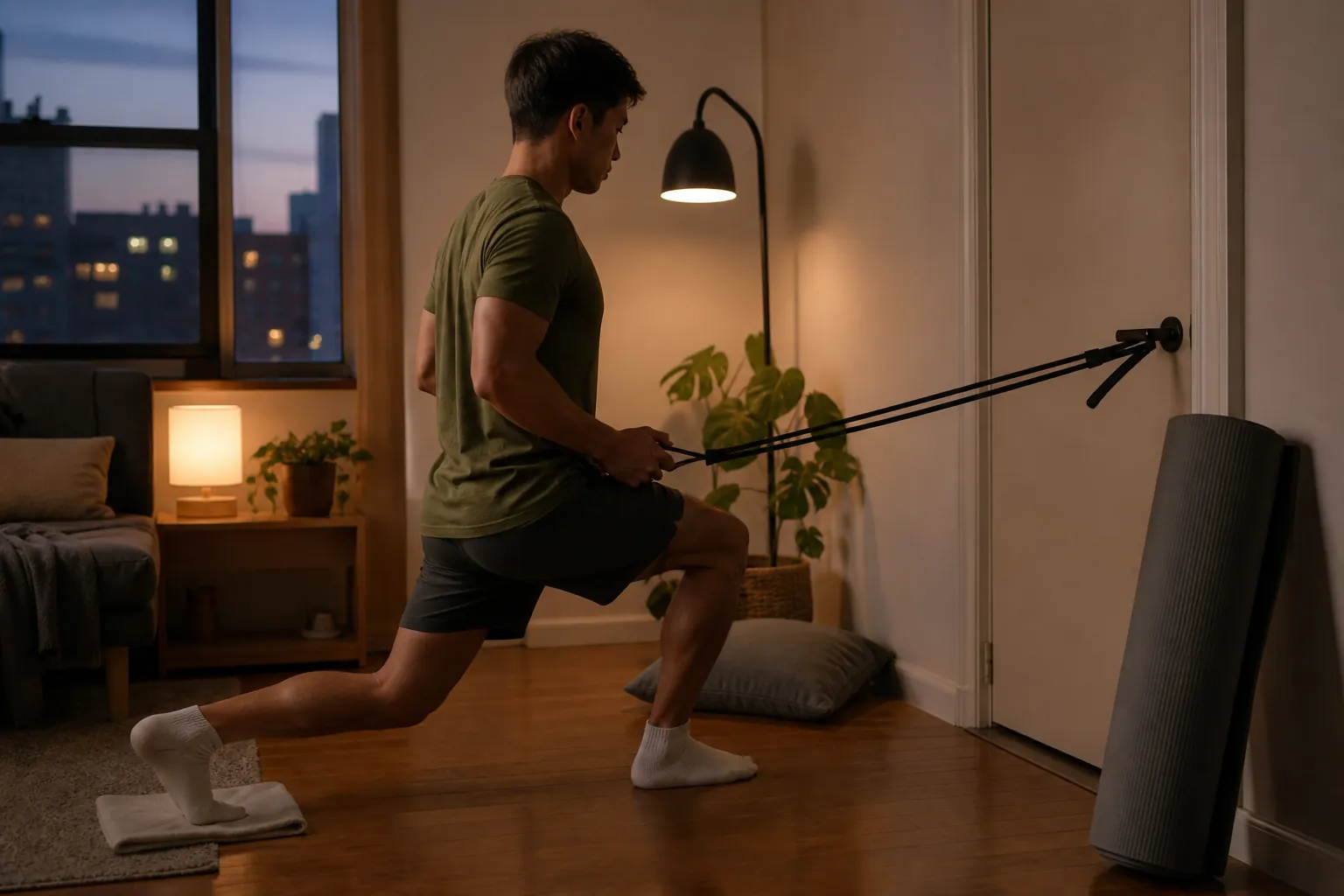
You do not need a gym lane to do quick power work. Next Level Athletics USA describes speed and agility training options for small spaces, including wall-drive holds and quick-step line drills, and frames some power work around an approximately 6-by-6-foot footprint.[9] That is a useful mental model for this workout: one square for movement, one edge for a line drill, one safe landing zone if jumping is included.
- Put the sprint line where your feet can move fast without changing direction blindly.
- Put the long-jump or power station on the most forgiving surface you have.
- Keep tug-of-war away from wobbly furniture and questionable door handles.
- Use the egg-and-spoon station as the reset corner, not as filler.
Swap Jumping Before You Skip the Workout
Quiet cardio can still be cardio. PS Fitness collected trainer-recommended low-noise options such as step jacks, marching, squat-to-reach patterns, and other no-jump moves meant to raise heart rate without pounding the floor.[10] Anytime Fitness also presents low-impact modification thinking in its circuit context, including an easier burpee variation rather than treating the full jump version as the only real version.[8]
| If the card says | Use this quiet swap |
|---|---|
| High knees sprint | Power march with hard arm drive |
| Broad jump | Squat-to-calf-raise or hinge-to-reach |
| Squat hop sack race | Squat march |
| Fast relay transition | Walk the baton to the next station |
| Jumping jack warm-up | Step jack |
A Complete 25-Minute Home Field Day
Here is the followable card. It assumes a small living room, a towel line, one soft object for balance, and an optional resistance band. Keep the standard version if your floor and joints tolerate it. Use the quiet version whenever the room says no.
| Time | Station | Standard version | Quiet version |
|---|---|---|---|
| 0:00–4:00 | Warm-up | March, side steps, arm swings, slow squats | Same |
| 4:00–5:00 | Sprint | Fast feet or high knees | Power march or step-jacks |
| 5:00–6:00 | Transition | Walk, breathe, set cushions | Same |
| 6:00–7:00 | Long jump | 3–6 broad jumps or small hops | Squat-to-calf-raise |
| 7:00–8:00 | Transition | Reset landing area | Same |
| 8:00–9:00 | Tug-of-war | Towel or band isometric pull | Same |
| 9:00–10:00 | Transition | Set towel line | Same |
| 10:00–11:00 | Sack race | Squat hops | Squat march |
| 11:00–12:00 | Transition | Pick up spoon object | Same |
| 12:00–13:00 | Egg-and-spoon | Balance walk | Single-leg balance hold |
| 13:00–14:00 | Transition | Choose next round versions | Same |
| 14:00–22:00 | Relay rounds | Repeat 4 favorite stations for 2 rounds | Use only noise 1–2 stations |
| 22:00–25:00 | Cool down | Easy walk, calf stretch, hip flexor stretch, shoulder reach | Same |
If you want to score it, score restraint: one point for a quiet landing, one for a clean balance pass, one for a tug-of-war hold that does not turn into shrugging, one for finishing the relay without moving furniture mid-round. That keeps the field-day mood without rewarding chaos.
Equipment Tiers That Actually Change the Workout
The $0 version is not fake. A towel, cushion, wall, chair, sock ball, and tape line can cover sprint, long jump, tug-of-war, sack race, egg-and-spoon, and relay. The band tier mainly upgrades pulling and lateral hip work. Small gear gives cleaner markers, a mat, sliders, or a jump rope, but it should not be required for the theme to function.
| Tier | What it unlocks | Best event cards |
|---|---|---|
| $0 apartment | Towel lines, cushion landings, sock-ball balance, towel isometrics | Sprint, quiet long jump, tug-of-war, egg-and-spoon, relay |
| Band tier | Rows, anchored pulls, lateral walks, partner-event translations without a partner | Tug-of-war, three-legged race, relay |
| Small-gear tier | Cones, mat, jump rope, sliders, light loading | Sprint, long jump, sack race, relay |
| Garage or forgiving-floor tier | More jumping volume and longer movement lanes | Sprint, long jump, sack race, power relay |
That tiering is also the clean way to keep budget from leaking into the plan. Buy gear only when it changes a station you already like. If the towel tug-of-war makes sense but feels too easy, a band is a logical upgrade. If quiet squat marches already do the job, a fake sack is just laundry with branding.
Where the Evidence Fits
The strongest way to defend this workout is also the least flashy: it is a themed circuit made from familiar training patterns. Sprint-style intervals, bodyweight circuits, broad-jump plyometrics, agility drills, balance tasks, and low-impact cardio all appear in ordinary home-training sources.[1][2][7][8][10]
The field-day names make the session more playful and easier to remember. They do not prove that a “sports day” circuit is superior to another circuit using the same movements. If a source gives a specific prescription, such as a certain number of laps or a particular rest interval, treat it as one workable template rather than a universal dosage.[7][8] Pick the standard, quiet, or equipment-tier version your room can tolerate. The medal is not upsetting the neighbor.
References
- 30 Moves to Make the Most of Your At-Home Workout, Healthline.
- Track & Field Inspired Running & Bodyweight Track Workout, Peanut Butter Runner.
- At-Home Exercises and Workouts For All Athletes, BSN SPORTS.
- Field Day Workout, Bootcamp Ideas.
- How to hold a family sports day, Action for Children Parent Talk.
- Have a silly sports day, Scouts UK.
- The 8 Best Agility Exercises You Can Do at Home, Healthline.
- At-Home Circuit Workout — No Equipment Needed, Anytime Fitness.
- Speed and Agility Training in Small Spaces, Next Level Athletics USA.
- 17 Quiet, At-Home Cardio Exercises That Trainers Recommend, PS Fitness.
What a small equipment investment adds
We don't have a build tagged to this exact tier yet. Browse all builds.
How often should you repeat this?
See our recovery and rest reference for citation-anchored rest-interval guidance.
Spot something off?
Tell us if a movement, tier assumption, or duration didn't match your experience.