
Stay Fit at Home Like Joan Collins Without Expensive Gear
Joan Collins stays fit at 93 with little more than a yoga mat and 30 minutes a day. This article shows what she actually does, why it works, and why you don't need a home gym to replicate her results.
- Equipment tier required
- none
- Duration
- 30 min
- Difficulty
- beginner
- Target area
- full body
- Space footprint needed
- yoga mat area
- Noise level
- low
Joan Collins was asked about fitness at 93, and the useful part was not a miracle routine, a new machine, or a celebrity wellness product. It was her refusal of the expected equipment story: “I do basic Pilates-type exercises rather than using one of those [reformer] Pilates machines,” she told The Telegraph, as reported by Page Six in June 2026.[1]
That one sentence does a lot of work. Reformer Pilates may be excellent when taught well and priced fairly, but it has also become one more way that home fitness gets quietly upgraded from “move your body” to “clear space, spend serious money, and buy the proper object first.” Collins’ answer cuts through that. The machine is not the center of the routine. The work is.
What she describes is modest by celebrity-fitness standards: basic Pilates-style mat exercises, roughly half an hour a day, physiotherapist-guided work, and swimming. In a My Weekly interview cited by Women’s Health UK and Hello!, Collins put it plainly: “Half an hour a day is mostly what I do and I’ve found that it gives me energy.”[2]
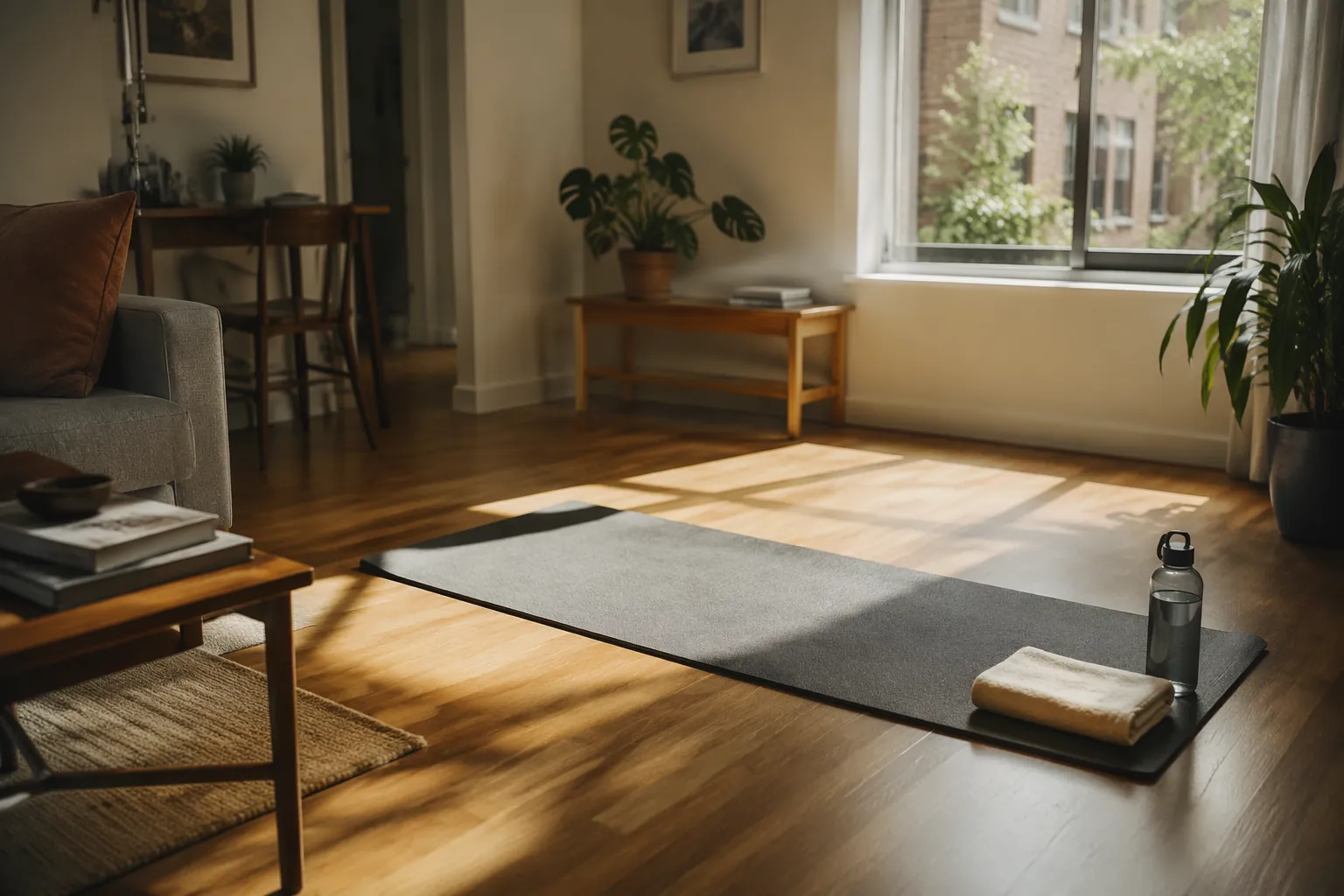
What Joan Collins Actually Does at Home
The phrase “Pilates-type exercises” matters because it is broader and less precious than the branded version of the activity. It points toward controlled bodyweight movement: lying, seated, kneeling, or standing work that asks the trunk, hips, legs, shoulders, and breath to cooperate. A mat helps. A towel helps. Clear floor space helps. A $1,500-plus reformer is not implied by the routine she described.
For someone trying to stay fit at home like Joan Collins at 93, the practical translation is not to copy her life. It is to copy the structure that survives when the celebrity details are stripped away:
- A daily or near-daily half-hour slot rather than occasional heroic workouts.
- Mat-based strength and mobility work instead of machine-dependent exercise.
- Movements matched to the body in front of you, especially if age, pain, or injury is involved.
- Some aerobic activity, such as swimming, when access and ability allow.
The repeatability is the least glamorous part and probably the most useful. A half-hour session fits between furniture. It does not require a garage, a spare room, or a permanent corner of equipment. It can be quiet enough for an apartment, especially if the routine avoids jumping and impact. It also keeps the decision small: roll out the mat, do the work, put the mat away.
There is still a caveat. Collins is not a budget-fitness case study. The same reports describe access to professional support, including physiotherapy and personal training.[2] That does not make the routine useless to ordinary readers; it just means the transferable lesson is not “do exactly what Joan does.” It is “do not confuse equipment with guidance.”
The Professional Help Is More Important Than the Machine
The physiotherapy detail deserves more attention than another paragraph about glamour. Collins has spoken about a trapped nerve that left her unable to function for two months, and Women’s Health UK reports that she recovered through physiotherapy alone; she has also recommended physiotherapist support for older adults.[2]
That is not medical advice, and it is not a promise that physiotherapy fixes every back problem. It is a useful ordering of priorities. If someone is older, returning after injury, or working around pain, the best “upgrade” may be a qualified person who can adapt movements, not a more impressive machine. A reformer can provide resistance and support, but it does not automatically know which movement is safe for your back, hip, shoulder, or balance on a given day.
For renters and small-apartment exercisers, this is a relief. The missing piece is often treated as hardware: the reformer, the bike, the cable system, the folding treadmill. Collins’ routine suggests a different missing piece: a sustainable menu of movements, scaled properly, repeated often enough to matter.
Why a Modest Amount of Strength Work Can Be Enough
The celebrity anecdote becomes more useful when it is put next to broader evidence on muscle-strengthening activity. A 2022 systematic review and meta-analysis in the British Journal of Sports Medicine found that 30 to 60 minutes per week of muscle-strengthening activity was associated with a 10% to 17% lower risk of all-cause mortality, cardiovascular disease, total cancer, and diabetes.[3]
That finding does not prove that Collins’ exact routine caused her appearance, energy, or longevity. The analysis looked at adults generally, not specifically people in their 90s, and it reports associations rather than a personalized prescription. Still, it is a useful antidote to the more-is-better pressure around home gyms. The largest health signal appears at a volume many people can actually fit into a week.
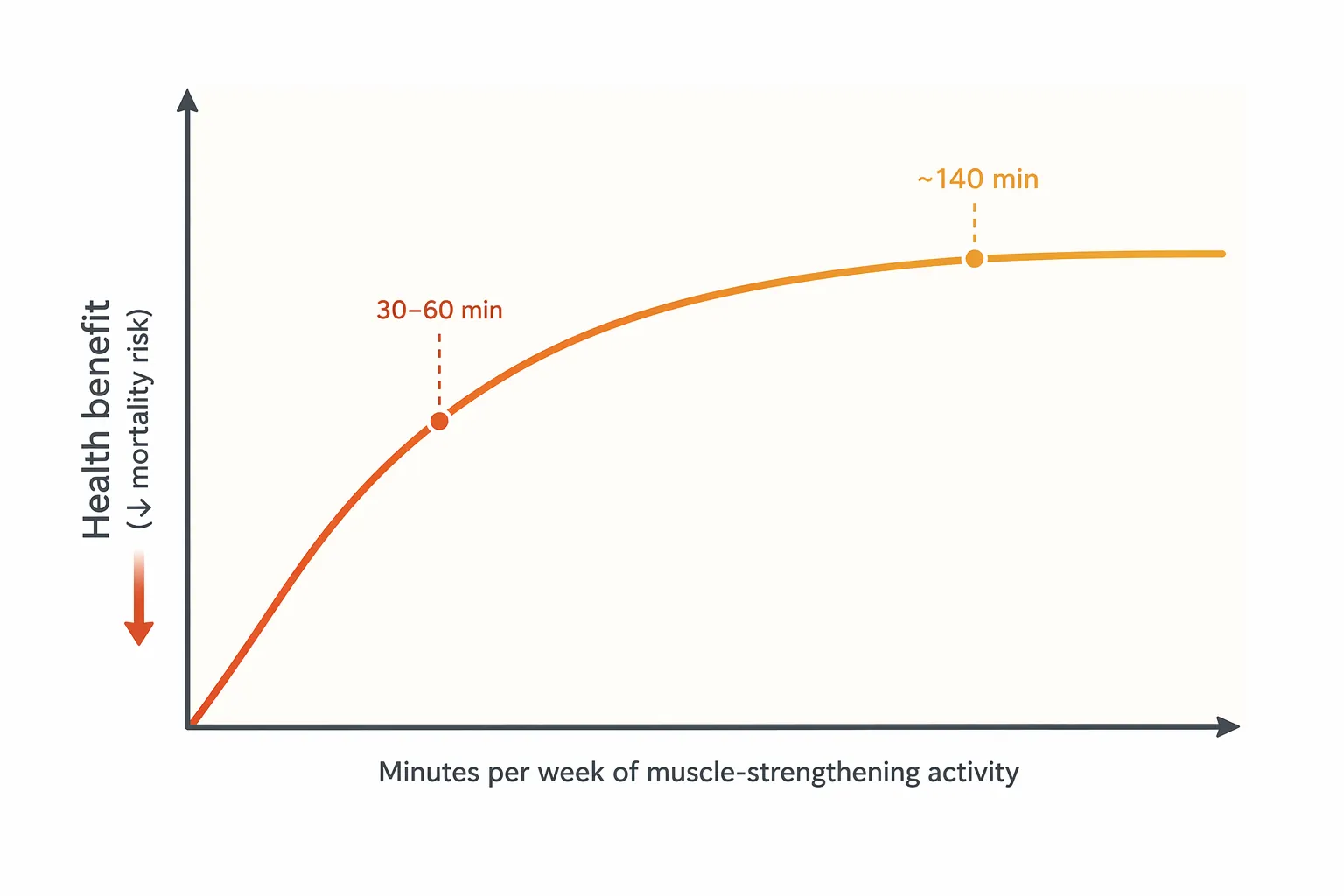
The same meta-analysis reported diminishing returns, with no additional benefit observed beyond about 140 minutes per week for all-cause mortality.[3] That is not an argument against doing more if you enjoy it, train for a sport, or need a specific goal. It is an argument against the idea that basic health maintenance begins only after you have built a serious home gym.
| Home-fitness choice | What it changes |
|---|---|
| A mat and 30 minutes | Lowers the barrier to starting and repeating strength or mobility work |
| A reformer or large machine | May add resistance and variety, but also adds cost, space, delivery, storage, and commitment |
| Professional guidance when needed | Helps adapt movement to pain, age, injury history, balance, and confidence |
What a Collins-Style Home Routine Looks Like Without the Celebrity Budget
A practical version of this routine should be quiet, low-cost, and boring enough to repeat. It does not need to imitate a studio class. It needs to cover the basics: controlled strength, joint-friendly range of motion, posture, balance, and enough consistency to accumulate weekly work.
A simple half-hour could be organized like this:
- 5 minutes of gentle mobility: neck, shoulders, spine, hips, ankles.
- 10 minutes of mat-based core and hip work: dead bugs, bridges, side-lying leg lifts, or similarly controlled movements.
- 10 minutes of bodyweight strength: sit-to-stand practice, wall push-ups, supported lunges, heel raises, or slow step-ups if appropriate.
- 5 minutes of stretching or easy breathing to downshift before returning to the day.
Those examples are intentionally plain. They are not presented as Collins’ exact session, and anyone with pain, medical conditions, balance concerns, or a recent injury should get individualized guidance before copying movements. The point is the equipment level: this is mat-and-floor work, not a disguised shopping list.
Swimming, which appears in reports of Collins’ routine, adds another lesson: the home workout does not have to carry every fitness demand by itself.[2] If you have access to a pool, walking route, stairs, or a safe outdoor space, the mat session can focus on strength and mobility while other activity supplies variety and cardiovascular work. If you do not, the mat routine is still a valid start.
The First Purchase Is Not a Machine
The most honest way to learn from Joan Collins is to leave the fantasy parts alone. Readers are not replicating her wealth, professional network, schedule, genetics, or decades of public-image discipline. Her interviews are self-reported, not clinical measurement. No one should pretend that a mat routine turns an ordinary life into a celebrity one.
But the equipment-light philosophy is real. Basic strength work starts working before the room looks like a gym. The research on muscle-strengthening activity supports meaningful benefits at low weekly volumes, and Collins’ own description points to the same practical pattern: little and often, guided when necessary, done on the floor rather than built around a machine.[2][3]
If the goal is basic strength, energy, and consistency at home, the first purchase is not a reformer. It is a repeatable half-hour slot, a mat, and a routine matched to the body that will actually be doing it.
References
- Joan Collins, 93, reveals the fitness routine she swears by, Page Six, June 13, 2026
- Joan Collins reveals the exercise routine that keeps her fit in her 90s, Women’s Health UK
- Muscle-strengthening activities are associated with lower risk and mortality in major non-communicable diseases: a systematic review and meta-analysis of cohort studies, British Journal of Sports Medicine, 2022, https://bjsm.bmj.com/content/56/13/755
What a small equipment investment adds
We don't have a build tagged to this exact tier yet. Browse all builds.
How often should you repeat this?
See our recovery and rest reference for citation-anchored rest-interval guidance.
Spot something off?
Tell us if a movement, tier assumption, or duration didn't match your experience.