
Train Like a Stunt Double at Home With No Equipment
Learn the exact bodyweight circuits used by Hollywood stunt performers to build explosive power, core stability, and muscular endurance — all in your living room with zero equipment.
- Equipment tier required
- none
- Duration
- 20 min
- Difficulty
- beginner
- Target area
- full body
- Space footprint needed
- small (plank length plus crawl steps)
- Noise level
- quiet-friendly
If you searched how to train like a stunt double at home, the useful answer is not a back flip in your hallway or a shopping list for gear you do not have room to store. The useful answer is a circuit that builds three things stunt work keeps asking for: explosive power, core stability for awkward positions and impact absorption, and muscular endurance so the body can repeat hard efforts without falling apart.
That is why the best home version starts with named stunt-performer protocols and then translates only the parts that truly need translating. Ryan Klarenbach’s no-equipment upper-body sequence gives you floor-based pressing and shoulder control. Chris Brewster’s conditioning test gives you the brutal repeated-effort side, though not every move belongs in an apartment. Bobby Holland Hanton’s home core circuit keeps the midsection work closer to what stunt bodies actually need: bracing, crawling, extending, and resisting motion rather than chasing endless crunches.

The Living-Room Stunt Circuit
This is a zero-equipment workout routine, not career advice and not a product guide. You need enough floor space to hold a plank, squat, crawl a few steps, and move a coffee table if it is in the way. Shoes are optional if your floor is slick, but noise control is not: land softly, keep jumps low when needed, and never let the word “explosive” become an excuse to punish the person downstairs.
| Block | Purpose | Source protocol | Apartment note |
|---|---|---|---|
| Upper-body stability | Pressing strength, shoulder control, triceps endurance | Ryan Klarenbach: plank-to-bear plank, staggered push-ups, diamond push-ups, reverse plank tricep dips | All floor-based; no equipment |
| Conditioning and power | Repeated high-effort work, squat power, whole-body fatigue tolerance | Chris Brewster: burpees, press-ups, bodyweight squats, tuck jumps, plus advanced muscle-ups and back flips in the original test | Muscle-ups and back flips are adapted, not copied |
| Core control | Bracing, trunk stability, crawling strength, posterior-chain endurance | Bobby Holland Hanton: air squats, plank pulses, wood chops with a water jug, bear crawl, superman swims | Water jug is optional; bodyweight version stays true to the pattern |
Start With Ryan Klarenbach’s Upper-Body Floor Work
Klarenbach’s no-equipment circuit is the cleanest place to begin because nothing in it asks for a bar, bench, rack, or heroic ceiling height. Men’s Health attributes the sequence to stunt performer Ryan Klarenbach and lists four movements: plank-to-bear plank, staggered push-ups, diamond push-ups, and reverse plank tricep dips.[1]
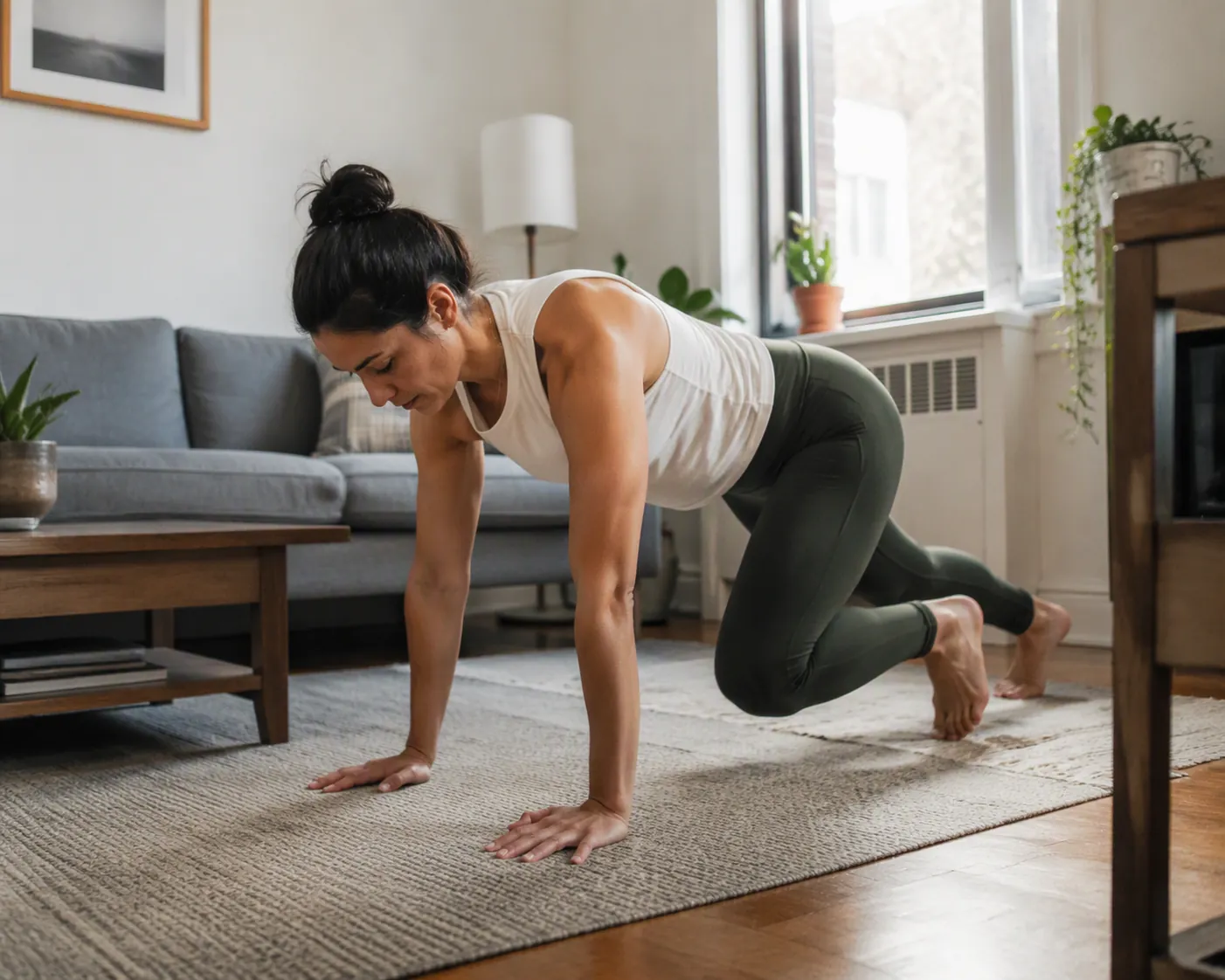
Run it as a controlled circuit rather than a race. Move through the exercises in order, rest when your push-up position starts to sag, and keep the floor quiet. A stunt-relevant push-up is not just chest work; it is a moving plank under fatigue.
- Plank-to-bear plank: Start in a high plank, then walk or lightly hop the feet forward until the knees hover under the hips. Pause, brace, and return to plank. If hopping is noisy, step one foot at a time.
- Staggered push-ups: Place one hand slightly ahead of the shoulder line and the other slightly behind it. Perform push-ups with the torso square, then switch the lead hand. Drop to knees only if you can keep the ribs and hips moving together.
- Diamond push-ups: Bring the hands close under the chest and lower with elbows tracking back. If the full version collapses your shoulders, widen the hands slightly; the point is triceps-heavy pressing, not wrist punishment.
- Reverse plank tricep dips: Sit on the floor, hands behind you, fingers angled where comfortable. Lift the hips, bend the elbows, and press back up. Keep the range small if your shoulders complain.
For a first pass, use a simple density format: 30 seconds of work per move, 20 to 30 seconds to reset, two or three rounds. The source protocol supplies the exercise menu; this work-rest structure is the apartment version that keeps form and noise under control.
Use Chris Brewster’s Test for Conditioning, Then Translate the Unsafe Pieces Honestly
Chris Brewster’s circuit is where the home-training problem becomes obvious. Men’s Fitness UK presents his stuntman fitness test with burpees, press-ups, bodyweight squats, tuck jumps, muscle-ups, and back flips.[2] That is a real stunt-specific mix: pressing, squatting, jumping, pulling, tumbling, and conditioning all stacked together. It is also not a responsible living-room prescription as written.
The honest home version keeps the intent and changes the barrier. A muscle-up is not simply an “upper-body move”; it is a high-skill pull-to-press transition on a bar. With no bar, the closest zero-equipment substitute is not pretending you pulled your body over anything. It is adding more pressing density and shoulder stability, using diamond push-ups or slow eccentric push-ups after the regular press-ups. A back flip is not a jump variation for a renter. It is an acrobatic skill with space, coaching, and landing demands. In an apartment circuit, tuck jumps or squat-to-calf-raise reps preserve the explosive leg drive without the airborne rotation.
| Original Brewster element | What it trains | Living-room version |
|---|---|---|
| Burpees | Whole-body conditioning and rapid floor-to-stand transitions | Step-back burpees or quiet burpees with no jump |
| Press-ups | Upper-body endurance under fatigue | Standard push-ups, knee push-ups, or slow eccentric push-ups |
| Bodyweight squats | Leg endurance and position control | Squats with a quiet tempo and full-foot pressure |
| Tuck jumps | Explosive leg drive | Low tuck jumps, squat jumps, or squat-to-calf raises for thin floors |
| Muscle-ups | Advanced pull-to-press skill | Diamond push-ups or staggered push-ups as a no-bar pressing substitute |
| Back flips | Advanced acrobatic power and spatial skill | Tuck jumps only if you can land quietly; otherwise squat-to-calf raises |
A practical apartment round looks like this: quiet burpees, push-ups, bodyweight squats, low tuck jumps or squat-to-calf raises, then diamond push-ups. Work for 30 seconds per move, rest 30 to 60 seconds after the round, and repeat for three to five rounds depending on conditioning. If the floor shakes, the jump is too high. If the push-ups turn into a worming motion, the round is over.
How to Keep the Conditioning Hard Without Making It Loud
Noise usually comes from careless transitions, not just jumping. Step the feet back in burpees instead of snapping them back. Land through the whole foot on tuck jumps. Slow the lowering phase of push-ups. Add a one-second pause at the bottom of squats. These changes make the muscles wait longer without asking the floor to absorb your impatience.
Add Bobby Holland Hanton’s Core Circuit Without Turning It Into Crunches
The core block matters because stunt-style fitness is not just push-ups plus sweat. Esquire UK published a home abs workout from Bobby Holland Hanton, known for doubling Chris Hemsworth, built around air squats, plank pulses, wood chops with a water jug, bear crawl, and superman swims.[3] The useful part is the direction: the trunk braces, rotates, crawls, extends, and stabilizes. It does not spend the whole session folding the spine off the floor.
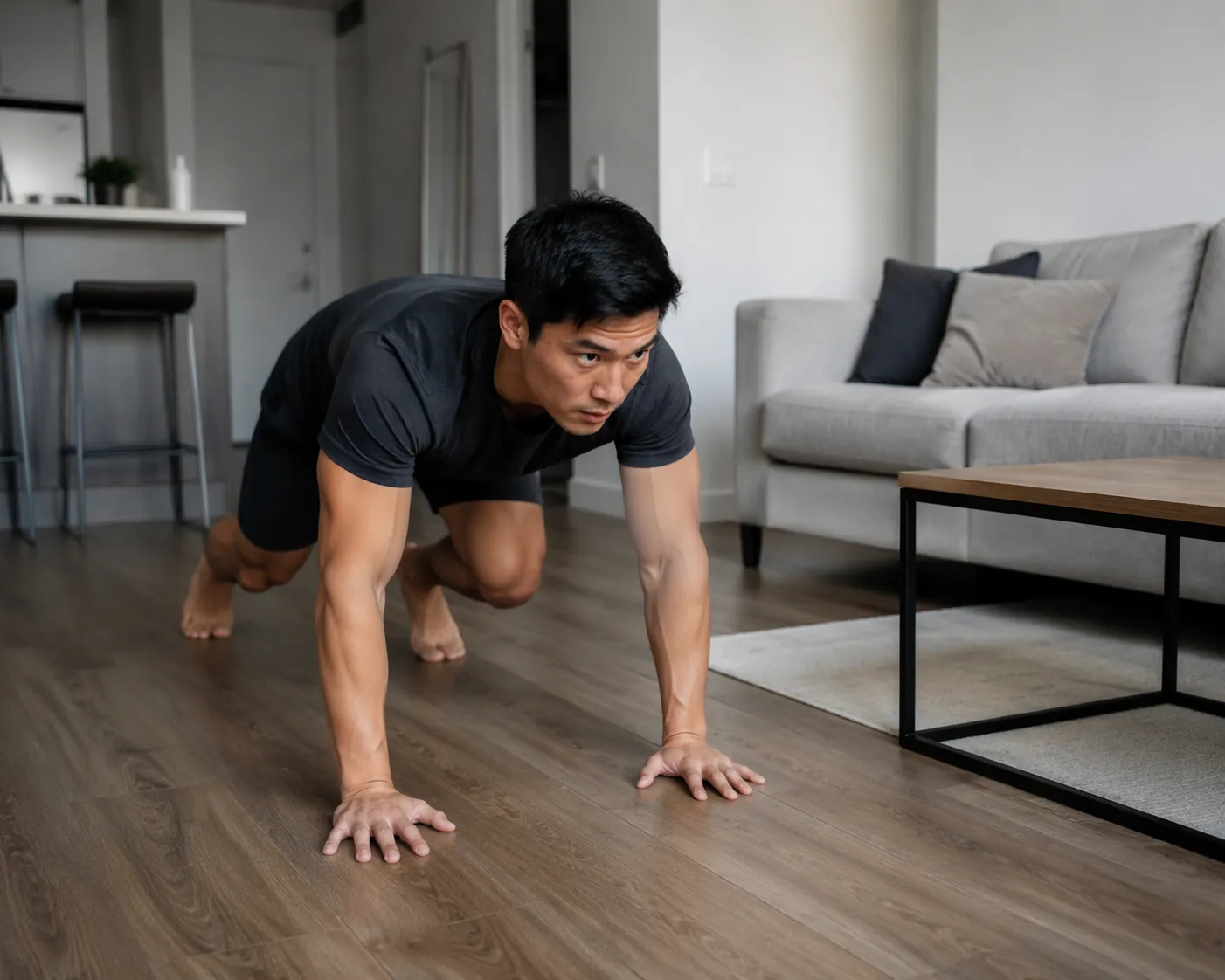
- Air squats: Use these as the bridge from conditioning into core work. Keep the ribs down and the pelvis controlled rather than arching hard at the top.
- Plank pulses: From a forearm or high plank, make small forward-back or shoulder-shift pulses while keeping the hips quiet. The range should be small enough that your lower back does not take over.
- Wood chops with a water jug: If you have a filled jug, use it lightly. If not, clasp the hands and move slowly through the same diagonal pattern. The value is controlled rotation, not load.
- Bear crawl: Move forward and back a few steps with knees hovering low. In a very small room, crawl two steps forward, two steps back, or hold the hover and tap one hand at a time.
- Superman swims: Lie face down, lift the arms and legs slightly, and make controlled swimming motions. Keep the neck long and the lift modest.
Run Hanton’s block after the Brewster-inspired conditioning, not before it, unless you are using the whole workout as a low-intensity day. Tired core work teaches a different lesson: can you keep position when the arms and legs have already been working? That is closer to the demand this style of training is borrowing from.
A clean format is 30 to 40 seconds per movement, one or two rounds. The bear crawl is the one to protect most carefully in an apartment. If you cannot crawl without thudding your hands or drifting into furniture, hold a bear plank instead. The floor space changes; the bracing demand stays.
Put the Three Blocks Together
The full session does not need to be elegant. It needs to be repeatable. Do the upper-body block first while your shoulders can still organize themselves, the conditioning block second while you can still land softly, and the core block last when your trunk has to prove it can stay useful under fatigue.
| Order | Block | Work |
|---|---|---|
| 1 | Klarenbach upper-body circuit | 2 to 3 rounds of plank-to-bear plank, staggered push-ups, diamond push-ups, reverse plank tricep dips |
| 2 | Brewster-inspired conditioning circuit | 3 to 5 rounds of quiet burpees, push-ups, squats, low tuck jumps or squat-to-calf raises, diamond push-ups |
| 3 | Hanton core circuit | 1 to 2 rounds of air squats, plank pulses, wood chops, bear crawl or bear plank, superman swims |
For most people, two days per week is enough at first because the pressing volume stacks up quickly. If you want a third day, make it quieter and cleaner: fewer burpees, no jumping, slower squats, longer planks, and more crawling control. Training like a stunt double at home should not mean failing every set. A performer who cannot repeat the next take has missed the point.
Progress Without Buying Anything
The easiest mistake is to progress by adding chaos: higher jumps, faster burpees, messier push-ups. In a small apartment, better progression usually means more control before more impact.
- Add one round before you add harder variations.
- Lengthen the lowering phase of push-ups instead of widening the hands into an unstable position.
- Turn jumps into quieter jumps before turning them into bigger jumps.
- Make bear crawls slower and lower before making them longer.
- Use shorter rest only if your landings and plank positions still look the same late in the workout.
A simple four-week progression is enough. In week one, learn the movements and stop each round before form breaks. In week two, add a round to either the upper-body or conditioning block. In week three, add tempo: slower push-up descents, paused squats, slower wood chops. In week four, reduce rest slightly or add one more core round. Then repeat the cycle with cleaner reps, not louder ones.
The Professional Ceiling Is Not the Starting Line
There is value in seeing how far professional trunk strength can go, as long as it does not distort the workout. T-Nation describes a stuntman weighted-plank progression reaching up to 220 pounds using a backpack or plates.[4] That is a benchmark from the far end of the spectrum, not a dare for someone doing plank pulses between a couch and a coffee table.
The lesson is not “load your plank until it looks impressive.” The lesson is that stunt-style core work eventually has to handle force while the body stays organized. At home, the entry point is a quiet plank, a steady bear crawl, a controlled wood chop, and a push-up position that does not collapse when breathing gets hard.
That is the realistic version of the stunt fitness effect: bodyweight circuits from named performers, adapted only where the original movement demands a bar, tumbling skill, or a forgiving floor. You keep the explosive intent, the bracing work, and the repeated-take endurance. You leave the back flips, muscle-ups, and overloaded planks where they belong until your space, skill, and coaching justify them.
References
- Ryan Klarenbach's no-equipment upper-body circuit, Men's Health
- Test Your Fitness With This Stuntman's Brutal Circuit, Men's Fitness UK
- Home Abs Workout From Chris Hemsworth's Stuntman, Esquire UK
- The T-Nation stuntman's weighted plank progression, T-Nation
What a small equipment investment adds
We don't have a build tagged to this exact tier yet. Browse all builds.
How often should you repeat this?
See our recovery and rest reference for citation-anchored rest-interval guidance.
Spot something off?
Tell us if a movement, tier assumption, or duration didn't match your experience.