
Stuntwoman Training Routine at Home: Zero Equipment
No equipment? No problem. This bodyweight training routine adapts the explosive power, core stability, and agility drills real Hollywood stuntwomen use into a sustainable home workout you can do in 20–40 minutes, 3–4 days a week.
- Equipment tier required
- none
- Duration
- 30 min
- Difficulty
- beginner
- Target area
- full body
- Noise level
- quiet-friendly
A stuntwoman training routine at home can be more than regular calisthenics wearing a leather jacket. The useful parts of stunt conditioning are surprisingly apartment-friendly: posterior-chain activation, bracing under fatigue, crawling and groundwork, fast direction changes, controlled landings, martial-arts coordination, and dense bodyweight circuits. None of that requires a garage, a plyo box, a pull-up bar, or a downstairs neighbor with heroic patience.
The proof is not that a movie performer has access to exotic training. It is that some of the most transferable work is plain bodyweight practice. Kortel Autrey, a motorcycle stunt performer whose credits include Black Panther: Wakanda Forever, told Men’s Health that he does a daily 12-minute Foundation Training routine to activate the glutes, core, and back without equipment; in the same article, stunt performer Ben Jenkin describes parkour as foundational cardio and says strength helps “keep the injuries away and take the big impacts we incur.” [1]
Danielle Burgio, who doubled Trinity in The Matrix sequels, built The Stuntwoman’s Workout around more than 50 bodyweight exercises organized into five daily circuits, blending martial arts, dance, and gymnastics without making a gym membership the price of entry. [2] Ryan Klarenbach’s home workout for Myprotein uses 30-second no-equipment intervals such as plank-to-bear-plank, staggered push-ups, diamond push-ups, and reverse plank dips, which is exactly the kind of structure that fits a small-room session. [3]
A caveat belongs up front: some of the most detailed exercise write-ups available are from stuntmen rather than stuntwomen. The movement principles still transfer—bracing, impact preparation, crawling, pushing, pulling, landing—but the framing should stay honest. This routine is stuntwoman-inspired home training, not a claim that 25 minutes on a mat replaces supervised fight choreography, falls, wire work, or years of martial arts.
The weekly structure: 3–4 sessions, 20–40 minutes each
The routine works best as three required sessions plus one optional agility day. If you train three days, rotate through Sessions A, B, and C. If you train four days, add Session D rather than stuffing more jumps and push-ups into the other workouts.
| Session | Main quality | Time | What you train |
|---|---|---|---|
| A | Core and stability | 20–30 minutes | Posterior-chain activation, heavy plank intent, bear plank transitions, dead bugs, balance |
| B | Explosive power | 25–35 minutes | Landing mechanics, squat and split-squat power, low-impact plyometric progressions, trunk control |
| C | Upper-body endurance | 20–35 minutes | Push-up variations, shoulder taps, reverse plank dips, optional table rows if safe |
| D | Agility and coordination | 20–30 minutes | Lateral shuffles, footwork patterns, pivots, controlled kicks, single-leg hops |
Every session starts with the same short activation block. That is not filler. It is the difference between training explosiveness and just throwing cold knees, wrists, and low backs at the floor.
Start every session with posterior-chain activation
Foundation Training is a branded method, so this is not a reproduction of a proprietary routine. The home-training takeaway is simpler: before impact work, wake up the glutes, hamstrings, back, and deep trunk muscles so your joints are not doing all the negotiating. Autrey’s daily use of a 12-minute bodyweight Foundation Training routine supports the point that stunt conditioning does not always begin with bigger weights; often it begins with better positions. [1]
- Hip-hinge reach: stand tall, soften the knees, push the hips back, reach the arms forward, and feel the hamstrings load without rounding the back. Hold or pulse for 45–60 seconds.
- Glute bridge with exhale: lie on your back, feet flat, ribs down, squeeze the glutes to lift the hips. Use slow exhales at the top instead of rushing reps.
- Bird dog hold: from all fours, reach opposite arm and leg long. Keep the pelvis level. If your low back twists, shorten the reach.
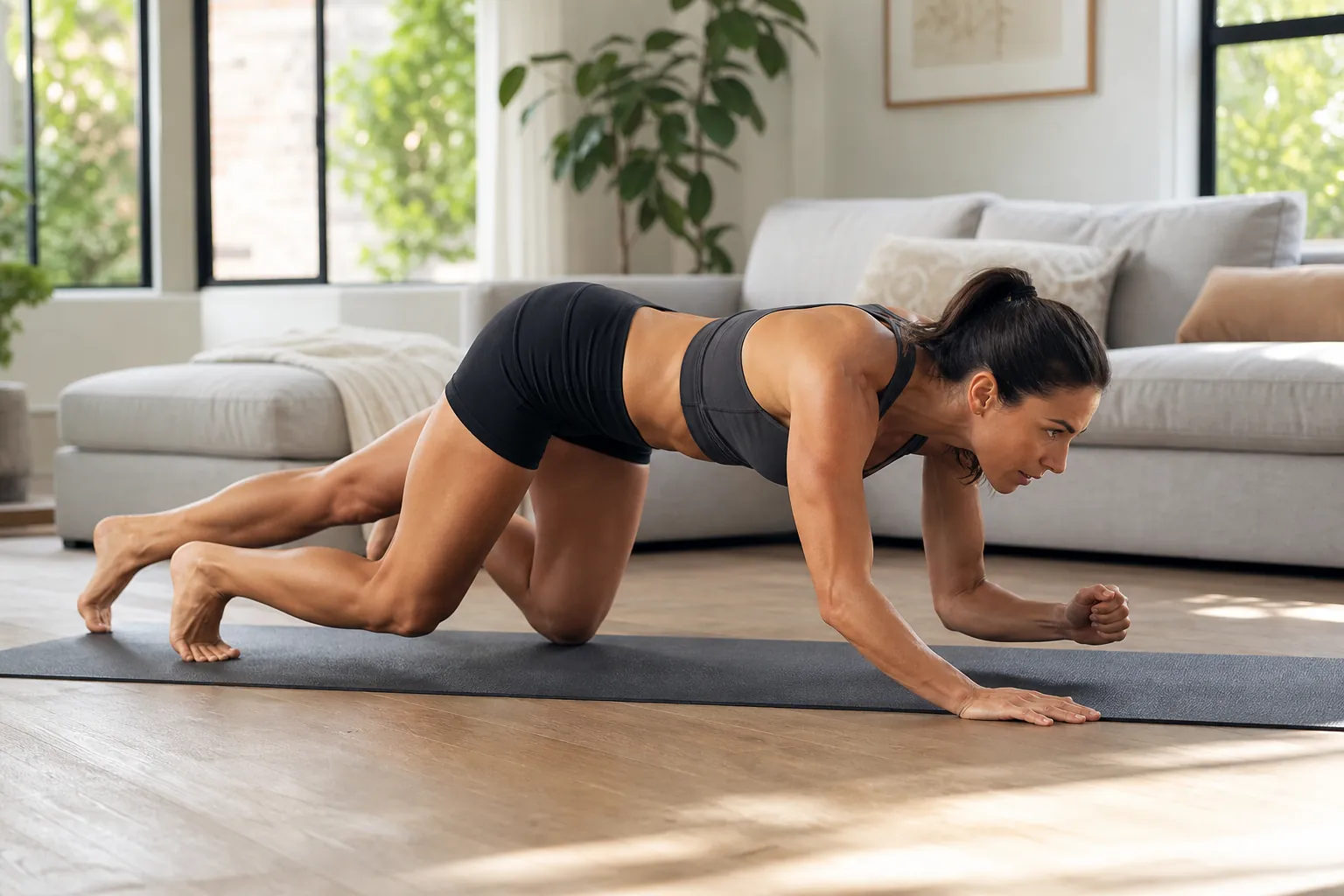
- Low bear hover: hands under shoulders, knees under hips, toes tucked. Lift the knees just off the floor and breathe for short holds.
- Standing balance hinge: shift weight to one leg, hinge slightly, tap the other foot behind you, and return without wobbling through the knee.
Keep this opening block around six minutes. On a tired day, it can become the workout’s quality control: if you cannot hold a low bear hover without dumping into your wrists or low back, the session should stay low-impact.
Session A: Core and stability that actually carries over
A lot of home core work is just ab fatigue. Stunt-style core work needs a different job description: brace while limbs move, resist rotation, change levels, and keep enough tension that a quick pivot or landing does not collapse through the spine.
The “heavy plank” idea is useful even with no equipment. A T-Nation stunt performer described 30-minute, three-day-per-week sessions that included heavy planks held for 30–45 seconds, in some cases with added load. [4] At home, “heavy” can mean full-body intent rather than plates: elbows pull toward toes, glutes squeeze, ribs stay down, and the floor feels like something you are trying to drag together.
| Move | How to do it | Scale it |
|---|---|---|
| Hard-style forearm plank | Hold 15–30 seconds with glutes tight, ribs down, and elbows pulling gently toward the feet. | Drop to knees or shorten the hold before your low back sags. |
| Dead bug heel tap | Lie on your back, brace, lower one heel at a time while keeping the ribs heavy. | Keep both arms down by your sides if the full opposite-arm reach makes your back arch. |
| Plank-to-bear-plank | Move from a high plank into a low bear hover, then back out with control. | Step one foot at a time; do not jump the feet forward. |
| Bear shoulder tap | From bear hover, tap one hand to the opposite shoulder while hips stay quiet. | Widen the feet or lower knees between taps. |
| Single-leg balance reach | Stand on one leg and reach the free foot lightly forward, side, and back. | Tap the floor between directions until the standing knee tracks cleanly. |
Run two to three rounds. Rest enough that the next set still looks controlled. This is not the day to chase sweat by making every movement faster. If the bear plank transitions start to look like a mountain climber accident, slow them down.
Why bear work belongs here
Klarenbach’s no-equipment workout uses plank-to-bear-plank inside 30-second work intervals, which makes sense for home stunt-style training because the move asks the shoulders, trunk, hips, and feet to coordinate while close to the ground. [3] That is more useful than another set of rushed crunches. It teaches you to move while braced, which is the whole point.
Session B: Explosive power without abusing your knees
Explosive training is the fun part, and also the part most likely to turn a small-room workout into a joint complaint. The rule is simple: landings come before jumps. If you cannot land quietly from a low hop, you have not earned higher impact work.
| Block | Exercise | Work |
|---|---|---|
| Landing practice | Snap-down to athletic stance | 3 sets of 5 controlled reps |
| Power base | Fast bodyweight squat up, slow 3-count lower | 3 sets of 6–8 reps |
| Single-leg power | Reverse lunge to knee drive | 2–3 sets of 6 reps per side |
| Low-impact plyometric | Pogo bounce or calf pop | 3 rounds of 15–20 seconds |
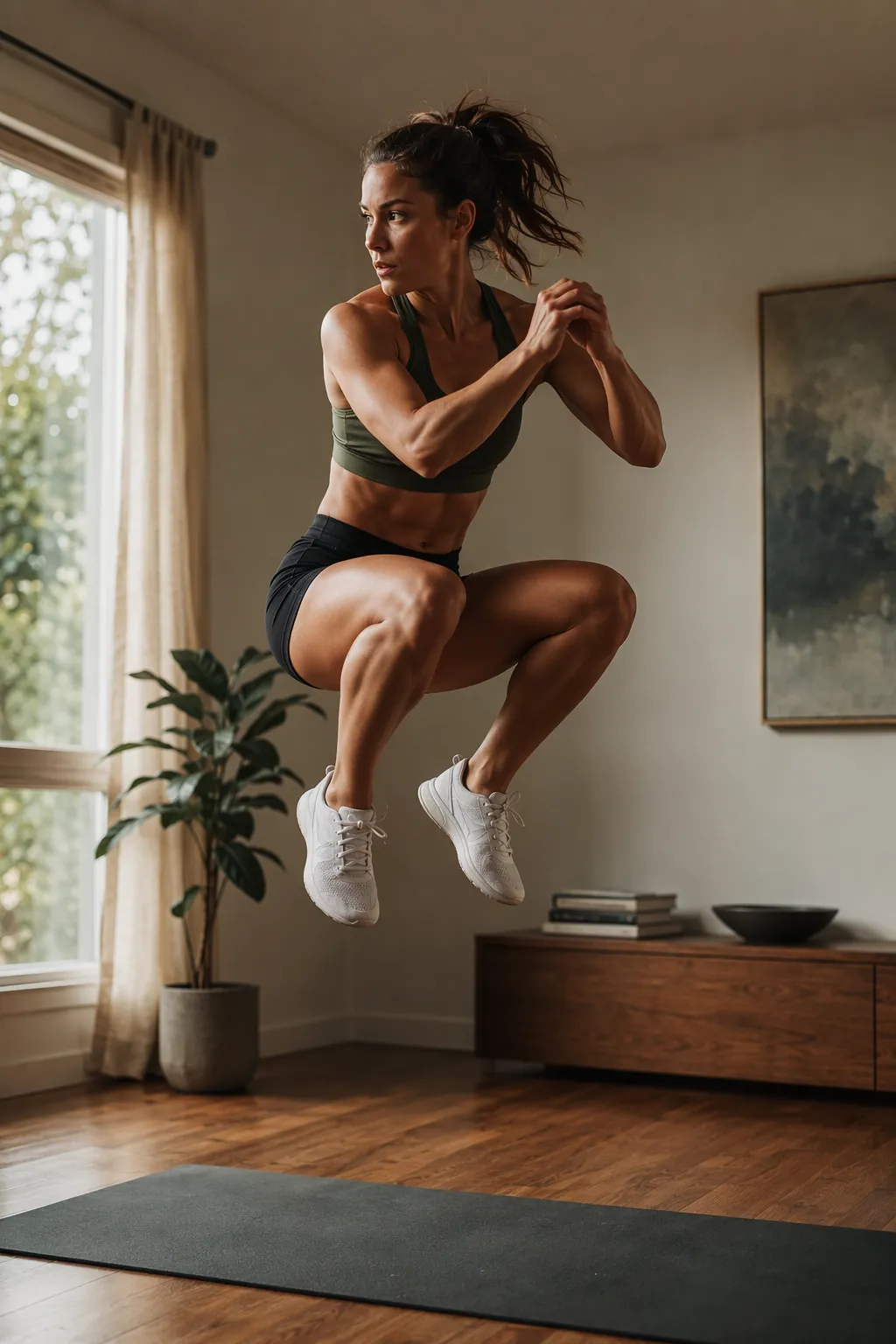
| Advanced option | Split squat jump or low squat jump | 2–3 sets of 3–5 clean reps |
| Upper-body power option | Incline plyo push-up to a wall or sturdy counter | 2–3 sets of 3–5 reps |
The snap-down is the unglamorous move that protects the rest of the session. Rise onto the toes with arms overhead, then quickly pull the arms down and catch yourself in a quarter squat. Feet stay flat, knees track over toes, ribs stay stacked over the pelvis. The catch should be quiet enough that someone in the next room would not know whether you jumped or just changed your mind.
If you are training over hardwood, in an apartment, or after a long day at a desk, use the low-impact version: fast concentric squats, reverse-lunge knee drives, and pogo bounces where the heels barely leave the floor. You still train stiffness, rhythm, and power without turning the workout into a noise complaint.
About knee jumps and plyo push-ups
Knee jumps and full plyo push-ups show up in stunt-flavored training because they look athletic. They also punish poor preparation. Treat them as optional advanced drills, not proof that the routine is “real.” A knee jump from a dead stop asks for explosive hip extension, a stable trunk, and tolerant knees. Most home exercisers get more benefit from squat jumps, split squat jumps, and clean landings first.
For push-up power, start at the wall. Push away fast enough that the hands briefly unweight, then catch softly. Move to a counter or couch only if the shoulders stay down and the ribs do not flare. Floor plyo push-ups can wait. There is nothing cinematic about irritating both wrists in week one.
Session C: Upper-body endurance, with enough pulling to stay honest
Stunt conditioning needs shoulders that can tolerate pushing, posting, crawling, and getting up from the floor. But a home routine can become push-up punishment very quickly. JoJo Batten’s shared training split separates pull, push, and lower-body work, which is a useful reminder even if we are not copying a gym split here: pushing volume needs balance. [5]
| Move | Work | Notes |
|---|---|---|
| Staggered push-up | 30 seconds work, 30–45 seconds rest | One hand slightly forward, one slightly back. Switch each round. |
| Diamond or close-grip push-up | 20–30 seconds work | Use knees or elevate hands if elbows flare or wrists ache. |
| Shoulder tap to push-up | 5–8 slow reps | Tap each shoulder, then perform one controlled push-up. |
| Reverse plank dip | 20–30 seconds work | Keep chest open and shoulders away from ears. |
| Prone W pull | 8–12 slow reps | Lie face down, squeeze shoulder blades gently, lift arms in a W shape. |
| Optional table row | 5–8 reps | Only use a heavy, stable table that cannot tip or slide. |
Klarenbach’s home workout includes staggered push-ups, diamond push-ups, reverse plank dips, and shoulder-tap patterns in 30-second intervals, which makes them a practical fit here. [3] Use that interval format for the first four movements: work for 20–30 seconds, rest, and repeat for two to four rounds depending on your current capacity.
The pulling problem is real in zero-equipment training. If you have no safe table, do not fake it under a wobbly desk. Use prone W pulls, prone swimmers, reverse snow angels, and longer bear holds to keep the upper back involved. They will not perfectly replace a row, but they are better than pretending shoulders can live on push-ups alone.
Session D: Agility, footwork, and martial-arts coordination
This is the optional fourth day, and it should feel different from cardio. Parkour influence does not mean vaulting the couch. In a living room, it becomes direction changes, low-level hops, careful landings, ground transitions, and the ability to stay oriented while the feet move quickly.
Jenkin’s description of parkour as foundational cardio gives permission to treat agility as conditioning, not as decoration. [1] Burgio’s no-gym stuntwoman workout also matters here because it blends martial arts, dance, and gymnastics—the exact mix that turns a workout from straight-line reps into coordinated movement. [2]
| Drill | How to do it at home | Keep it safe by |
|---|---|---|
| Lateral shuffle and stick | Shuffle two to three steps to one side, freeze on the outside leg, then return. | Stopping before speed pulls the knee inward. |
| Floor-line footwork | Use floorboards, rug edges, or imaginary lines for in-in-out-out steps. | Keeping steps small and light. |
| Quarter-turn pivot | Step, rotate 90 degrees, brace, then return. | Turning through the ball of the foot instead of twisting the knee. |
| Controlled front kick | Lift knee, extend lower leg, recoil, step down quietly. | Kicking lower than hip height until balance is easy. |
| Single-leg compass hop | Hop lightly forward, side, and back, returning to center each time. | Making the hop tiny and landing with a soft knee. |
| Crawl to stand | Bear crawl two steps forward, step one foot in, stand, then reverse. | Moving slowly enough that hands and feet do not slap the floor. |
Run this as a circuit for three to five rounds. Work 20–30 seconds per drill, then rest just long enough to keep the next drill crisp. If space is tight, make every direction change smaller. If noise is an issue, replace hops with step-and-stick landings.
The anti-rotation piece
Martial-arts-inspired core work is not just kicking harder. It is learning to move the hip while the trunk stays organized. After each controlled kick, pause for one breath before the foot returns to the floor. After each pivot, freeze long enough to notice whether your ribs, pelvis, and standing knee arrived together. That pause is where coordination gets trained.
How to choose three days versus four
Choose three days if you are new to plyometrics, returning after a break, training in an apartment, or already doing other exercise. A clean three-day week might look like this:
- Monday: Session A, core and stability
- Wednesday: Session B, explosive power
- Friday or Saturday: Session C, upper-body endurance
Choose four days if your joints feel good, your landings are quiet, and you are not dragging fatigue into every session. The fourth day should be Session D, not a second max-effort jump day.
- Monday: Session A, core and stability
- Tuesday or Wednesday: Session B, explosive power
- Thursday: Session C, upper-body endurance
- Saturday: Session D, agility and coordination
If you only have 20 minutes, do the activation block, two main movements, and one finisher. If you have 40 minutes, add rounds rather than adding random exercises. The routine works because the same skills get repeated often enough to improve.
Progress without buying equipment
The zero-equipment promise does not mean you stay at the same difficulty forever. It means the first progressions come from control, not shopping.
- Clean the position: make planks tighter, landings quieter, bear transitions smoother, and kicks more balanced.
- Add tempo: lower for three counts on squats and push-ups, pause at the hardest point, then rise with intent.
- Extend holds: add 5–10 seconds to planks, bear hovers, balance reaches, and landing sticks.
- Increase density: keep the same exercises and finish the same quality work with slightly shorter rests.
- Add impact carefully: move from step-and-stick to tiny hops, then to low jumps, then to split squat jumps only if landings stay quiet.
- Add optional load later: a backpack or resistance bands can come after the bodyweight version feels controlled, not because the routine failed.
Progression should feel almost boring on paper. That is a compliment. Stunt-style fitness has to leave you capable of training again next week.
Small-room safeguards that matter
Wrists, knees, and shoulders usually complain before conditioning gives out. Build the routine around that reality.
- For wrists: elevate push-ups to a wall or counter, use fists only if comfortable, and break up long plank blocks with forearm variations.
- For knees: make every landing quiet, keep hops low, and replace jumps with fast squats or reverse-lunge knee drives when needed.
- For shoulders: balance push-ups with prone upper-back work, keep shoulder taps slow, and stop reverse plank dips if the front of the shoulder pinches.
- For downstairs neighbors: use step-and-stick drills, low bear crawls, controlled pivots, and tempo strength instead of repeated jumping.
- For tight spaces: train smaller ranges with better stops. A two-step shuffle done sharply is more useful than a wild sprint into furniture.
The home version should not imitate film falls, weapon work, fight choreography, wire pulls, or high-impact stunts without coaching and proper mats. What it can do is build the base those skills keep asking for: hips that switch on, a trunk that braces, shoulders that tolerate the floor, feet that land quietly, and enough coordination to move in more than one direction.
References
- 7 Elite Stunt Performers Share Their Fitness Secrets, Men’s Health
- The Stuntwoman’s Workout: Get Your Body Ready For Anything!, Women In Stunts
- Train Like American Stuntman | Work Out From Home, Myprotein
- Stuntman Strength and Action Hero Abs, T-Nation
- Stuntwoman JoJo Batten’s Go-To Lower-Body Workout, Muscle & Fitness
What a small equipment investment adds
We don't have a build tagged to this exact tier yet. Browse all builds.
How often should you repeat this?
See our recovery and rest reference for citation-anchored rest-interval guidance.
Spot something off?
Tell us if a movement, tier assumption, or duration didn't match your experience.