
Train Like Tadej Pogačar With These Home Cycling Workout Tips
Amateur cyclists can train like Tadej Pogačar at home with four structured indoor workouts adapted from his pro routine—Zone 2 endurance, tempo criss-cross, VO₂ max intervals, and sprint power—all doable on a basic smart trainer in 60–90 minutes.
- Equipment tier required
- $100-300
- Duration
- 60 min
- Difficulty
- intermediate
- Target area
- legs
To train like Tadej Pogačar at home, the useful move is not chasing his watts. It is borrowing the shape of the work: long easy endurance, controlled tempo, hard VO₂ intervals, and a little sprint violence with enough recovery to make it real. That can fit into a spare-bedroom smart trainer setup. It just has to be scaled to your FTP, your heart rate, your neighbors, and the hour you actually have.
Here is the whole promise before we complicate it: four indoor sessions, each 60–90 minutes, doable on a basic smart trainer, using your own zones rather than Pogačar’s numbers.
| Session | Home version | What it borrows from Pogačar-style training |
|---|---|---|
| Zone 2 endurance | 60–90 minutes at your own Zone 2 power or heart rate | The home-sized version of huge aerobic base work; public reporting has described Pogačar riding Zone 2 around 320–340W for about five hours [1] |
| Tempo / criss-cross tempo | 3×15 minutes at 80–89% FTP, with easy recovery between blocks | A controlled pre-Tour-style tempo format published by MyWhoosh [2] |
| VO₂ max intervals | 4×3 minutes at 110% FTP, with generous easy spinning between efforts | A short, hard aerobic-capacity set also published in the MyWhoosh pre-Tour workout examples [2] |
| Sprint power | 6×15 seconds all-out, with 10 minutes easy between sprints | A neuromuscular power session format reported by Cycling Weekly [1] |
The rules before the workouts
Pogačar’s public training numbers are fascinating, but they belong in the context drawer, not on your workout target screen. The reported 320–340W Zone 2 work and the often-circulated roughly 6.6W/kg FTP figure are public-facing numbers, not lab data handed over with his full training file [1]. They tell you the scale of an elite engine. They do not tell you what your Tuesday ride should be.
For these sessions, set intensity from one of two things: your current FTP if you train with power, or your heart-rate zones if that is what you trust. If you do not have a recent FTP estimate, use a ramp test or a conservative app estimate and keep the first week easier than your ego wants. Indoor workouts punish overestimation quickly because there is no coasting, no traffic light, and no downhill to hide in.
- Use your zones. If Pogačar’s Zone 2 is more than your threshold power, that is not a character flaw. It is the entire point of scaling.
- Reduce volume before reducing structure. A pro’s five-hour endurance ride becomes 60–90 minutes, not a five-hour guilt trip.
- Keep the week repeatable. Three good indoor sessions beat one heroic session followed by four days of avoidance.
- Treat published pro-style sessions as examples. They are not a locked copy of Pogačar’s Tour de France calendar.
- Do not turn every workout into a test. Tempo should feel controlled; VO₂ should feel hard; sprints should be explosive and then done.
You do not need a superstar trainer setup
A direct-drive smart trainer helps because ERG mode can hold the target power while you focus on breathing, cadence, and not flooding the floor with sweat. But these workouts do not require elite hardware. In 2026 testing, BikeRadar listed the Van Rysel D100 at about $260 with a stated 58dB noise level, and the Wahoo Kickr Core 2 around $499–550 with ±1% accuracy [3]. That range is enough to run structured sessions in Zwift, MyWhoosh, TrainerRoad, or a head unit workout file.
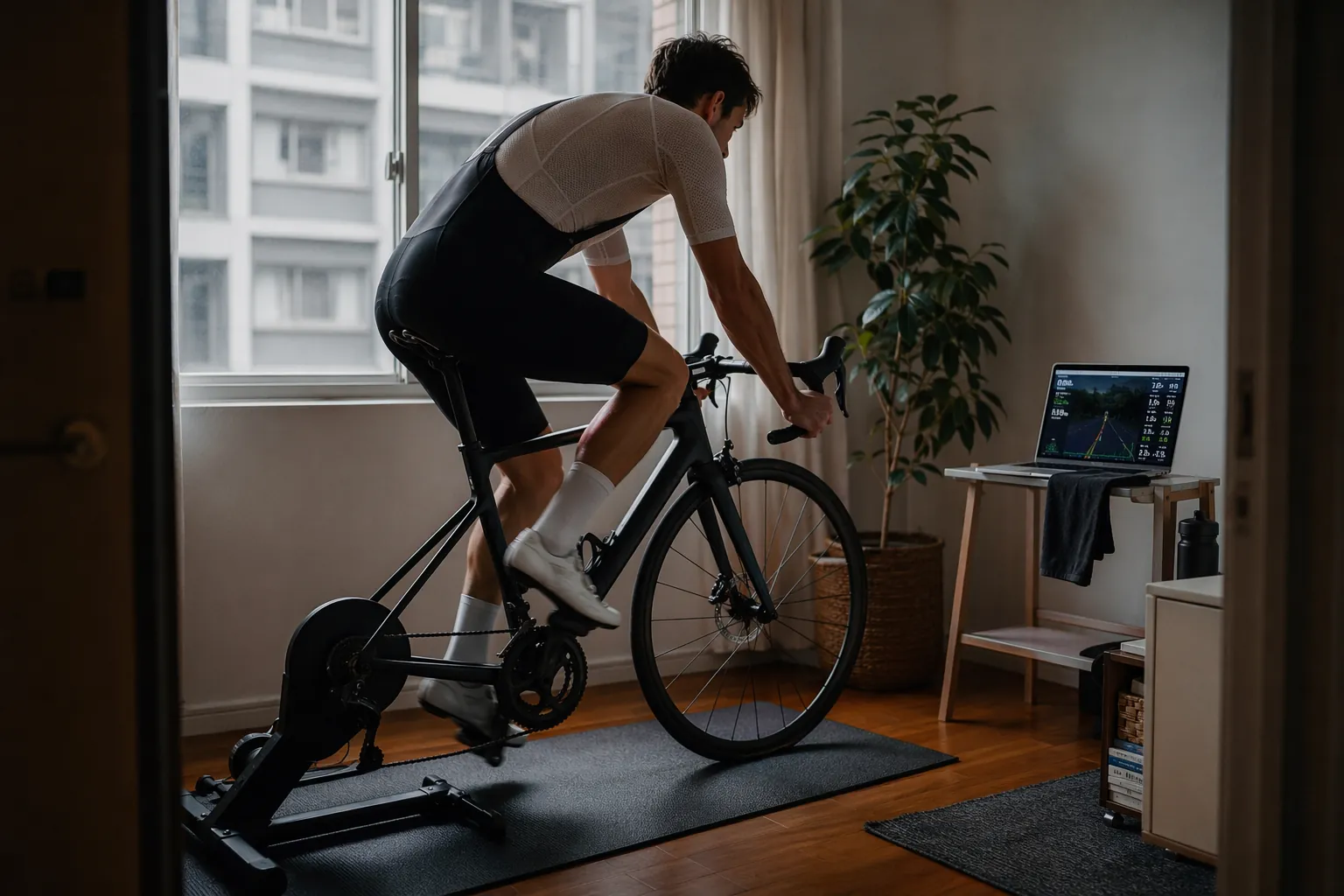
For an apartment, the unglamorous setup matters. Put a mat under the trainer, use a fan for normal sessions, keep a towel over the bars, and place the laptop or phone where you can see the interval target without craning your neck. If you train before work, the difference between a quiet direct-drive trainer and a rattling wheel-on setup may matter more to household peace than another claimed percentage point of power accuracy.
Workout 1: Zone 2 endurance that is actually easy
This is the workout most people ruin because it looks too simple. Pogačar’s endurance base is enormous; the amateur version is not to fake that volume indoors. It is to spend 60–90 minutes riding steadily at a pace you can repeat several times per week without needing a nap under your desk afterward.
| Part | What to do |
|---|---|
| Warm-up | 10 minutes easy, gradually moving from very light spinning into low Zone 2 |
| Main set | 45–75 minutes at your own Zone 2 power or heart rate |
| Cadence | Mostly natural cadence; include a few short cadence changes if boredom is becoming the limiter |
| Cool-down | 5 minutes very easy |
| Total time | 60–90 minutes |
Power riders can aim for the Zone 2 range in their training platform. Heart-rate riders should let heart rate rise gradually and then keep it capped. The first 15 minutes may feel embarrassingly easy. That is fine. The useful question is whether you can still breathe through your nose or hold a calm conversation after an hour.
The indoor trap is drift. You start at sensible endurance power, get bored, nudge up a few watts, then finish in tempo and call it discipline. Do that often enough and your easy day stops supporting the hard days. If heart rate climbs while power stays the same, do not chase the original wattage at all costs. Lower the resistance, drink, and keep the session aerobic.
Use this ride when you want the Pogačar lesson without the pro volume: aerobic work is not junk mileage just because it is not dramatic. It builds the floor under the more exciting sessions.
Workout 2: Tempo and criss-cross tempo without making it a threshold test
MyWhoosh’s published pre-Tour examples include 3×15 minutes at 80–89% FTP, which is a perfect indoor format for riders who want something more purposeful than a free ride but less savage than threshold intervals [2]. The range matters. At 80% FTP, the effort should feel controlled and durable. At 89%, you are still below threshold, but the pressure is obvious. If you are gasping halfway through the first block, you are not doing tempo anymore.
| Part | What to do |
|---|---|
| Warm-up | 12–15 minutes easy, including three 30-second smooth spin-ups |
| Block 1 | 15 minutes at 80–84% FTP |
| Recovery | 5 minutes easy |
| Block 2 | 15 minutes at 84–87% FTP |
| Recovery | 5 minutes easy |
| Block 3 | 15 minutes at 86–89% FTP, only if the first two blocks were controlled |
| Cool-down | 8–10 minutes easy |
That progression is one clean way to ride the session. For a criss-cross feel, keep the same 15-minute blocks but gently move within the range: a few minutes near the lower end, then a short lift toward the upper end, then back down before the effort turns into threshold. The point is learning to absorb small changes without panicking and surging. Indoor ERG mode can help, but resistance mode may teach better pacing if you tend to fight the trainer.
This is a good after-work session because it asks for concentration rather than bravery. You should finish knowing you trained, not wondering whether tomorrow’s stairs will require a railing. If you only have 60 minutes, shorten the warm-up and cool-down slightly, not the three tempo blocks. The value is in accumulating controlled time under tension.
Workout 3: VO₂ max intervals, short enough to do right
The 4×3-minute VO₂ max set at 110% FTP is the most tempting one to overcook because it looks small on paper [2]. Three minutes is not long until you are two minutes in, pinned indoors, with the fan roaring and the app still asking for another sixty seconds. Ride the first interval like there are three more coming, because there are.
| Part | What to do |
|---|---|
| Warm-up | 15–20 minutes easy to moderate, with three 1-minute efforts building toward tempo |
| Main set | 4×3 minutes at 110% FTP |
| Recovery | 4–5 minutes very easy between intervals |
| Cool-down | 10 minutes easy |
| Total time | About 55–70 minutes |
At 110% FTP, the first minute should feel controlled-hard, the second minute should demand focus, and the third minute should be uncomfortable but still organized. If the target power collapses in interval three, the session was set too high or the recoveries were too short. Adjust next time instead of turning the last interval into an ugly sprint to save the average.
Cadence can sit slightly higher than your endurance rhythm if that helps you breathe and keep torque manageable. In ERG mode, avoid stomping when the interval starts; bring cadence up a few seconds early so the trainer does not feel like it has grabbed the rear axle. In resistance mode, watch the first 20 seconds carefully. Many riders lose the session there by starting at 125% FTP and spending the next two minutes paying for it.
Do this session once a week at most if you are also riding tempo and sprint work. It is small in minutes and large in cost.
Workout 4: Sprint power, with the boring recoveries left intact
Cycling Weekly reported a Pogačar-style sprint format of 6×15 seconds all-out with 10 minutes of recovery [1]. The sprints are simple. The recovery is where most home riders cheat. Do not. If the goal is peak power and neuromuscular sharpness, the long easy riding between efforts is part of the workout, not dead space.
| Part | What to do |
|---|---|
| Warm-up | 20 minutes, gradually building, with a few 5-second openers |
| Main set | 6×15 seconds all-out |
| Recovery | 10 minutes very easy after each sprint |
| Cool-down | 5–10 minutes easy |
| Total time | About 80–90 minutes |
Use resistance mode if your app allows it. ERG mode is usually clumsy for true sprints because the effort is too short and the trainer may lag. Shift into a gear that lets you accelerate hard without grinding from a dead stop. Stay seated if your trainer setup is not stable enough for standing sprints; there is no glory in testing your security deposit.
Each sprint should be violent but clean: brace your upper body, drive the pedals, and stop at 15 seconds even if the app does not clap for you. Afterward, spin easily. Very easily. If sprint six looks like sprint one, you probably did it right. If sprint three is already a soggy mess, either the first two were too long, the gear was too heavy, or the recoveries were not honest.
Bonus adaptation: heat training is not a casual upgrade
Heat training is the spicy detail people love to pull from pro programs, and it deserves more caution than hype. UAE performance chief Jeroen Swart has described an indoor protocol of 45–75 minutes with no fan and winter clothing to reach about 38.5°C core temperature [1]. He has also said amateurs can do similar types of training and that most would see improvements, while reducing the volume [1].
That does not mean you should shut the windows, put on a thermal jacket, and guess your way through heat stress after work. Without a reliable way to monitor core temperature, this becomes blunt and risky. If you experiment, keep it separate from VO₂ or sprint days, reduce intensity, hydrate, and stop if you feel dizzy, chilled, confused, nauseated, or unusually weak. This is not medical advice, and it is not required to get value from the four main sessions.
How to combine the sessions across a real week
A realistic Pogačar-inspired home week is not a miniature grand tour. It is three or four structured rides that leave you able to come back next week. Start with three sessions if you have not been training consistently. Add the fourth only when the first three feel repeatable.
| If you can ride 3 days | Session |
|---|---|
| Day 1 | Zone 2 endurance |
| Day 2 | Tempo / criss-cross tempo |
| Day 3 | Alternate weekly between VO₂ max intervals and sprint power |
| If you can ride 4 days | Session |
|---|---|
| Day 1 | Zone 2 endurance |
| Day 2 | Tempo / criss-cross tempo |
| Day 3 | Easy Zone 2 or rest, depending on fatigue |
| Day 4 | VO₂ max intervals one week, sprint power the next; advanced riders can include both if recovery is genuinely good |
Keep at least one easy or rest day after the VO₂ session. Avoid stacking VO₂ and sprint work on back-to-back days unless you already know you recover well. If life cuts the week down to two rides, keep one Zone 2 ride and choose either tempo or VO₂ for the second. The endurance ride is the anchor; the harder sessions are the seasoning.
The winning move is consistency with pro-inspired structure, not imitation of Pogačar’s watts, volume, or heat protocol.
References
- 11 ways to train more like Tadej Pogačar — Cycling Weekly
- How to Train Like Tadej Pogacar Before the Tour de France — MyWhoosh
- BikeRadar 2026 smart trainer testing — BikeRadar, 2026
What a small equipment investment adds
We don't have a build tagged to this exact tier yet. Browse all builds.
How often should you repeat this?
See our recovery and rest reference for citation-anchored rest-interval guidance.
Spot something off?
Tell us if a movement, tier assumption, or duration didn't match your experience.