
Combine Time-Restricted Eating with Home Resistance Training
Learn how to pair time-restricted eating with home resistance training to lose fat and preserve muscle, with practical scheduling templates and protein strategies backed by recent research.
- Equipment tier required
- $0-100
- Duration
- 45 min
- Difficulty
- beginner
- Target area
- full body
- Space footprint needed
- minimal
Can you use a 16:8 eating window to lose fat from home without watching your muscle disappear? Yes, under the conditions that matter most: lift with structure, place the workout inside or close to the eating window, and make protein a daily target instead of a vague “eat healthy” hope.
That is the useful version of time-restricted eating for home fitness results: not fasting as a personality, not pretending black coffee is a training plan, just an 8-hour eating window that helps some people keep a calorie deficit while resistance training and protein intake do the muscle-preserving work.
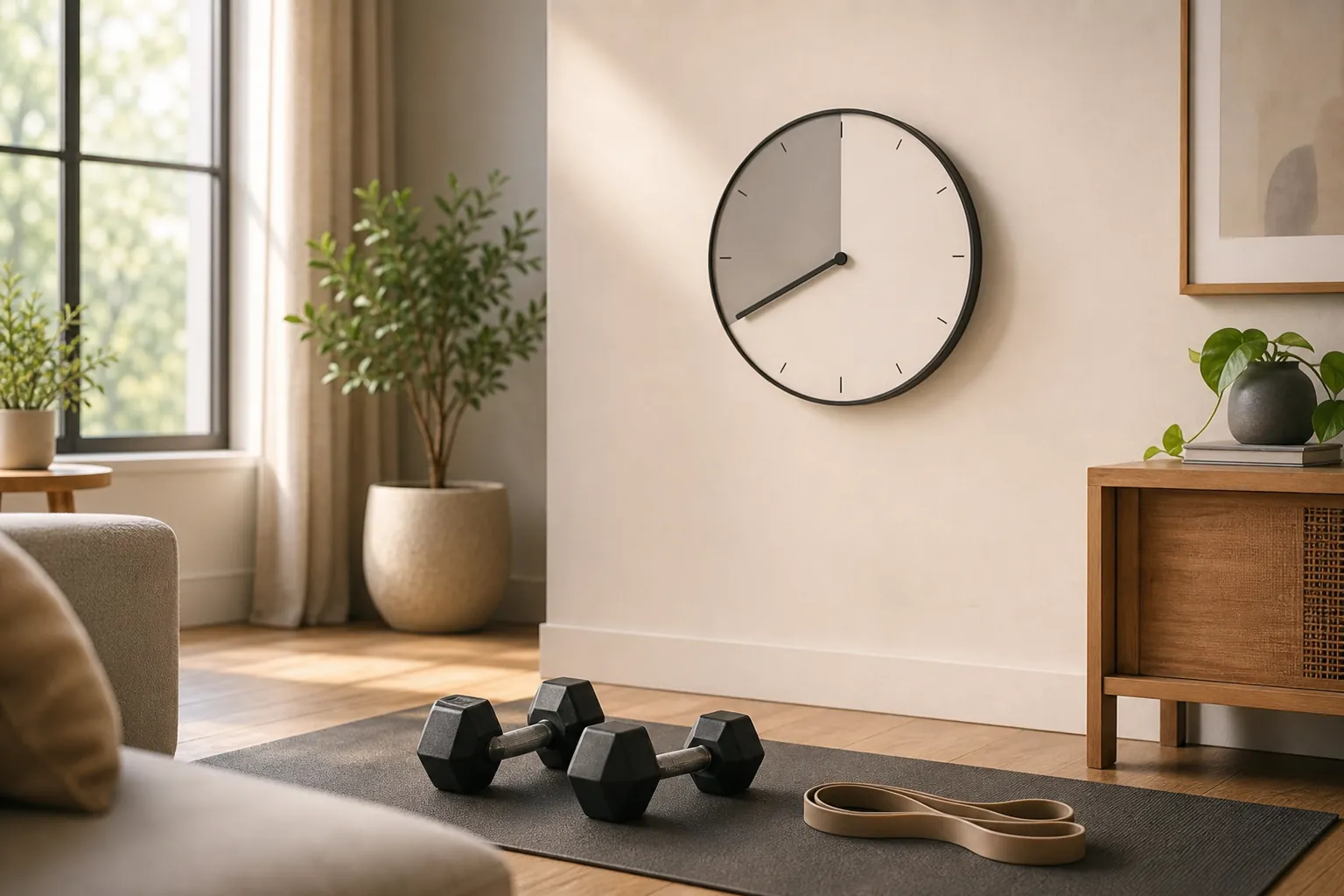
What the best evidence actually says
The strongest piece of evidence here is not a before-and-after photo or a fasting influencer’s appetite story. A 2025 systematic review and meta-analysis by Hays and colleagues pooled 15 randomized controlled trials with 338 participants and compared time-restricted eating plus exercise against exercise without TRE. The TRE-plus-exercise groups lost about 1.3 kg more fat mass and reduced body-fat percentage by about 1.34 percentage points more than exercise-alone groups, with no significant loss of fat-free mass. [1]
That “no significant loss of fat-free mass” part matters. For a home lifter, the goal is usually not to become smaller at any cost. It is to lose enough fat that the training shows, while keeping the muscle that makes daily life, joints, and future dieting easier.
There is one protocol detail worth treating as a rule of thumb: all 15 studies in that meta-analysis scheduled the exercise sessions during the feeding window. [1] That does not prove that training fasted is harmful. It does mean the muscle-preserving evidence base was built around fed-window training, not around heroic 6 a.m. lifting followed by six hours of waiting to eat.
So if you are setting this up in an apartment, garage, or spare bedroom, the question is less “Does fasting burn fat?” and more “Can I place my hard sessions where food and protein are available?”
Build the day around the workout, not around the fast
Most people do not fail 16:8 because the clock is confusing. They fail because the workout floats around the day with no relationship to meals. The eating window then becomes too compressed for protein, recovery, and normal life.
| Template | Eating window | Training placement | Best fit |
|---|---|---|---|
| Morning strength, noon break-fast | 12 p.m.–8 p.m. | Lift in the morning only if you can eat soon after, or keep the session moderate and prioritize protein at noon | People who can train early but do not lift best on a full stomach |
| Late-afternoon lifting with dinner fuel | 12 p.m.–8 p.m. | Lift around 4–6 p.m., then eat a protein-forward dinner | Most home lifters with workday constraints |
| Fasted morning cardio, fed evening lifting | 12 p.m.–8 p.m. | Easy cardio in the morning; resistance training inside the eating window | People who like morning movement but want hard lifting supported by meals |
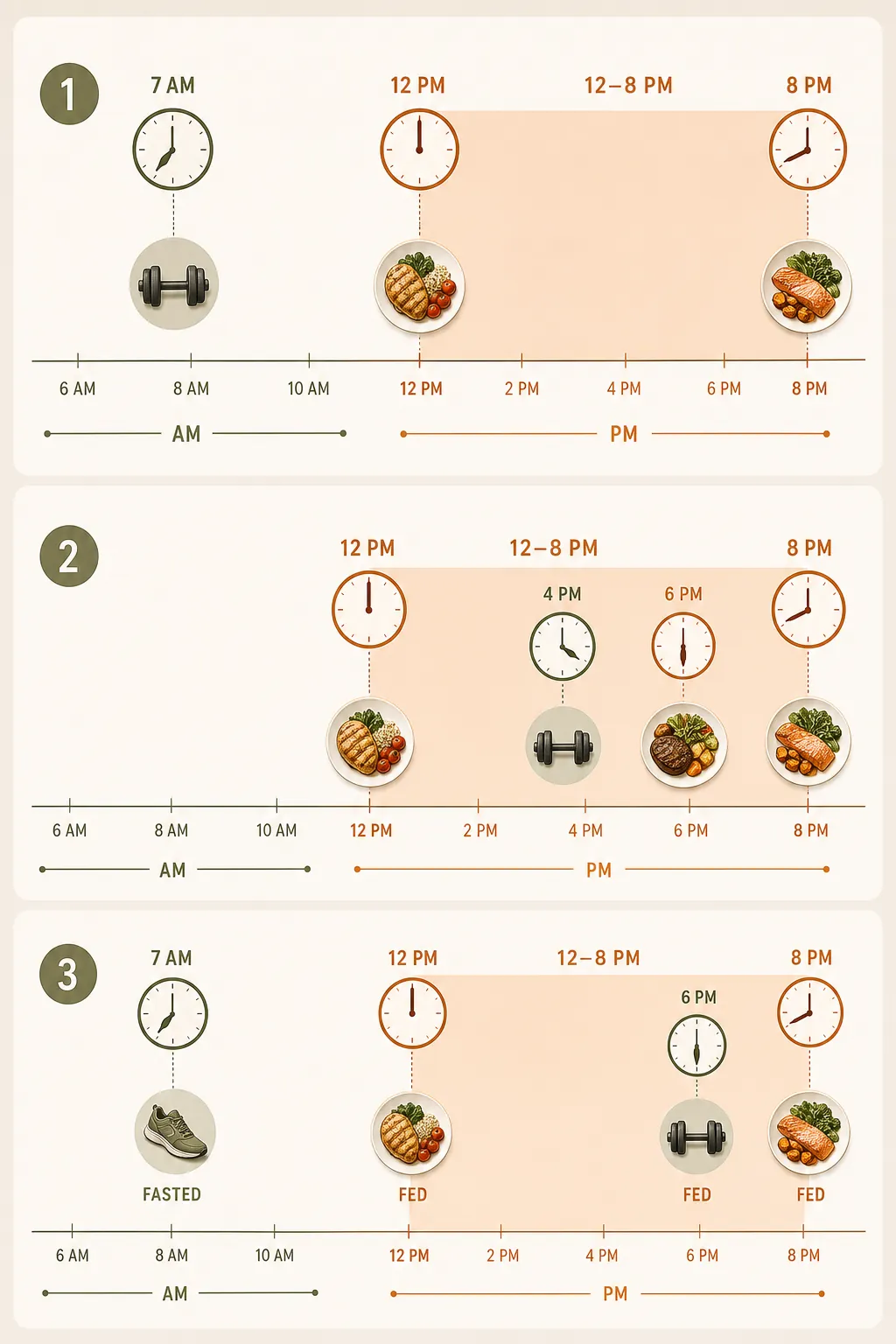
Morning training with a noon break-fast
This is the template people want to work because it protects the evening. It can work, but it asks more of the session design. A hard lower-body dumbbell workout at 6:30 a.m. followed by no protein until noon is not the setup used in the trials behind the strongest body-composition result.
If the morning is your only realistic slot, keep the lifting session clean and repeatable: 35–45 minutes, mostly compound movements, no marathon finishers. Then make the first meal at noon decisive. That meal should not be a salad with optimism on top. It needs a large protein anchor, carbohydrate if the session was hard, and enough total food that dinner does not have to rescue the entire day.
Late-afternoon lifting with dinner fuel
For most home exercisers, this is the least dramatic and most evidence-aligned option. Eat at noon, train after work or late afternoon, then have dinner within the window. You do not need a commercial gym or a five-meal bodybuilding day. You need a session you can repeat and a dinner that is not accidentally low-protein.
A good version looks boring on paper: lunch, maybe a small pre-workout snack if needed, dumbbells and bands for 45 minutes, dinner. Boring is useful here. When training happens inside the eating window, you remove the biggest practical conflict between TRE and muscle retention: finishing a hard session with no plan to feed recovery.
Fasted morning cardio, fed evening lifting
If you like morning movement, use it for low-stakes work: walking, easy cycling, mobility, or light zone-style cardio. Save the progressive resistance training for the eating window. That split gives you the psychological benefit of starting the day with movement without making your hardest muscle-preserving session compete with a long fast.
This is also a useful setup during fat loss medication, aggressive dieting, or any period where appetite is unreliable. The principle is the same: the session that asks your muscles to stay should be close to the meals that help them stay. FitAtHome’s guide to home workouts for Mounjaro weight loss follows the same basic logic for preserving lean mass during weight-loss phases.
Protein is the part that decides whether 16:8 feels sustainable
The practical protein target for this setup is 1.6–1.9 g/kg of body weight per day. For non-competitive lifters, total daily protein is the main lever; meal frequency and a perfect post-workout timing ritual are secondary. [2]
That is good news if you train at home and do not want to eat every three hours. It is also where TRE gets unforgiving. An 8-hour window can make protein easier because there are fewer random snacks. It can also make protein harder because two small meals and a late protein shake may not be enough.
| Body weight | Daily protein at 1.6 g/kg | Daily protein at 1.9 g/kg | Simple 8-hour structure |
|---|---|---|---|
| 70 kg | 112 g | 133 g | Two 35–45 g meals plus one 30–40 g protein snack |
| 80 kg | 128 g | 152 g | Two 40–50 g meals plus one 35–50 g protein snack |
| 90 kg | 144 g | 171 g | Two 45–55 g meals plus one 45–60 g protein snack |
A small kitchen does not need to become a meal-prep factory. The usual anchors work: Greek yogurt, eggs, chicken thighs, tofu, tempeh, canned tuna, lean ground meat, cottage cheese, edamame, lentils, and pre-cooked rice or potatoes. Whey is not magic, but it is useful when the window is closing and you are still short. One scoop can be the difference between “I did TRE today” and “I dieted on vibes and underfed my training.”
For a noon-to-8 p.m. window, a workable day could look like this: a protein-heavy lunch at noon, a snack or shake before late-afternoon lifting, and a dinner that carries the remaining protein. If you train in the morning and break the fast at noon, the first meal has to carry more weight. If you lift at 5 p.m., dinner becomes the easiest place to finish the target.
The mistake is treating the eating window as the goal and protein as a bonus. If the compressed window keeps making you miss the target, widen the window or drop TRE. Muscle retention does not care that the schedule looked clean in a tracking app.
What “structured resistance training” means at home
The exercise in TRE-plus-training studies was not random movement. At home, structured resistance training means you can name the exercises, repeat them, progress them, and recover from them. Adjustable dumbbells, resistance bands, a mat, and a stable bench or step are enough for most people. If you are still deciding what belongs in a small-space setup, start with FitAtHome’s compact home gym equipment guide for apartments before buying anything loud, huge, or annoying to store.
A 3-day full-body plan is usually the cleanest match for 16:8 because it gives you enough lifting stimulus without turning every evening into a negotiation.
| Day | Main work | Accessory work | Progression target |
|---|---|---|---|
| Day 1 | Goblet squat, dumbbell floor press, one-arm dumbbell row | Band pull-aparts, plank variation | Add reps until the top of the range, then increase load |
| Day 2 | Romanian deadlift, push-up or dumbbell press, split squat | Band row, side plank | Keep 1–3 reps in reserve on most sets |
| Day 3 | Dumbbell front squat or step-up, hip thrust or glute bridge, overhead press | Curl-to-press, calf raise, dead bug | Progress one lift per session, not everything at once |
Use 2–4 working sets per exercise and a rep range you can standardize, such as 6–12 for the main lifts and 10–20 for accessories. The exact split matters less than the presence of progressive overload. If the dumbbells are light, slow the eccentric, add pauses, increase range of motion, use single-leg variations, or shorten rest periods carefully. FitAtHome’s piece on the constraints-led approach to home workouts is useful when your equipment is not the limiting factor so much as your ability to make the same tools harder over time.
Leg training is where small-space programs often get lazy. If you do not have heavy weights, unilateral work has to do more of the job: split squats, step-ups, single-leg Romanian deadlifts, sliding hamstring curls, and tempo goblet squats. For a lower-body session that does not depend on machines, the no-equipment leg day blueprint can slot into the same feeding-window schedule.
TRE does not automatically block muscle gain, but context matters
The fear that any fasting window automatically prevents muscle gain is too broad. In an 8-week hypercaloric resistance-training study published in 2025, the TRE group gained 2.67 kg of fat-free mass compared with 1.82 kg in the regularly fed group, while gaining 0.26 kg of fat compared with 1.67 kg in the fed group. [3] That does not mean TRE is a superior bulking strategy for everyone. It means the eating window itself did not prevent gains when training and total intake were handled.
Timing may matter too, though the evidence is narrower. Yu and Ueda compared early TRE from 8 a.m. to 2 p.m. with delayed TRE from 12 p.m. to 6 p.m. in a 2025 trial. The early TRE group lost 2.61 kg, while the delayed TRE group lost 1.44 kg, and all groups gained comparable muscle thickness of about 1.4–1.5 mm. [4]
That sounds interesting, but it should not become a new rule for everyone with dumbbells under the bed. The trial included 24 women and used a single push-up exercise. [4] It supports the possibility that timing can influence results. It does not settle whether your best window should be breakfast-to-afternoon or lunch-to-evening when your real training plan includes squats, hinges, presses, rows, and a work schedule that does not care about ideal physiology.
Where the evidence is thinner than the routine looks
The Hays meta-analysis is useful, but it is not a blank check. The study populations skewed young, healthy, and active, with a mean age of about 29 years. [1] If you are older, sedentary, recovering from injury, or managing a medical condition, the result may not transfer cleanly.
The effect sizes also varied. The meta-analysis reported high heterogeneity for fat mass and body-fat percentage, with I² values of 75% and 83%. [1] In plain terms, the average result is encouraging, but different studies produced meaningfully different outcomes.
Most studies were short, often 4–12 weeks, so the long-term story is less settled. [1] One 12-month TRE-plus-resistance-training study discussed in the literature raised concern that long-term TRE may impair muscle mass maintenance in some settings. [1] That does not erase the shorter-term fat-loss findings. It does argue against putting your diet on autopilot for a year without checking strength, measurements, recovery, and protein consistency.
There are also people who should not treat 16:8 as a casual experiment. TRE is not appropriate for people with a history of eating disorders, pregnant or breastfeeding women, or people taking medications that require specific food timing without medical guidance. If the eating window makes your behavior more rigid, your recovery worse, or your food intake chaotic, that is not discipline; it is feedback.
A practical decision rule
Use 16:8 time-restricted eating if it helps you maintain a calorie deficit, train hard at home, and hit 1.6–1.9 g/kg/day of protein inside the eating window. Put resistance training inside or close to that window whenever you can, because that is how the strongest current evidence was built.
Reconsider the setup if the compressed window repeatedly makes protein inconsistent, workouts flatter, recovery worse, or eating behavior more rigid. TRE is not the muscle-preserving lever by itself. It is a schedule that can work when home resistance training and protein are doing their jobs.
References
- Time-restricted eating combined with exercise: a systematic review and meta-analysis — International Journal of Obesity, 2025
- Resistance Training and Time-Restricted Eating — FoundMyFitness
- Time-restricted eating during hypercaloric resistance training — Journal of the International Society of Sports Nutrition, 2025
- Effects of Early and Delayed Time-Restricted Eating Combined with Resistance Exercise — Nutrients, 2025
What a small equipment investment adds
Cable Machine Alternatives That Save Space and Money
Compare the best cable machine alternatives for home gyms – from resistance bands and pulley systems to suspension trainers and compact digital units – and find the right option for your space and budget.
Small Treadmill Buying Guide: 7 Critical Specs to Check Before You Buy
A cross-category spec primer for apartment and small-space dwellers comparing walking pads, ultra-compact folding treadmills, and full-size folding treadmills. Learn the concrete thresholds for motor HP, deck length, noise, warranty, and subscription lock-in so you can compare apples to apples.
How to Practice Basketball at Home Without Noise Complaints
Learn how to run a full basketball workout in a small apartment without noise complaints. This guide covers no-dribble handling drills, wall form shooting, and silent ball options that let you train without disturbing neighbors.
How often should you repeat this?
See our recovery and rest reference for citation-anchored rest-interval guidance.
Spot something off?
Tell us if a movement, tier assumption, or duration didn't match your experience.